892. ‘Uptown Girl’, by Westlife

Stung by their first ever non-number one (‘What Makes a Man’ having been kept off top spot by Bob the Builder), Westlife return with a foolproof strategy for restoring their chart fortunes. A carbon copy of a beloved classic.

Uptown Girl, by Westlife (their 8th of fourteen #1s)

1 week, from 11th – 18th March 2001

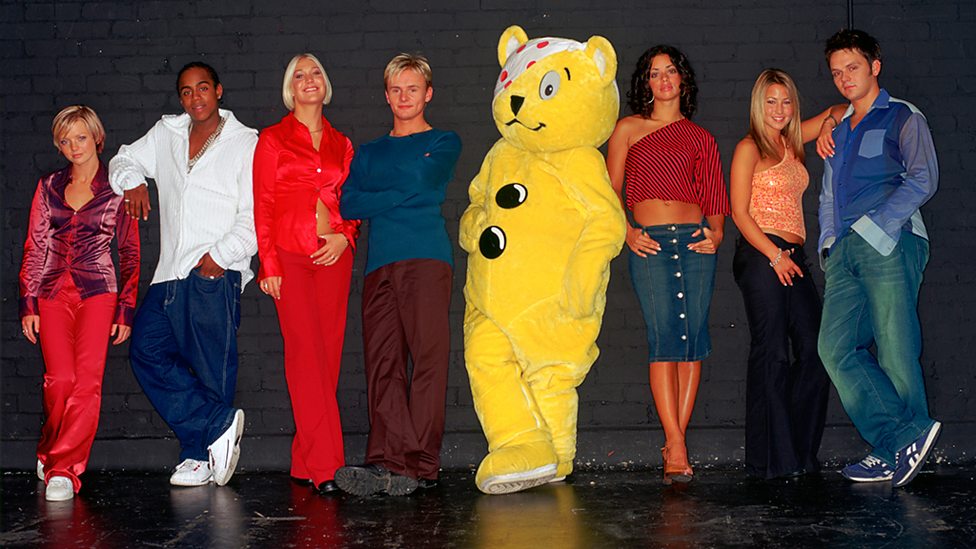
If a note-for-note cover of Billy Joel’s 1983 chart-topper was not enough of a guarantee, then making it the official Red Nose Day single was the clincher. Guaranteed, sure-fire, bookies not even letting you place bets sort of number one. And so it was, opening with Westlife’s biggest ever sales week.

And, on a very surface level, this isn’t a terrible record. It doesn’t irk in the same way that, say, A1’s cover of ‘Take on Me’ does. Probably because Westlife’s producers sensibly kept things very un-experimental, retaining the original’s doo-wop, Four Seasons-aping energy. It adds nothing, however, and you will never need to listen to the Westlife version of ‘Uptown Girl’ as long as Billy Joel’s original is available.

Actually, it’s not strictly true that nothing is added. Because this is Westlife, ‘Uptown Girl’ now has a key change. Hey ho. Again, it doesn’t ruin the song. If you squint hard enough you can imagine you’re listening to the original. Am I being overly charitable? About this charity record? Maybe. Or maybe I’m just glad that this is a Westlife number one that ISN’T A BALLAD! Of their frankly unbelievable total of fourteen number ones, I’d say that only two are officially not ballads (while I will hear arguments for ‘If I Let You Go’ being their third non-ballad #1, if anyone cares to make them…)

Westlife were following in Boyzone’s footsteps here, Ronan and his gang having released the previous Comic Relief single two years earlier: a similarly faithful redo of another eighties classic. It’s almost as if the same evil genius was behind both bands… But I will give Westlife the credit of not being anywhere near as reliant on cheesy covers as their predecessors. Over half of Boyzone’s chart-topping records were covers, whereas this was only Westlife’s second out of nine releases.

To be fair, the video is quite fun, with Claudia Schiffer as the uptown girl, and a little dig at Bob the Builder too…

891. ‘It Wasn’t Me’, by Shaggy ft. RikRok

In today’s instalment of Ask Shaggy, we have a letter from RikRok, in Jamaica… “Dear Shaggy: I was recently caught red-handed by my wife, creeping with the girl next door. Picture this, we were both butt-naked, banging on the bathroom floor…

It Wasn’t Me, by Shaggy (his 3rd of four #1s) ft. RikRok

1 week, from 4th – 11th March 2001

Ricardo ‘RikRok’ Ducent is in a bit of a pickle alright. How could I forget that I had given her an extra key? he asks, hand to forehead. Shaggy is not in the mood for sympathy however, offering blunt advice: deny everything. To be a true player you have to know how to play, If she say a-night, Convince her say a-day…

Caught on camera? Heard the screams of passion? Marks on your shoulder? The evidence of her very own eyes…? It wasn’t me. It’s not hard, nearly a quarter of a century on, to read a sinister subtext to this well-remembered chart-topper. It’s pure gaslighting, and not something you’d be allowed to get away with in the year of our Lord twenty twenty five.

But. At the same time, this is such a silly song, the situation so preposterous, Shaggy at his most cartoonishly alpha (especially in the video), that you cannot take it seriously. The idea that his advice will work is never supposed to enter the listener’s head. And at the end of the day, morality wins out, with RikRok deciding to ignore the advice and apologise: Gonna tell her that I’m sorry for the pain that I’ve caused, I’ve been listening to your reason, It makes no sense at all…

Compared to his two earlier hits, this is a much more pop-infused reggae than in ‘Oh Carolina’ or ‘Boombastic’. And in comparison to those hits, Shaggy is not the main attraction. Most of the story is carried by RikRok, with Shaggy delivering his two verses as the devil on his shoulder (in his trademark deliciously thick patois). But the move into pop paid off, as this was Shaggy’s first big hit in over half a decade, and the year’s biggest seller. (As well as becoming the decade’s highest-selling song not connected to a TV talent show!)

It wasn’t even supposed to be released as a single, but Shaggy and his record label were convinced after a radio DJ obtained an illegal copy of the song from Napster – nice period detail, there – and it became his most requested song. The single had a full four-month build up period before being released, and smashed in at number one with sales well over a quarter of a million.

And you have to admire Shaggy’s limpet-like ability to weather changes in style, to go for years between hits, and to still re-appear at the top of the charts every so often. In fact, 2001 will go down as his most successful year by far, with one further massive number one hit to come soon. Maybe this just proves, once and for all, that reggae is the one genre which will never truly die.

890. ‘Whole Again’, by Atomic Kitten

The first thing that hits your ears with our next number one is the pre-set drumbeat, and synthy organs. It sounds cheap. And ‘cheap’ sets the perfect tone for one of the new millennium’s biggest ballads, and one of its biggest girl groups.

Whole Again, by Atomic Kitten (their 1st of three #1s)

4 weeks, from 4th February – 4th March 2001

If the Spice Girls were the group you’d like to have hung out with, and All Saints were the group you were terrified of running into in the corridor; Atomic Kitten were the group that would happily nick you a packet of fags from the Spar as long as you let them keep a couple. Kerry, Liz, and Tash, three likely scouse lasses.

If that sounds a bit snobby; I don’t mean it to. I imagine it was a big part of their appeal, and their success. They genuinely looked like girls from your school. They weren’t the best singers, they weren’t glamour models, and the production on their songs was largely cheap and largely cheerful. You could argue that they were to pop music what Limp Bizkit, the act they knocked off top spot, were to rock. (Though both acts, I will argue, do have brilliant names.)

I will also contest that ‘Whole Again’ is a great pop ballad, with an almost cynically heart-tugging chord progression, and a retro feel (especially in the spoken word middle-eight). If it had had a bit more money thrown at it, if it had come within five hundred metres of an actual musical instrument, and been sung by someone like Gabrielle, it would be regarded as a true classic. But it is let down by not having all of the above, and is now just a nostalgic classic, and not a song you hear all that often anymore. (Unless of course when it’s being re-written in tribute to Gareth Southgate…)

Yet, it managed to become huge. It stayed at number one for a full month, the longest stay of the millennium so far, increasing in sales for each of those four weeks. It became the 2000’s 13th highest-selling single, and Britain’s 4th biggest girl group single of all time, behind ‘Wannabe’, ‘2 Become 1’, and ‘Never Ever’. And maybe this success was exactly because it sounds so of its time: the ballad that came along in the right place, at the right time, and will forever be rooted in the winter of 2000-2001.

I actually remember hearing ‘Whole Again’ for the first time, probably the week before it went to number one. We were snowed in from school, and I saw the video on GMTV or something. And I remember thinking that it sounded like a massive hit. (I also remember the first time I heard one other #1 from 2001, and it is one of the three songs from this year to outsell ‘Whole Again’…)

This was actually Atomic Kitten’s last roll of the dice, as they were on the verge of being dropped from their record label and consigned to the girl group dustbin had ‘Whole Again’ not been a hit. Adding to their difficulties was the fact that Kerry Katona had quit the group a couple of weeks before this was released, and her parts hastily re-recorded by replacement Jenny Frost.

Still, it mattered not. The record was huge, launching Atomic Kitten Mk II, and bringing about several years’ worth of hits, including two more number ones that we we’ll get to in due course. Without giving too much away, both those chart-toppers are fairly crap, but I would argue for the quality of their earlier Mk I hits, ‘See Ya’ and ‘I Want Your Love’: catchy and experimental, the kooky brainchildren of OMD’s Andy McCluskey and Stuart Kershaw, who had created the group.

Cover Versions of #1s – Bob Geldof & Sinéad O’Connor

As with my previous cover versions post (featuring the Manics and Suede), I am again mining ‘Ruby Trax’, the 1992 covers compilation put together by the NME to celebrate the fortieth anniversary of the singles chart (and of the NME, where the very first charts were published).

While the forty acts featured on the album tended to be the hot rock and indie bands of the day – Teenage Fanclub, The Wonder Stuff, Inspiral Carpets and so on – there was room for some less predictable choices. Such as relative veteran Bob Geldof’s take on the Kinks’ 1966 classic ‘Sunny Afternoon’.

It’s actually a great cover, taking the original’s already strong music hall sound, and turning it into a rousing bar room anthem. You can almost hear Geldof and his band rolling out the barrel, while the strings and accordion give it a nicely Celtic feel. I mean, it is a song about a drunken, dissolute character, and so giving it a boozy edge certainly does work.

Elsewhere on the 3-CD album, another outspoken Irish star took on an even more golden oldie. ‘Secret Love’ was a nine-week number one for Doris Day way back in 1954, taken from the soundtrack to the movie musical ‘Calamity Jane’.

Sinéad O’Connor takes what was a fairly sparse and emotive ballad, and turns it into a swinging, big band extravaganza. I think this style suits the lyrics better, as she sounds suitably happy that her secret love is no secret anymore. (Though I’ve never seen ‘Calamity Jane’, and am unsure whether this is a good thing in the context of the film.) One thing O’Connor keeps the same is the way she belts out the iconic Now I shout it from the highest hill… in a manner befitting of Day herself. The song also featured on O’Connor’s 1992 covers album ‘Am I Not Your Girl?’

889. ‘Rollin”, by Limp Bizkit

Alright, partners. Do we know what time it is…?

Rollin’, by Limp Bizkit (their 1st and only #1)

2 weeks, from 21st January – 4th February 2001

Time for the UK’s first and only nu-metal number one, that’s what time it is. And on one level, any sort of metal chart-topper is to be celebrated. There haven’t been many… Iron Maiden, for sure. Stiltskin? The head-banging bit from ‘Bohemian Rhapsody’? The Kinks inventing the genre with ‘You Really Got Me’?? So, yeah, any number one this heavy is worth a moment of appreciation.

And yet, most fans of heavy metal would want nothing to do with this song. Many metal heads want nothing whatsoever to do with nu-metal as a genre, and even if they did, grudgingly, then they might accept Linkin Park, or Slipknot. Korn, maybe. But not Limp Bizkit. Not Fred Durst, with his backwards Yankees gap and his douchey goatee.

Not these processed guitars, which you could easily believe were completely computer generated. And not the rapped lyrics, which reach spectacularly moronic levels. In the space of three chart-toppers we’ve gone from ‘Stan’s Shakespearian tragedy, to: So where the fuck you at, punk? Shut the fuck up! And back the fuck up, while we fuck this track up… (And if you think that’s bad, then don’t google the etymology of the album this single appeared on: ‘Chocolate Starfish and the Hot-Dog Flavoured Water’. Or, for that matter, where the band’s name itself allegedly comes from…)

So, yes, on one level this is a God-awful number one. An offensive new nadir for the new millennium. And yet… and I’m sure you know what I’m about to say… I love this song. I love how dumb it is. I love how processed and fake it is – the rock music equivalent of a Big Mac – and I love the fact that it somehow made number one. Not only that, but ‘Rollin’ was on top of the charts for my fifteenth birthday, which I’m sure you’ll agree is the prime age for appreciating garbage like this.

But also, it feels musically relevant that at least one nu-metal song appears on this countdown. It was one of the touchstones of the millennial teenage experience. Between 1999 and 2002, my high school playground was a sea of black Limp Bizkit, Linkin Park, Slipknot and Korn hoodies. Like it or not, grandad, this was the sound of a generation.

The rock version of ‘Rollin’ is technically the ‘Air Raid Vehicle’ remix, the original ‘Urban Assault Vehicle’ mix being a purely hip-hop version featuring rappers DMX, Redman and Method Man. And we have to mention the video, which is a time capsule of early 2000’s nonsense, featuring Ben Stiller and some faux boy-band dance moves. Plus, it also has one of the very last pop culture appearances of the World Trade Centre in New York, on top of which Fred and his gang filmed just a few months before 9/11. (I tried out a couple of edgy closing sentences, but I think they all went too far. Please insert your own tasteless jokes here.)

(Or if you’d prefer it swears intact…)

888. ‘Love Don’t Cost a Thing’, by Jennifer Lopez

A few weeks ago we welcomed Beyoncé to the top of the charts, and now we welcome another twenty first century icon…

Love Don’t Cost a Thing, by Jennifer Lopez (her 1st of three #1s)

1 week, from 14th – 21st January 2001

It does seem a bit laughable to compare Jennifer Lopez with Beyoncé now, in 2025, but in the early years of the millennium there were few bigger pop stars than J Lo. And for her first number one, the Beyoncé comparison is very fitting, as I hadn’t realised how much ‘Love Don’t Cost a Thing’ owed a debt to Destiny’s Child and their fluttery style of R&B.

It’s also similar to ‘Independent Women (Pt 1)’, though Lopez compares love, rather than independence, to wealth in the lyrics: Baby credit cards, Aren’t romance, Still you’re tryna buy, What’s already yours… Call me a cynic, but I’m not totally sold on the idea that J Lo would be happy dating a pauper, but at least it gives us a treasure trove of early ‘00s slang: Think you gotta keep me iced, You don’t… If I wanna floss I got my own… Rumours at the time suggested it was a dig at her then-boyfriend, P Diddy, who apparently had the cash but not the class. Looking back, if the worst he did was buy her a few Mercedes then she probably got off quite lightly…

Musically it’s fine. It rattles along at a fair clip, not giving you a chance to pick holes with some of the now pretty dated production touches. I do like the synthy drum fills, and the break where squelchy horns take over the beat. Like most US pop songs at the time its slick and polished, though it comes nowhere close to the heights of a Britney or a Christina record from the same time.

In fact, without giving too much away, I find all three of J Lo’s number ones slightly underwhelming. She had some great tunes fall short, such as her other classic of false modesty ‘Jenny From the Block’, and the banging ‘Play’, which made #3 a few months after this chart-topper. This is decent enough pop, very much of its time – a time capsule record – but perhaps not the sort of record that would have topped the charts at any time other than January.

887. ‘Touch Me’, by Rui da Silva ft. Cassandra

Into 2001 we go… Picture the scene: it’s January, the Christmas decorations are down, the weather’s shit… Time for some Random Dance.

Touch Me, by Rui da Silva ft. Cassandra (their 1st and only #1s)

1 week, from 7th – 14th January 2001

I mean, why not? Now’s as good a time as any, and ‘Touch Me’ does have a cold, wintry feel to it. This is moody dance, made for mixing deep into a set at around two thirty in the morning. It’s not a grab-your-handbags floor-filler. I remembered the hook – Touch me in the morning, And last thing at night… – but little else about it.

What this reminds me of is that around the time this charted I was preparing for my Standard Grades (GCSEs to the rest of Britain), and in our art class we were allowed to have the radio on as we worked on our final projects. I can’t say for sure if ‘Touch Me’ was played often, but it’s the sort of thing that would have done. (We were also allowed to bring in snacks, which was even more of a treat than the radio).

I’m taking detours down memory lane not only because it’s fun, but because I can’t think of much to write about this record. It’s alright for what it is, which is not my type of thing. There’s not much to get your teeth into, really (unlike the fruit pastilles I was launching down my gullet in art class). It’s more of a vibe, a mood, than a melody and a hook. It’s technically ‘progressive house’, the first record of its kind to be a number one single, and I can see that. It’s more layered, more cerebral perhaps, than most dance records.

It’s also the first ever UK chart-topper by a Portuguese act, DJ Rui da Silva hailing from Lisbon. Vocalist Cassandra Fox, meanwhile, wrote the lyrics and became the third youngest woman to debut at #1, after Billie Piper and Britney Spears. Her voice has a nice throaty rasp well beyond her eighteen years. And actually, if we’re being pernickety, it this song, and not ‘The Masses Against the Classes’, which is technically the first number one of the new millennium.

So there are some stories here, just not necessarily within the song itself. Still, ‘Touch Me’ still seems to be well-respected in dance music circles. Meanwhile, the Guardian has claimed it to be both the ‘most forgotten number one of the decade’, and the 70th greatest UK number one single of all time.

Either an official video was never made, or has never been uploaded to YouTube.

Today’s Top 10 – June 12th, 1979

This latest randomly chosen Top 10 truly was randomly chosen. Other ‘Today’s Top 10’ posts have been themed around the Summer of Love, or the Merseybeat Explosion, or my birthday. This one though doesn’t feel like it has a theme. Yet mid-1979 was an interesting time for the charts – late-stage disco and cutting-edge new wave jostling to be the sound of the era – and I’d count the late seventies to early eighties one of the most fertile periods for number ones during our regular countdown. So, I’m intrigued and excited to hear what the top ten selling singles were this week forty-six years ago! Let’s do it…

10. ‘H.A.P.P.Y. Radio’ by Edwin Starr (up 12 / 4 weeks on chart)

Setting the tone for what is a fairly toe-tapping chart, it’s Edwin Starr and a disco-soul beauty crashing into the Top 10. ‘Songs celebrating the joy of listening to the radio’ is a not insignificant sub-genre, especially in the seventies and eighties, and this is a great addition to the canon. It’s a musical natural high… Edwin growls, over a high-tempo beat and funky horns. I had never heard this before – the only Starr song I knew was ‘War’ – but this was his third biggest hit in the UK (ascending to its #9 peak a week later). And he is an absolute dude in the video above, shimmying like a pro while some very perky backing dancers cut shapes behind him.

9. ‘Theme from the Deer Hunter (Cavatina)’, by The Shadows (up 1 / 8 weeks on chart)

If I’d sat down to make a list of acts I might have expected to see in the Top 10 in June 1979, then I think it would have taken me several days to suggest the Shadows. But here they are. For their recent ‘String of Hits’ album they had covered several big seventies hits, such as ‘Bridge Over Troubled Water’, ‘Baker Street’ and ‘You’re the One That I Want’ (link provided, because that’s just too intriguing not to…) Their take on ‘Don’t Cry for Me Argentina’ had made #5 a few months before, and now this cavatina – Italian for a simple melody – gave them their sixteenth Top 10 hit (or their forty-first, if you include all their Cliff features). It’s a beautiful melody, much more mature and restrained than their earlier work, but Hank Marvin’s guitar chimes as crystal clear as ever.

8. ‘We Are Family’, by Sister Sledge (up 13 / 4 weeks on chart)

Here comes the disco, then. Despite how close to the genre was to imploding through over-exposure (more so in the US, with ‘disco sucks’ and all that, than in the UK), the first six months of 1979 brought us some of disco’s biggest hits. ‘I Will Survive’, ‘Tragedy’, not to mention ‘Y.M.C.A’. In fact, just cast your eyes further down this Top 10 to see the extent of the disco domination. ‘We Are Family’ was the follow-up to Sister Sledge’s breakthrough hit ‘He’s the Greatest Dancer’, and surprisingly for such a ubiquitous anthem it managed no higher than #8 (then #5 after a remix in 1993). It was written by Nile Rodgers and Bernard Edwards, the first song they had ever written and not recorded with Chic.

7. ‘Are “Friends” Electric’, by Tubeway Army (up 13 / 5 weeks on chart)

Disco may have been reigning supreme, but there were signs that its days were numbered. Here comes the sound of the future: Gary Numan and Tubeway Army storming into the Top 10 on their way to number one. Not technically the first new-wave #1, but certainly one of the most arresting of all time. And almost certainly the only one about a robot prostitute. Read my original post here.

6. ‘Shine a Little Love’, by Electric Light Orchestra (non-mover / 5 weeks on chart)

Every band seemingly had a disco phase in the late-seventies, and ELO were no different. Though they were hardly the most unlikely candidates to do so, being always willing to try out various pop sounds in their fantastic run of singles throughout the decade. There’s so much more to this record than the disco strings: the galloping beat, the falsetto chorus, the groovy bassline… Great stuff.

5. ‘Ain’t No Stopping Us Now’, by McFadden & Whitehead (up 3 / 5 weeks on chart)

Disco could often veer towards cheesiness – see the record on top of this chart – but the record peaking this week at #5 is as classy and soulful as the genre got. Despite sounding more like a law firm, McFadden and Whitehead were R&B producers du jour throughout the seventies, working with acts like Gloria Gaynor, The Jacksons, James Brown and Gladys Knight, before releasing their own recordings. ‘Ain’t No Stopping Us Now’ was their one big hit, but it has gone down in history as an anthem of Black Americans: I know you refuse to be held down no more… Its fantastic bassline has also lived on, and provided the foundations for Madison Avenue’s 2000 chart-topper ‘Don’t Call Me Baby’.

4. ‘Boogie Wonderland’, by Earth, Wind & Fire and The Emotions (non-mover / 6 weeks on chart)

Disco-ed out yet? Hopefully not, for here we have one of the most disco-drenched records of all time. ‘Boogie Wonderland’ delivers on its titular promise, providing five minutes of dramatic strings, falsetto vocals and funky bassline. The video gives the impression of a massive jam session, with the members of Earth, Wind and Fire, along with female vocalists the Emotions, having a grand old time on stage. It was inspired, though, by the story of a murdered schoolteacher, with ‘Boogie Wonderland’ representing a mythical place where troubles could be forgotten.

3. ‘Dance Away’, by Roxy Music (down 1 / 8 weeks on chart)

Perhaps the outlier in this week’s Top 10, as Roxy Music give us a slice of smooth, smooth soft rock. It was their first big hit in almost four years, and marked a new chapter after their emergence as a maverick glam rock act at the start of the decade. ‘Dance Away’ was dropping from its #2 peak, making it Roxy Music’s joint-biggest hit in the UK, and it set the tone for their second era of chart dominance, which would end in a belated #1, with their cover of ‘Jealous Guy’ in the wake of John Lennon’s assassination.

2. ‘Sunday Girl’, by Blondie (down 1 / 5 weeks on chart)

Dropping after three weeks on top, it’s Blondie’s second British number one. Perhaps the most forgotten of their six chart-toppers? But considering that Blondie had one of the strongest runs of hitmaking in pop history, even their less well-remembered tunes are crackers. It’s also their poppiest number one, with a retro girl-group feel among the new-wave power chords. Read my original post on it here.

1. ‘Ring My Bell’, by Anita Ward (up 2 / 3 weeks on chart)

And climbing to the top for the first week of a fortnight at number one, one of the last huge disco hits. In fact, you could argue that this was the last true disco chart-topper, as it was followed by Tubeway Army, the Boomtown Rats, the Police and the Buggles. Of course plenty of number ones since have had disco touches, all the way through to the nu-disco dance hits that we’ve been covering throughout 2000, but they all feel more like they’re using it as a reference, rather than being born of the movement.

So, if ‘Ring My Bell’ was indeed the last true disco #1, it is both a classic of the genre, and an explanation for why some were growing sick of it. For everyone who enjoys the pew-pew sound effects and the high-pitched innuendo of the chorus, there will be others who find it gimmicky and annoying. I could go either way on this record, depending on my mood.

And that was the Top 10 on this day forty-six years ago. A real uptempo run of hits, dominated by disco, but with enough of a hint of the decade to come to keep things interesting. And, of course, the Shadows, too. Up next, we will be heading into 2001…

886. ‘Can We Fix It?’, by Bob the Builder

Ah, the classic British Christmas. Pigs in blankets, a half-pissed Granny, more rain than snow outside, and some novelty tripe at number one in the charts…

Can We Fix It?, by Bob the Builder (his 1st of two #1s)

3 weeks, from 17th December 2000 – 7th January 2001

Bob the Builder joins Mr Blobby, Benny Hill, the kids of St. Winifred’s, Little Jimmy Osmond, and several more, in the festive hall of shame. But I will say that, while ‘Can We Fix It?’ is not a song I’m desperate to ever revisit after this; it’s far from the most heinous example of festive excess.

It’s an expansion on the theme to the popular kids’ TV show, with lots of fun musical references. It opens with a version of the escalating ‘Twist and Shout’ intro, also heard in more respectable chart-toppers from David Bowie and the Manic Street Preachers (which means that the year 2000’s first and last #1s are connected in the most unlikely way). Elsewhere there’s a pretty current 2-step garage beat, and lots of record scratches. For a song based on a children’s TV show theme it actually sounds like it could, in a not too distant parallel universe, be a real pop song.

In the video, by which novelties like this often live and die, Bob the Builder puts on various pop star guises, the most memorable of which is Liam Gallagher, complete with a parka and a sneering microphone stance. It also helps that Neil Morrissey, AKA Bob, has a Jarvis Cocker-esque drawl to his voice, sounding almost like a real rock star, but also like he’s very much not taking this seriously at all.

So, like I said, far worse musical crimes have been committed in the name of a Christmas number one. (And that’s before we mention the many God-awful, non-festive novelty chart-toppers…) But quite how this managed to become 2000’s best-selling single – in a year not short of generational classics – and the entire decade’s 10th best seller (!), I’m not quite sure. But hey, at least it kept Westlife’s ‘What Makes a Man’ off top spot, denying them a second Christmas #1 in a row.

Interestingly too, it was the only one of the year 2000’s forty-two chart-toppers that climbed to the top, entering at #2 behind ‘Stan’ the week before. It then peaked in sales in its third week, taking the coveted Christmas prize.

We finally, then, reach the end of 2000: the longest year we’ll ever cover. I published the first number one of this year on 23rd January, real-time, and we’re now well into June. I’m not sure I can sum up a year with so many different number one singles, but I’ve enjoyed more of them than I expected to (while it’s also been a self-indulgent trawl through my fifteenth year on this planet). Back then I was frustrated at the high turnover, feeling that it devalued the charts (which it does), but I’m coming round to the feeling that variety is indeed the spice of life. Meanwhile, at the time of writing in 2025, the current UK #1 has just entered its twelfth week on top…

885. ‘Stan’, by Eminem

The end of the longest year in chart-topping history is in sight: here we are at the forty-first and penultimate number one of 2000. And of all the zeitgeist grabbing #1s we’ve met along the way – Craig David’s seven days, Robbie’s rocking DJ, Destiny’s Child and their independent women – we’ve reached the ultimate pop culture reference. For none of those other records’ titles have entered the OED, as both a noun and a verb…

Stan, by Eminem (his 2nd of eleven #1s)

1 week, from 10th – 17th December 2000

With ‘The Real Slim Shady’, Eminem announced himself, for better or worse, as a foul-mouthed, parent-baiting, attention-demanding cartoon character. With ‘Stan’ he announces himself as something else entirely. It’s a study of fame, of fandom, of what we would now call toxic masculinity, much of which is even more pressing today than it was a quarter of a decade ago. And it was almost a Christmas number one.

I don’t love Eminem, and I’m not the biggest fan of hip-hop. But I am a writer, and the way he constructs a character, a backstory, and a narrative with not one but two twists, in four verses is one of pop music’s great feats. One little detail stood out to me on this re-listen: in verse one Stan mentions how sloppy his handwriting is, while in the third he calls back to it and claims he wrote the address on his letters perfectly. That’s some proper plotting.

The tension builds as the letters from Stan pile up, unanswered. (The fact that Eminem manages to make some weirdo writing letters this gripping is another great feat.) The start of the third verse (the best of the four) is my favourite moment: Dear mister I’m too good to call or write my fans…! Stan then launches into a rambling rant about how he’s like the character in Phil Collins’ ‘In the Air Tonight’, with Eminem capturing perfectly how someone on a fistful of downers and a fifth of vodka would sound.

Then there’s the twists. First that Eminem hasn’t been ignoring Stan’s letters, he’s just not had the time to reply. And then Eminem remembering in the final lines that he’d heard about some guy on the news who’d driven off a bridge, killing his pregnant girlfriend. Come to think about it, His name was… It was you… Damn. Thunderclap. It’s an almost theatrically, dare I say camply, abrupt ending. But it works, ending a near seven-minute record in a flash.

The fact that Stan references Eminem having written songs about killing his ex-wife Kim, inspiring him to do the same, is worth mentioning. Eminem knows the controversy he causes, knows the monsters he might create. But he doesn’t apologise, doesn’t judge, doesn’t celebrate. He offers us a glimpse of a life lived, and ended. And it’s art, quite high art, of a level that not many #1s can achieve.

The only thing that feels forced is the P.S. line about Stan wanting ‘to be together’ with Eminem. I covered the homophobic side of Eminem in my last post, and again maybe this is just the repressed fears of fourteen-year-old me, but I don’t think the song needs a gay element to it. Stan is already unhinged enough without wanting to literally fuck his idol. It just feels like an excuse to allow Eminem to reject him in the final verse – That type of shit makes me not want us meet each other… – a chance for him to prove, yet again, that Marshall Mathers is definitely not homosexual.

Beyond Stan’s story, what makes this record stand out is one of the great uses of a sample. Dido’s ‘Thank You’ had existed since 1998, and had been used in the soundtrack to the film ‘Sliding Doors’ (which gave us an earlier chart-topper in Aqua’s ‘Turn Back Time’) A DJ put the chorus to a hip-hop beat, and the demo found its way to Eminem who was inspired by the line got your picture on my wall to write about a deranged fan. In the wake of ‘Stan’s success, both ‘Thank You’ and Dido’s debut album raced up the charts, establishing her as one of the biggest British stars of the new millennium.

But as great as ‘Stan’ is, I am glad it didn’t hold on to become Christmas number one. No, after this tragic tale we all needed some light relief…