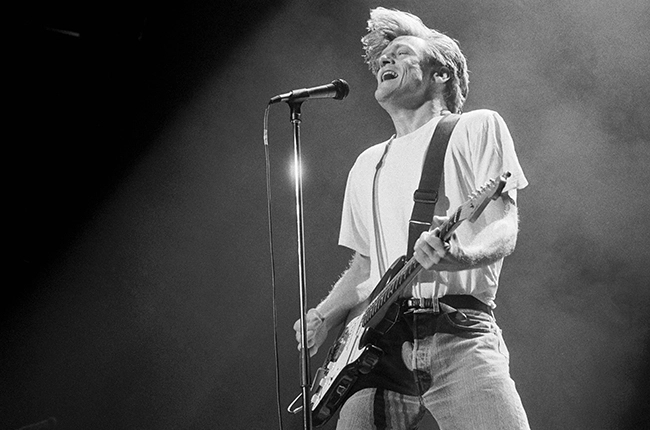
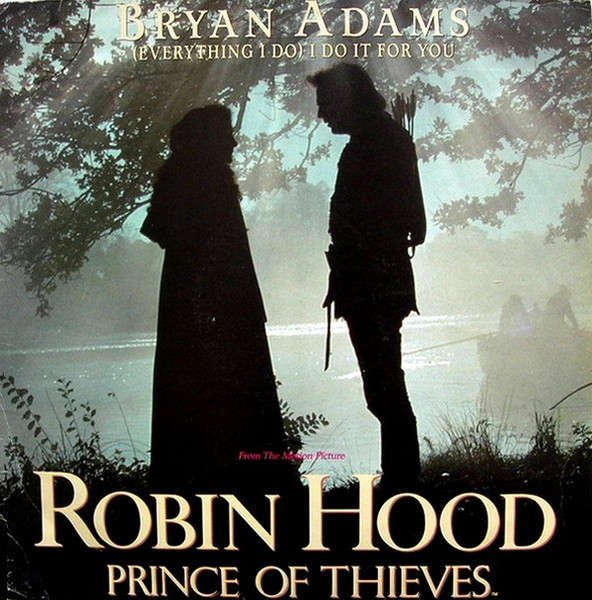
(Everything I Do) I Do It for You, by Bryan Adams (his 1st of two #1s)
16 weeks, from 7th July – 27th October 1991
The 1980s gets the rep as the era of the power-ballad, when big drums and even bigger hair stalked the pop landscape. And yes, the ‘80s gave us ‘Total Eclipse of the Heart’, ‘Take My Breath Away’, ‘The Power of Love’… All gigantic anthems. All of them, to me at least, pretty good. But the 1990s was when power ballads really started to bulk up, to hit the gym, to mutate, Jurassic World-style, into the beast that stands before us now…
Everything about this record is colossal. The slow-build intro, the strained vocals, the sentiment, the production… Nothing is subtle, nothing left to chance. The title, even, tells you exactly what sort of song this will be before you even press play. The listener is not required to think; they merely have to submit to its awesome power. I bet very few of the couples who’ve chosen this as a first dance at their wedding actually like the song; they’ve just been bludgeoned into submission, a sort of musical Stockholm syndrome.
I could pick any line from ‘(Everything I Do…)’ and bask in its cliched stupidity. It’s all the sort of the stuff even a lovestruck fourteen-year-old would think was too overwrought. Take me as I am, Take my life, I would give it all, I would sacrifice… Bryan Adams growls. I get that we live nowadays in a more cynical age, but did anyone actually take this seriously at the time?
Well, probably. Because a record this overblown couldn’t just have a couple of weeks at #1. Not even a couple of months would suffice. No, ‘(Everything I Do) I Do It for You’ needed sixteen long weeks at the top to get its message across. It famously holds the record for the most consecutive weeks at number one (though not the most weeks in total: Frankie Laine’s ‘I Believe’ racked up eighteen over three different runs in 1953). And the UK wasn’t alone in suffering through a summer (and autumn) of Adams. It was #1 for seven weeks in the US, nine in his homeland of Canada, eleven in Australia, and twelve in Sweden.
But there’s a reason why this record, despite its success, has been semi-forgotten, and earlier power ballads by Bonnie Tyler and co remain well-loved. ‘(Everything I Do)…’ just isn’t fun. There’s nothing here that isn’t full-on, one-hundred percent sincerity. And for a power ballad to truly work, you need to feel that the singer is aware, on some level, that what they’re singing is ridiculous. And yet here’s this behemoth, with all the charm of a constipated brontosaurus. Adams isn’t an insufferable guy – he’s recorded plenty of fun, upbeat songs – but this one…? It’s way too earnest.
It’s also probably an indicator of where we are, in pop music terms. The fun of glam metal has fizzled out, and grunge hasn’t quite broken through yet. (Symbolically, ‘Nevermind’ was released right in the middle of this record’s long, long run at the top…) Glam metal hadn’t made much impact at the top of the British charts (neither would grunge for that matter), but it did mean that guitars slowly returned to the mainstream and allowed huge hit singles like this. (Compare this with a power-ballad from the mid-eighties, and it’s much more ‘rock’.)
This single was of course from the soundtrack to ‘Robin Hood: Prince of Thieves’, the ginormous box-office hit of that summer. Chart-toppers from movie soundtracks have been around since the dawn of the charts, but it does feel as if they are taking over in the early nineties. Of the last five #1s, all have been from soundtracks (if we count stage shows as well as films). And this won’t be the last theme song to make it to double-figures at the top of the charts. We’ve got plenty more of these mutant power-ballads to come soon… Brace yourselves.
(For some reason, the single-edit version of the video to ‘(Everything I Do)…’ seems to have been erased from history in favour of the six and a half minute album version.)
Jason Donovan’s final UK number one throws us a bit of a curveball… Musical theatre chart-toppers are generally few and far between, as are hit songs based on bible stories. But perhaps the strangest thing about this song is Jason himself…
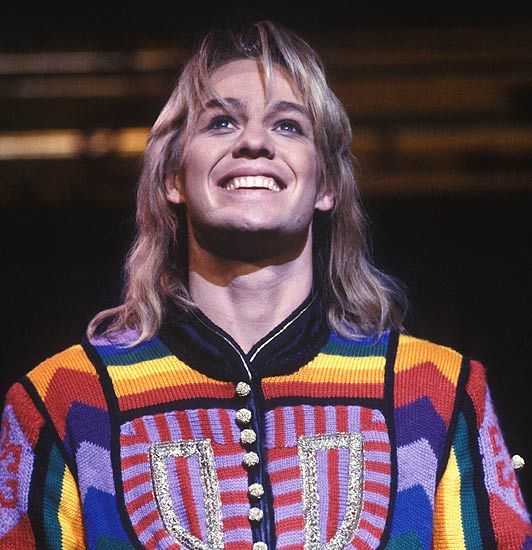
Any Dream Will Do, by Jason Donovan (his 4th and final #1)
2 weeks, from 23rd June – 7th July 1991
Given a blind listening test, there’s no way you would peg this for the same guy who just two years ago was singing ‘Too Many Broken Hearts’. He sounds so proper, so refined. Not that he was a hellraiser back in his SAW days; but he’s gone full musical the-ay-tah, pronouncing every syllable and projecting his voice right to the cheap seats. My gran, whose main requirement in a singer was that you could ‘make out what they were saying’, would have approved.
Away from JD, the record’s production is average, verging on cheap, and the kids’ choir in the background sounds phoned-in. It is of course from ‘Joseph and The Amazing Technicolour Dreamcoat’, an Andrew Lloyd-Webber/Tim Rice musical based on the story of Joseph, from the Book of Genesis. They had written it in the late sixties, but the show hadn’t had a run in the West End for almost twenty years before a revival, starring Donovan as the title character, turned it into one of Britain’s best-loved musicals. Lloyd-Webber, meanwhile, scored his second #1 in under a year, after bringing us Timmy Mallett and his infamous bikini…
It’s a well-trodden path. A pop star’s hits begin to dry up and so they migrate to the stage. Not that Jason Donovan had fallen that far from his heyday – his second album had produced three Top 10 hits, though no #1s – but perhaps he could see which way the wind was blowing. It was a smart move, bringing him to the attention of a whole new audience, and gaining him a pretty unexpected swansong at the top of the charts.
If I’m honest, it’s hard for me to judge this song with any sort of impartiality. We have, in fact, reached a massive milestone. After five and half years of writing, and six hundred and sixty-six number ones (note the irony of a bible-based song being the 666th…) we arrive at the first chart-topper that I was actually aware of at the time. In fact the soundtrack to ‘Joseph…’ was the first CD I ever owned, while I went on a Sunday school trip to see the show in Edinburgh (though by that point I believe it was Phillip Schofield in the starring role).
And so, what would otherwise be a fairly unremarkable chart-topper, save for the odd coda it gave Donovan’s chart-career, takes on great significance. For me, at least. I can’t hear the soaring A crash of drums, A flash of light… line without picturing that old worn-out CD (although my favourite songs at the time were the country-ish ‘One More Angel in Heaven’ and the unhinged jazz-polka of ‘Potiphar’).
I’ve written before about Jason Donovan (and Kylie) being pop ground zero for older millennials like me. Kylie may have gone on to slightly bigger things – she’s literally back in the Top 10 as I write this, aged fifty-five, an absolute icon – but Jason has remained in the public eye for better (a plethora of stage and light entertainment shows) or worse (lawsuits and drug addiction). When I was a student, the mere suggestion that he might be making a private appearance at a nightclub would be enough to sell the place out. (It happened several times, and he never once turned up…) So here’s to you, Jason Donovan. Not many pop stars had a bigger impact on my formative years.
I arrive at this next chart-topper, and a question immediately springs to mind: what’s worse – the name of the song, or the name of the group?
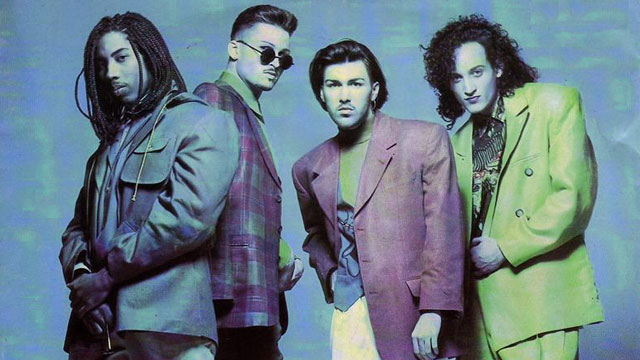
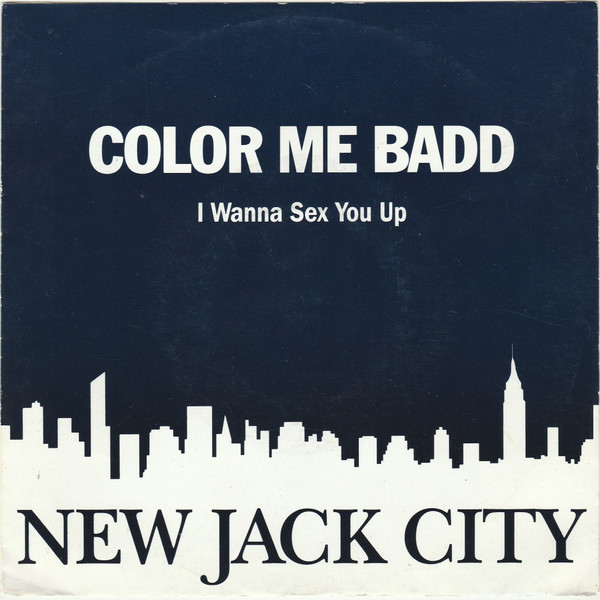
I Wanna Sex You Up, by Color Me Badd (their 1st and only #1)
3 weeks, from 2nd – 23rd June 1991
I mean, both could win the pop music equivalent of the Razzies. But for me it’s the song title that is a smidge more excruciating. And that’s because it lends its name to four minutes of cringe-inducing boyband R&B. Come inside take off your coat, I’ll make you feel at home… squeaks a Poundshop Prince. The lyrics start of icky – all lighting candles and pouring wine – and only get ickier…
For example: Disconnect the phone so nobody knows… Personally, I don’t see disconnecting the phone as a sexy move; more a creepy, ‘there’s no escape’ kind of move. And then there’s the piece de resistance: making love until we drown… dig… Drown in what, dare I ask? (Vomit, probably, given the way these lyrics are making me feel.)
There’s a spoken-word section, of course, though it’s more of a whispered-word section: Just lay back, Enjoy the ride… The only redeeming moments in the song are the two hooks – the ooh-ooh-eeh-ooh and the tick tock ya don’t stop – that run on a loop. In fact, if you can block out the lyrics, the song itself sounds very modern. If I hadn’t known, then I’d have placed it in the mid-to-late nineties, rather than 1991. The song featured on the soundtrack (another soundtrack #1!) to ‘New Jack City’, an action-crime movie featuring the likes of Chris Rock, Wesley Snipes and Ice-T.
Was this controversial at the time? Few #1s have been this upfront about sex, save for Serge and Jane, and Frankie saying ‘Relax’. (Off the top of my head, I believe this might be the first chart-topper to feature the word ‘sex’ in its title.) Or did people just write it off as simply too ridiculous to be a threat to young and impressionable minds? The video is nowhere near as saucy as it might have been, mainly featuring the four Badds sauntering along railway tracks, like NKOTB’s moody older brothers. And, of course, it seems very PG-13 compared to some of the songs that have made number one between then and now, from ‘Freak Me’ to Megan and Cardi B’s wet-ass you-know-whats…
Color Me Badd were four high school friends from Oklahoma, who were helped on their way to brief stardom by Robert Bell of Kool & The Gang, who found them a manager, and Bon Jovi, who let the boys open for them at a concert in New York. They were a racially diverse group, too: one white, one black, one Mexican, and one part Native-American.
They had two further #1s in the US (where ‘I Wanna Sex You Up’ stalled at #2), including the actually pretty great ‘All 4 Love’, which was their only other UK Top 10. They split up in 1998. They’ve left behind a complicated legacy: some sources list this as one of the ‘50 Worst Songs Ever’, while others have it as one of the ‘100 Greatest Songs of the ‘90s’. Personally I’d lean towards the former, though it is so silly in places that it almost becomes quite fun.
Twenty-six years after her first number one single, Cher finally claims her second. (That’s a record by the way, for longest gaps between chart-toppers, beating one set by The Righteous Brothers just a few months before. It would stand until the mid-‘00s, when Leo Sayer broke it. And it would stand as the record for a female act right through until 2022, when Kate Bush ran up that hill to #1.)
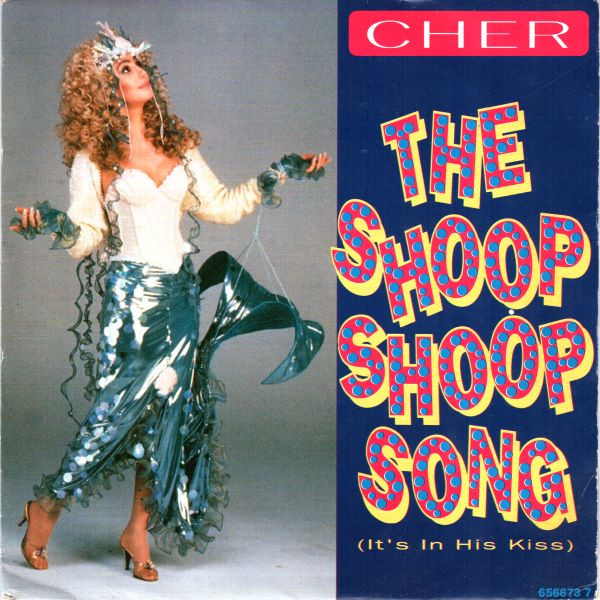
The Shoop Shoop Song (It’s in His Kiss), by Cher (her 2nd of four #1s)
5 weeks, from 28th April – 2nd June 1991
But we’re getting ahead of ourselves. A record breaker it may be, but what of the song? And why? Why, after all the ‘70s and ‘80s hits that Cher delivered, was it this camp and catchy cover of an old Betty Everett tune which brought her back to the top? It’s a pretty faithful cover, with lots of glossy production touches. It goes without saying that there’s more authenticity to the simple percussion used in Everett’s version; but there’s also something quite fun in the kitchen-sink approach taken to this cover. An approach typified by the way Cher over-sings pretty much every line, from the opening Does he love me? I wanna know! to the song’s most ridiculous moment: Oh no! That’s just his arms!
But she does it with such gusto, Cher in character as Cher, selling the impression that she was having a tonne of fun while singing it, and sweeping the listener along with her. It’s a mere notch above karaoke, but when Cher’s in this mood who cares? If I believed in the concept of ‘guilty pleasures’, then this would definitely be one of mine.
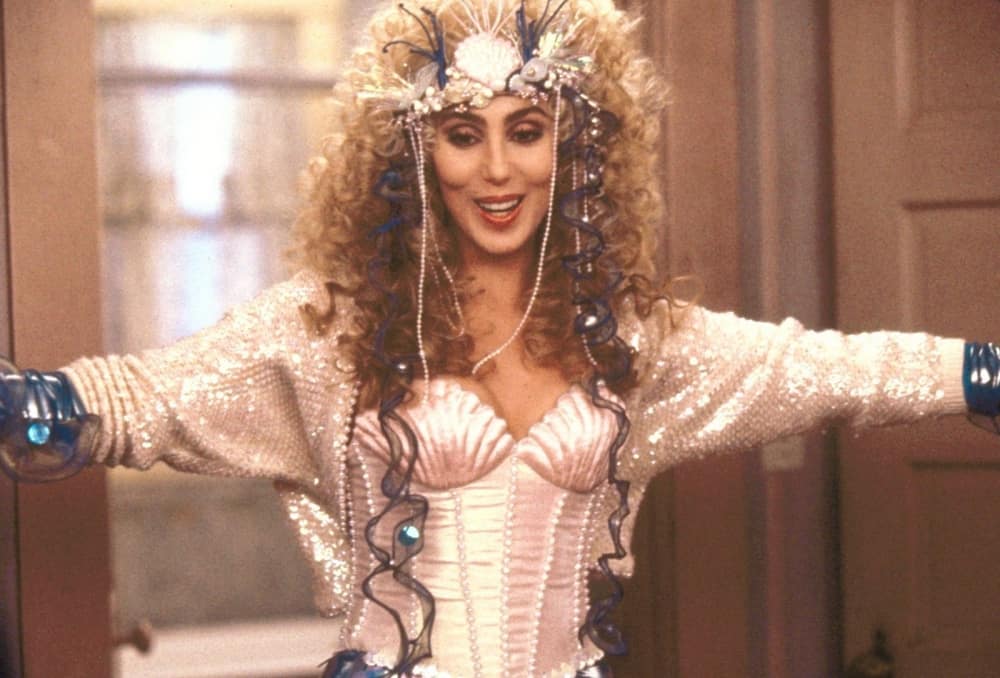
It was recorded for the soundtrack of the movie ‘Mermaids’, a film that seems pretty well-regarded but that – as with so many of these recent soundtrack hits’ origins – I have never seen. The video is cute, though, with Cher using the lyrics as a lesson to her two on-screen daughters, played by Winona Ryder and Christina Ricci.
As fun as this record is, I must admit myself surprised to find that this was Britain’s second highest-selling song of 1991. For a start, Cher was in her mid-forties when it made #1 – ancient in female chart-topping terms – while, for all its charms, it’s a fairly basic cover. Betty Everett’s original had only made #34 in the UK, though a disco version by Linda Lewis had gone Top 10 in 1975. Linda Ronstadt also had a habit of performing it live, on TV and in concert. Perhaps, then, it was the simple combo of a familiar favourite and the star power of Cherilyn Sarkisian. And the nineties would go on to be Cher’s best era by far for number one singles. She has two more to come, including one of the decade’s defining pop hits…
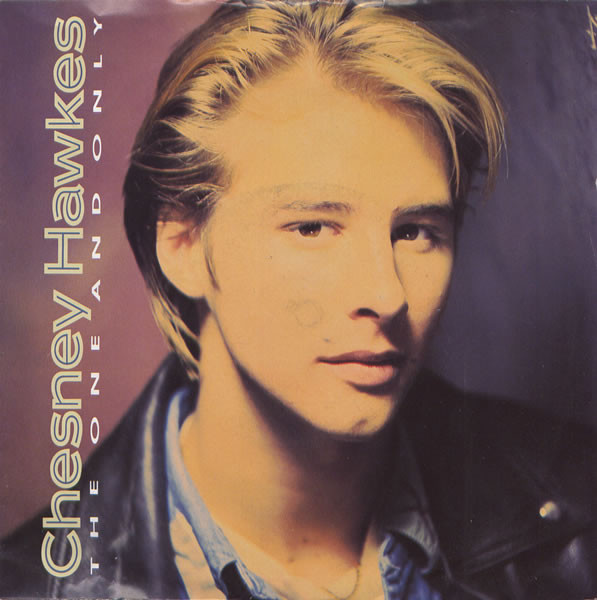
The One and Only, by Chesney Hawkes (his 1st and only #1)
5 weeks, from 24th March – 28th April 1991
…which I’ve never understood the love for. It does have a fun intro, I will admit, with what sounds like guitars fed through a motorbike engine. And at the time, the first appearance of the soaring title line: I am the one and only… must certainly have caught the ears.
But beyond that, and with the benefit of hindsight and over-saturation, this is a very middling effort. As Chesney Hawkes moves into the first verse, things settle down into run of the mill power balladry. It’s not helped by the fact that the lyrics read like a self-help book: No one can be myself like I can, For this job I’m the best man… And while this may be true, You are the one and only you… It’s all pretty lame: ‘rock’ music for people who don’t quite know what rock music is.
And yet, it is rock. Ok, pop rock. Guitars feature prominently, though, and there’s a solo – one that fades in comparison to those we’ve heard recently from Queen and Iron Maiden, but still. It’s another tick in the ‘rock is making a comeback’ box as we move deeper into the 1990s. My problem is that this was played to death in nightclubs when I was a student, and the chorus is up there with ‘Sweet Caroline’, or ‘Livin’ on a Prayer’, for punchable ubiquity. No amount of alcohol can make me enjoy it these days, and I’m not sure I ever did. (God, with this and ‘The Stonk’, I’m sounding quite the curmudgeon recently…)
Chesney Hawkes was just nineteen when this, his debut single, made number one. His boy-next-door charms are undeniable – outrageously floppy hair and cute mole on the upper lip – but no self-respecting rock star pronounces ‘rather’ like he does. He came from chart-topping stock, though: his father was Len ‘Chip’ Hawkes of The Tremeloes, who played on their 1967 number one ‘Silence Is Golden’. (Nowadays Chesney acts as lead-singer when the Tremeloes go on tour.) And that’s not the only sixties link we can make here, as ‘The One and Only’ came from the soundtrack to ‘Buddy’s Song’, a film starring Hawkes as a wannabe rock star and none other than Roger Daltrey as his dad. In fact, this is possibly as close as a member of The Who ever came to featuring on a number one single… (though to be fair did Pete Townshend play bass on ‘Something in the Air’)
Chesney failed to repeat the success of his debut single, and has never charted higher than #27 with any of his subsequent releases. He’s still active in the public eye, appearing on various reality TV shows and, of course, the nineties nostalgia circuit. He’s only fifty one, despite his biggest hit coming thirty two years ago, which is suddenly making me feel very old as well…
Hot on the heels of The Clash, can we also claim this next number one as part of the recent rock revival…?
The Stonk, by Hale & Pace and The Stonkers (their 1st and only #1)
1 week, from 17th – 24th March 1991
Hear me out! There’s a boogie-woogie rhythm, and a honky-tonk piano… The lyrics are somewhat anarchic, vaguely saucy even, if you try hard enough… OK. No, I admit. This isn’t rock and/or roll. This is the return of the chart phenomenon that brought us such treats as Cliff Richard and the Young Ones remake of ‘Living Doll’: the Comic Relief single.
Those of you who live beyond British shores may never have enjoyed this bi-annual TV fundraiser, in which the great and the good of British light entertainment come together for an evening of forced merriment. Hence why the video for ‘The Stonk’ features Bruce Forsyth, Rowan Atkinson as Mr Bean, and (if my eyes didn’t deceive me) David Baddiel, while it opens with newsreader Angela Rippon being whacked out the way by a red-nosed Big Ben. (It is compulsory for Comic Relief to feature newsreaders doing stupid things. It’s funny, you see, because they are usually so serious.)
If this all sounds completely insufferable, then you’d be right. The gags, such as they are, all land flat. Ich bin ein Stonker… announces JFK, while Neil Armstrong claims one giant Stonk for mankind… Even Shakespeare isn’t safe: Shall I compare thee to a summer’s Stonk? someone asks, which makes no sense on any level. It’s shit, and completely unbothered about it. Proud of it, even. Maybe I’m a miserable sod, but I firmly believe that Red Nose Day would make even more money if people donated on the proviso that it would end an hour earlier for every million raised.
(Note the fact that this is advertised as a double-‘A’ side, alongside the much-loved Victoria Wood. The charts only mention Hale & Pace, however. Perhaps this record’s success had something to do with the other song on offer…)
And yet… I can’t list ‘The Stonk’ as one of the all-time worst chart-toppers. It’s not plumbing the depths alongside ‘Star Trekkin’ (which raised not a penny for charity) or ‘No Charge’ (the least humorous ‘novelty’ record of all time). That cheap, relentless boogie-woogie beat, and the chorus’s strong whiff of ‘The Timewarp’, does sort of hook me in. I didn’t want to, honestly I didn’t, but I’ve ended up tapping my feet.
It was written by comedy duo Gareth Hale and Norman Pace who, despite being TV mainstays throughout the 1990s, somehow never managed to become a part of my childhood. I couldn’t name a single one of their sketches or characters. Meanwhile, despite sounding as cheap and cheerful as a Butlin’s ‘knobbly knees’ contest, it does feature ‘proper’ musicians: British rock royalty even, in Queen’s Brian May and Roger Taylor, Black Sabbath’s Tommy Iommi, and Pink Floyd’s David Gilmour.
In wrapping this post up, I have no desire to ever hear this song again. I doubt anybody has actively listened to it since it left the Top 40 (as is the way with most charity singles). It isn’t on Spotify, and all that’s left as proof that this nonsense was, for one week in March 1991, the best-selling single in the country is this grainy YouTube video…
Last week, in a recap of the past thirty chart toppers, I made a lot of just how eccentrically the charts have been behaving over the past year or two. And happily, they show no signs of becoming predictable quite yet…
Should I Stay or Should I Go, by The Clash (their 1st and only #1)
2 weeks, from 3rd – 17th March 1991
For yes, we must sound the ‘random re-release’ klaxon one more time: The Clash score their sole UK #1. And once again, as with ‘The Joker’, it’s Levi’s Jeans we have to thank for giving this classic tune a new lease of life (the ad team knew how to pick them!)
We open with a nonchalantly cool intro. Two guitars have a little call-and-response, before a bass guitar so jagged it almost rips your speakers in two. It’s a simple riff, so easy and familiar that my immediate response is to dredge the memory banks to recall if it’s a cover version. It isn’t, but Mick Jones based it, knowingly or otherwise, on ‘Little Latin Lupe Lu’, a sixties garage-band classic.
The whole thing is loveably ramshackle, and a world away from the polished dance hits that have been the sound of the early 1990s. The guitars crackle, Joe Strummer sneers, and the band holler and screech the backing vocals in Spanish. The main lyrics meanwhile, tell the story of a toxic relationship: It’s always tease, tease, tease, You’re happy when I’m on my knees… and the chaotic ‘chorus’, such as it is, does its best to portray the frenzy of a conflicted mind.
The singer’s happy to remain, no matter the torture doled out, but by the end of the song we’re left none the wiser over whether he stays or goes. (I struggle to see how this helped to advertise jeans, but who am I to question…?) I’d call this record pretty poppy for The Clash, as well as assuming it was one of their early singles. But it was the 3rd release from their 1982 album ‘Combat Rock’, making #17 at the time. And despite coming five years after the band’s sixth and final studio album, this re-release was their first Top 10 hit, let alone their first number one.
Over the past few months, rock music has started to creep back in to the upper reaches of the charts (hurray!) If we start with ‘The Joker’s classic rock, then five of the past twelve #1s have been rock of one kind or another: indie rock (The Beautiful South), heavy metal (Iron Maiden), progressive rock (Queen) and now this. Is ‘Should I Stay or Should I Go’ more classic rock? Or is it garage? Or is it our first real punk rock #1, a decade and a half too late…? Or should we simply not care, and just revel in proper rock ‘n’ roll enjoying its new-found moment in the sun?
The past thirty #1 singles have thrown the charts into a state of flux. We last recapped in July 1989, and the song that kicked off this latest section was Sonia’s ‘You’ll Never Stop Me Loving You’. Back then, Stock Aitken Waterman were responsible for what felt like one in every two chart-toppers, their brassy synths and predictable melodies the sound of the late 1980s…
And then, suddenly, they weren’t. After Sonia, SAW had just two number ones left in the tank – Band Aid II, and Kylie’s cute cover of ‘Tears on My Pillow’ – and neither of those were classics of their kind. No, it seemed that as dance music took over, people realised that there was a world beyond SAW. Black Box’s ‘Ride on Time’, for example, that autumn’s monster hit, and the record I claimed as the first modern dance #1.
From then on, we slipped into a dance groove as we began the final decade of the 20th century. Beats International, Snap!, Adamski, even New Order with the finest football song of all, and Madonna with another of her famous shapeshifts. It was dance music of a different sort: not one hundred manic samples all smashed together; but cool, confident music that, to be honest, wasn’t always that easy to dance to.
Yet to claim that this recap is solely about the dance hits is to airbrush a lot of what makes this period in chart history so interesting. For while the dance hits were trying to hold everything together, the rest of popular music was going ever so slightly mental. We caught glimpses of the decade to come, with the first modern boyband (NKOTB), some lilting indie from The Beautiful South, and the first movie-soundtrack monster ballad of the ‘90s in ‘Show Me Heaven’. It won’t be the last.
Then there were the continued random releases of golden oldies that have been a feature of the charts since 1986, thanks to Levi’s adverts (‘The Joker’) and movies about ghosts with a fetish for pottery wheels (‘Unchained Melody’). And then there was the long-awaited arrival of hip-hop as a genuine chart force, with the genre scoring three out of the past thirty number ones. (Though, as those raps were either about animated turtles, or delivered by cartoon children, or Liverpool midfielders, or… oh yeah… Vanilla Ice, it’s safe to say that it’s a genre still finding its feet. Its time will come soon enough.)
And then it’s almost too easy to pass over the fact that Elton John scored his first ever solo #1, and that Cliff Richard went all Christian-contemporary to ensure he managed a chart-topper in each of the singles chart’s five decades, and his 3rd Xmas #1 appearance in a row! Because all that pales into insignificance when we hit the run of number one singles that came in the deep midwinter of 1990-91. Iron Maiden brought the heavy metal. Enigma brought the Gregorian chanting. Queen brought the Spanish guitars (not to mention the end of the world). And the KLF brought the house down with their industrial dance banger ‘3AM Eternal’, complete with machine guns.
Anything else…? Oh, but I’d almost forgotten. At least, I’d tried to forget. Jive Bunny. J-J-J-Jive Bunny. He was a thing that happened. And he didn’t just ‘happen’. Three #1s, ten weeks at the top, in barely four months. For a brief moment it was the Bunny’s world and we were just living in it (and I’ve only just realised quite how much these past few months have been dominated by cartoon characters…) To tell the truth, I quite enjoyed his first two hits, with their perky mash-ups of rock ‘n’ roll classics. By the 3rd, Christmas-themed, hit however the joke had run out of steam…
Which brings us on to the awards. The ‘Meh’ Award is hard to decide, as so many of the past thirty records have been anything but dull. I could give it to Lisa Stansfield’s ‘All Around the World’, but that was a bit too classy. I could give it to NKOTB’s ‘Hangin’ Tough’, but that was entertainingly lame. So, I’ll have to give it to Band Aid II, for their completely faithful, but nowhere near as iconic, attempt to recapture the magic of ‘Do They Know It’s Christmas?’ At least it raised some money for a worthy cause.
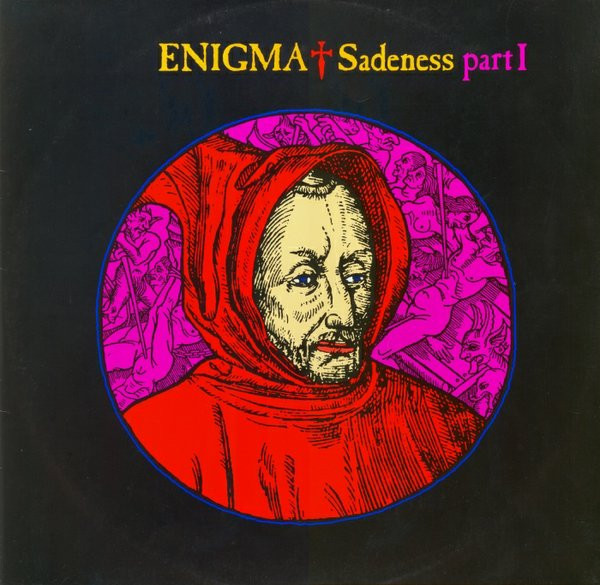
There have rarely been as many rich pickings for our next award, the The WTAF Awardfor being interesting if nothing else. Where in God’s name do we start? Partners in Kryme? Timmy Mallet and his scantily clad young ladies? The Simpsons? Iron Maiden? Vanilla Ice?? J-J-J-Jive Bunny?? No, I think it’s between two back to back #1s from January 1991. ‘Innuendo’, and ‘Sadeness Part 1’. And as much as I grew to enjoy Queen’s 3rd chart-topper (or perhaps because I now like it so much…) I’ll have to give it to the one with the chanting monks, and the lyrics in French about a perverted literary genius.
Finally, then, to the main events. The Best and, before that, our 22ndVery Worst Chart-Topper. I listed so many weird and wonderful hits above, but I’d be loath to give it to any of them. No, this one’s cut and dried. I’m giving it to the record which confirmed that the Jive Bunny joke had ceased to be funny: ‘Let’s Party’. Cheap covers of Slade, Wizzard and Gary Glitter, stitched together with the subtlety of a charging elephant, do not a classic record make.
Much more tricky to decide is this recap’s Very Best Chart-Topper. I started off with a longlist but, as much as I enjoyed ‘Vogue’, Beats International and the KLF, I pretty quickly refined things down into a shortlist. Black Box’s ‘Ride on Time’, and a song I haven’t even found time to mention yet… Sinéad O’Connor’s ‘Nothing Compares 2 U’. Two very different records, two worthy winners. Black Box set the sound for the decade to come, whereas O’Connor’s take on Prince’s original would sound, yes, iconic in any decade. ‘Nothing Compares 2 U’ for the win.
To recap the recaps:
The ‘Meh’ Award for Forgettability
‘Hold My Hand’, by Don Cornell.
‘It’s Almost Tomorrow’, by The Dream Weavers.
‘On the Street Where You Live’, by Vic Damone.
‘Why’, by Anthony Newley.
‘The Next Time’ / ‘Bachelor Boy’, by Cliff Richard & The Shadows.
‘Juliet’, by The Four Pennies.
‘The Carnival Is Over’, by The Seekers.
‘Silence Is Golden’, by The Tremeloes.
‘I Pretend’, by Des O’Connor.
‘Woodstock’, by Matthews’ Southern Comfort.
‘How Can I Be Sure’, by David Cassidy.
‘Annie’s Song’, by John Denver.
‘I Only Have Eyes For You’, by Art Garfunkel.
‘I Don’t Want to Talk About It’ / ‘The First Cut Is the Deepest’, by Rod Stewart.
‘Three Times a Lady’, by The Commodores.
‘What’s Another Year’, by Johnny Logan.
‘A Little Peace’, by Nicole.
‘Every Breath You Take’, by The Police.
‘I Got You Babe’, by UB40 with Chrissie Hynde.
‘Who’s That Girl’, by Madonna.
‘A Groovy Kind of Love’, by Phil Collins.
‘Do They Know It’s Christmas?’, by Band Aid II.
The WTAF Award for being interesting if nothing else
‘I See the Moon’, by The Stargazers.
‘Lay Down Your Arms’, by Anne Shelton.
‘Hoots Mon’, by Lord Rockingham’s XI.
‘You’re Driving Me Crazy’, by The Temperance Seven.
‘Nut Rocker’, by B. Bumble & The Stingers.
‘You’ll Never Walk Alone’, by Gerry & The Pacemakers.
‘Little Red Rooster’, by The Rolling Stones.
‘Puppet on a String’, by Sandie Shaw.
‘Fire’, by The Crazy World of Arthur Brown.
‘In the Year 2525 (Exordium and Terminus)’, by Zager & Evans.
‘Amazing Grace’, The Pipes & Drums & Military Band of the Royal Scots Dragoon Guard.
‘Kung Fu Fighting’, by Carl Douglas.
‘If’, by Telly Savalas.
‘Wuthering Heights’, by Kate Bush.
‘Hit Me With Your Rhythm Stick’, by Ian Dury & The Blockheads.
‘Shaddap You Face’, by Joe Dolce Music Theatre.
‘It’s My Party’, by Dave Stewart & Barbara Gaskin.
‘Save Your Love’ by Renée & Renato.
‘Rock Me Amadeus’, by Falco.
‘Pump Up the Volume’ / ‘Anitina (The First Time I See She Dance)’, by M/A/R/R/S
‘Doctorin’ the Tardis’, by The Timelords
‘Sadeness Part 1’, by Enigma
The Very Worst Chart-Toppers
‘Cara Mia’, by David Whitfield with Mantovani & His Orchestra.
‘The Man From Laramie’, by Jimmy Young.
‘Roulette’, by Russ Conway.
‘Wooden Heart’, by Elvis Presley.
‘Lovesick Blues’, by Frank Ifield.
‘Diane’, by The Bachelors.
‘The Minute You’re Gone’, by Cliff Richard.
‘Release Me’, by Engelbert Humperdinck.
‘Lily the Pink’, by The Scaffold.
‘All Kinds of Everything’, by Dana.
‘The Twelfth of Never’, by Donny Osmond.
‘The Streak’, by Ray Stevens.
‘No Charge’, by J. J. Barrie
‘Don’t Give Up On Us’, by David Soul
‘One Day at a Time’, by Lena Martell.
‘There’s No One Quite Like Grandma’, by St. Winifred’s School Choir.
‘I’ve Never Been to Me’, by Charlene.
‘Hello’, by Lionel Richie.
‘I Want to Know What Love Is’, by Foreigner.
‘Star Trekkin’’, by The Firm.
‘Nothing’s Gonna Change My Love for You’, by Glenn Medeiros.
‘Let’s Party’, by Jive Bunny & The Mastermixers.
The Very Best Chart-Toppers
‘Such a Night’, by Johnnie Ray.
‘Cherry Pink and Apple Blossom White’, by Perez ‘Prez’ Prado & His Orchestra.
‘Great Balls of Fire’, by Jerry Lee Lewis.
‘Cathy’s Clown’, by The Everly Brothers.
‘Telstar’, by The Tornadoes.
‘She Loves You’ by The Beatles.
‘(I Can’t Get No) Satisfaction’, by The Rolling Stones.
‘A Whiter Shade of Pale’, by Procol Harum.
‘I Heard It Through the Grapevine’, by Marvin Gaye.
‘Baby Jump’, by Mungo Jerry.
‘Metal Guru’, by T. Rex.
‘Tiger Feet’, by Mud.
‘Space Oddity’, by David Bowie.
‘I Feel Love’, by Donna Summer.
‘Heart of Glass’, by Blondie.
‘The Winner Takes It All’, by ABBA.
‘My Camera Never Lies’, by Bucks Fizz.
‘Relax’ by Frankie Goes to Hollywood.
‘You Spin Me Round (Like a Record)’, by Dead or Alive
As with all novelty singles, I approach this next number one with trepidation, my finger hovering reluctantly over the play button. But the intro actually sounds quite cool: a new jack swing beat and a squelchy bassline. Something by Janet Jackson perhaps, or a Prince ‘B’-side…
Do the Bartman, by The Simpsons (their 1st and only #1)
3 weeks, from 10th February – 3rd March 1991
The only version available on Spotify is the five minute (!) album version – from ‘The Simpsons Sing the Blues’ LP – so I don’t know for how long this intro did its funky thing on the single-edit. Eventually Homer comes in, yelling at Bart for some unspecified misdemeanour. Nobody saw me… I didn’t do it…
From here on things follow a fairly formulaic hip-hop single format: i.e. rapper tells us how great he is. Except here the rapper is a yellow cartoon boy, voiced by a thirty-five year woman (kudos to Nancy Cartwright here, as it can’t be easy rapping while putting on such a voice). There are some fun lines: I’m the kid that made delinquency an art, Last name Simpson, First name Bart… but the song ends up caught between not being funny enough to work as a novelty, yet still being gimmicky enough to annoy. The ‘joke’ wears especially thin on the, it bears repeating, five minutes long extended album version.
The fact that this does almost work as a pop song is probably down to the alleged involvement of Michael Jackson. He’s not credited – his label insisted he couldn’t be – and there are differing accounts of what he actually contributed towards the song, but it seems he wrote some of the lyrics and contributed backing vocals, as well as giving the song its title. He also apparently insisted that he be name-checked (If you can do the Bart, You’re bad like Michael Jackson…) Jackson would also feature in an episode of The Simpsons a few months after this had been a hit single. The video too is a six-minute long MJ-esque epic, in which Bart takes over a school talent show with his new dance routine (or was it all a dream…?)
It’s credited to ‘The Simpsons’, but it’s largely just Bart. Lisa gets a saxophone solo, and Homer gets to yell throughout. Marge and Maggie are conspicuous by their absence. I wonder if, to many British listeners, ‘Do the Bartman’ was their first exposure to ‘The Simpsons’. At the time this was released, the show was just halfway through its second season in the US, and was only broadcast on satellite TV in the UK (I remember it coming to terrestrial TV, on Channel 4, much later in the mid-nineties). If so, the song’s success is quite remarkable, as I’m not sure it holds much enjoyment for someone who’s never seen the show.
Anyway, in this moment ‘The Simpsons’ was on the verge of becoming the biggest TV programme in the world. Between series three and ten it was untouchable, and a fixture in my own house every dinner time. They even managed a second Top 10 single, another hip-hop track (and actually much better than this) ‘Deep, Deep Trouble’. After that, the show came to a natural conclusion in the early 2000s, and is remembered as one of the best series ever, and as a lesson in how to go out on top. Right? No…?
I’m going to stick my neck out here, and claim that we’re in the midst of what is the strangest run of number one singles. From ‘Unchained Melody’, past Vanilla Ice and Christian Cliff, Iron Maiden bringing our daughters to the slaughter, Enigma’s Gregorian chanting, and Queen’s ‘other’ epic single… to the KLF.
3A.M. Eternal (Live at the S.S.L.), by The KLF (their 1st and only #1)
2 weeks, from 27th January – 10th February 1991
And on the face of it, ‘3A.M. Eternal’ is a return to the dance music that’s shaped the early ‘90s. If you were being harsh, you could claim it to be a rehash of Snap!’s ‘The Power’, with its Russian radio intro, and its mix of a male rapper with a big-voiced female (the singer belting it out at the start is soul legend P.P. Arnold). But this is The KLF, and with them nothing is what it seems.
For a start, the sound that immediately follows the radio intro is a machine gun, strafing the listener into pieces. There’s all the chanting about the ‘Ancients of Mu Mu’ (the band’s former name). And then there’s the crowd noise, and the announcement at the end that KLF have now left the building… It’s all fake, the S.S.L. in the title refers to a Solid State Logic mixing desk. And there’s the fact that this is actually a remix of a 1989 release of the same name: a deep trance track that failed to chart and that sounds unrecognisable from this much poppier version.
But above all that, one fact remains: it’s a banger. All my talk of comparing it to ‘The Power’ fades away because this, in my opinion, is the far better song. It’s dance music with rock chords, and with about three different hooks: the KLF is gonna rock you chant, the uh-huh-uh-huhs, and the Ancients of Mu Mu. And as fake as it may be, the soaring crowd noise adds an epic, stadium quality to the track. (This was #1 on my fifth birthday, and it’s one of my very favourite birthday chart-toppers.)
This being the KLF, you do wonder if this remix was done with the aim of aping the big dance hits of the age – all the ingredients are there – and in the end making a song that betters them all. They’d done it once before, as The Timelords (they’ve gone under quite a few names over the years…) and the ridiculously catchy, sample-heavy ‘Doctorin’ the Tardis’ from three years earlier. And they weren’t done remixing ‘3AM Eternal’, as a year later they recorded a thrash metal version with crust punk group Extreme Noise Terror, with whom they duetted at the Brit awards, and pretended to machine gun the audience (the original plan had been to disembowel a dead sheep live on stage, before the lawyers stepped in…) The performance is on YouTube, and it’s amazing to think that it was broadcast on primetime BBC.
You’d need an entirely separate blog post to go into sufficient detail on the KLF, Bill Drummond and Jimmy Cauty, their many guises and their many moments of notoriety. Aside from their Brits performance, shout outs need to be made to their duet with Tammy Wynette on ‘Justified and Ancient’, which made #2 later in 1991, in shades of the Pet Shop Boys and Dusty. And their retirement, when they deleted their entire back catalogue (it was only restored a couple of years ago) and set fire to their remaining one million pounds in royalties on a remote Scottish island.
So there you go. As talented as they were tasteless, and responsible for yet another weird and wonderful number one. You’ll be glad to hear that things aren’t getting any less bizarre either, for up next is the most famous pop star of the age, with the most famous animated family of all time…









 The UK Number Ones Blog