693. ‘Living on My Own’, by Freddie Mercury

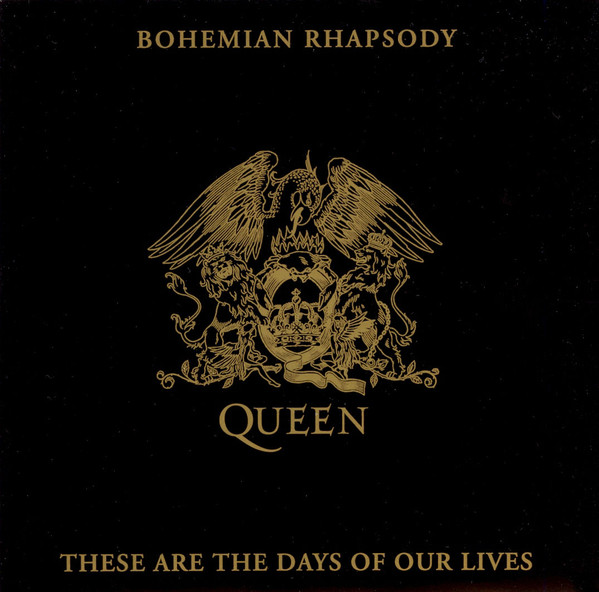
It feels like we’ve been bidding farewell to Freddy Mercury for a while now. From the re-release of ‘Bohemian Rhapsody’, paired with ‘These Are the Days of Our Lives’, in the weeks following his death, to George Michael’s tributes on the ‘Five Live EP’, to this.

Living on My Own, by Freddie Mercury (his 1st and only solo #1)

2 weeks, from 8th – 22nd August 1993

And of the three, this remix of his minor 1985 hit is the tribute that Freddie himself might have enjoyed the most. On the one hand it is a shame that his solitary solo number one isn’t a blistering rocker; but then he was a musician who never let himself be restricted within one genre. ‘Living on My Own’ is updated nicely for the early-mid nineties, with a chilled out house beat, by a production trio called No More Brothers and, although it was still listed on the charts as the 1985 original, it was undoubtedly this remix that sent it to #1.

I say that Freddie would have liked this version and, presumptuous as that might be, if you listen to the original, from his ‘Mr. Bad Guy’ solo album, then it was already much more dance than rock. The lyrics, meanwhile, are very personal: Sometimes I feel I’m gonna break down and cry, Nowhere to go, Nothing to do with my time… I get lonely… They’re based heavily on quotations from Greta Garbo (which feels very Freddie Mercury…) and each chorus ends on the positive mantra: Got to be some good times ahead… Though knowing how soon it all would end, that line is tinged with sadness.

I will also give a shoutout to an earlier remix – which I initially thought was the chart-topping version – by Julian Raymond. This is my favourite of the three versions, with a faster, industrial beat, more of Mercury’s trademark yodelling, alongside a frenetic piano line. It was commissioned as part of the ‘Freddie Mercury Album’, released in November 1992 to mark the 1st anniversary of his death, but never released as a single.

The video to the 1993 version of ‘Living on My Own’ was the same as the 1985 one, and featured footage of a Drag Ball held for Mercury’s 39th birthday party. I love this quote: “Because of the garishly costumed homosexuals and transvestites celebrating a decadent, raucous party in the video clip, the BBC long refused to broadcast the music video on its channels.” Good old Beeb, always ready to ban those garish homosexuals…

I hadn’t realised quite how well Freddie Mercury’s solo career – while nothing compared to Queen’s discography – had been ticking along since the mid-80s, when he made the Top 10 with ‘Love Kills’. The ‘Living on My Own’ remix was his seventh, and final, Top 20 hit, and a huge smash across Europe. (Especially in France, where it did a Bryan Adams and stayed at #1 for fifteen weeks! Bryan or Freddie… I know who I’d rather have clogging up the number one spot…)

With this we can finally bid farewell to Freddie Mercury. Three number one singles in his lifetime, two after his death, and one well-intentioned tribute in-between. For my money, he is the greatest frontman of all time. Not only could he rock with the very best; he could do opera, musical theatre, pop, disco, camp ditties about girls with fat bottoms… And he sounds just as at home here, on a house track released two years after his death, as he does anywhere.
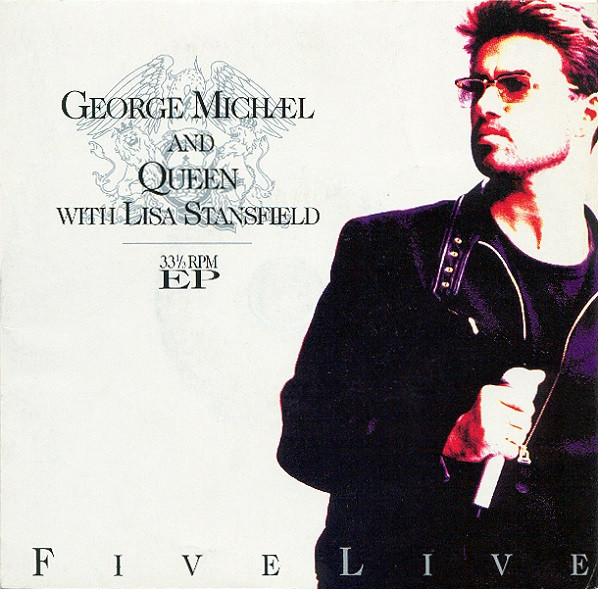
688. ‘Five Live E.P.’, by George Michael & Queen with Lisa Stansfield

I have to admit my heart sinks each time I see an EP coming along. It’s hard enough writing about double-‘A’s (in fact, it can be hard writing about some of the standalone number ones…), but when it’s four songs to get through? Cancel my three o’clock…

Five Live E.P., by George Michael (his 5th of seven #1s) & Queen (their 5th of six #1s) with Lisa Stansfield (her 2nd and final #1)

3 weeks, from 25th April – 16th May 1993

Luckily for me, the final EP to top the British singles chart has five whole tracks to get through! Five live tracks (hence the name) by George Michael, with assistance from Queen on two of them, and Lisa Stansfield on one. Let’s not tackle them in order, but take the two Queen covers first, recorded at the famous Freddie Mercury Tribute Concert a year earlier.

First up, George has a good old crack at ‘Somebody to Love’. It’s a thankless task, trying to do Freddie Mercury, singing one of his signature songs. But GM gives it a bloody good go. It might be the most impressive vocal performance of all seven of his solo #1s, especially given that it was recorded live. It’s a straightforward cover, but a decent one. And it takes to number one a Queen song that should, like many of their post-Bo Rap singles, have got there first time around. One wonders if this was where Brian May got the idea to start touring again, eventually, with the likes of Paul Rodgers and Adam Lambert.

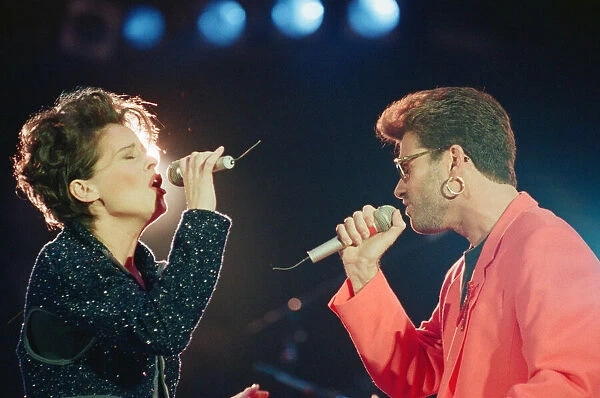
The other Queen cover is ‘These Are the Days of Our Lives’, the track that had made #1 in the immediate wake of Mercury’s death. George is joined by Lisa Stansfield, who he welcomes on stage remarking that she hasn’t any hoover or curlers (presumably referring to her performance of ‘I Want to Break Free’ earlier that night, and not just being sexist…) Again it’s fine, excellently sung – particularly by Stansfield, who didn’t really get to show off her vocal chops on ‘All Around the World’. I don’t imagine it was easy going on stage with George Michael in full flow and holding your own, but she manages. Yet this track isn’t as enjoyable, because a) it was #1 barely a year before and b) it’s not as good as ‘Somebody to Love’ in the first place.

The three other tracks are George Michael solo efforts, recorded in March 1991, again at Wembley (from the same tour that gave us his ‘Don’t Let the Sun Go Down on Me’ duet with Elton John). According to the records, he covered both Adamski’s ‘Killer’ and The Temptations’ ‘Papa Was a Rolling Stone’, but both tracks are hard to, well, track down. Luckily on the British version of the EP he used a shortened, medley version, and again it’s… OK. You’d need a good ear to hear these tracks as a medley, but it works.

However, I refer you back to my comments on Michael’s earlier live #1: live versions being rarely better than the originals and, unless you were actually at the concert, the crowd noises are little more than a distraction. It’s like modern-day shaky camera phone footage, but better produced. Still it was for charity, which is always good, benefiting the Mercury Phoenix Trust, an AIDS fund set up by the remaining members of Queen, their manager Jim Beach, and Mercury’s former partner Mary Austin.

Did we need a fifth track though, making this the longest record to ever make #1 (a milestone that is now almost impossible to break)? Not really. This is where we tip into real self-indulgence, something that George Michael was always prone to, with a cover of ‘Calling You’, originally recorded by soul singer Jevetta Steele for the film ‘Bagdad Café’. I hadn’t heard of it, although the crowd’s reaction suggests that some of them had, at least. And in fairness it did win the Best Original Song Oscar for 1988. The vocals are amazing, from both George and his backing singers, especially again considering it was recorded live. But… It does go on. It unfolds at a snail’s pace, over five minutes. My patience is well and truly tried.

The history of EPs – longer than singles but shorter than LPs – on the UK singles chart is hard to pin down. In the sixties, their heyday, they sold very well and had their own chart. Between the 70s and 90s they fell out of fashion, but could chart alongside the singles. We’ve had three earlier EP #1s, from Erasure, The Specials and Demis Roussos. ‘Five Live’ was the last one to make the top, and maybe this sprawling beast of a record helped to kill them off. Nowadays the closest we’ve got to an EP is a Maxi-CD, or a digital bundle, but since the download/streaming era individual tracks can simply chart in their own right. The same fate has also befallen the double-‘A’ record, though we’ve still got a few more of them to come before then…

672. ‘Bohemian Rhapsody’ / ‘These Are the Days of Our Lives’, by Queen

On November 23rd 1991, Queen frontman Freddie Mercury released a statement announcing that he was HIV positive, and had developed AIDS, confirming years of speculation about his ailing health. Barely one day later another announcement followed: Mercury was dead, aged just forty-five.

Bohemian Rhapsody / These Are the Days of Our Lives, by Queen (their 4th of six #1s)

5 weeks, from 15th December 1991 – 19th January 1992

Which brings us to the final #1 of the year – the Christmas Number One – and the first time a song has re-topped the charts. How to deal with this? Write about ‘Bohemian Rhapsody’ all over again? I’d rather not… Or just provide a link to my original post on the song, back when it was a nine-week chart-topper (and another Xmas #1) back in 1975-76? Neither seems the perfect solution… ‘Bo Rap’ may well be one of the best-loved, most innovative, outré pop songs of all time; but it has been played to death. We all know what it sounds like. Luckily, Queen twinned it with a song from ‘Innuendo’, their latest album, and gave us something else to talk about!

‘These Are the Days of Our Lives’ couldn’t be more different from its re-released partner. A lounging, glossy soft-rock tune, with a gentle Bossa nova beat. It’s not classic Queen – it sounds more like a Freddie Mercury solo record – until Brian May’s trademark guitar come chiming in towards the end. Lyrically, though, it’s the perfect swansong.

It was written by Roger Taylor, but lines like You can’t turn back the clock, You can’t turn back the tide, Ain’t that a shame… are sung ruefully by Mercury, in what many have claimed were the final vocals he ever recorded. It’s unashamedly sentimental, and usually that would have me running a mile, but when lyrics like Those days are all gone now, But one thing is true, When I look, And I find, I still love you… are sung by a dying man then they hit much harder.

The video – filmed in black and white to hide just how gaunt Mercury was – is certainly the last thing he filmed, six months before his death. Ever the showman – behold the cat waistcoat! – he asked for the closing shot to be re-filmed, in which he chuckles to himself, looks down, then whispers I still love you… Not a dry eye left in the house.

The lyrics shift from ‘those were’ the days of our lives to ‘these are…’, in a positive message, a sign that even in the shadow of death each day is a gift. Again, this is something I might balk at if it weren’t for the fact that a dying man is singing it. If he believes it then who am I to judge? Personally, I’d have liked ‘The Show Must Go On’ as the posthumous single – much more dramatic, much more Queen – but that had been released a couple of months earlier, making #16.

For sure ‘These Are the Days of Our Lives’ wouldn’t have made number one on its own, without either Mercury’s death or ‘Bo Rap’s re-release. A certain run-of-the-mill Elton John song will suffer a similar fate a few years later, caught up in another famous death, becoming one half of the highest-selling single ever in the process. ‘Bohemian Rhapsody’ meanwhile added five more weeks in top spot to its original nine, becoming the third longest-running #1 ever. And this isn’t the end of the chart-topping story for either Queen or Freddie. But it is the end for 1991, one of the more interesting years for chart-topping singles, with Gregorian chants, rapping cartoon characters, sixteen-weekers, Bono in character as ‘The Fly’, Vic Reeves (because why not?), and it all ending on a farewell to the greatest frontman who ever strutted the stage.

658. ‘Innuendo’, by Queen

It feels like a trick pub-quiz question: which number one hit by Queen is over six minutes long, composed of several sections, in several genres…?

Innuendo, by Queen (their 3rd of six #1s)

1 week, from 20th – 27th January 1991

‘Bohemian Rhapsody’ everyone will shout, and everyone will be wrong. (For Bo Rap isn’t quite over six minutes long…) No, ‘Innuendo’ is Queen’s true forgotten epic. And what an epic. It starts off brooding, and ominous, reminiscent of Led Zeppelin’s ‘Kashmir’, with apocalyptic lyrics such as: While there’s a wind and the stars and the rainbow, ‘Til the mountains crumble into the plain… Freddie bemoans mankind’s inability to live in harmony, and its insistence on dividing people by race, religion and creed.

Then come the flamenco guitars, which to my untrained ears sounds like some serious musicianship (it was played by Brian May and Steve Howe of Yes), and a bridge that sounds like a cross between the monkish chants used by Enigma, and a Disney theme. After all that, it’s hard not punch the air when a trademark Brian May guitar solo comes swooping in, saving this monster from disappearing up its own arse.

It ends as it began, ominously stomping its way to the end of time. It’s hard not to read this as Freddie coming to grips with his impending death, when he asks: If there’s a God or any kind of justice under the sky, If there’s a point, If there’s a reason to live or die. He knew that this was the last album Queen would release in his lifetime, and so the line Through our sorrow, All through our splendour, Don’t take offence at my innuendo… almost becomes a farewell to Queen’s fans and detractors alike.

Ultimately, though, it ends on a positive note: Yes, we’ll keep on trying…And that line is the moment in this bizarre epic that sounds like classic Queen. Otherwise, it’s one of the weirdest #1 singles ever, in an era of increasingly weird #1s. And it’s amazing to think that it’s only Queen’s 3rd UK chart-topper, after ‘Under Pressure’ and the aforementioned ‘other’ epic’. Just think of the classic Queen hits, the ‘Radio Gaga’s and the ‘Another One Bites the Dust’s, that didn’t make it while this beast (described beautifully by one journalist at the time as ‘seductively monstrous’) did.

It’s unfair to compare this record to ‘Bohemian Rhapsody’, though it’s perhaps inevitable. Bo Rap was the sound of a band in their infancy, four young men going wild simply because they could, because nobody had told them not to, and there’s a great joie de vivre throughout that song (and I say that as someone who would happily never hear it again). ‘Innuendo’ is far darker and much less optimistic, four middle aged men, one of whom was terminally ill, pledging to ‘keep on trying’ despite the odds being stacked against them, and against mankind.

As a teen, I had Queen’s three-disc Greatest Hits. I usually skipped ‘Innuendo’ in favour of the earlier hits (in fact, I think it was on Disc 3, which I barely bothered playing). But writing this post has given me an appreciation of this dark, strange record. The fact that it was a #1 hit is amazing – down to a combination of low January sales and Queen’s dedicated fanbase – but I’m glad it was. The band will be back before the end of the year, for their fourth #1, under predictably sad circumstances.

489. ‘Under Pressure’, by Queen & David Bowie

It’s time to sound the ‘iconic intro’ klaxon. That bass line, those two piano notes, the handclaps and the finger-clicks… They’re impossible to mistake. Unless you mistake them for, you know, the song that sampled them…

(It is near-impossible to get a picture of Queen and Bowie together at the time this record came out…)

Under Pressure, by Queen (their 2nd of six #1s) & David Bowie (his 3rd of five #1s)

2 weeks, 15th – 29th November 1981

But we’re not there yet, thankfully. We’ve got the original to enjoy first. It’s one of those #1s that come along now and then, one that I could sing along to pretty much in its entirety – even Freddie Mercury’s ad-libs – and yet haven’t actually listened to in years.

One of the first things that stands out is that we have two of the most iconic singers in rock ‘n’ roll history, trying to out-frontman each other. Mercury in particular seems to be asserting himself as the alpha rock star: scatting, soaring into falsetto, taking the Why can’t we give love, give love, give love… line into the stratosphere.

For me, though, it’s Bowie who gets the best bits. From the opening Pressure!, to the driving It’s the terror of knowing… line, to the closing ‘Cause love’s such an old-fashioned word… I have never sang this at karaoke, but I can imagine it would be great fun. It’s a song full of little moments, and it would be nigh on impossible to camp it up more than Freddie and David do.

The ‘little moments’ idea is actually worth expanding on here. Although ‘Under Pressure’ sounds nothing like the song that marked Queen’s only previous appearance on this blog, ‘Bohemian Rhapsody’, it is far from being a verse-bridge-chorus kind of pop song. Like ‘Bo Rap’, it’s lots of little segments stitched together, apparently because the two singers recorded most of their parts in separate studios. According to Brian May: “you had four very precocious boys and David, who was precocious enough for all of us.” It could have been a hot mess, but it somehow works wonderfully.

Until today, I had never quite realised what this song was about. It’s quite clear though: it’s about pressure, pressure that puts people on streets. It’s about being a good person, about not sitting on the fence, about giving love one more chance… The video doesn’t feature either act, instead it shows crowds of people spliced with shots from old horror movies, buildings collapsing and, most tellingly, scenes from the Great Depression: ‘2 million unemployed’ one sign reads. I’ve never thought of this as a political song, but it is. The Specials have a rival…

Like ‘Ghost Town’, the message here doesn’t detract from the brilliance of the song (clearly, as I’d missed the message for the past twenty years). And in a just world this would be each act’s eighth or ninth chart-topper, given the hits that both had churned out since the early seventies. But it was just Bowie’s third, and Queen’s second. And amazingly, for a band so synonymous with this decade… ‘I Want to Break Free’, ‘Radio Gaga’, Live Aid… ‘Under Pressure’ is their only #1 of the 1980s. In fact, the bass riff from this song will be back at #1 before they are…