33. ‘Cherry Pink and Apple Blossom White’, by Eddie Calvert

maxresdefault

Cherry Pink and Apple Blossom White, by Eddie Calvert (his 2nd of two #1s)

4 weeks, from 27th May to 24th June 1955

And so, for the second time in chart history, two versions of the same song take their turn at the top. It’s not quite as dramatic as David Whitfield and Frankie Laine replacing one another with ‘Answer Me’ back in November 1953 (and then completing the ’50s chart bingo board by tying for the number one slot), but still.

You do have to wonder, once again, why people needed multiple versions of the same song. Was it a case of people buying every version of ‘Cherry Pink and Apple Blossom White’ going because they really loved the song? Or was it Team Perez Vs Team Eddie? As far as I’m concerned, there should only have been one winner…

This is the knock-off version, the Poundland version, the 2-bit ringtone version… you get the idea. It is the same tune: the same notes and rhythm without any of the oomph of Prado’s version. Calvert is trying all the same tricks, even doing the same drawn-out, low then high, note that Billy Regis did to such giddy effect on the original. (I know they are contemporaneous, but the Prado version will from now on be ‘the original’ to me) Even Calvert’s trumpet sounds different, reedy, not up to the task. Why on earth this lasted twice as long at number one is a mystery.

But… maybe it shouldn’t be. Calvert was British, for a start, not some moustachioed Cuban. And everything about this record that I’m filing in the ‘Against’ column – the fact that it’s a bit restrained, a bit stiff, a bit less raunchy – probably actually explains this version’s greater success. Calvert was from Preston, and he certainly did not go ‘Huh!’, ‘Ooh!’ and ‘Aah!’ during his records. Respectable households could drop this disc on to the gramophone after Sunday lunch safe in the knowledge that grandma wouldn’t be requiring the smelling salts.
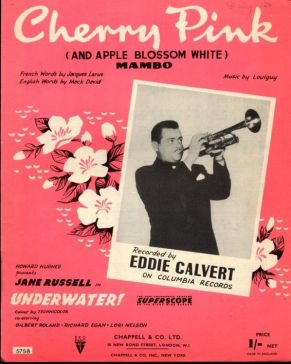
cherry-pink-and-apple-blossom-white-eddie-calvert-jane-russell

There is a section, towards the end of this version, in which Calvert goes a little wild and takes it away from Prado’s version, which is commendable, but no. The ending of this version, in particular, is a complete damp squib. It’s not an awful #1 – a good tune is a good tune – but Perez Prado just did so much more with it. We won’t be hearing from Eddie Calvert again in this countdown, I’m not terribly sad to say. He burned brightly, but briefly, and didn’t have an awful lot of singles chart success beyond 1955.

It’s worth also noting here that we are in the midst of a film/musical soundtrack run here: two versions of ‘Cherry Pink and Apple Blossom White’, which featured in the Jane Russell movie ‘Underwater!’, as well as Tony Bennett’s Broadway hit ‘Stranger in Paradise’ sandwiched between. I suppose it would be hard to downplay the role cinemas had in influencing music buying tastes in the 1950s. Very few people owned a TV set, radio barely played any chart music… Films were one of the few places where people could actually hear current, popular music. Get your song in a film and hey presto! And it’s a trick that still works to this day.

16. ‘Oh Mein Papa’, by Eddie Calvert

eddie-calvert-oh-mein-papa-1953-6-78

Oh Mein Papa, by Eddie Calvert (his 1st of two #1s)

9 weeks, from 8th January to 12th March 1954

Perhaps, as we tick over into 1954, we should pause once again to take stock. Just what kinds of records were topping the charts in these distant, misty, slightly-eccentric, pre rock days…?

Actually ‘distant, misty and slightly eccentric’ might just sum up most of the records I’ve described thus far. They have been surprisingly varied in style: from proto-rock numbers to gentle instrumentals, from jaunty novelties to brow-furrowingly earnest numbers about unrequited love. In a way, though, they’ve all been a bit similar too: all very safe, very chaste and very… twee? To my modern ears, anyway.

And so, onwards – to another mammoth hit. It’s the third time in just over a year that a record has racked up nine weeks at the top, and the latest record to do so is… a trumpet instrumental.

Now. There are lots of instruments that can carry an entire song: guitars and pianos, obviously, along with saxophones and violins. Drums cannot usually carry an entire song, but I wouldn’t like to say it was impossible. Tambourines definitely cannot. And nor, it would seem, can trumpets.

I’m struggling to write much about this song. There’s a trumpet. There’s a simple guitar rhythm, with some backing singers shrilly harmonising and occasionally chanting the song title. Oh, and there’s an organ. As I wrote in my post about the last #1 to involve an organ (‘Broken Wings’), it lends a cheap, Blackpool seafront kind of vibe to proceedings. I suppose it could go down as the first ever foreign language number one, but there is only one line. Oh Mein Papa. Which I believe translates as ‘Oh My Daddy.’ Oh my, Daddy, indeed.

The tune isn’t even interesting. The one other instrumental we’ve covered so far, Mantovani’s ‘Moulin Rouge’, at least had a melody that buried itself in your brain after a few listens. So this, with no words and no melody, to my ears at least, has little going for it.

There are lyrics to ‘Oh Mein Papa’, which I searched out and listened to, courtesy of our friend Eddie Fisher – whose version reached #9 – lyrics about how lovely the singer’s father was, taking him on his knee when he was a nipper… And I suppose, when this backstory is taken into consideration, Calvert’s lone trumpet, parping out its melancholy tune, takes on a little more resonance. But then, that’s the problem with instrumentals as a whole: without lyrics, are they songs or simply pieces of music? And yes, yes, you can come at me with Beethoven, Mozart and all that lot; but we’re talking about pop music here. Pop music should be immediate and relatable, and I’m not sure it can be without lyrics. Or, at least, it’s difficult for it to be so without lyrics. Anyway, who am I to say? This track lorded it over all comers for over two months.

p03t218h

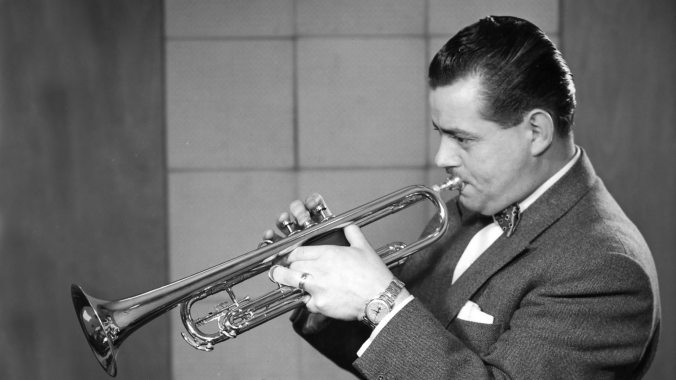
Eddie Calvert himself, looks like an interesting character. He looks old-fashioned, even in contemporary photographs from the 1950s. His hair is heavily Brylcreemed and he has a roguish moustache (Oh nein, Papa!). He’s half jazz session musician and half black-market spiv. If you were given a choice of where he was from, and the choices were A) Chicago, Illinois or B) Preston, Lancashire, you’d go for A). But you’d be wrong. In almost every picture I’ve found he is clutching his trademark trumpet. He probably had a name for it.