Remembering Alma Cogan

I’ve covered 342 #1 singles since starting this blog. Some have been classics, some have been terrible, some have been by the most famous acts in pop music history, some have been by acts unknown to me until that moment… One of the singers I have been happiest to discover on my journey, is the singer of the 35th UK #1 single, Alma Cogan.

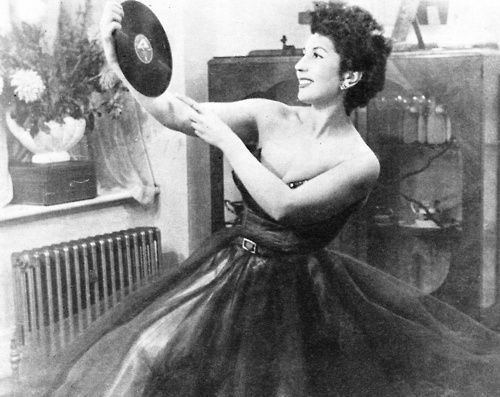
Born in East London in 1932, she went from singer-in-residence at a hotel, to the biggest British female star of the fifties. ‘The Girl with the Giggle in Her Voice’ – a nickname she earned after bursting into laughter during an early recording session – with huge frocks and a healthy pair of lungs – to listen to her early hits is to lose yourself in unpretentious pop perfection. Of which ‘Dreamboat’, her one and only chart-topper, is perhaps the perfect example.

(You can read my original post on it here.) Voted Outstanding British Female Singer by NME readers four times between 1956-1960, she scored hits throughout the decade by covering standards such as ‘Mambo Italiano’ and ‘Why Do Fools Fall in Love?’, ‘Little Things Mean a Lot’ and ‘Hernando’s Hideaway’. Being a popular singer in the fifties and early sixties meant that she also recorded her fair share of novelties – ‘Never Do a Tango with an Eskimo‘ – and showtunes. But she sings them with such a twinkle in her eyes that you forgive even her cheesiest moments. Here she is, belting out ‘As Long as He Needs Me’ from ‘Oliver!’ (Apparently the part of Nancy was written with Cogan in mind, and she does have a fantastic cockney rasp in her voice, compared to other more stage-school actresses who have played the role.)

The swinging sixties killed off her chart-topping days, as they did to many stars of the fifties. But there is a fascinating coda to Alma Cogan’s career – her friendship with The Beatles…

Cogan’s star was waning and the Fab Four’s was on the rise, but they would still meet at the same TV recordings. She was the first person that Paul played ‘Yesterday’ to, and she allegedly had an affair with John. She also tried to relaunch herself back into the charts by covering some of the bands hits – her ‘Eight Days a Week’ is a particular moment of overblown brilliance.

For whatever reason, she couldn’t seem to reignite her singles career – in the UK at least – and died tragically young from cancer in 1966. She was just thirty-four. Which terrifies me, as I am thirty-four and I have neither enjoyed a decade-long singing career nor had an affair with a Beatle… Just what have I done with my life?

Here’s one of Alma Cogan’s later TV performances – a cover of ‘The Tennessee Waltz’ – as introduced by her (supposed) lover John Lennon. They do flirt quite heavily in this clip, I must say…

And if that doesn’t leave with a smile on your face, then I don’t know what medication to recommend…

Alma Cogan, 19th May 1932 – 26th October 1966

35. ‘Dreamboat’, by Alma Cogan

alma-cogan-dreamboat-hmv

Dreamboat, by Alma Cogan (her 1st and only #1)

2 weeks, from 15th to 29th July 1955

This is more like it! This is a pop song – a pop song as we would recognise one today. In our countdown so far I would count perhaps only Guy Mitchell’s ‘Look at that Girl’, and now this, as examples of The Modern Pop Song. No orchestras, no silly declarations of love, no grandstand finishes… Just a quick beat, a doo-doo-doo, and some lyrics about how in love the singer is.

I know this song quite well, and have it in regular rotation in my Spotify library, though I’m not sure how or why. I know next to nothing about Alma Cogan and, as you may have been able to tell from previous posts, I haven’t explored this era in popular music very extensively at all. It must have popped up as a suggestion – Spotify does love a suggestion – and I must have liked it enough to save it.

Anyway, know it I do. In fact, I don’t just know it – I love it! Cogan has this little flip in her voice at the start of every line, which makes her sound like an excitable school girl. And, for this song it really works. She’s got a crush, you see: You dreamboat, you loveable dreamboat, the kisses you gave me, set my dreams afloat… She’s besotted, and would follow the object of her desire anywhere – she would sail the seven seas, in fact: even if you told me to go and paddle my own canoe (I can’t help but think that sounds like a euphemism – ‘Just off to paddle my canoe darling, don’t wait up’).

There isn’t much else to ‘Dreamboat’ -it’s a fun little ditty. Cogan sings it well, with the perfect pronunciation we’ve come to expect but also with a light, playful touch that’s been missing from many of the number ones thus far. She sounds like she’s having a ball, as if she has a big, broad smile on her face while belting it out. Again, it’s a female singer having a good time. Contrast this with the song it replaced at the top – Jimmy Young’s painfully earnest take on ‘Unchained Melody’. Even in 1955 girls were having all the fun. It’s a noticeably shorter record than all the previous chart toppers as well, clocking in at well under two minutes, and that’s one of the most important things to consider when writing a brilliant pop song: make sure that it doesn’t outstay its welcome!

de565d5d80ca47f8aae75ff675d21485--vinyl-records-singers

It’s a shame, I think, that this is Alma Cogan’s only song on this countdown. I like the cut of her gib. She was another young, British-born singer who, along with Ruby Murray and Dickie Valentine earlier in 1955, was dragging popular music away from old crusties like Vera Lynn and David Whitfield and towards the teenagers, towards rock ‘n’ roll. This is a song, essentially, about a hunk and his sweet kisses.

A quick look at Cogan’s Wiki throws up a colourful picture: the highest paid female star of the late ’50s, serial winner of the NME Outstanding British Female Singer award, and perennial visitor to the Top 10. Parties with Princess Margaret, Cary Grant and Noel Coward. An affair with a young John Lennon just as the Beatles were shooting to fame. And then dead at the tragically young age of thirty-four…

A life well lived, though cut far too short. I have a feeling that I’ll miss her even more – this ‘Girl with the Giggle’ – when we return to the bog-standard, plodding ‘pre-rock’ songs that I fear are still to clock up the charts, before rock truly lands.