Remembering Connie Francis

Earlier this week the sad news of Connie Francis’ death was announced, aged eighty-seven, closing the door on yet another chapter from the earliest chart years. There can’t be many, if any, older chart-toppers than Francis still around… And there were precious few women, either, who were scoring rock ‘n’ roll hits and competing with the big male stars of the late fifties.

Francis scored two huge, six-weeks-apiece #1s in 1958, the sassy ‘Who’s Sorry Now’ and the whipcracking ‘Stupid Cupid’ (twinned with ‘Carolina Moon’). I also covered her 1960 hits ‘Mama’ and ‘Robot Man’ as a Random Runner-Up. Follow those links to hear those tunes, and to read my original posts. But since writing those posts – and this has been one of the best things about doing this blog, discovering artists’ non-chart topping back catalogues – I’ve fallen in love with many of Connie’s other hits. So let’s share some here, in her memory.

‘Lipstick on Your Collar’ – #3 in 1959

I love the camp melodrama of this bop, about a cheating boy given away by lipstick smudges. How does Connie know the lipstick isn’t hers? Well, eagle-eyed, she notices his is red, while hers is baby pink. Coleen Rooney eat your heart out. Turns out that floozy Mary Jane had been smooching her man right outside the juke joint. But, as with so many of her early records, Connie does not wallow in heartbreak. In fact, she seems almost thrilled to have rumbled him…

‘Plenty Good Lovin” – #18 in 1959

A similarly uptempo, more swinging, hit from the same year. And this one is positively raunchy by 1959 standards. In fact, I’m not sure Connie isn’t simulating orgasm during the break in the middle… She sings the praises of a man who doesn’t have a nice car, can’t play guitar, is neither intelligent nor particularly good-looking, but who’s got somethin’ that’s better by far… I mean, gurrrrlllll… Plenty of things that he don’t know, But this boy shines when the lights are low…

‘Everybody’s Somebody’s Fool’ – #3 in 1960

Her first US #1, and in fact the first Billboard Hot 100 number one by a female singer (the chart having launched well over a year earlier). Which just goes to prove how impressive Francis’s hit making was, stacked against the likes of Elvis, Pat Boone, Ricky Nelson and co. I love the honky-tonk feel to this, with the rolling organ and the rickety, country beat, and her voice drenched in echo.

‘Where the Boys Are’ – #5 in 1961

Francis made her acting debut in 1961, in the movie ‘Where the Boys Are’. And the title track gave her another big hit, proving that she could sing something a little more traditional to go along with all the rock ‘n’ roll. In 1978, as she was attempting a career comeback, Connie recorded a disco version. If that doesn’t grab you, how about a Japanese version? Today’s female stars could only dream of such versatility.

‘Vacation’ – #10 in 1962

Despite not having an original bone in its body, and already sounding dated in 1962, I love this throwaway tune. ‘Vacation’ was Francis’s last Top 10 hit in both the US and the UK, as the Merseybeat acts prepared to render so many stars obsolete. But it’s hard not to get carried along with this record’s exuberance. Maybe because I’m an English teacher in my day job, I’m instinctively drawn to songs that spell words out in the lyrics. Similarly, it’s probably why I’m drawn to songs about the summer holidays. So this one works for me on many levels.

‘Pretty Little Baby’

It would be wrong to finish without mentioning her final ‘hit’. ‘Pretty Little Baby’ was a B-side back in 1962, but in recent months you’ll surely have heard it if you’ve spent any amount of time scrolling on Instagram or TikTok. In one of her final interviews, Francis claimed to have forgotten of the song’s existence, but that she was touched by its resurgence, and how even kindergartners now know her music. Back to teaching for a moment, I can attest to this as I have a student who has been singing this to himself for several months now… Musically this is cute, and I love whatever early electronic device the solo was recorded on.

From the mid-sixties onwards the hits dried up, and Connie Francis’s personal life took several dark turns. The Guardian published a good article on her many highs and lows yesterday, and she became an advocate for mental health following various traumatic experiences. Having read that, it feels impressive that she lived such a long life and fulfilled life. She returned to music, and only officially retired a few years ago.

Connie Francis, December 12th 1937 – July 16th 2025

On This Day… 27th May

Time for another instalment of ‘On This Day’, and how the 27th May has tied in to various number one singles over the years (links to my original posts for each one).

Starting off with the record sitting atop the charts sixty-seven years ago today…

Many of the 1950s’ biggest hits were boringly straight-faced declarations of love, done in a bombastic fashion. Thank goodness for Connie Francis’s classic tale of sass and schadenfreude, then, which is one of my favourite number ones of the decade. I love the bluntness of the closing line: I’m glad that you’re sorry now… ‘Who’s Sorry Now’ isn’t a fifties original however, as it dates all the way back to 1923. What’s amazing is that 1923 to 1958 is what 1990 is to 2025… Like Sabrina Carpenter covering ‘Vogue’, or something. All of which begs a discussion as to how much popular music changed between 1923 and 1958, and how much it hasn’t changed in the past thirty-five years. A discussion for another day, perhaps. Anyway, Connie Francis is still with us, aged eighty-seven, having only retired from music in 2018.

Meanwhile on this day in 1943, ‘ar Cilla was born in Liverpool. Proud achiever of eleven top ten singles between 1964 and 1971, the first two of which gave her a brace of #1 singles, before she moved more into TV. ‘Anyone Who Had a Heart’ was the UK’s biggest-selling single by a female artist through the entirety of the 1960s – a fine achievement considering some of the legendary divas she was up against.

Next up, a Stones double-header. For not only was ‘Paint It, Black’ number one on this day in 1966 (meaning that the coolest comma in rock history had its moment in the sun), but on May 27th two years earlier newspapers were reporting that eleven fifth-form boys had been suspended from Woodlands Comprehensive School in Coventry for having ‘Mick Jagger haircuts’. Donald Thompson, their headmaster, decried the boys’ hair as ‘long and scruffy’, and that they could return to school only ‘with a neat Beatle cut’. We can clearly see what side of that great rock rivalry Mr Thompson was on…

Finally, on May 27th 1977, just in time for Her Majesty’s Silver Jubilee, the Sex Pistols released the number one that never was. In my Should Have Been a #1 post on ‘God Save the Queen’ I erred on the side of caution, not committing to sensationalism without proper evidence like a proper, upstanding blogger. This time, though, I’m just going to come out and say it: ‘God Save the Queen’ was the best-selling single the week of the Silver Jubilee, but was kept from the top by some very selective book-keeping. (For one week only, records bought in a shop owned by the label they were released under didn’t count towards the chart. It’s as if they knew Virgin’s Sex Pistols might sell quite a few singles in Virgin Megastores…)

It seems I’m not alone, as many sources have retrospectively awarded the Sex Pistols a number one, and the furore over it now seems incredibly quaint. How society has changed in forty-eight years… And hey, being blocked from number one by the establishment is way more punk than actually getting there. I’m sure Johnny Rotten and co. weren’t at all bothered.

Random Runners-up: ‘Mama’ / ‘Robot Man’, by Connie Francis

I’m running a new feature this week – a moment in the sun for the singles that didn’t quite make it to the top. These aren’t particularly long-running, or unlucky #2 singles. They may not even be particularly good… They all simply peaked in the runners-up position.

Today’s random runner-up…

‘Mama’ / ‘Robot Man’, by Connie Francis

#2 for 1 week, behind ‘Three Steps to Heaven‘, from 23rd – 30th June 1960

A double-‘A’ to double your pleasure. Except… I haven’t missed these OTT pre-rock intros. Strings swirl, soar, flutter and fly – you know the score. Even in 1960 this sounded old-fashioned. When the evening shadows fall, And the lovely day is through… Darkness falls, and Connie Francis gets to thinking about a lost love. Not a boyfriend, though… Her ‘Mama’.

Connie Francis had two chart-toppers in 1958, the all-time classic ‘Who’s Sorry Now’ and another double-‘A’ in ‘Stupid Cupid’ / ‘Carolina Moon’. They were great rock ‘n’ roll singles (OK, ‘Carolina Moon’ was a bang-average ballad, but still). This though… this is not for me. It’s beautifully sang, gorgeously orchestrated, all that kind of thing, but no. I give thanks that the days of overwrought dramatic ballads hitting #1 are long gone.

‘Mama’ was from Francis’s album ‘Italian Favourites’. She is Italian-American, although she apparently couldn’t speak the language fluently and had to get a tutor to correct her pronunciation as she sang. And perhaps she was ahead of the curve… In a few months Elvis would return from his stint in the army by belting out ‘It’s Now or Never‘ and ‘Surrender‘ – both based on old Italian hits.

Had this made it to #1 then the most interesting thing about it would have been that it was sung largely in a foreign language – not many chart-toppers can claim that – and that it was four minutes long (making it the longest #1 up to that point.) But it didn’t, so all that is moot.

Luckily for us, just before ‘Mama’ lulls us into a stupor, we can flip the disc and enjoy ‘Robot Man’. It’s Connie Francis ™ rock ‘n’ roll by numbers – a mix of ‘Stupid Cupid’ and ‘Lipstick on Your Collar’ – but it’s more than welcome. Plus it’s got a bizarre B-movie sounding intro because, well, robots.

Connie’s sick of ‘real life boys’ giving her grief, so she wishes she could have a robot man. (Or, as Connie sings it in her New Jersey-by-way-of-Alabama twang, a roo-bot mayun.) That way, she wouldn’t have to put up with any of his human shit. We would never fight, Cos it would be impossible for him to speak!

But, if science fiction has taught us anything it is that robots don’t stay obedient for long. They will learn, they will evolve, and they will enslave us. Soon Connie will be chained to a bucket and mop, reminiscing about flesh and blood boys whose worst fault was that they didn’t phone.

Another runner-up tomorrow…

Top 10s – The 1950s

Time for a Top 10… Usually I rank the ten best singles from a particular artist (last time it was The Kinks) but I thought I’d fiddle with my criteria a little, and rank my favourite #1 singles from an entire decade.

Starting with the singles chart’s very first decade. Back where it all began, when rock ‘n’ roll was but a twinkle in Elvis’s eye. The list is in chronological order – not ranked in order of preference – and to choose the songs I went back and read through my recaps to see which ones I dug at the time, live, as it were…

So, without further ado, the ten best #1 singles of the 1950s, according to me:

1. ‘Look at That Girl’, by Guy Mitchell – #1 for 6 weeks in Sept/Oct 1953

Only the 12th-ever number one single, from one of the decade’s biggest chart stars, and a runner-up in my first recap. This was the very first whiff of rock ‘n’ roll at the top of the UK charts (a very faint whiff, but still) and I think it appealed more than it probably should have because I’d waded through so much Eddie Fisher and Mantovani to get to it. Still, a catchy, upbeat tune. As I wrote in my original post:

“It sounds to me as if a battle is taking place here, between traditional easy-listening and the burgeoning rock ‘n’ roll movement. On the one hand you’ve got the usual twee backing singers and floaty trumpets, parping away at the end of each line; on the other you have the hand claps and the guitar solo.”

3dfa9028eb05e4f4072a50a1d556666a--american-artists-classic-rock


2. ‘Such a Night’, by Johnnie Ray – #1 for 1 week in April/May 1954

Johnnie Ray was known for his emoting, which lent him two spectacular nicknames: ‘The Prince of Wails’ and ‘The Nabob of Sob’. But for his 1st of three #1s he was overcome with a slightly more enjoyable emotion… lust! By far the sauciest number one of the pre-rock era, I awarded it ‘Best Chart-Topper’ in my 1st recap. I’d go as far as saying it was the best #1 single ever… Until 1957 came along. My original post is here:

“…what makes it, and elevates it to a classic, are Ray’s vocals. Like Doris Day before him there’s an effortlessness to his voice that draws you in and yanks you along. But his voice is nothing like the clean-cut, honeyed tones of Miss Day. ‘Such a Night’ isn’t being sung here – it’s being ridden, it’s being humped… it’s being performed!”

cb7c74a231dcd2dd49842e43981cd00f--josephine-musicians


3. ‘Mambo Italiano’, by Rosemary Clooney & The Mellomen – #1 for 3 weeks in Jan/Feb 1955

I remember noting, back in the early days of the charts, that it felt like the girls were having all the fun. Guys were being boringly earnest – Al Martino, Eddie Fisher, David Whitfield all proclaiming overwrought, undying love over heavy orchestration. Meanwhile Rosemary Clooney, in her 2nd #1, was singing in cod-Italian about fish bacalao (which is Portuguese, but whatever.) It’s a song that resonates to this day, with a 00s remix and a 2011 pastiche by Lady Gaga. I named it a runner-up in my first recap:

“…while this is a mambo record, sung by an easy-listening singer-slash-actress, this is rock ‘n’ roll. It may be fun and funky, but it just about manages to retain an air of cool around all the silliness. While we were waiting for Bill Haley to come along and kick-off things off, the ideals and attitudes, if not the actual sounds, of rock ‘n’ roll were being sneaked in right under our noses.”

clooney-94b833378517905808a9405ad88dff3bcfe05e4b-s900-c85


4. ‘Cherry Pink and Apple Blossom White’, by Perez ‘Prez’ Prado & His Orchestra – #1 for 2 weeks in April/May 1955

Another saucy slice of Latin pop, which I named the very best song in my 2nd recap! Again, my opinion of it was probably exaggerated because of all the pre-rock easy-listening mulch surrounding it. It is catchy, though. Just you try not swaying along. Can’t be done! I tried summing up the record’s appeal in my original post

“…it allows Janet and John from Southend to draw close and to feel one another’s bodies, taught and trembling from two and a half minutes of intense mambo.”

R-582429-1341876426-2330.jpeg


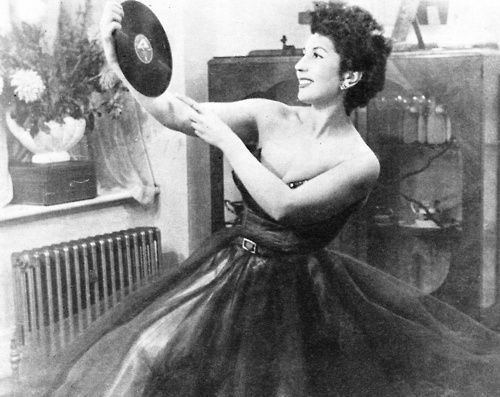
5. ‘Dreamboat’, by Alma Cogan – #1 for 2 weeks in July 1955

The 3rd #1 from 1955, making it officially the best year of the decade… (Hmm…) ‘Dreamboat’ is just a spectacularly fun pop song, sung with a giggle and a wink by perhaps the biggest British female star of the pre-rock age. As I wrote at the time:

“…there isn’t much else to ‘Dreamboat’ -it’s a fun little ditty. Cogan sings it well, with the perfect pronunciation we’ve come to expect but also with a light, playful touch that’s been missing from many of the number ones so far.”

de565d5d80ca47f8aae75ff675d21485--vinyl-records-singers


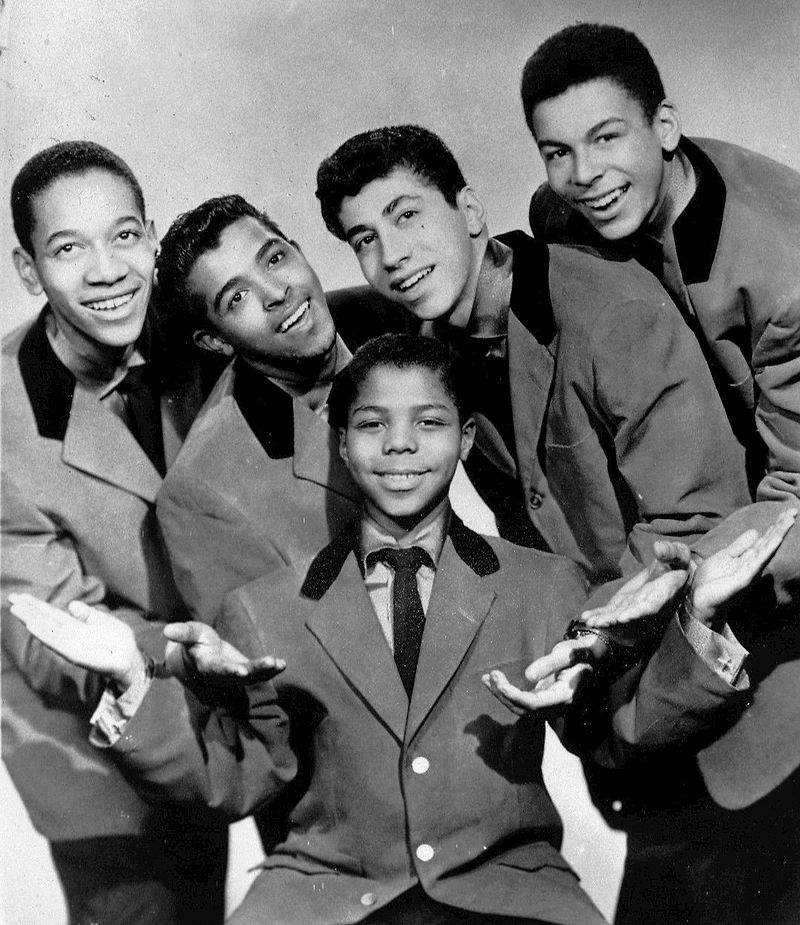
6. ‘Why Do Fools Fall in Love’, by The Teenagers ft. Frankie Lymon – #1 for 3 weeks in July/Aug 1956

Regrets, I have a few… One of them being that I named this classic as a runner-up to Perez Prado in my 2nd recap. What was I thinking? ‘Cherry Pink…’ is great and all, but this is timeless. The first number one by kids, for kids – the Teenagers were all, you guessed it, teenagers – is one of the catchiest, golden pop moments of all time, let alone the decade. As I wrote

“… it’s just a great song. A summer smash. It oozes New York city: steam, water spraying from a sidewalk valve, the sun blasting down, the Jets and the Sharks… (I dunno. I grew up in small town Scotland.)”

Frankie_Lymon_and_the_Teenagers


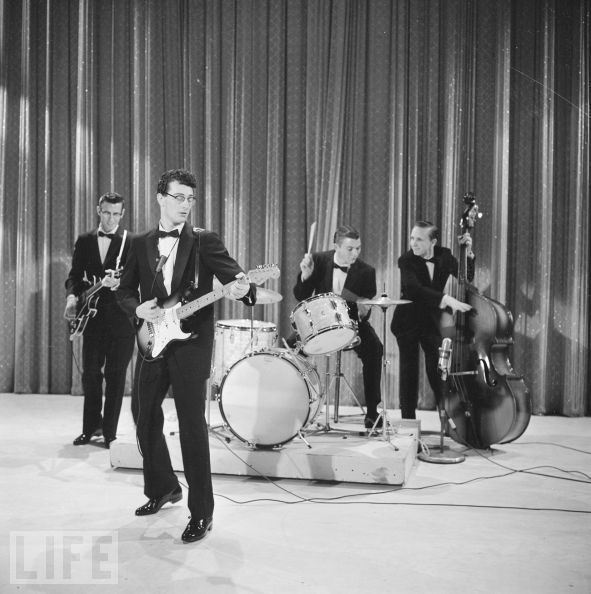
7. ‘That’ll Be the Day’, by The Crickets – #1 for 3 weeks in November 1957

Perhaps the most obvious choice of the ten… What else needs to be said. Press play, gasp at the spectacular intro, and enjoy two and a half minutes of rock ‘n’ roll perfection…

“…Buddy Holly’s voice dances and flirts – toys, almost – with the listener. He coos, he pauses, he growls… The Crickets play tightly, but also very loosely. There’s a great, rough-around-the-edges feel to this record that contrasts with the polished cheese of Paul Anka’s ‘Diana’, whose bumper run at the top this track ended.”

13b76502b2e66b8af543e51889003212


8. ‘Great Balls of Fire’, by Jerry Lee Lewis – #1 for 2 weeks in January 1958

https://www.youtube.com/watch?v=BQa7wOu_I_A

But… I didn’t name ‘That’ll Be the Day’ as one of the very best chart-toppers. Oh no. In my 3rd recap, that honour was reserved for The Killer. On any given day, I could wake up and prefer ‘Great Balls…’ to ‘That’ll Be the Day’, or vice-versa. What’s the point in debating?  These two records were nailed-on to make my 50’s Top 10. Pure rock ‘n’ roll greatness…

“…It’s just an absolute blitz, an assault on the senses, a two-minute blast which takes rock ‘n’ roll up another notch.”

jerryleelewis22


9. ‘Who’s Sorry Now’, by Connie Francis – #1 for 6 weeks in May/June 1958

https://www.youtube.com/watch?v=i9QEAtcz3o8

A spot of schadenfreude in the decade’s sassiest #1 single. Connie got dumped, and is now taking great pleasure that the tables have turned on her ex in his new relationship. You had your way, Now you must pay, I’m glad that you’re sorry now… Who says girls in the 50’s were all sweetness and apple pie? The twang in her voice when she launches into the final verse is something to behold. As I wrote at the time…

“A lot of the female artists we’ve met previously on this countdown have been cute, and flirty, and fun to listen to – Kitty Kallen, Kay Starr, Winifred Atwell… But no girl has brought this level of spunk to the table.”

Connie_Francis_1961


10. ‘Dream Lover’, by Bobby Darin – #1 for 4 weeks in July 1959

Last up –  a record that encapsulates everything great about the 1950s, mixing rock ‘n’ roll with swing, doo-wop and a touch of pre-rock crooning, to create pop perfection. Another runner-up to Jerry Lee in my 3rd recap, but there’s no shame in that. In my original post, I wrote:

“…I don’t want to really write any more about this record. I want to leave it there. Minimalist. This is where easy-listening and pop collide to create a seriously classy song.”

MI0002749454

And there we have it! The ten best #1 singles of the 1950s!

Remembering Bobby Darin

Named after a faulty sign outside a Chinese restaurant (the letters M-A-N were blacked out, leaving only D-A-R-I-N), today we remember perhaps the most underrated of the big fifties stars…

MI0002749454

Underrated, perhaps, because nobody knew where to fit him in. He didn’t look much like a teen-idol. He could sing rock ‘n’ roll, as well as more old-fashioned swing and jazz. His hit singles include both self-penned songs, like his debut ‘Splish Splash’, and modern interpretations of standards, such as his 1961 Top 10, ‘You Must Have Been a Beautiful Baby’.

Born in Harlem, New York, in 1936, into a family of low-level mobsters and vaudeville singers, his mother was actually his grandma and his sister his biological mother  – a fact he didn’t find out until he was in his thirties. He was a sickly child, with recurring bouts of rheumatic fever, and always knew that he was not expected to live to an old age.

ss

(The sheet music for Darin’s first big hit.)

Which perhaps explains why he crammed so much into his short life. Songwriter, singer, actor, presenter, political campaigner, chess player… His two UK chart toppers perhaps best sum up his approach to life and music. In the space of four months in 1959 he hit #1 with the swaying rock ‘n’ roll ballad ‘Dream Lover’

And then with a cover of ‘Mack the Knife’, a German musical number from the 1920s, about a murdering, thieving, raping ‘shark’ called MacHeath…

https://www.youtube.com/watch?v=SEllHMWkXEU

Two number ones of the highest quality. ‘Mack the Knife’ stands out in particular – it doesn’t sound much like any of the other hits of the time, and the lyrics are pretty niche. It’s simply a record that got to #1 because it’s really, really good. Darin continued to have hits through the early sixties, including karaoke standard ‘Beyond the Sea’ and one of my personal faves, ‘Things’.

1960-photo-ed-sullivan-tv-bobby-darin-connie_1_1a60acb097042d853882e5eb19a09d46

(Bobby Darin with Connie Francis – whom he wrote songs for and had a relationship with – and Ed Sullivan in 1960.)

As the sixties progressed he moved into films, then TV and political campaigning. Darin was heavily involved in Robert F. Kennedy’s career, and he went into a deep depression when Kennedy was assassinated, having been present when it happened.

He continued to perform right up until his death, and by the end was on oxygen before and after each performance. Bobby Darin passed away during an operation on his heart, aged just thirty seven.

Bobby-Darin

Bobby Darin, May 14th 1936 – December 20th 1973


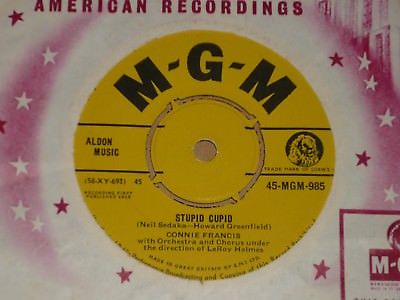
75. ‘Stupid Cupid’ / ‘Carolina Moon’, by Connie Francis

Connie-Francis-Stupid-Cupid-MGM-45

Stupid Cupid / Carolina Moon, by Connie Francis (her 2nd of two #1s)

6 weeks, from 26th September – 7th November 1958

A double ‘A’-side, which again means double the songs to write about. I’d better get cracking.

Connie Francis is back at the top. Three months on from ‘Who’s Sorry Now’s six-week reign at #1, ‘Stupid Cupid’ arrives to spend – you guessed it – six weeks at #1. She may only have had two chart-toppers, but twelve weeks in total at the top is nothing to be sniffed at. It reminds me of Rosemary Clooney’s chart run from a couple of years ago: two quick-fire chart toppers by a sparky female lead…

In ‘Who’s Sorry Now’, Connie was enjoying a bit of schadenfreude at her ex’s expense. Now, in ‘Stupid Cupid’, she’s back in love. Except she doesn’t want to be…

We start with a staccato sax, chugging drums, and then: Stupid Cupid, you’re a real mean guy, I’d like to clip your wings so you can’t fly, I’m in love and it’s a cryin’ shame, And I know that you’re the one to blame, Hey, hey, set me free, Stupid Cupid… Stop pickin’ on me! There’s a twang in her voice to match the twang in the guitar, and the song bounces along nicely. It’s a very sax-heavy track – with a chunky little solo in the middle – and it seems that we might be having a bit of a ‘sax phase’ at the top of the UK charts with this following on from ‘When’. It’s nice, considering that we’ve already had plenty of guitar and piano – the three main rock ‘n’ roll instruments taking their turn to dominate.

As with ‘Who’s Sorry…’, the best bit of this record is the bridge. It seems to be the point in her songs where Ms Francis really lets loose, belting the lines out while losing none of her sparkle: You mixed me up but good right from the very start, Hey! Go play Robin Hood with somebody else’s hea-a-a-art… Cue handclaps and a shimmy.

By the end of the song, however, it turns out that her reluctance in love has been a bit of front: Since I kissed his lovin’ lips of wine, The thing that bothers me is that I like it fine… The little minx! And the way she lingers over the final ‘I like it fine’ is perhaps the most playful, nudge-nudge, wink-wink moment of any chart-topper so far.

s-l300 (1)

Which makes the flip-side of this disc all the more disappointing… ‘Carolina Moon’, to be perfectly honest, is a bit dull. I get that you want to show off the different sides to a singer’s range – though in the previous double ‘A’ both Lonnie Donegan tracks were pretty similar. ‘Stupid Cupid’ is simply a really hard act to follow.

The sax is gone, replaced by a harmonica, a plinky piano and swaying guitars. Carolina moon, Keep shinin’, Shinin’ on the one who waits for me… Now Connie’s sitting at home pining for a guy. Make up your mind, love… How I’m hopin’ tonight, You’ll go, To the right, Window… Tell him that I’m blue and lonely… Dreamy Carolina moon…

I know Connie Francis’s music quite well, but somehow I’d never heard this before. And I wasn’t missing much. Lyrically, this pretty old-fashioned. There was a surfeit of songs back in 1953 / ’54 where people were waiting patiently for their distant loved ones. There was even one – ‘I See the Moon’ by The Stargazers – in which the singer implored the moon to ‘shine on the one they loved’. These days we’re used to something a bit more immediate, though, a bit less passive. Don’t just sit at home relying on the moon to tell the man of your dreams that you love him! Get out there and make him notice you!

Francis’s voice is still very nice on this record, but it lacks bite. She definitely sings better when there’s a bit of sass in the lyrics. This is just an average rock ‘n’ roll ballad… I had a sneaking suspicion that this might have been a pretty old song resurrected for the rock age, a la ‘Who’s Sorry Now’… And I was right. Wiki tells us that it was originally a hit way back in 1928.

And with this double whammy, Connie Francis’s short-lived time as a UK chart-topper comes to an end. Mopey songs about moons aside, her two lead singles have been highlights of the year so far. One a ballad with a spikey twist, the other a rollicking ride of a pop song. I’ll link here to some of her better non-chart toppers: songs such as ‘Where the Boys Are’, ‘Lipstick on Your Collar’, ‘Everybody’s Somebody’s Fool’, and hands-down the raunchiest song recorded in 1959: ‘Plenty Good Lovin’ (sample lyric: People say he’s not too smart, But he knows the way to a woman’s heart, Plenty of things that he don’t know, But this boy shines when the lights are low…) Oh, Connie. You are awful! I have a suspicion that we’ll be missing you before long.

71. ‘Who’s Sorry Now’, by Connie Francis

s-l300

Who’s Sorry Now, by Connie Francis (her 1st of two #1s)

6 weeks, from 16th May – 27th June 1958

I really didn’t mean to set it up like that at the end of the previous post, truly I didn’t. It simply occurred to me that we hadn’t had a female singer at the top of the charts for a long old time and then, lo and behold, here we are…

Not since the 19th October 1956 – just shy of seventeen months ago – have we had a feminine voice on a #1 record. Since then sixteen different male singers, or male groups, have come and gone with twenty different number one singles.

And the differences between ‘Who’s Sorry Now’, and the last female-led chart-topper – Anne Shelton’s ‘Lay Down Your Arms’ – paint a very telling picture of how the landscape of popular music has changed in recent months. Because, basically, rock ‘n’ roll has happened. Anne Shelton hit the top around the same time as ‘Que Sera Sera’ and Frankie Laine’s big-band show tune ‘A Woman in Love’. ‘Lay Down Your Arms’ was a bizarre, military marching fruit-loop of a song that harked back to World War II, Vera Lynn and all that. Since then we’ve had Elvis, and Lonnie Donegan, and Buddy and Jerry Lee. And now Connie Francis takes all that rock ‘n’ roll attitude, and gives it her own, feminine twist.

Who’s sorry now? Who’s sorry now? Whose heart is achin’ for breakin’ each vow…? Miss Francis had her heartbroken, but the man who hurt her now has his own romantic troubles… Who’s sad and blue? Who’s cryin’ too? Just like I cried, Over you… There’s a twang in her voice, a sassy hiccup, and it gives the distinct impression that she’s struggling to dredge up much sympathy for her ex.

Is this a rock ‘n’ roll ballad? The slower tempo and the backing singers suggest that it is. If so, I make it only the second one ever to top the charts – the first being The Dream Weavers’ ever-so-dreary ‘It’s Almost Tomorrow’ from two years back. (I thought about including ‘Young Love’ as a ballad; but that was just a soppy little pop song – ballads need a little bit of emosh about them).

And ‘Who’s Sorry Now’ certainly gives us emotion. It’s a song of two halves. During the first, Francis’s voice lilts and coos. For the second, she whips it up a notch or five. Right till the end! Just like a friend! I tried to warn you somehow… The drums start whippin’, cymbals crash, and her voice almost snaps… You had your way, Now you must pay… Then she delivers the final, crushing blow… I’m glad that you’re sorry now… It is a moment!

Connie_Francis_1961

This is part torch-song, part clap-back. If I were a sassy black drag-queen, I would have clicked my fingers and shouted ‘Preach’ as this track shuddered to a halt. Alas, I am not; but I love this song all the same. This is a big stepping stone in music, make no doubt about it: this is paving the way for Madonna, The Spice Girls, and any other female act with even a smidgen of attitude. This is Beyoncé’s ‘Lemonade’ repackaged for the late fifties. A lot of the female artists we’ve met previously on this countdown have been cute, and flirty, and fun to listen to – Kitty Kallen, Kay Starr, Winifred Atwell, I’m looking at you. But no girl has brought this level of spunk to the table. Alma Cogan and Rosemary Clooney were having a great time on records like ‘Dreamboat’ and ‘Mambo Italiano’ but they were, ultimately, throwaway pop discs, with nothing like the bite of ‘Who’s Sorry Now’.

I love this song, and I love Connie Francis, and have done for a while. You can’t truly be into rock ‘n’ roll without having discovered Connie, Brenda Lee and the other female stars of the time. She was just twenty-one when this hit the top-spot, and in her pictures she sports a perfectly ‘fifties’ look: short curls an’ smokey eyes. But, on doing a little further research, I was surprised – nay, shocked! – to learn two things. One: that ‘Who’s Sorry Now’ was actually first recorded in 1923! And two: that Connie Francis was initially resistant to recording it. Luckily for all of us she did, and this version is completely different to the reedy-sounding 1923 version (which was an instrumental, for a start).

I shan’t wax too lyrical on Ms Francis just yet – we’ll be meeting her again before the year’s out, with an equally brilliant but completely different record. For now, I shall ask one more time… ‘Who’s Sorry Now? Not Connie. No sir… Preach!’

https://www.youtube.com/watch?v=i9QEAtcz3o8