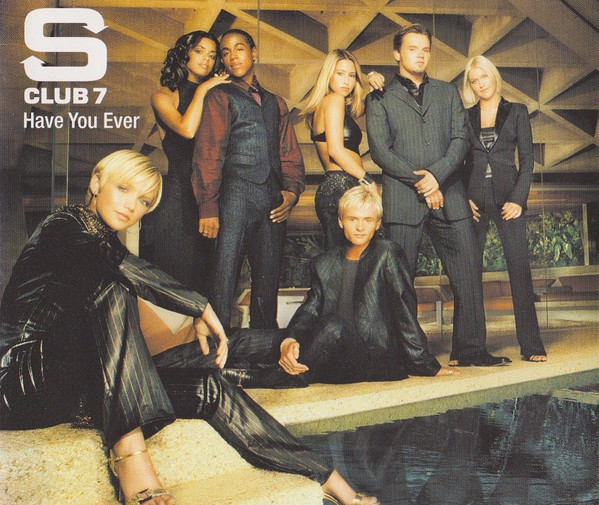
914. ‘Have You Ever’, by S Club 7

Our third pop ballad in a row… Bear with us, as this is the last ballad for a (short) while at least…

Have You Ever, by S Club 7 (their 4th and final #1)

1 week, from 25th November – 2nd December 2001

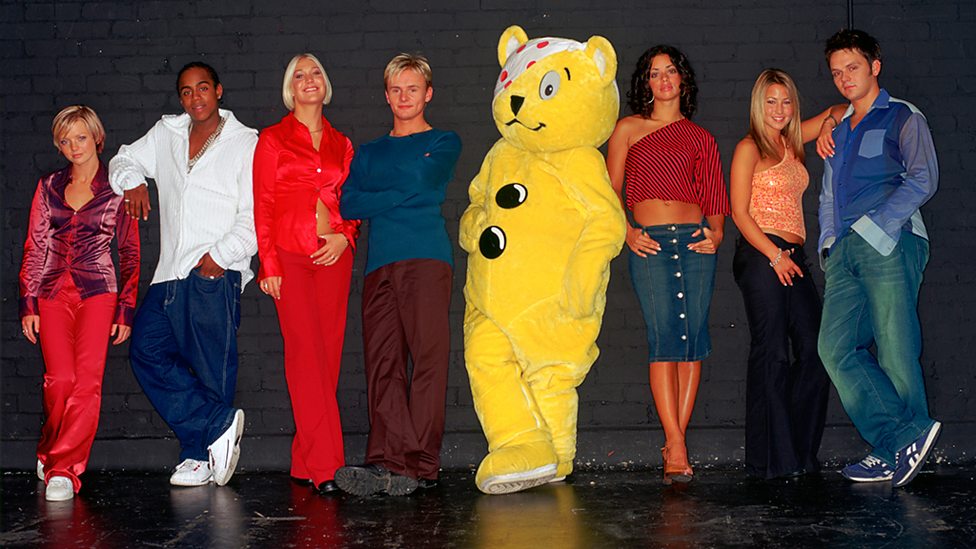
After the success of ‘Never Had a Dream Come True’ a year ago, making #1 and raising lots of money for Children in Need, it makes sense that S Club would have another crack at it. It also feels a little cynical, if you’ll allow: as if they were padding out their chart-topping stats with songs that aren’t remembered as well as some of their other hits.

Compared to the previous two pop ballads, I’d plonk this in the middle. It’s fresher, more modern, less of a slog than Westlife’s ‘Queen of My Heart’; but it doesn’t have the energy of Blue’s ‘If You Come Back’. Musically it is quite similar to the Blue ballad, though, with a skittish R&B beat and a powerhouse vocal performance from Jo O’Meara. I never realised at the time how much she dominated many of S Club’s singles, to the extent that you have to wonder why they needed six other members…

This record also suffers from being the ‘follow-up’ to ‘Never Had a Dream Come True’, which I think is the better ballad, and to ‘Don’t Stop Movin’’, which is one of the decade’s great pop songs. ‘Have You Ever’ feels like an afterthought to both these records. And can I take a moment to bemoan song titles that are questions, but don’t have a question mark? This is far from the first example…

Though S Club 7’s two Children in Need singles topped the charts, and sold a surprisingly identical number of copies in debuting at #1, ‘Never Had a Dream Come True’ was the year 2000’s 9th biggest seller, while ‘Have You Ever’ was 2001’s 21st biggest. Which feels about right. Apparently, though, this song holds the record for the number of voices used in a single recording, as when the band performed the song live for CIN, they were joined by six school choirs via video link, and 3610 other schools on tape, plus spin off group S Club Juniors (two of whom we’ll meet as chart-toppers down the line).

S Club 7 released one further single before Paul Cattermole quit, and they became plain old S Club. The band split in 2003, having managed the impressive feat of charting in the Top 5 with all eleven of their singles. Their post-split careers were a mixed bag of solo success (Rachel Stevens), racism scandals (O’Meara) and student union tours (Bradley McIntosh), while Cattermole declared bankruptcy and Hannah Spearritt claimed to have been made homeless. They reformed in 2023, but Cattermole sadly died of heart failure a few weeks later, aged just forty-six. They are still touring, though, and are currently an S Club 5, with Spearritt having opted out of the comeback. And I’d say that for people of my vintage, no matter how cool they thought they were (or think they still are…), at least one or two S Club tunes hold a place in their hearts.

892. ‘Uptown Girl’, by Westlife

Stung by their first ever non-number one (‘What Makes a Man’ having been kept off top spot by Bob the Builder), Westlife return with a foolproof strategy for restoring their chart fortunes. A carbon copy of a beloved classic.

Uptown Girl, by Westlife (their 8th of fourteen #1s)

1 week, from 11th – 18th March 2001

If a note-for-note cover of Billy Joel’s 1983 chart-topper was not enough of a guarantee, then making it the official Red Nose Day single was the clincher. Guaranteed, sure-fire, bookies not even letting you place bets sort of number one. And so it was, opening with Westlife’s biggest ever sales week.

And, on a very surface level, this isn’t a terrible record. It doesn’t irk in the same way that, say, A1’s cover of ‘Take on Me’ does. Probably because Westlife’s producers sensibly kept things very un-experimental, retaining the original’s doo-wop, Four Seasons-aping energy. It adds nothing, however, and you will never need to listen to the Westlife version of ‘Uptown Girl’ as long as Billy Joel’s original is available.

Actually, it’s not strictly true that nothing is added. Because this is Westlife, ‘Uptown Girl’ now has a key change. Hey ho. Again, it doesn’t ruin the song. If you squint hard enough you can imagine you’re listening to the original. Am I being overly charitable? About this charity record? Maybe. Or maybe I’m just glad that this is a Westlife number one that ISN’T A BALLAD! Of their frankly unbelievable total of fourteen number ones, I’d say that only two are officially not ballads (while I will hear arguments for ‘If I Let You Go’ being their third non-ballad #1, if anyone cares to make them…)

Westlife were following in Boyzone’s footsteps here, Ronan and his gang having released the previous Comic Relief single two years earlier: a similarly faithful redo of another eighties classic. It’s almost as if the same evil genius was behind both bands… But I will give Westlife the credit of not being anywhere near as reliant on cheesy covers as their predecessors. Over half of Boyzone’s chart-topping records were covers, whereas this was only Westlife’s second out of nine releases.

To be fair, the video is quite fun, with Claudia Schiffer as the uptown girl, and a little dig at Bob the Builder too…

884. ‘Never Had a Dream Come True’, by S Club 7

What’s a turn-of-the-century Christmas time without a downtempo ballad from one of the big pop acts of the day?

Never Had a Dream Come True, by S Club 7 (their 2nd of four #1s)

1 week, from 3rd – 10th December 2000

Ballads for Christmas are not a new phenomenon, but there has been a very specific kind of syrupy love song popping up around this time since East 17 in 1994 (none of which have come close to matching ‘Stay Another Day’). Think Peter Andre’s ‘I Feel You’, B*Witched’s ‘To You I Belong’, Steps’ ‘Heartbeat’, and Westlife’s double-A massacre for the new millennium…

So actually, ranked alongside some of those dubious hits, S Club’s addition to the canon of wintry ballads is actually fairly decent. It’s got an old-time, almost soulful, feel in the groove. And it’s helped by the fact that Jo is on lead vocals, and that she was S Club’s Mel C (i.e. the one that could properly sing). Meanwhile the video is a classic of the genre, with the group all in white, trying their best to brood amidst blasts of fake snow.

I mean, it’s nothing hugely special. But it’s a nice enough song to endure for three minutes and forty-five seconds. I imagine it soundtracking a thousand and one snogs at school discos that year, and being a conduit for teenage lust is as noble a reason for a song’s existence as I can think of. Oh, and it was also 2000’s Children in Need official single, which is almost as good a cause, and probably a big factor in it becoming a belated second #1 for S Club, as well as the year’s ninth biggest seller.

My attention, though, starts to wander sometime around the midway point. I begin to realise why this has been forgotten among S Club’s peppier hits. They acquit themselves well but really, slow songs like this aren’t what S Club were about. Interestingly, though, this was their only single to make the Billboard charts – no mean feat for a British pop act at the time – and it ascended all the way to #10.

By the time this record ends in a cascade of tinkles, I’m starting to think this might actually have tipped over into the saccharine, and might actually be a bit crap. But no! I block these thoughts because, as with Steps and the Spice Girls, I am disposed to think kindly of S Club 7, thanks to those old rose-tinted spectacles. For which I will not apologise!

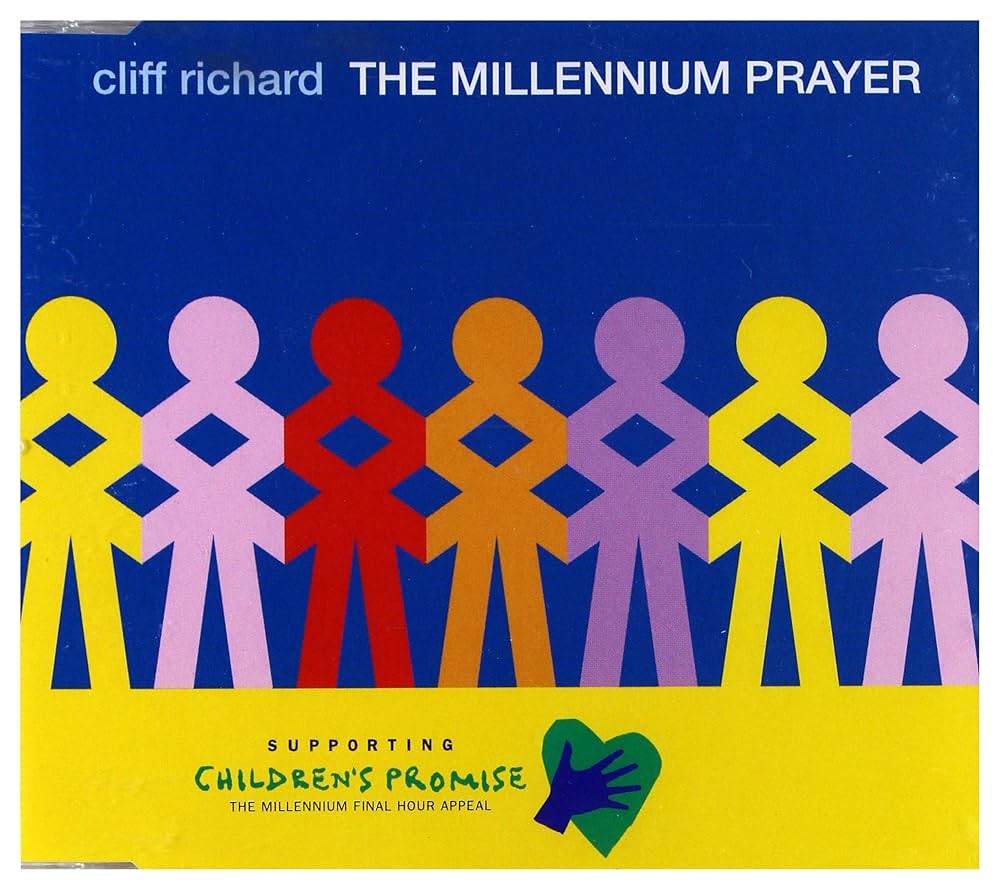
843. ‘The Millennium Prayer’, by Cliff Richard

And so, after forty and a half years, Britain’s most decorated chart artist bows out from chart-topping duty, with his sixty-fourth Top 10 hit, and fourteenth number one.

The Millennium Prayer, by Cliff Richard (his 14th and final #1)

3 weeks, from 28th November – 19th December 1999

In some ways it’s tragic that Cliff ends in this way, as he has been responsible for some great hits, and was arguably the nation’s first real homegrown rock star. But in other ways, it’s entirely fitting and predictable for Cliff, an artist who had long since given up caring about such concepts as relevance, and quality control, to leave us with ‘The Millennium Prayer’.

It’s a simple enough idea: the Lord’s Prayer set to the tune of ‘Auld Lang Syne’. A prayer for the new millennium, twinned with a world-famous new year’s melody. ‘Auld Lang Syne’ is a lovely tune, heartwarming and yet melancholy, and so on one level there is something bearable about this record. The production is fairly minimal, though very dated by 1999’s standards, with a marching drumbeat and a trumpet solo in the middle. There is, naturally, a gospel choir brought in towards the end.

What makes it less bearable are Cliff’s ad-libs, decorated with assorted vocal gymnastics that are, I suppose, impressive for a man approaching sixty. What makes this near-nauseating is the video, a live performance in which Cliff goes into full Messiah-mode, prancing around, arms stretched, surrounded by a children’s choir.

I’m a fairly irreligious person, and I’m being careful not to let my opinions on organised religion cloud my judgement of this song’s merits. But I’m hopeful that even the most committed Christians, who may agree with the song’s sentiments (and lovely sentiments they are, too), can recognise that this record is garbage. It makes Cliff’s two previous festive chart-toppers, ‘Mistletoe and Wine’ and ‘Saviour’s Day’, sound like masterpieces of subtlety and restraint.

In fact, can I just take a moment to rant against the concept of Christian rock in general? Christianity has centuries’ worth of hymns, psalms, carols… Plus, the entire gospel canon. Gospel music, sung by a choir, can be wonderfully moving, even for a heathen like me. But there’s something fundamentally wrong with Christian contemporary rock music, such a disconnect between the rock ‘n’ roll beat, the guitars, the long hair – the entire raison d’etre of rock and roll – and the churchy message. I have a sneaking suspicion that God, whoever they may be, really, really hates Christian rock. (Although having said all that, ‘The Millennium Prayer’ is almost entirely saved in my estimations by the fact that Jesus himself received a writing credit!)

My mum was one of the hundreds of thousands who bought ‘The Millennium Prayer’, making it both the year’s third highest seller, and the third biggest hit of Cliff’s entire career. I remember it sitting in our CD tower at home for years, but I never remember her playing it. I suspect this was the case for most of the copies sold. Christians around the country mobilised en masse to buy the record, probably multiple times, especially after it had been refused airplay by most (sensibly-minded) radio stations. Nowadays it’s a festive tradition for the charts to be stuffed with protest songs around Christmas: songs bought, downloaded, or streamed as a statement, not because anyone particularly likes the music. Was ‘The Millennium Prayer’ the first modern protest number one?

I billed this as Cliff’s farewell, and while he has no further number ones to come (he currently sits in joint-third position in the ‘most number ones’ table, behind only Elvis and The Beatles), he is still very much active and recording well into his eighties. The 2000s brought him four more Top 10s, while his most recent album, ‘Cliff with Strings’, made #5 just over a year ago. Despite his many musical mis-steps, the man is a living legend. (While anyone who claims that ‘We Don’t Talk Anymore’ isn’t his best number one is just plain wrong.)

Of course, Cliff was aiming for his third Christmas #1, and presumably the final #1 of the century, with this modern day hymn. He didn’t quite make it though, as he was held off by a record that we may discover to be every bit as irredeemable as ‘The Millennium Prayer’…

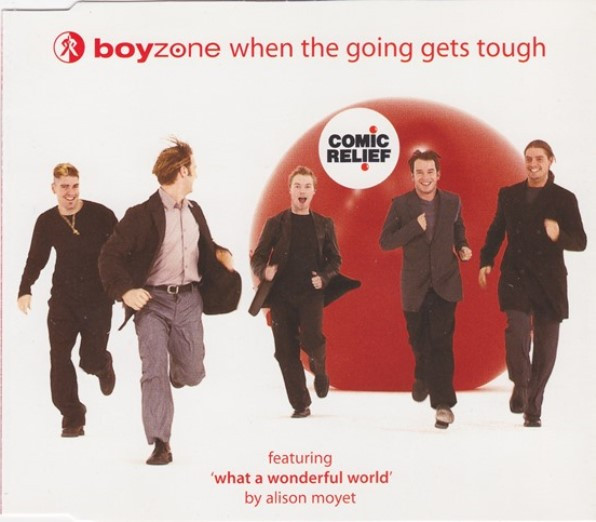
818. ‘When the Going Gets Tough’, by Boyzone

From pop heaven, it’s back down to earth with a hefty bump…

When the Going Gets Tough, by Boyzone (their 5th of six #1s)

2 weeks, from 7th – 21st March 1999

Boyzone return with their penultimate chart-topper. Yes, we’re almost done with them. And, hey, at least this isn’t a ballad! Instead it’s that other modern pop group staple: the charity cover. From the late nineties onwards, charities desperate for your money made a clear shift away from novelty singles over to classic covers by the day’s big acts. There are similar crimes against pop to come from the likes of Westlife, Girls Aloud, and One Direction.

The synths are cheap and the production tacky on this version of Billy Ocean’s 1986 #1, while I think this might be Ronan Keating’s most grating vocal performance yet (a category with some very strong competition). In fact, this is pretty poor all round. I just don’t think Boyzone had the personality to do anything other than bland balladry. The fun and frivolity here sounds much too forced.

The best bit by far is that they keep the original’s saxophone solo almost note for note, which means we get a blast of sweet mid-80s sax – a sound I never realised I’d missed. And yes, the Billy Ocean version is a decent enough song (though not one I was overly hot on in my original post), and it’s hard to completely ruin decent source material. That original feels like a lifetime ago (in some ways it was, as I was born a few weeks before Ocean made #1), but the thirteen year gap between these versions means it’s the same as an artist in 2024 covering a song from 2011, which sounds like the blink of an eye…

This was the 1999 Comic Relief single, raising money for any number of good causes. So yes, yes, yes we shouldn’t be too harsh on it. (Though I would donate far more money than the price of a CD single to never hear Boyzone again). The video features the requisite plethora of celebs goofing around in the name of charidee. In fact, watching this was the most enjoyable part of this whole exercise, seeing people that hadn’t crossed my mind for many years: Will Mellor, John McCririck, Mystic Meg (RIP) and Saracen from Gladiators (as well as a very young Graham Norton).

777. ‘Perfect Day’, by Various Artists

After several Comic Relief #1s (I count four, at least), it’s time for the UK’s other annual charity telethon to get a look-in. I may be a fully paid-up British citizen, but I would struggle to explain the difference between Comic Relief and Children in Need. One’s for children, the other’s for… comics?

Perfect Day, by Various Artists 

2 weeks, from 23rd November – 7th December 1997 / 1 week, from 4th – 11th January 1998 (3 weeks total)

At least the Children in Need number ones – and there are quite a few to come after this – don’t adhere to the same forced-funniness mantra that gave us Cliff & The Young Ones, or the dreaded Stonk. They tend to be genuine pop songs, co-opted for the event. Or, in classic charity single fashion, all-star singalongs like this one. In fact, this is probably the most impressive line-up ever seen for a charity single. ‘Do They Know Its Christmas?’ and ‘We Are the World’ eat your hearts out.

This take on ‘Perfect Day’ was first recorded as a promo for the BBC’s music coverage, and so covers a wide range of genres, from pop, to rock, to jazz, country and classical. We begin with Lou Reed, whose song this originally is. Of course, there are those who might raise their eyes at a famous ode to heroin being used by Auntie Beeb. But Reed has always denied that it is about drugs, rather that it is literally about a perfect day: Drink sangria in the park… Feed animals in the zoo… Then later a movie too…

Then it’s on to several massive names that we’ve met already on this blog: Bono, Elton John, David Bowie (who produced Reed’s original), Tammy Wynette, Tom Jones… Boyzone. And then lots of legendary names for whom this is their only glimpse of a UK #1 single: Suzanne Vega, Emmylou Harris, Shane MacGowan, Brett Anderson… Plus, there are people I don’t know much about but who are legends in their own right: the conductor Andrew Davis, the soprano Lesley Garrett, roots-reggae artist Burning Spear, blues artists Dr. John (whose pronunciation of ‘poifect’ is a highlight) and Robert Cray, plus a clarinet solo from jazz star Courtney Pine.

There’s even time for Huey Morgan from Fun Lovin’ Criminals, and the Joan Armatrading! Plus did I mention Lou Reed – on a number one single! And we can’t forget M People’s Heather Small, whose unsubtle reading of her your gonna reap what you sow line either makes or breaks the single, depending on your tolerance for her strident vocal style. Each star gets a line, barely a few seconds to make their mark, but the song hangs together remarkably well. It is somehow understated, despite the galaxy of names and different vocal styles on show (perhaps because it jumps from singer to singer so fast, even Bono isn’t allowed time to show-off…)

You might say this set a new standard for how to do charity singles. Maybe because it wasn’t originally intended to be used as a charity single… The fact that it remained in the Top 10 over Christmas 1997, then returned to the top in the new year, shows just how popular this record was. Sadly, the history books show that the standards set here weren’t adhered to. Children In Need will produce five more #1s, with several more from Comic Relief, and few will match the heights of this song. As a telethon, CiN actually outdates Comic Relief by several years, first broadcast in 1980. Surprising, then, that none of its earlier singles had ever charted higher than #24. Or not, when you see that its previous singles had been recorded by the likes of Sid Owen & Patsy Palmer, or Bruno Brookes and Jive Bunny. The previous year’s song had been ‘When Children Rule the World’, by something called the Red Hill Children, and had made #40.

Sadly for what may well be the ultimate novelty/charity number one, ‘Perfect Day’ has never been released on any digital platform thanks to the myriad copyright issues that so many different performers bring with them. It can only be enjoyed, then, in fairly grainy YouTube videos, as below.

762. ‘Mama’ / ‘Who Do You Think You Are’, by The Spice Girls

Think ‘festive hits’, and your mind goes straight to Christmas, and then perhaps Halloween. Is there an Easter pop classic? Not that I can think of. What’s for certain is that the Spice Girl’s ‘Mama’ is the first, and only, number one single aimed at the Mother’s Day market.

Mama / Who Do You Think You Are, by The Spice Girls (their 4th of nine #1s)

3 weeks, from 9th – 30th March 1997

It’s a wonder why more acts haven’t tapped this under-used commercial seam… Or is it? Because ‘Mama’ pretty much ticks every box, sounding exactly how a pop song about how much we love our mothers should. ‘Mama’ killed the Mother’s Day hit off before it ever got going. It’s perfect.

But by perfect, I don’t mean it’s much good. It’s pleasant, with a nice minor-key melody, and is cleverly written as a letter of apology from a now adult child, for being such a little shit when they were growing up. I didn’t want to hear it then, But I’m not ashamed to say it now, Every little thing you said and did was right for me… And the Spices’ mums are in the video, holding pictures of the girls as kids, which is cute.

But by and large, it’s fairly bland. Plus, there are too many dated flourishes – scratchy fills between lines, and a strange organ riff – that distract from the actual song. It’s by far the weakest of their four singles so far. Luckily for us, ‘Mama’ is only half the main event here, and the record as a whole is redeemed by the other ‘A’-side.

‘Who Do You Think You Are’ is a fun slice of dance-pop: a tribute to the disco, funk and soul records of twenty years before. There’s a very funky bassline, and horns, and cheesy strings. There’s nothing particularly original in this pastiche, which means its only their second best song so far – still behind ‘Say You’ll Be There’ – but it’s become a wedding party staple. Plus it gave the world perhaps the ultimate Spice Girls image – Geri in her Union Jack dress, which she wore as the group performed the song at the 1997 Brit Awards.

‘Who Do You Think You Are’ was adopted as that year’s Comic Relief single, and a second video was made featuring The Sugar Lumps: a band comprised of French & Saunders, Kathy Burke, Llewella Gideon, and… Lulu. Who was a good sport because she’s actually, you know, a singer. This does mean, though, that she has been involved in the two biggest disco-pop hits of the nineties, after her feature on Take That’s ‘Relight My Fire’.

Charity records are at their best when they piggy-back on actual pop songs, and don’t inflict something ‘funny’ on the world in the name of a good cause. And this, with the Spice Girls at the height of their fame, probably made a lot more money than ‘The Stonk’. If I believed in such a thing as a ‘guilty pleasure’, then this would be one. Because who has not, at one point or another, belted out Mel C’s lines as the song closes? (She always got the best parts…)

The success of this pair of tunes confirmed a 100% chart-topping record for the Spices: four out of four. ‘2 Become 1’ had already lifted them into exalted company, as only the fifth act (and the first females) to reach #1 with their first three singles, behind luminaries such as Gerry & The Pacemakers, Frankie Goes to Hollywood… checks notes… Jive Bunny, and Robson & Jerome. And now this confirmed them as record breakers – chart-toppers with their first four, with many more to come.

717. ‘Love Can Build a Bridge’, by Cher, Chrissie Hynde & Neneh Cherry with Eric Clapton

Love Can Build a Bridge, by Cher (her 3rd of four #1s), Chrissie Hynde (her 2nd and final solo #1) and Neneh Cherry with Eric Clapton (their 1st and only #1s)

1 week, from 19th – 26th March 1995

What this? Cher… Chrissie Hynde?… Neneh Cherry and Eric Clapton? It can only mean one thing: charity single ahoy!

It probably means one other thing… That this record isn’t going to be much good. Not that it stinks – no, we’ve endured far worse chart-toppers in the name of a good cause. But following directly on from one of the all-time power-ballads, this one meanders by fairly blandly.

The three women gamely try to wring some cheer out of this tune, spending much of the video swaying arm in arm as if it was a trailer for ‘Steel Magnolia’s II’ (the fact that they do so while standing on a moving collage of famine victims seems slightly tasteless…) But really, a song with such an impressive cast-list should have little more life to it. The two moments that raise the pulse are the middle eight – When we stand together, It’s our finest hour… – and the solo, provided by one of the most famous guitarists ever to wield the instrument. File Eric Clapton under an ever-expanding folder titled: ‘legends poorly served by their ‘biggest’ hit’…

‘Love Can Build a Bridge’ was written and originally recorded by mother and daughter duo The Judds in 1990, with lyrics inspired by Naomi Judd’s battle against Hepatitis C. This version was the 1995 Comic Relief single, which is interesting, as there’s nothing ‘comic’ about this song. But considering that previous Comic Relief number ones have included Cliff and The Young One’s remake of ‘Living Doll’, and ‘The Stonk’, this comes as something of a relief (if you’ll pardon the pun).

Though this does mean that there’s not as much to write about here, compared to the truly heinous charity singles. The most noteworthy thing is that it is Clapton and Neneh Cherry’s highest-charting hit (it being the fourth of only five UK Top 10s for Cherry), and Chrissie Hynde’s final #1, after ‘Brass in Pocket’ with The Pretenders and a duet with UB40 (interestingly a cover of Sonny & Cher’s ‘I Got You Babe’). The one contributor that we will be hearing from again is, of course, Ms Sarkisian, who has the small matter of releasing the biggest-selling hit by a solo female… ever… to come.

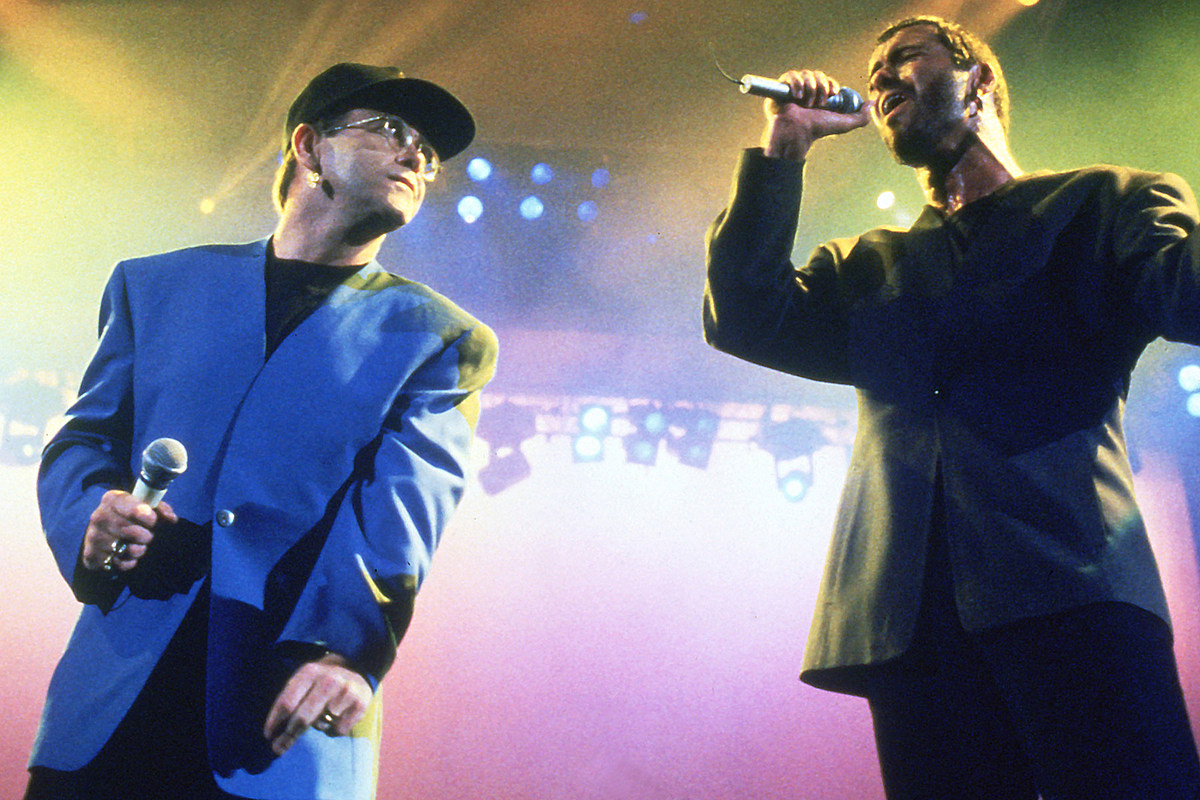
671. ‘Don’t Let the Sun Go Down on Me’, by George Michael & Elton John

It’s been a while since we’ve had a live number one. And here’s one featuring two of Britain’s best-loved pop stars…

Don’t Let the Sun Go Down on Me, by George Michael (his 4th of seven #1s) & Elton John (his 3rd of ten #1s)

2 weeks, from 1st December – 15th December 1991

It starts off as George Michael doing a cover of a 1974 Elton John hit. It’s nice enough – Michael is an excellent singer, especially considering that it’s a live recording – but I’m not sure if live recordings are ever better than studio versions. They’re great at capturing the essence of an artist, and sound fine as long as you’re a singer as competent as George Michael. But unless you were there, in the crowd at Wembley Arena in March 1991, is this as enjoyable as it would have been in the studio?

What happens at the end of the first chorus, though, elevates it above most other live singles. The crowd noise rises… something’s happening… and George utters the immortal line: Ladies and gentlemen, Mr Elton John! The crowd’s reaction suggests it was a surprise, arranged for the closing night of Michael’s tour. From then on, this record becomes a moment in pop history. They had already performed the song together at Live Aid in 1985, while at Elton’s recent Glastonbury headline show he touchingly dedicated the song to his late partner in this duet.

What I will say in its favour is that, despite being almost six minutes in length, this cover doesn’t drag. The slow build of the intro and first verse, the revelation, and then the duet are all propelled along by the crowd’s reaction. There’s real drama there. Were this a studio recording then it may well have dragged (which the original does, a bit, despite it eventually reaching a pretty rousing climax, and despite having two out of the five Beach Boys on backing vocals…)

Like the artist they knocked from top spot, Michael Jackson, the 1990s would be among Elton and George’s ‘best’ periods for #1s, despite them being synonymous with earlier decades. It’s only Elton’s second chart-topper of the decade, and that’s already better than his ‘70s and ‘80s returns combined. Meanwhile, apart from his duet with Aretha Franklin, none of Michael’s ‘Faith’ era smashes made number one in the UK.

Aside from the fact that it featured two of the nation’s biggest pop stars, another reason for this record’s instant success (it entered at the top) was that all money raised went to AIDS charities. And our very next chart-topper might explain why, sadly, the disease was at the forefront of the public’s consciousness in late 1991.

662. ‘The Stonk’, by Hale & Pace and The Stonkers

Hot on the heels of The Clash, can we also claim this next number one as part of the recent rock revival…?

The Stonk, by Hale & Pace and The Stonkers (their 1st and only #1)

1 week, from 17th – 24th March 1991

Hear me out! There’s a boogie-woogie rhythm, and a honky-tonk piano… The lyrics are somewhat anarchic, vaguely saucy even, if you try hard enough… OK. No, I admit. This isn’t rock and/or roll. This is the return of the chart phenomenon that brought us such treats as Cliff Richard and the Young Ones remake of ‘Living Doll’: the Comic Relief single.

Those of you who live beyond British shores may never have enjoyed this bi-annual TV fundraiser, in which the great and the good of British light entertainment come together for an evening of forced merriment. Hence why the video for ‘The Stonk’ features Bruce Forsyth, Rowan Atkinson as Mr Bean, and (if my eyes didn’t deceive me) David Baddiel, while it opens with newsreader Angela Rippon being whacked out the way by a red-nosed Big Ben. (It is compulsory for Comic Relief to feature newsreaders doing stupid things. It’s funny, you see, because they are usually so serious.)

If this all sounds completely insufferable, then you’d be right. The gags, such as they are, all land flat. Ich bin ein Stonker… announces JFK, while Neil Armstrong claims one giant Stonk for mankind… Even Shakespeare isn’t safe: Shall I compare thee to a summer’s Stonk? someone asks, which makes no sense on any level. It’s shit, and completely unbothered about it. Proud of it, even. Maybe I’m a miserable sod, but I firmly believe that Red Nose Day would make even more money if people donated on the proviso that it would end an hour earlier for every million raised.

(Note the fact that this is advertised as a double-‘A’ side, alongside the much-loved Victoria Wood. The charts only mention Hale & Pace, however. Perhaps this record’s success had something to do with the other song on offer…)

And yet… I can’t list ‘The Stonk’ as one of the all-time worst chart-toppers. It’s not plumbing the depths alongside ‘Star Trekkin’ (which raised not a penny for charity) or ‘No Charge’ (the least humorous ‘novelty’ record of all time). That cheap, relentless boogie-woogie beat, and the chorus’s strong whiff of ‘The Timewarp’, does sort of hook me in. I didn’t want to, honestly I didn’t, but I’ve ended up tapping my feet.

It was written by comedy duo Gareth Hale and Norman Pace who, despite being TV mainstays throughout the 1990s, somehow never managed to become a part of my childhood. I couldn’t name a single one of their sketches or characters. Meanwhile, despite sounding as cheap and cheerful as a Butlin’s ‘knobbly knees’ contest, it does feature ‘proper’ musicians: British rock royalty even, in Queen’s Brian May and Roger Taylor, Black Sabbath’s Tommy Iommi, and Pink Floyd’s David Gilmour.

In wrapping this post up, I have no desire to ever hear this song again. I doubt anybody has actively listened to it since it left the Top 40 (as is the way with most charity singles). It isn’t on Spotify, and all that’s left as proof that this nonsense was, for one week in March 1991, the best-selling single in the country is this grainy YouTube video…