Have I ever heard this song before…? The much-anticipated solo debut from Take That’s leading man? I was about to start my final year of primary school, fairly well up on the pop hits of the day, and yet…
Forever Love, by Gary Barlow (his 1st of three solo #1s)
1 week, from 14th – 21st July 1996
There’s a chance I may never have heard ‘Forever Love’ before; but there’s also a chance I’ve heard it a hundred times and simply forgotten. It is… Dull. Bland. Pedestrian. Lacking any sort of hook, or memorable lines. Love it has, So many beautiful faces, Sharing lives, And sharing days… See what I mean. Meh.
My last two posts have been lengthy, so this one can be short and sweet. Dull love song has week at number one. Hardly the first time, and at least it was just one week. Except, ‘Forever Love’ should be so much bigger, so much more of an event. Gary Barlow was the biggest pop star in the land, striking out alone. The next George Michael, maybe?
I think he was probably trying too hard. This record is clearly well produced, something that took a lot of time and careful thought. But it’s too fussy, too needlessly ornate. The album-version intro is so long, and overwrought, that you’re bored before Gary has even opened his mouth. At the three minute mark you check how long is left, and sigh when you see there are two more to go… I’ve never written a classic pop song, but I bet nobody that’s managed it ever sat down at their piano and said ‘today is the day I write something timeless!’ You feel that Barlow probably set himself that goal, though.
The obvious comparison to make is with his former bandmate, the one who had jumped ship first and was also about to release his debut single, a cover of ‘Freedom’ by George Michael (clearly both men had the same ambition). Initially it was Gary who had the bigger hits, but it was Robbie Williams who understood better what a pop star is about, what the public wants: some catchy tunes and some showmanship. Most of them don’t care about the ‘craft’. (Also, Robbie very sensibly got someone in to help him write said tunes…)
And so Robbie will very soon eclipse his estranged bandmate. Gary has one further solo number one to come – another that, at first glance, I don’t think I’ve heard for the best part of three decades – before a decade in the wilderness beckons.
Oh Lord, here we go. I steel myself, as I always do when a song concerning the England Football Team comes along…
Three Lions, by Baddiel & Skinner & The Lightning Seeds (their 1st of two #1s)
1 week, from 26th May – 2nd June 1996/ 1 week, from 30th June – 7th July 1996 (2 weeks total)
The thing is, I do like ‘Three Lions’. It’s a Britpop classic (you could argue that it’s the Britpop classic, alongside ‘Common People’ and ‘Don’t Look Back in Anger’, given how ubiquitous it remains, almost thirty years on…) and it’s given The Lightning Seeds – a brilliant pop act – a moment or two on top of the singles charts.
There’s also a lot I really bloody hate about this song; but for a moment let’s focus on the positives. Football aside, ‘Three Lions’ is a very British pop song, in the tradition of The Kinks and Blur, in that it is part music hall, part pub singalong, and yet part quite sophisticated rock music. Separated from the crowd noises and the snatches of commentary, the chords and the pianos are quite melancholy, almost baroque.
The lyrics are also very particularly British. Few nations would start a song that should ostensibly be about sporting glory, with a verse about how England’s gonna throw it away, Gonna blow it away… We don’t like to revel in success. If anything, we much prefer to wallow in disappointment. (And England are actually quite good at football! Wait till you hear about Scotland…)
‘Three Lions’ was recorded ahead of Euro ’96, the first big tournament to be held in the UK – the land that invented association football – since the 1966 World Cup. Hence the It’s coming home… refrain. David Baddiel and Frank Skinner are comedians, and were hosts of the popular ‘Fantasy Football League’ TV show, who teamed up with Ian Broudie of the Lightning Seeds. He had been asked by the FA to write the official England team song, but had declined the offer of the players singing on the song. Broudie wanted it to be different to its predecessors – ‘Back Home’, ‘World in Motion’ etc. – and be written from the fans’ point of view. The title, meanwhile, refers to the three lions on the England team’s crest.
All three men take turns on lead vocals: Brodie is clearly a good singer, Skinner acquits himself well, Baddiel…. Well, let’s just say he gives it a good go. Listening to the song now, it sounds a lot more lightweight, a lot simpler than I remember. Maybe I’m just used to hearing it bellowed out by tens of thousands rather than by three fairly reedy voices. And it contains one of pop music’s great mondegreens. Hands up who thinks the words are jewels remain still gleaming? When they are of course Jules Rimet still gleaming, a reference to the original World Cup trophy that England lifted in 1966, and which Brazil got to keep following their 1970 triumph.
So what is it that I hate about this song? Well, I hate what it’s become. I hate that it still gets bellowed out by England fans, usually drunk, often belligerent, sometimes with a flare stuck up their arse. ‘Oh but it’s a joke, it’s self-deprecating…’ some will argue. No, when it’s sung about a tournament not hosted by England (i.e. every major tournament since 1996) it sounds obnoxiously entitled, as if the trophy is coming home, pre-destined, to England. Except it never does. 1966 remains England’s only triumph. The thirty years of hurt in the lyrics now stand at fifty-eight, and long may that number continue to grow.
Luka Modric mentioned the song’s arrogance as a motivating factor for Croatia in their 2018 World Cup semi-final win over England. So maybe it’s time to retire the song as the moron’s anthem of choice, for England’s own good if anything, and return the song to beloved Britpop classic status. Deliciously, back in 1996, German fans started singing ‘Three Lions’ following their semi-final win over England. If only they had a word for taking pleasure in another’s misfortune…
This is already a very long post, and I know that most of my readers don’t give a hoot about football, or soccer, but I should mention the nice touches in the video. Baddiel and Skinner recreate famous moments from English football – when Lineker scored, that tackle by Moore – on a muddy playing field with the ’96 squad. (It’s definitely Steve Stone’s finest achievement in an England shirt.) And then Geoff Hurst – hattrick hero of ’66 – turns up at the pub, but they don’t realise.
One last thing before we finish: we need to give a shout out to the Lightning Seeds. ‘Three Lions’, in all its versions, is by far their biggest hit, but they were mainstays of the ‘90s and the sort of act who can put together a brilliant Greatest Hits. My personal favourites are ‘Lucky You’ and ‘Sugar Coated Iceberg’, and I’d check them out if you aren’t familiar.
I did say, a post or two ago, that we were hitting a golden vein of chart-toppers. In fact, Take That’s feeble swansong aside, 1996 has already been a vast improvement on the year before, and we’re only in April…
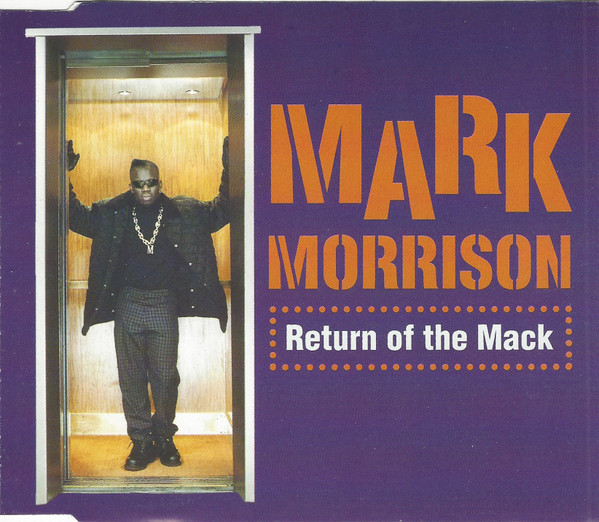
Return of the Mack, by Mark Morrison (his 1st and only #1)
2 weeks, from 14th – 28th April 1996
‘Return of the Mack’ is completely different from our last number one – the Prodigy’s searing ‘Firestarter’ – but it’s every bit as catchy. It’s slick, very mid-nineties R&B; but I don’t mean slick in a boring way. More in a supremely confident, honeyed, knows exactly what it’s doing sort of way.
You could easily believe that this was being sung by a US soul superstar, a Boyz II Men-Bobby Brown hybrid of some sort, apart from one detail: it’s actually quite fun, and doesn’t take itself too seriously. A lot of US R&B at this time was spotlessly honed to the point of being completely transparent and unmemorable. We had a taster of it when Michael Jackson’s ‘You Are Not Alone’ was at #1, but thankfully this sound never dominated the British charts like it did the Billboard.
I assume that the ‘Mack’ in the chorus is supposed to be Mark Morrison himself, and this self-referencing adds another layer of braggadocio to what is already a swaggering tune. He’s back, feeling better than ever, and ready to lord it over his ex… So I’m back up in the game, Running things to keep my swing, Letting all the people know, That I’m back to run the show… It’s not harsh to suggest that Morrison has a unique singing voice – high-pitched and nasal – and the way he enunciates certain words, like ‘swing’, adds another hook to the record.
We’re getting deep into the pop stars of my childhood now, and two things I remember about Mark Morrison were his very cool slanted mohawk hairdo, and the fact that ‘Return of the Mack’ was about his release from jail. Except, my mind is playing tricks on me… Morrison did do jailtime, for the always inadvisable crime of trying to take a gun onto an aeroplane, but not until a year after ‘Return of the Mack’ made number one.
Although he was released from his three month stretch just as the song started to climb the US charts, eventually settling at an impressive #2, so I wasn’t completely wrong. The fact that this up-tempo R&B did so well in the land of down-tempo R&B suggests that even Americans might have been growing weary of all the syrupy ballads. It was the first of an impressive five Top 10 UK hits from the one album (though, in the States, Morrison remains a one-hit wonder).
Gun-toting on aircraft wasn’t Morrison’s only brush with the law, and he’s also been in trouble for affray, assault, driving without a licence, suspected kidnapping, and for paying a lookalike to do his community service. An eventful life, then, though he has remained active in the music industry throughout. More recently, he seems to have been rediscovered by modern rap and R&B stars, being sampled by Chris Brown and working with Post Malone.
Take That have been a pioneering boyband in many ways, over the course of their eight number one singles. Multi-generational appeal with ‘Relight My Fire’, Ivor Novello-winning song writing in ‘Back for Good’, rock star level production on ‘Never Forget’…
How Deep Is Your Love, by Take That (their 8th of twelve #1s)
3 weeks, from 3rd – 24th March 1996
And now they push the idea of the ‘goodbye’ single. Ever since, every boyband worthy of the name has released a ballad after the inevitable split has been announced, and solo careers begin to loom large on the horizon. Not just boybands, even, as The Spice Girls will soon attest. Sadly, though, for a band capable of very good pop songs, this is a fairly flat goodbye: a serviceably average Bee Gees cover.
It’s a faithful take on ‘How Deep Is Your Love’, which had made #3 in 1978 when the Bee Gees were at the height of their disco powers. Rather than disco, though, Take That go for a soft-rock, acoustic guitars with some hand-held drums, sound. It reminds me of ‘More Than Words’ by Extreme… Make of that what you will.
One thing the stripped back production does is push the boys’ – a four-piece now after Robbie’s departure – voices to the fore. Their harmonies are nice, almost a cappella at times, but they can’t lift this record to anything other than middling heights. It is not a patch on the original, which I would rate as one of the Brothers Gibb’s crowning glories.
Take That had announced their split a few weeks before this final single was released, ahead of a Greatest Hits album, and so it was inevitable that it would make top spot. (Helplines had to be set up to counsel distraught fans following the news…) Since ‘Pray’ in 1993, only one of their singles had failed to make #1. And then that was it, or so everyone assumed. Gary Barlow was about to embark on a solo career – we’ll meet him again very soon – as were Mark and Robbie, all to varying degrees of success. I doubt any one predicted that a decade later Take That would launch one of the most successful musical comebacks the country had ever seen… But all that can wait for another day! In our more immediate future, with this drab one out the way, we are about to embark on a run of classic chart toppers, starting with an ode to pyromania…
1996 kicks off in the most understated way imaginable – with a slow, slinky, seven-minute bossa nova from George Michael.
Jesus to a Child, by George Michael (his 6th of seven solo #1s)
1 week, from 14th – 21st January 1996
I listen to it, properly, for the first time ever I think, and try to pinpoint the musical reason for this making number one. It’s not catchy – there’s no identifiable chorus – it meanders, weaves its smooth spell, then eventually departs. My thoughts are cast back a decade, to Michael’s similarly understated ‘A Different Corner’. He has a knack for taking unlikely songs to the top. But ‘Jesus to a Child’ makes ‘A Different Corner’ sound like the most instant, bubble-gum pop.
The reasons for it making #1 may have been largely to do with the power of the name. It was his first release for three years, since the ‘Five Live E.P.’, or for four if we only count original material. It was the lead single from ‘Older’ – his first studio album in nearly six years – though he had been performing the song live for over a year. You have to admire the sheer disregard for commercial success he showed in picking this as the first single.
The reasons for George Michael wanting to release this are now well-known, and very sad. ‘Jesus to a Child’ was written as a tribute to his late boyfriend, Anselmo Feleppa, who had died in 1993 after an AIDS-related brain haemorrhage. Michael had been unable to write anything for eighteen months after Feleppa’s death, until he wrote this elegy in under an hour. He set it to a bossa nova beat as a tribute to his lover’s Brazilian heritage.
The lyrics are beautiful: Sadness, In my eyes, No one guessed, Or no one tried, You smiled at me, Like Jesus to a child… and it sounds churlish to call this song ‘boring’. I imagine writing it was powerfully cathartic, and so perhaps we should view it as a poem, or a reading at a funeral. One that just happened to become a chart-topping hit, thanks to the enormous star power of its singer.
What is worth noting that is that even though the song is so clearly about a lost lover – The lover I still miss, Is Jesus to a child… – Michael couldn’t mention anything explicitly. There was rumour, and innuendo, like Freddie Mercury before him; but it would be another two years before he would come out (or be brutally outed, let’s be honest). 1996 is within my living memory, but the idea that a pop star nowadays wouldn’t reveal that a song was about their gay lover seems thankfully unlikely.
In my previous posts on George Michael, I’ve admitted that I don’t quite get the adoration for his music. A lot of it is good; but a lot of it is a bit too glossy, a bit too smooth, for me. Like this, even though many sources class it among his very best work. If this had been his last UK #1, I’d had to have written it of as a bit of a flat ending. Luckily, he has one more chart topper to come very soon, his 7th, and it’s probably my favourite of the lot. What’s not in doubt about George is that he seems to have been an incredibly warm and generous person – it was revealed after his death that all the royalties from this single had been donated to the charity ChildLine, a fact kept secret at his insistence.
You can approach this next number one very cynically, if that’s your thing, as there’s lots to be cynical about…
Earth Song, by Michael Jackson (his 6th of seven #1s)
6 weeks, from 3rd December 1995 – 14th January 1996
For his sixth solo UK chart-topper, the King of Pop, long-since divorced from reality, fully realises his Messianic potential. What about elephants? he demands of us, towards the end of this colossal track. Have we lost their trust? Pulp’s Jarvis Cocker certainly let us know what he thought, famously mooning Jackson’s performance of the song at the Brit Awards.
But, once your eyes have completed their rolling, and you stop to listen to ‘Earth Song’, then you can’t help but be impressed. You might not want to hear it every day, but the very fact that he conceived of, wrote, and recorded this track, and then managed to sell the message in a way that only Michael Jackson could – largely through the conviction in his whoops and hollers – is darned impressive. Like ‘You Are Not Alone’, this is a lullaby underneath all the dressing (Jackson intended it to be simple, so that it could be understood right across the world). But what dressing… When the drums and funky bass kick in it’s a bit of a moment, as is the gigantic key change. The last three minutes is basically MJ berating us about the state of the planet, accompanied by a wind machine and a gospel choir.
And, let’s be honest, much of what he’s singing about is true. It was true in 1995, and it’s true thirty years on. What about children dying?…Can’t you hear them cry?… Where did we go wrong?… Someone tell me why… It’s preachy, sure, but he ain’t wrong. Of course, though, sending this song to number one is a lot easier than actually changing our ways, and if Jackson truly thought this would make any difference to the fate of the human race then he was Wacko indeed.
The video too is every bit as OTT as you might expect. I can remember watching it on ‘Top of the Pops’ at the time, aged almost ten, and being captivated. Watching back now, it’s painted in very broad strokes, but it’s vivid, and memorable. Dead elephants, felled trees, someone clubbing a seal… Then through his sheer bloody star power, clinging to some tree stumps, Jackson undoes all the damage, and we live happily ever after.
At the end of the day, most people are more Jarvis Cocker than they are Michael Jackson. And most of the time, that is a good thing. ‘Earth Song’ is preposterous, and overblown, and now interestingly forgotten among his illustrious back catalogue. But it also delivers an uncomfortable truth, however clumsily the message is conveyed.
This was the 1995 Christmas #1, famously holding off The Beatles’ much feted ‘comeback’ single ‘Free As a Bird’ (they’ll manage their 18th chart-topper, eventually). It also wraps up a very odd, very underwhelming year, in which the charts have felt at odds with what people were actually listening to. One interesting thing, though, to chart geeks like me, is that 1995 was the year where singles suddenly started entering at #1. What was once a freak event, marking an act out as the very biggest in the land, was happening much more often. From ‘Back for Good’ to ‘Earth Song’, all but two #1s were held-back, heavily promoted songs that entered at the top. This will continue as the nineties progress, with the turnover of number ones increasing all the time as well.
Oh yes, time for more golden-oldies karaoke, from your granny’s favourites.
I Believe / Up on the Roof, by Robson & Jerome (their 2nd of three #1s)
4 weeks, from 5th November – 3rd December 1995
This time, they resurrect one of the very biggest number one singles. The biggest ever, if ‘weeks at number one’ is the metric we’re using. Frankie Laine’s original racked up eighteen weeks at the top way back in 1953. It was just the 9th #1, and it’s pretty amazing to think that its record still stands over seventy years on.
And for such a massive single, I feel it’s been a little forgotten (1953 was a long time ago, to be fair) and so it’s good in a way that it had another moment in the sun. And R&J’s take on it is… okay. Better than either of the tunes on their first single. It’s still cheap, still karaoke; but it doesn’t cloy as much, and builds to a fairly soaring climax. Maybe that’s testament to the quality of the song…
Plus, it’s short – barely two minutes, like Laine’s version – and ‘shortness’ is ideal when these two take to the mic. Sadly, any mild positivity I can muster here is wiped out by the flip side of this disc: a version of The Drifters’ ‘Up on the Roof’ which takes the duo to new levels of tackiness. It is truly dreadful – synthy horns and horrible Disney princess tinkly bits. That this is a timeless classic’s only appearance at #1 (anywhere, as far as I can tell!) is genuinely criminal.
Equally criminal to some is the fact that this record held Oasis’s ‘Wonderwall’ at #2. However, thanks to Oasis not lacking for #1 singles, and thanks to ‘Wonderwall’s annoying ubiquity, I don’t class that an upset as heinous as this pair’s first single holding off ‘Common People’.
One thing I do notice, listening to these two songs, is that Robson & Jerome’s singing voices sound different. Better, more polished, than on ‘Unchained Melody’, or on ‘White Cliffs of Dover’. Whether this was the result of singing lessons, or something more sinister, I don’t know. Des Dyer, formerly of ‘70s band Jigsaw, made allegations that it was him singing on the records. He was paid off, and told to shut up. Much later, Mike Stock admitted that the duo’s vocal’s were ‘patched up’ by sessions singers.
Whether or not they were singing on these songs, it didn’t do them much harm. While not quite as successful as their debut, this record still made a month at #1 and reached almost a million sales. An album inevitably followed, on which they murdered The Beatles, The Monkees, The Walker Brothers, and Elvis, as well as ‘Amazing Grace’ and ‘Danny Boy’. At least they didn’t cling on at the top to become one of the worst Christmas Number Ones. For the King of Pop had other ideas…
And so we arrive at yet another staging-post on the long, but thinly spread, chart-topping career of Michael Jackson. One number one with his brothers, and seven solo, stretched out over two decades. Interestingly, and perhaps aptly, he only ever made #1 in odd numbered years…
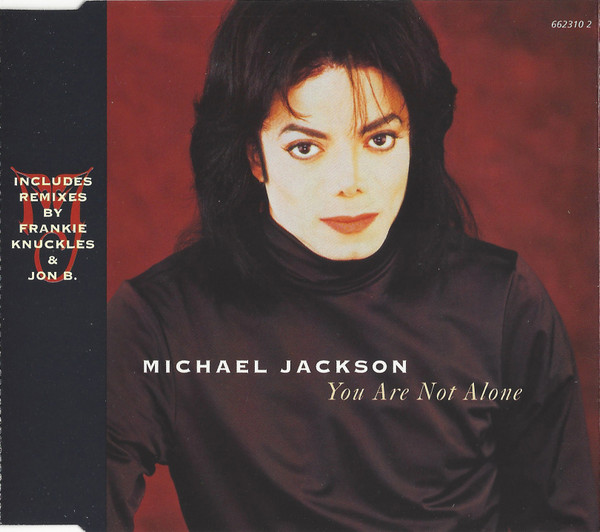
You Are Not Alone, by Michael Jackson (his 5th of seven #1s)
2 weeks, from 3rd – 17th September 1995
’77, ’81, ’83, ’87, ’91 and now 1995. And this is just what we’ve been missing on our 1995 bingo card. After all the dance, the Britpop and the power balladry, what we really needed was some slow and syrupy, mid-nineties R&B. This sound was (thankfully) much more prevalent on the Billboard charts, possibly the sound of US pop at the time, and few acts would have had the star power to drag this sludge to the top spot in the UK.
Trust MJ, though. It was the second single from the ‘HIStory’ album, following ‘Scream’, the duet with sister Janet, more famous for its record-breakingly expensive video. And there is a sweet simplicity to this song. The chorus plays almost like a lullaby: You are not alone, I am here with you, Though you’re far away, I am here to stay… Like a lullaby in that it’s pretty, and in that it may send you to sleep.
Jackson puts in a pretty strong vocal performance as well, limiting the ticks and the gulps that have marked most of his music since ‘Bad’ (there’s not a single ‘eeeh hee’ either). He gives the lungs a workout towards the end, post key-change, reminding us that underneath it all he was always a fine singer.
And yet… Watch the video, and it’s easy to become distracted from the actual song. He is now fully white, and very plastic-looking. We’re almost treated to a full-frontal from the King of Pop, as he smooches with then wife Lisa Marie Presley, wrapped only in a towel. It’s all pretty icky. Of course, knowing what we know now means that any Jacko love song comes with its own in-built ick-factor. (‘You Are Not Alone’ was also written by R Kelly, just in case we needed any extra ickiness.)
So, in summary, this is a sweet enough, well-performed ballad, your enjoyment of which depends on how much you can block out thoughts of what we know now, and of a near-naked MJ canoodling with Elvis’s daughter. 1995 will actually turn out to be Jackson’s most successful year, in terms of chart-toppers. He still has a massive Christmas #1 to come, in which he puts his clothes back on and returns to his usual preposterous, overblown nonsense.
For many, Take That peaked with ‘Back for Good’, their sixth and best-loved number one single. Where to go from there, then? Back to decent-but-unremarkable pop, such as ‘Sure’? Or do they get Jim Steinman, a kids’ choir, and a sample from Verdi’s ‘Requiem’, and throw together an extravagantly OTT remake of a track from their most recent album?
Never Forget, by Take That (their 7th of twelve #1s)
3 weeks, from 30th July – 20th August 1995
I’m sure you already know, but it was the latter. Trumpets of the type usually reserved for announcing royalty herald this next chart-topper. Angelic children’s voices telling us that we’ve come so far, and we’ve reached so high… Depending how you score on the Barlow-tolerance meter, this is either further evidence that Take That were not just another boyband… Or the sound of them, and their songwriter-in-chief, disappearing up their collective arses.
When all the choirs and the Verdi are done, and the song slips into a bog-standard mid-nineties soul-pop beat, it’s a little disappointing. Much of this song’s near seven-minute runtime is fairly mundane, but nobody remembers that. They remember the soaring chorus (that takes well over two minutes to arrive) and the extended fade-out, rather than the dull verses.
It’s now a standard boyband cliché: the song about how fame hasn’t changed them, or how fame isn’t everything it’s cracked up to be. This record might be where that trope stems from, as Howard Donald (on rare lead-vocal duty) announces weighty lyrics like We’ve had success, We’ve had good times, But remember this… while a slideshow of pictures from their childhoods plays in the video, interspersed with clips of them winning awards and generally being adored.
Again, if you have a cynical little mind (like I do) you could see this entire project as a massive humblebrag. My mind starts to wondering if Robbie left before or after ‘Never Forget’, as his voice is nowhere to be heard. But then he appears, eventually, to throw some ad-libs around in the long fade-out. Perhaps his diminished role is a clue as to why he did finally quit the band, post-recording but before ‘Never Forget’ was released. He’s had a fairly small role in all but one of their #1s (‘Everything Changes’), with nothing to suggest that he was going to be the huge solo star that he is.
I do like aspects of this single, just in case I’ve sounded too down on it. The sheer scale of it, the Jim Steinman-isation of it. The chorus is one of their very best, too. But by the six minute mark I’ve had my fill, and there’s a false ending that really tests the patience. Still, it was a huge hit – of course it was – and their seventh chart-topper in just two years. Yet it was the beginning of the end. Robbie had left, no further singles were released from the album, and there’s only a fairly limp Bee Gees cover to come before Britain’s biggest boyband are laid to rest. For a bit, anyway.
Serious question: who were the worst musical duo of 1995? In any other year, the moronic Outhere Brothers would have taken the prize hands down. And yet… We also have to reckon with another, potentially even more heinous, pair…
Unchained Melody / White Cliffs of Dover, by Robson & Jerome (their 1st of three #1s)
7 weeks, from 14th May – 2nd July 1995
Robson Green and Jerome Flynn were two actors and television personalities – still are, in fact. They had risen to prominence in the ITV series ‘Soldier Soldier’, in which they played, yes, soldiers. In one episode, they sang an impromptu version of ‘Unchained Melody’ at a wedding, going by the name the Unrighteous Brothers… And the rest was history.
This record suffers from two major problems. First off, it’s terrible. Secondly, the incomparably superior version of ‘Unchained Melody’ that this cover was based on is still fresh in the memory, having topped the charts barely four years ago. Which makes this sound even more like a cheap karaoke cash-in than the tinny backing track and the dodgy vocals might suggest.
And OK, they may have been going for a ‘cheap and cheerful’ feel, as in the TV programme, but that might be giving them a little too much benefit of the doubt. Allegedly the duo had a little ‘assistance’ in the recording studio (to the point where some claim that it’s not really them singing), but I’m not one to cast aspersions. Robson and Jerome seem like decent blokes, not taking themselves too seriously, enjoying an unexpected change in career direction… So on the one hand we shouldn’t get too annoyed by this silly #1. Yet, on the other, there’s the fact that what should have been a fun scene from a TV show was turned into a seven-week chart-topper, and the best-selling single of 1995 – nay, the best-selling single of the entire decade so far! The British public, once again, showing themselves unfit to be trusted within twenty feet of a record shop.
On the flip side of the disc, there’s something slightly more interesting. ‘(There’ll Be Bluebirds Over) The White Cliffs of Dover’ is a song from the Second World War, made famous by the forces’ sweetheart Vera Lynn. It’s interesting, because it may well have been a tie-in for the 50th anniversary of VE Day, and because it’s a clear indication of who this record was aimed at. Grannies across the land kept this on top of the charts, holding off U2 and, in a travesty far worse than Engelbert or ‘Shaddap You Face’, Pulp’s ‘Common People’.
‘Bluebirds’ itself is every bit as rotten as ‘Unchained Melody’, while the production may be even cheaper and nastier, slathered over twee lines about shepherds watching their flocks and little Jimmy sleeping safe in his room (which I’m sure were powerful in 1942 with the Luftwaffe swarming overhead, but which just sound maudlin here). At least, by the end, the pair have been relieved of their singing duties by a much more competent gospel choir.
Apparently both Robson and Jerome had to be persuaded to do any of this, to the point that Green threatened to sue for harassment. Who, pray tell, could be cynical enough to risk a court appearance in the name of unleashing this crap on the nation…? Oh, right, yep. Simon Cowell. The dark overlord of the charts in the 2000s cut his blood-sucking teeth with this, his first number one record. It was produced by two-thirds of SAW (Stock and Aitken), giving this disc yet another stamp of quality…
If only this was a one-off, for both Robson & Jerome, and for Simon Cowell. But, of course, it wasn’t. Much more is to come. Until then, let’s distract ourselves with some chart trivia. This marks the first time that a song has topped the chart in three different versions (the Righteous Brothers, of course, and the Jimmy Young version from way back in 1955). Meanwhile, ‘White Cliffs of Dover’ became the longest-titled #1 single ever – as long as you include the brackets at the start.






 The UK Number Ones Blog