235. ‘All You Need Is Love’, by The Beatles

The top of the British Singles Chart has just endured its longest Beatles-less spell (at least, you know, until they split up and stop making music) but they are back! Though you could be forgiven for thinking that this is a completely different band.

The Fab Four were killed off a year or so ago. Since then they’ve hit #1 with the string drenched ‘Eleanor Rigby’ and the kids’ singalong ‘Yellow Submarine’. Before that came the bass-heavy garage of ‘Paperback Writer’. Both big steps away from the Beat sound that had made them huge. This single is another massive leap away, even compared to their innovation of ’66. This single opens with the French national anthem…
mainBEATLESLOVE

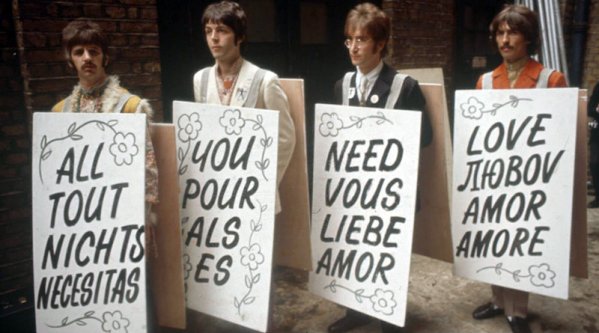
All You Need Is Love, by The Beatles (their 12th of seventeen #1s)

3 weeks, from 19th July – 9th August 1967

Because, why not? They’re The Beatles and they can do whatever the hell they want. ‘La Marseillaise’ doesn’t last for long, and soon we swing into a simple ditty. Love, love, love… and a mantra. Nothing you can do that can’t be done, Nothing you can sing that can’t be sung… On first listen it sounds like a hippy-dippy, peace (man!) anthem for the Summer of Love. But, actually… Nothing you can know that isn’t known, Nothing you can see that isn’t shown… It’s kind of negative. ‘Why bother?’ seems to be the message…

John Lennon allegedly kept the lyrics simple, as the song was to be debuted on TV screens around the globe for ‘Our World’, the first ever global tele-link. But, Lennon being Lennon, I sense a bit of needle in there. A bit of sarcasm, maybe? It’s definitely not as straightforward as it sounds. He later described the lyrics as ‘revolutionary propaganda.’ The chorus, though, is simplicity in action: All you need is love… Love is all you need.

Like ‘Good Vibrations’ – a record that spurred The Beatles on to greater experimentation – ‘All You Need Is Love’ jumps around all over the place, from national anthems, to drunken jazz in the chorus, to an electric guitar solo, to stabbing strings, with some music-hall ‘All together nows’ for good measure.
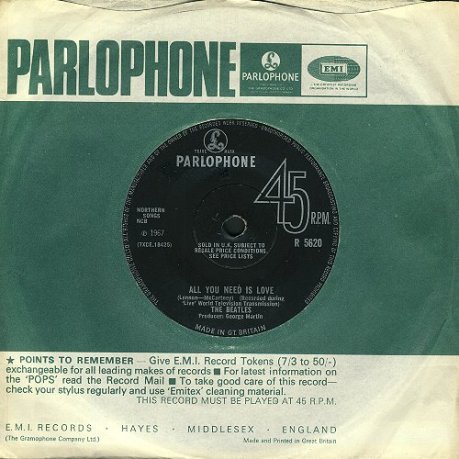
r5620

And then there’s the finale. Where it all just goes a little bit mental. We get horns from Bach (meaning the 18th Century composer has influenced two #1s in a row!), a snippet of Glen Miller’s ‘In the Mood’ and, naturally, ‘Greensleeves’. From revolutionary France, to WWII mess-halls, to Tudor England in one four minute pop song… And there are snatches of two other Beatles’ classics as well: ‘Yesterday’ and ‘She Loves You’. (Opening up an interesting sub-category: #1 singles that feature in other #1 singles…) All the while the band and guests whoop and holler until the whole messy shebang fades from sight. It sounds like the best party you’ve never been to.

Where to start analysing this? Why even bother? I certainly don’t feel qualified to go into any more detail. With other bands, and other singles, you can see where they were coming from, what they were trying to do, even how you might have done it better. Not with this song, not with The Beatles. It’s unthinkable, really. Throwing out singles that most bands would have built whole careers around, willy-nilly. Here’s ‘She Loves You’, there’s ‘Help!’, watch you don’t trip over ‘Eleanor Rigby’, or ‘Ticket to Ride’ over there in the corner… You’d like a song for a lame TV show? Here’s ‘All You Need Is Love’. And ‘Yesterday’, the song that they reference here – the song that has been covered over 2000 times, the song that has been voted ‘Best Song Ever’ on several occasions? They stuck that away on Side 2 of an album. Oh, The Beatles… Beatles, Beatles, Beatles…

But, just so that they don’t go getting too big-headed, too full of themselves – Paul and Ringo definitely read this blog, right? – I feel compelled to add that when they next appear in this countdown, it’ll be with what I personally think is the worst of their seventeen chart-toppers…
234. ‘A Whiter Shade of Pale’, by Procol Harum

And so we reach the summer of 1967, which you might also have heard of as The Summer of Love. Flower power. Tie-dye. Making love not war. (I dunno, really – I’m just hitting all the clichés.) If you can remember it, man, you weren’t really there…

Despite Britain being thousands of miles away from the pot-haze of Haight-Ashbury, somehow the singles chart managed to reflect, in real time, this cultural movement, with three heavyweight #1s between early June and early September. The first being this next one…

8e71278a9668608a2c28a7deebf1a9c5

A Whiter Shade of Pale, by Procol Harum (their 1st and only #1)

6 weeks, from 8th June – 19th July 1967

It’s a record that strides confidently into the room, with an unmistakeable organ riff and Spector-esque drums. (Apparently it owes a debt to J. S. Bach, this intro… I wouldn’t know much about that. I would simply describe it as ‘soaring.’) It’s rock, it’s progressive, it’s classical, it’s psychedelic… It’s everything and nothing. It just is.

It reminds me a little of The Moody Blues’ ‘Go Now!’, from a couple of years back, in its proggy, jazzy take on pop music. But not really. ‘A Whiter Shade of Pale’ is unique. It doesn’t really sound like the logical next step in the evolution of pop; more like a record that has arrived, nobody knows how or from where, to dominate until normal service resumes.

As much as it stands out musically, what has made this such a famous record are the lyrics. Just what on earth are they about? We skipped the light fandango, Turned cartwheels cross the floor… The first verse, at a push, can be seen as someone drunk at a party. The room was humming harder, As the waiter brought a tray… But surely a song this renowned can’t just be about getting pissed at a party, turning white, and chucking up?

Well, no. We’ve not got to the Chaucer-referencing chorus yet. Or the second verse… I wandered through my playing cards, And would not let her be, One of sixteen vestal virgins… Uh-huh… ‘Vestal virgins’ being a select group of young women locked away inside a temple in ancient Rome to tend an eternal flame (my undergrad degree in History not going to waste there…) I mean, I don’t want this post to go on forever and so I’ll spare you my interpretation of the lyrics. They are, what they are: pretty far out, man.

71fuv+dGY4L._SL1280_

Plus, boring lyrical analyses will just take away from the fact that this is a superb song – up there with earlier bizarro classics like ‘Telstar’ and ‘Good Vibrations’. A song that’s clever without being alienating, and weird without being off-putting. It’s a long song, at over four minutes, and oddly structured to boot – the two verses and two choruses sandwiched between long stretches of organ instrumental. I love the sweep of the organ every time the chorus begins, and the fact that it fades just seconds after the final, triumphant chorus begins. I love that there is a third and fourth verse that the band only play live. I love that they are called Procol Harum, after the ‘cat fancy’ name for their producer’s Burmese cat (I don’t even understand the reason behind the band’s name; let alone the name itself!)

Above all, I love that we’ve finally broken the cheesy, easy-listening slump that 1967 has brought to the charts. For the next three chart-toppers, at least, we’re back innovating, pushing the envelope of pop. Procol Harum, for all the brilliance of their debut hit, wouldn’t bother the singles charts too much afterwards. Their follow-up, ‘Homburg’, did hit #6 though, and is actually the first Harum song I ever heard, as it featured on the sixties compilation tape in my parents’ car that I must have mentioned twenty times by now. I guess the compilers couldn’t afford ‘A Whiter Shade of Pale’.

Anyway, I’m sure you are in no doubt about the brilliance of this record, but just to make sure… It was announced in 2004 that it was the record with the most radio/TV plays of the previous seventy years. It has sold more than ten million copies worldwide. Over one thousand cover-versions have been recorded… No doubt about it – ‘A Whiter Shade of Pale’ is pop royalty.

My hand-made Spotify playlist:

233. ‘Silence Is Golden’, by The Tremeloes

It’s been over three and a half years since The Tremeloes scored their first number one hit, a raucous cover of ‘Do You Love Me’. Since then they’ve dropped Brian Poole – or, rather he’s left to pursue a solo career – and mellowed their sound right down.

4045b26e9793a0ec8f807e95b9d9ea48

Silence Is Golden, by The Tremeloes (their 2nd and final #1)

3 weeks, from 18th May – 8th June 1967

I’m getting a Beach Boys, folky vibe as we start off. ‘Silence Is Golden’ is yet another song I know as being ‘part the swinging sixties canon’, without having ever listened to it properly. It’s a nice melody, the harmonising is nice… It’s a nice song. Oh don’t it hurt deep inside, To see someone do something to her… It’s the song of a watcher, one that either still has feelings for an ex, or that has an unrequited love. He wants to tell her that she’s being taken for a ride: Should I tell her, Or should I be cool…?

In the end he decides that silence is indeed golden, and that he should keep schtum. I like the idea that it’s actually the singer’s conscience singing to him, and that it at one point calls him ‘a fool’, but some time around the second chorus this song starts to get irritating.

It’s the forced falsetto voices, and the cheesy doo-wop backing vocals. It’s the ‘solo’, which is the band converging for a long oooweeeooowaaawaaawooowooow. By the end, when the final note swoops upwards like you’ve changed the speed setting, you’re glad it’s over. Like I said, it’s nice enough… But it’s a bit wishy-washy. It’s trying too hard. If this record were a schoolboy, he’d be getting his lunch money stolen.

R-563702-1400510024-1639.jpeg

(Can we just take a moment to appreciate that this disc appears to have had an actual picture sleeve, which seems to have been very rare thing indeed in Britain in the ’60s! Maybe that’s why it made it to  #1!)

‘Silence Is Golden’ is actually a cover of a Four Season’s ‘B’-side from a few years earlier. I’ll link to it here, but have to admit that that version also leaves me a bit cold. I dunno. Sometimes songs just don’t connect. It is very impressive, though, that The Tremeloes’ chart-topping career spanned the very middle of the 1960s, a time when pop music was developing at lightning speed. Their contemporaries in 1963 were Gerry & The Pacemakers and Billy J. Kramer, who were nowhere near the #1 spot in 1967. (And The Beatles who, to be fair, were still enjoying reasonable success…)

To conclude: file under so-so. The Tremeloes powered on, given a second wind by their second number one, and scored hits right through to the early seventies. They still tour on the oldies circuit, and reunited with Brian Poole for their 40th anniversary. And, since I’m struggling to write much more, I’ll end with a great bit of trivia. The Tremeloes contributed heavily to nineties pop, inadvertently, as the band members’ children included duo Alisha’s Attic and the one and only (gettit?) Chesney Hawkes!

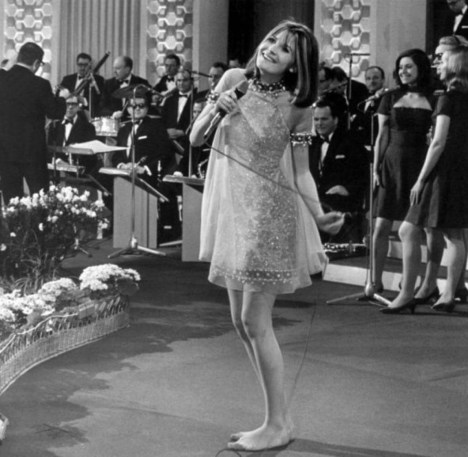
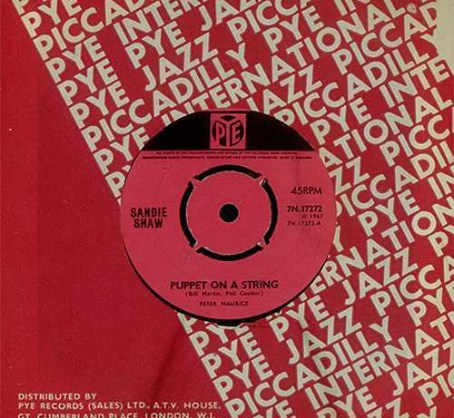
232. ‘Puppet on a String’, by Sandie Shaw

Oh, won’t somebody drag us out of the middle-of-the-road slump we’ve been in for months now…? Can that somebody be Sandie Shaw? I have high-hopes…

8d917f1f-518a-4e31-a3e8-cfb1159edd27

Puppet on a String, by Sandie Shaw (her 3rd and final #1)

3 weeks, from 27th April – 18th May 1967

…that are not disappointed. Roll up! Roll up! This is a crazy little record. From the get-go. From the oompah band intro that morphs into a fairground soundtrack – a demented, horror-movie kind of fairground, that is.

Love is just like a merry-go-round… sings Sandie, like your aunt after a sherry or two… With all the fun of the fair… It’s a fairly simple metaphor: love as fairground ride. But this song takes it all the way, to the extent that we get Big Top sound-effects and crashing cymbals. You really can picture her as a marionette, or as a Judy doll behind a makeshift stage.

If you say you love me madly, I’ll gladly be there, Like a puppet on a string… It’s a fun record. A bit mad. If it were a person you might cross the street to avoid them. But it’s interesting, if nothing else, unlike some of our recent chart-toppers. It’s chanty, and catchy, and Sandie does at least get to stretch her lungs on lines like: Are you leading me on, Tomorrow will you be gone…? At other points she sounds a bit drunk, to be honest. It’s a ‘proper’ pop song, but it’s comes very close to crossing the line into ‘novelty’ territory’.

SANDIE_SHAW_PUPPET+ON+A+STRING+-+4-PR-408516

It makes complete sense that this was a Eurovision Song Contest entry. In fact, it explains a lot. Subtlety and  nuance are not in big supply at Eurovision. And not only was it an entry, it was the winning entry! Britain’s first ever! (Yes, the UK used to win Eurovision.) Sandie had been convinced to perform the British entry to get back into the public’s good books after a divorce scandal, although she hated it. In her own words: ‘I hated it from the first oompah… I was instinctively repelled by its sexist drivel and cuckoo-clock tune.’ Brilliant stuff, up there with Frank Sinatra’s dismissal of ‘Strangers in the Night’.

I think she was a bit harsh, to be honest. It’s fun, camp, silly… Perfect for Eurovision and, most importantly, not a bland, easy listening, country-lite ballad. Had ‘Puppet on a String’ come along elsewhere in our countdown I might have had less patience with it but, as it is, I’m just happy to have it liven proceedings up. And Sandie must have softened towards it, or the royalty cheques it brought her, as she rerecorded it for her sixtieth birthday.

That’s it for Ms. Shaw and the top of the charts. She would only have one more Top 10 – the equally kooky ‘Monsieur Dupont’ in 1969. I’ve enjoyed it every time she’s come along, with the classy ‘(There’s) Always Something There to Remind Me’ and the fluffy ‘Long Live Love’ and now this. She just seems very, I don’t know, sixties. She officially retired from the music business in 2013. And, if nothing else, I appreciate the symmetry of all three of her chart-toppers spending three weeks each at the top!

Follow my Spotify playlist, why don’tcha:

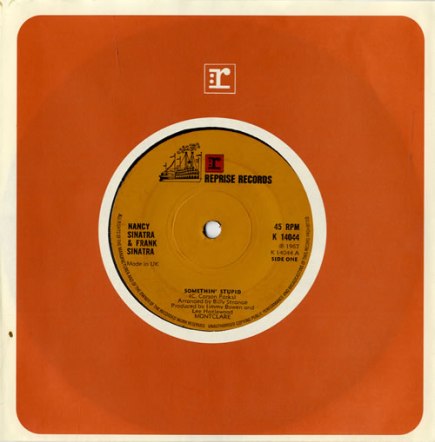
231. ‘Somethin’ Stupid’, by Nancy Sinatra & Frank Sinatra

We are still stuck in the seventh circle of easy-listening hell, it seems. In calendar terms, it’s now getting on for a good half-year of dullness…

R-1373325-1414604339-5769.jpeg

Somethin’ Stupid, by Nancy Sinatra (her 2nd and final #1) & Frank Sinatra (his 3rd and final #1)

2 weeks, from 13th – 27th April 1967

And I have to admit that I thought this latest chart-topper would be better. It’s a song I know, one that’s ingrained in popular culture, and one which had a second wind thanks to a certain ex-Take That singer and an Australian actress when I was at high-school, but one that I’d never really paid much attention to.

The main problem with it, I think, is that Frank and Nancy both sound pretty bored. I know I stand in line until you think you have the time to spend an evening with me… Strings swirl and Latin guitars strum, much like they did in Petula Clark’s ‘This Is My Song’. And if we go someplace to dance I know that there’s a chance you won’t be leaving with me… It’s a wordy song, and the lines are well constructed – the alliteration in the see it in your eyes you still despise the same old lies… one is great, to give credit where it’s due. And the hook of ‘I love you’ being a stupid thing to say is cute.

But beyond that I’m left feeling a bit underwhelmed. Especially remembering how fierce Nancy sounded on ‘These Boots…’, and knowing the swagger that Frank was capable of. Both recorded far, far better songs in their careers. Perhaps they felt they had to meet in the middle, cancelling one another out. It certainly sounds like they’re holding back.

Or maybe they’re just feeling uncomfortable singing, as father and daughter, a duet clearly written for a pair of lovers… I mean, it could, maybe, be seen as song in which the father is lamenting how little time his kid spends with him… I practise every day to find some clever lines to say to make the meaning come true… That could speak of a strained inter-generational relationship, right? Of course, lines like The time is right, Your perfume fills my head… would be more difficult to sell in that way… Nancy has, apparently, gone on record to say she thinks it’s sweet that people refer to this as ‘The Incest Song.’

FRANK_SINATRA_SOMETHING+STUPID-560726

By the end we have some very-sixties horns thrown into the mix, and the pair are mumbling I love you… over the fade-out. It doesn’t end with a bang. It’s not the worst disc from our half-year of easy-listening (hello, Engelbert), but it’s not the best either (hello, Petula). It’s a shame that both Nancy and Frank are bowing out of their chart-topping careers with this slice of meh.

Perhaps the big problem with this duet – and this has just come to me – is that it’s not a duet. They sing each and every line together. A duet should have a bit more give and take, call and response, you know? Nancy especially is relegated to little more than breathy backing vocalist here. Anyway, she was about to go on to make some of the best recordings of her career, with a more suitable partner: Lee Hazlewood. Here’s a link to their version of ‘Jackson’, proving that boy could she pull off a duet, under the right circumstances.

And what of her dad? A star since the late 1930s, now into his fifties. One of the legendary figures of 20th Century popular music. He isn’t very well-represented by his three UK chart-toppers, to be honest. The bland and now forgotten ‘Three Coins in the Fountain’, the much more famous, but hated by Frank himself, ‘Strangers in the Night’, and now this limp duet with his daughter. But he wasn’t done yet. In a couple of years he will record the biggest hit of his whole career, ‘My Way’, and he’ll go on scoring Top 10s through to his version of ‘New York, New York’ in 1979, aged sixty-four. If only that could have been his final chart-topper… They were still playing that as the ‘lights-up’ song in nightclubs when I was a kid!

230. ‘Release Me’, by Engelbert Humperdinck

An unassuming intro leads us, soft and gentle, into a swaying lullaby of a latest chart-topper. Please release me, Let me go, For I don’t love you, Anymore…

ftcms_a4559c7c-d05f-11e8-9a3c-5d5eac8f1ab4

Release Me, by Engelbert Humperdinck (his 1st of two #1s)

6 weeks, from 2nd March – 13th April 1967

Sigh. What has happened to the charts in recent weeks? We’ve gone from the pinnacle of the swinging sixties to the easy-listening doldrums… Jim Reeves, Tom Jones, Petula Clark (who’s fab, but still…) and now this. A new level of schmaltz.

I have found a new love dear… And I will always want her near… The one redeeming thing about this record is that it’s not a love song. It should be; but it’s really a break-up plea. Which gives it a slightly OTT, unintentionally comic feel. Especially with lines like Her lips are warm while yours are cold… (Ouch!) Such is the strength of the plea, I’m assuming he’s singing to his wife, and needs a divorce. Otherwise, why doesn’t he just dump her…? Or is he just too much of a gentleman to do a caddish thing like that?

When the backing singers come in, it really is a step too far. So let’s tune out for a moment, and focus on the most interesting thing about this record (apart from the singer’s name, but we’ll get to that in a bit.) ‘Release Me’, famously, held The Beatles’ ‘Penny Lane’ / ‘Strawberry Fields Forever’ double-‘A’ off the top-spot. For a fortnight, one of the most innovative and respected pop singles ever was outsold by just one disc. Engelbert’s.

ENGELBERT_HUMPERDINCK_(SINGER)_RELEASE+ME-302426

He turns it up a notch or two for the final chorus. We move from crooning to belting. He gives the final So….. some real welly. It goes without saying that, yes, he sings it well. I feel I’ve written that quite a lot recently. And frankly, it’s not enough to save this one. It’s like saying that a footballer kicks a ball well. He’s still got to find the goal! And the slow pace and pure blandness of this record means it’s one that bobbles well wide of the post.

Unlike ‘This Is My Song’, which just sounded old, ‘Release Me’ was a (fairly) old song. First written and released in 1949, and given the treatment by Patti Page, The Everly Brothers and Dean Martin among others. It goes without saying that Humperdinck’s version is the best-known. It was, inevitably, the highest-selling single of 1967.

And what of the elephant in the room? That name. Engelbert Humperdinck was a stage name, his real one being Arnold Dorsey. But, amazingly, it is an actual name. Engelbert Humperdinck I was a German composer from the turn of the century. Humperdinck II just wholesale borrowed the name – which seems cheeky to me. He was managed by the same guy as Tom Jones, and ‘Release Me’ was his breakthrough hit. His post-sixties career is pretty interesting, but I’ll hold off on the full bio as, joy of joys, he has another huge chart-topper coming up shortly…

Follow along with this handy playlist:

229. ‘This Is My Song’, by Petula Clark

This next #1 has an intro that really sets a scene. A laundry-strung alley in old Napoli. Candles. Red-chequered tablecloth. The strings flutter. The guitar is lightly-plucked. When the moon hits your eye like a big pizza-pie…

83692aecd543105978cc66e31f402c81

This Is My Song, by Petula Clark (her 2nd and final #1)

2 weeks, from 16th February – 2nd March 1967

Nope. Wrong song. This one goes: Why is my heart so light, Why are the stars so bright…? Questions, questions. I’m sure you’ve already guessed why. Why is the sky so blue, Since the hour I met you…? Petula’s in love. And so she runs through various clichés: Flowers are smiling, stars are shining… We know we’re getting a big ol’ chorus, but she builds up to it very slowly, keeping us waiting… I know why the world is smiling… It hears the same old story, Through all eternity…

Finally it comes. Love… This is my song… It’s a chorus made for movie-soundtracks. It’s outrageously cheesy, but undeniable. Don’t try to argue with it. Just let yourself get swept along by it. The world, Cannot be wrong, If in this world, There is you… It’s timeless stuff. By the solo, with its Bierfest horn section, I’m sold. I love it. Here is a song, My serenade to you…

Of the last six chart-toppers, half could be described as sentimental schmaltz. ‘Distant Drums’, ‘The Green, Green Grass of Home’, and now this. But ‘This Is My Song’ is different. I’m not sure how, but it is. Somewhere in there, buried deep in the swaying, woozy rhythm, the spirit of the sixties remains. Somehow, it manages to be quite sexy, in amongst all the cheese…

Petula-Clark-This-Is-My-Song

I may be biased. Petula Clark was one of my first true loves, ever since ‘I Couldn’t Live Without Your Love’ – to which ‘This Is My Song’ was the follow-up – featured on a ‘60s Hits cassette on heavy-rotation in my parents’ car. Not that I listen to her very often now, but… This is a woman who was a child star – a ‘singing sweetheart’ and mascot to WWII troops, whose hit first records were released in the 1940s, who first charted alongside the likes of Vera Lynn and Doris Day, whose two #1s – ‘Sailor’ and this – bookend the swinging sixties, who caused scandal in the USA by (gasp!) touching Harry Belafonte on the arm, who is as comfortable singing in French, German or Italian as she is in English, and who still performs to this day, aged eighty-six! (She’s currently playing in ‘Mary Poppins’ in the West End.) She is, to apply an over-used but in this case completely appropriate term, a legend.

Meanwhile, the story of this record is almost as interesting. It is not, though it sounds it, based on an old Neapolitan folk tune. It had been written just the year before, for the soundtrack of the film ‘A Countess From Hong Kong’, by one Charlie Chaplin. Yep, that Charlie Chaplin. The film was set in the thirties, and so Chaplin wanted a song that would invoke the sound of that time. I’d say he managed it. To give it that period finish, he also wanted Al Jolson to record it. Except – small problem – Jolson had died in1950. So, he asked Petula Clark to record it instead. Clark, apparently, hated the lyrics…

Anyway, I enjoyed that. And if you didn’t enjoy this one, if you thought it was just a bit too much, too overblown and old-fashioned, just you wait till you hear what’s up next…

228. ‘I’m a Believer’, by The Monkees

We leap into 1967 grins and cheeky winks all round. Hey, hey… It’s The Monkees!

87f124a078fed3759c43f8baf2317a9c

I’m a Believer, by The Monkees (their 1st and only #1)

4 weeks, from 19th January – 16th February 1967

Wham: The organ riff intro. Bam: The guitar lick. This is a record that doesn’t hang around. I thought love was only true in fairy tales, Meant for someone else, But not for me… And then, less than thirty seconds in, we hit the chorus. It feels quick, even though it’s a regular two and a half minute song. Or maybe it feels like boxes are being ticked. Check, check, check. We got ourselves a hit record.

It’s hard to write about The Monkees – and I say that as someone who knows very little about them – without resorting to the clichés. The first manufactured boy-band. They didn’t write their own songs (This one was written by Neil Diamond, no less.) They couldn’t really play their guitars! The TV series. ‘An American rip-off of The Beatles’. All stuff that has passed into pop-culture legend. You can’t help but picture them running goofily along a beach. But, and I hope that this has become apparent as this blog has gone on, I’m no music snob. A good song is a good song, no matter who it was recorded by. And ‘I’m a Believer’ is ‘A Good Song’. It’s an ear-worm. You don’t switch stations when it comes on the radio.

The chorus especially, hits all the right spots. Then I saw her face, Now I’m a believer, Not a trace, Of doubt in my mind… Then the Mmmmhhh… And the perfect hook of rhyming ‘believer’ with ‘couldn’t leave her.’ Yes, the verses are a bit basic: ‘pain’ and ‘rain, and so on. And the topic is love. Or, not love. Lust. But not lust. It’s a song about the general concept of love, with a smudge of lust, for kids who don’t know yet what those feelings are. And it’s not a Beatles ‘rip-off’. Not quite. It’s definitely influenced by the Beat sound, especially the guitar licks between the verses. But the most Beatles thing about The Monkees were their haircuts. It’s a disc that ends on a high too, with that great Yayayayayaay!

SEV928 (265)

‘I’m a Believer’ feels like a moment. The fact that it’s the first #1 of a new year, maybe. Something’s shifting. Is this perhaps the first ‘pop song’? Hear me out… Up to now pop music has been jazz, and swing, and rock ‘n’ roll, R & B, and rock. All those sounds have been popular. But this. This is a song written with the single purpose of being popular. Of promoting a group of young men and forcing them into the hearts, and onto the bedroom walls, of girls aged between nine and, say, fourteen.

What I mean to say is that The Monkees are taking the sound of the mid-sixties: Beat pop mixed with folk and R&B, on the cusp of flower-power, and diluting it into pure pop. But, of course, that’s been happening for years. Paul Anka’s ‘Diana’ was diluted rock ‘n’ roll. Helen Shapiro’s ‘You Don’t Know’ was diluted jazz. The Four Pennies ‘Juliet’ was diluted Merseybeat. I’ve just answered my own question, then. This is not the first ‘pop song’. This isn’t anything new. It’s just a next step in The Evolution of Pop.

I’ll stop before I disappear any further into my own mind. This is a post on ‘I’m a Believer’; not a philosophical dissertation. But it is The Monkees’ one and only appearance on this countdown and so I did need to cram it all in. Anyway, a quick glance at their discography on Wikipedia shows just how much of a monster hit ‘I’m a Believer’ was: #1 across the world, from Australia, to Germany, to Canada. And, like all the best boy-bands, they burned out pretty quickly. Though not before they left us with some great pop songs: ‘Last Train to Clarksville’, ‘Daydream Believer’, ‘Pleasant Valley Sunday’… And one I had never heard of before starting this post, but which may be my new favourite-ever song title: ‘Randy Scouse Git’ (released, perhaps unsurprisingly, as ‘Alternate Title’ in the UK.)

https://www.youtube.com/watch?v=wB9YIsKIEbA

Listen to every #1 so far in this playlist: