Today’s Top 10 – November 26th, 1963

The two earlier ‘Today’s Top 10’s I’ve done were pretty succesful. Thanks to all who had a look, liked and commented. I was wondering what to do with the feature going forward, and I think I’ll use it to take a deeper look at interesting periods in chart history. What can the Top 10 tell us about where pop music was at a particular time and place?

So, we’ve done the death of the ’60s, and we’ve done the Summer of Love. Now we turn to perhaps one of the most exciting times in modern popular music: late-1963. The moment when the sixties finally started to swing. Thanks, mainly, to the Beatles. But not, as this chart will hopefully prove, solely because of them. For those interested in significant world events, this was also the Top 10 on the week that JFK was assassinated.

10. Let It Rock / Memphis, Tennessee, by Chuck Berry – down 4 (7 weeks on chart)

But what’s this…? Two rock ‘n’ roll tunes first released in 1959. How the charts like to mess with us… The reason is tied to the times, though. The Godfathers of rock, Buddy Holly, Jerry Lee Lewis, and Chuck Berry, had inspired the new Beat groups that we’ll be meeting further up this chart. The Beatles early albums were full of Berry songs, while the Stones’ first hit had been a cover of ‘Come On’ earlier in 1963. Pye Records saw an opportunity, and released some of these influential tunes for the first time in the UK. Amazingly, this was Berry’s first ever visit to the UK Top 10. A runaway train might not be the most obvious topic for a rock ‘n’ roll tune, but this wasn’t Berry’s first time singing about a railroad. And the way he makes his guitar sound like a train horn is iconic.

It was paired with the more laidback ‘Memphis, Tennessee’, which had also been a hit in a version by Dave Berry & the Cruisers around the same time. It pulls the same trick as such classics as Gilbert O’ Sullivan’s ‘Clair’, and Brotherhood of Man’s ‘Save Your Kisses for Me’, by tricking the listener into thinking that the singer is singing about a girlfriend, when he is actually singing about a small child. Berry, though, consumate storyteller that he was, manages to do it in a far less creepy manner, making the song more about the messy break-up, and the father’s regret, than about dodgy double entendres.

9. I’ll Keep You Satisfied, by Billy J. Kramer & The Dakotas – up 2 (3 weeks on chart)

This one’s much more 1963. One of the big beat combos that had broken through earlier in the year (with another three to come higher up), and who had been at #1 just a few weeks earlier with the Lennon-McCartney tune ‘Bad to Me’. ‘I’ll Keep You Satisfied’ is another L&M composition and, while it would peak decently at #4, it isn’t quite as good. Still, it’s better than the Dakota’s next hit, the dubious ‘Little Children’. Watching the video above, the music may be (slightly) rocking, but Billy J. is giving good crooner energy. Nothing to worry grandma… yet.

8. I (Who Have Nothing), by Shirley Bassey – up 1 (9 weeks on chart)

A constant presence on the charts of the ’50s and ’60s: a bit of Bassey. This is three minutes of pure melodrama, as Shirley watches an old-flame woo his new girl. ‘I (Who Have Nothing)’ was adapted from an Italian hit, which was something of a theme in the early sixties. It’s a classic of its genre: an intro of swirling strings, quiet bits, and bits where she lets loose, belting out high notes like nobody else can. I always find Shirley Bassey somewhat lacking in subtlety, but then again – if you’ve got it flaunt it. If I could sing like her then I’d be belting out my Starbucks orders.

7. Blue Bayou / Mean Woman Blues, by Roy Orbison – down 3 (10 weeks on chart)

Another double-‘A’ side from an American rocker, who had been around since the ’50s. Unlike the Chuck Berry record, though, this was a new hit. ‘Blue Bayou’ is one of Orbison’s gentler numbers – for the Big ‘O’ could of course give Shirley Bassey a run for her money in the belting stakes – but it’s always been one of my favourites. Even as a young ‘un who had no idea what the hell a ‘bayou’ was. Linda Rondstadt recorded a famous cover in 1977, though that didn’t make the UK Top 10.

On the flipside of this disc was a cover of ‘Mean Woman Blues’, an Elvis track from 1957. Personally, while they are both fine singers, I prefer Elvis’s version. I prefer bombastic, overblown Orbison to rocking Orbison. On this record he tries out the famous Grrrrrr, which he’d use to great effect on his chart-topping ‘Oh, Pretty Woman’ the following year.

6. Secret Love, by Kathy Kirby – up 6 (3 weeks on chart)

We’re keeping an eye out for the bands that came along in 1963 and changed popular music forever. But for every beat combo that made it big, there were plenty of British women who were just as instrumental in making the sixties swing. Kathy Kirby’s name hasn’t lasted alongside the likes of Cilla, Dusty, Lulu or Sandie Shaw, but here she is, enjoying her biggest hit. Her take on ‘Secret Love’ starts off very bombastically, much like Doris Day’s chart-topping original from a decade earlier, but soon a groovy guitars-and-backing-singers beat takes over, nicely updating the song for a new era. Plus, she has a great voice, with a bit of bite to it. Kirby may have retired from showbusiness in the early eighties and died in relative obscurity, but for a while she was a huge name: representing the UK at Eurovision in 1965 (finishing as runner-up) and hosting her own television programme.

5. Don’t Talk to Him, by Cliff Richard & The Shadows – up 2 (3 weeks on chart)

Common knowledge would have it that with the arrival of the Beatles et al the career of Cliff Richard – the hottest star in the land just a year or so earlier – fell off a, well, cliff. But glance at any Top 40 from any random moment post-1962, and it quickly becomes clear that Cliff went nowhere. Okay, he didn’t hit #1 as regularly, but ‘Don’t Talk to Him’ was one of an astounding 33 Top 10 hits he achieved across the sixties. I’d never heard this before, but it’s actually a really good song, combining a latin rhythm with some very current, beat guitars. This could easily have been written and recorded by one of the acts a couple of places up this chart, proving that Cliff gave those young whippersnappers a stronger run for their money than the history books suggest. *Some sources disagree as to whether this was Cliff solo, or Cliff with the Shadows, but I’ve gone with the latter*

4. Be My Baby, by the Ronettes – up 1 (6 weeks on chart)

The first of two all-time great, hall of fame pop songs in this week’s Top 4. The fact that this never made it higher than number four is a shock, and I’ve already done a post on how this really Should Have Been a #1. Even on this chart, in the year that it was recorded, where girl groups like the Ronettes were common, ‘Be My Baby’ stands out as special. It would stand out as special on any chart, in any era, simply because it is better than 99.95% of anything else in the history of pop.

3. Sugar and Spice, by the Searchers – down 1 (5 weeks on chart)

Here we are then, a purely Liverpudlian Top 3. The Searchers had been the 3rd Merseybeat band to make number one that year, after the two acts ahead of them in this chart, with their cover of The Drifters’ ‘Sweets for My Sweet’. Although still on the candy theme, ‘Sugar and Spice’ was an original, written by producer Tony Hatch. The chiming guitars and harmonies, as well the almost skiffle rhythm section, are pleasant, almost proto jangle-pop. But within a year, once the Stones, Kinks and Animals started making the upper reaches of the charts, it would start to sound a bit safe. The Searchers had two much better hits to come: their majestic second #1 ‘Needles and Pins’, and their cover of ‘When You Walk in the Room’. Like so many Beat bands that didn’t, or couldn’t, write their own material, the Searchers’ chart shelf-life was limited.

2. She Loves You, by The Beatles – up 1 (13 weeks on chart)

The song that officially kicked off the swinging sixties? The way that ‘She Loves You’ barrels in, chorus-first, on a wave of tight guitars and precision drumming, and yeah yeah yeahs. In France, this style of Beat music literally became known as ‘Yé-yé’ (and surely everyone knows by now how Mr McCartney Senior thought ‘yes, yes, yes’ would have sounded much more proper…) It is utterly perfect pop, to rank alongside the Ronettes a couple of places below it on this week’s chart. Although they developed their sound so far beyond this, I would still rank ‘She Loves You’ in my personal Beatles Top 3. You can read my original post on it, as a number one, here. On this week in November 1963, it was on its way back to number one, having already spent a month there that autumn, and on its way to becoming the biggest-selling single ever, at that point, in the UK (where it remains the Fab Four’s highest seller). Also, the seven-week gap between its two runs at the top remains a record to this day.

1. You’ll Never Walk Alone, by Gerry & the Pacemakers – non-mover (7 weeks on chart)

The 4th Beat group in the Top 10 on this day sixty-one years ago, Gerry & the Pacemakers had made history by being the first act to make #1 with their first three singles. This was the final week of a month-long run for ‘You’ll Never Walk Alone’, and it would also be The Pacemakers final week on top of the charts. (You can read my original post on it here.) The fact that for only their 3rd single the band had turned to a cover of a song from a 1945 musical is telling. While the Beatles were just warming up, their contemporaries were often relying on covers (or on handouts from Lennon & McCartney). Plus there was the fact that for record labels and producers, rock and roll was still a very new thing, one that many were convinced wouldn’t last. It was seen as essential for bands to branch out, and to nurture a wider appeal.

Of course we know now that rock ‘n’ roll was here to stay, even if Gerry & The Pacemakers weren’t. ‘You’ll Never Walk Alone’ was also here to stay, and by the end of its initial chart run it had already been adopted by the crowd at Anfield as Liverpool FC’s unofficial anthem, to be belted out pre-match from here to eternity. The song returned to number one in a charity version by The Crowd, following the Bradford City fire, while it also made top spot for a third time in 2020 in a version featuring Michael Ball and the 100-year-old Captain Tom Moore, a phenomenon that can only be explained by how crazy we all went during lockdown. It is nothing short of a modern-day hymn, given the song’s role in the current British psyche.

I hope you enjoyed this flashback to Today’s Top 10 in 1963. What a snapshot of popular music that was, as Britain finally cast off the shadow of the War and started to get a little groovy. Up next we’ll return to 1999, and to a country just a few months away from the terrifying uncertainty of a new millenium. Would all the computers crash? Would planes start dropping from the sky…? Nobody knew, so confused and distracted were people that they kept buying Ronan Keating records in large quantities. Stress will do that to you…

Random Runners-Up: ‘Do You Want to Know a Secret?’, by Billy J. Kramer & The Dakotas

Our next randomly selected #2 comes from what, for my money, must have been the most exciting time to be a pop music fan. Come with me back to the summer of 1963, and the Merseybeat explosion…

‘Do You Want to Know a Secret?’, by Billy J. Kramer & The Dakotas

#2 for 2 weeks, from 30th May to 12th June 1963, behind ‘From Me to You’

And its one Liverpudlian act, Billy J. Kramer, covering another, The Beatles. Many of the early beat bands ended up relying on Lennon & McCartney hand-me-downs, and The Dakotas were no different. A few months after this, their debut hit, they would score a first number one with another Beatles cast-off, ‘Bad to Me’.

‘Do You Want to Know a Secret?’ had featured on the Fab Four’s first album, ‘Please Please Me’, released in March that year. (I only just realised that it was sung by George Harrison, who sounds remarkably like Paul McCartney on the recording.) It’s a sweet, simple song, but not one which really indicates that the band were going to be the biggest pop phenomenon the world had ever seen. And The Dakotas’ version is even more diluted, a little more ramshackle, a little old-fashioned in a rockabilly kind of way. Again nice, but they’d pick up the pace on ‘Bad to Me’.

It made #2 during the seven-week run of The Beatles’ first chart-topper, ‘From Me to You’ (not the last time Lennon & McCartney would occupy a Top 2…) It may even have been the best-selling single in the country at some point during its run, but not on the Record Retailer chart, which is what the Official Charts now recognise. It’s the reverse of the situation a few months earlier, when The Beatles’ ‘Please Please Me’ had stalled at #2 in Record Retailer, and therefore the history books, behind yodeller supreme Frank Ifield.

Billy J. Kramer would remain popular for a year or two, scoring a second chart-topper with the ever so slightly creepy ‘Little Children’. Like so many of the earliest Merseybeat stars, though, his star had waned by 1965. The original ‘Do You Want to Know a Secret?’, meanwhile, would go on to be released as a single in the US, where it also made #2.

Random Runners-Up: ‘From a Jack to a King’, by Ned Miller

Time to step away from our regular parade of #1 singles, and to shine a light on some songs that never quite made it. Yes, it’s Random Runners-Up Week – five posts on five randomly chosen number two hits. The dates used can range from the start of the singles chart in 1952 right up to our current location in time (mid-1986)… And these songs genuinely were chosen at random, and not because I like them (which I hope will become abundantly clear when you see what tunes the date generator threw up this time…)

First up, then…

‘From a Jack to a King’, by Ned Miller

#2 for 3 weeks, from 11th Apr-2nd May 1963, behind ‘How Do You Do It?’

…a simple country ditty. From a Jack to a King, From loneliness to a wedding ring… It’s a ultra-country premise: love as a card game, with lots of references to ‘lady luck’ and ‘winning a queen’. A guitar strums out a simple riff, then plucks out a simple solo, and the backing singers see-saw a simple melody back and forth. Simple, and sweet.

I think I may have overused the word ‘simple’ in that there paragraph. But there’s no better word for this tune, especially when I compare it with the era I’ve been writing about in recent months (the over-produced eighties…) It sounds almost prehistoric by comparison. In fact, this song sounds dated even for 1963!

And that’s because it was actually from 1957. It hadn’t charted – hadn’t even been released at the time – but for reasons I cannot pinpoint it made the Top 10 over five years later. The early sixties were a hot-bed of retrospective and re-released hits, though. And this is a significant #2, because it sat behind the very first Merseybeat #1 from Gerry & The Pacemakers. It’s easy to view the moment that ‘How Do You Do It?’ hit the top as a turning point, as the moment the sixties began to swing, which it was. But things clearly didn’t turn overnight, with Ned Miller crooning away just behind…

Once this record had belatedly become a hit, it quickly became a country standard, covered by Elvis, Jerry Lee Lewis, and Mud. It also ensured that Ned Miller had a fairly succesful career on the US country charts for the rest of the decade. He is so very nearly a UK one-hit wonder, though. His only other single to chart made #48 a few years later…

Another #2 up tomorrow – one that gives us a big ol’ change of tone…

Songs That Should Have Been #1… ‘Be My Baby’, by The Ronettes

The Stargazers, Don Cornell, The Johnston Brothers, The Dream Weavers, Jerry Keller…? Nope, me neither. But they’ve all had the honour of topping the UK singles chart.

How well a single performs in the charts can be influenced by various things… promotion, star power, tastes and trends, time of year… pure luck. And that most fickle, unpredictable of  factors: the general public. Do enough of them like your song to make it a smash? Or will they ignore it, and let it fall by the wayside?

I’m taking a short break from the regular countdown to feature five discs that really should have topped the charts. Be it for their long-reaching influence, their enduring popularity or for the simple fact that, had they peaked a week earlier or later, they might have made it. (I’ll only be covering songs released before 1964, as that’s where I’m up to on the usual countdown.)

Last up…? Why, if it isn’t the best pop song of all time!

image

Be My Baby, by The Ronettes

Reached #4 in November 1963

Not sure I have to write much more than that… But I’ll try.

Why is it such a classic? Well… There’s the intro, THE crashing, smashing Wall of Sound, the cascading drums, the melodramatic handclaps, the horns, the over-dubbing, the full-on orchestra in the background, the lyrics that range from girlishly submissive (I’ll make you happy, baby…) to flirty ( …just wait and see) in the space of one line…

Phil Spector may be a terrible person; yet against the backdrop of his crimes, and his truly messed-up relationship with Ronette’s lead singer Veronica ‘Ronnie’ Bennett (the only member of the group to actually sing on this song – every voice in the record is hers) ‘Be My Baby’ shines out even more brightly as a slice of pop perfection. Beauty out of something, or someone, awful.

Put simply, this is an amazing song, and it is a crime that it never topped the charts. I’ll end this mini-countdown imagining a parallel universe, where ‘Be My Baby’ sat astride the UK singles chart for a good month or two…

The usual #1s countdown will resume in a couple of days…

https://www.youtube.com/watch?v=ZV5tgZlTEkQ

Songs That Should Have Been #1… ‘Please Please Me’, by The Beatles

The Stargazers, Don Cornell, The Johnston Brothers, The Dream Weavers, Jerry Keller…? Nope, me neither. But they’ve all had the honour of topping the UK singles chart.

How well a single performs in the charts can be influenced by various things… promotion, star power, tastes and trends, time of year… pure luck. And that most fickle, unpredictable of  factors: the general public. Do enough of them like your song to make it a smash? Or will they ignore it, and let it fall by the wayside?

I’m taking a short break from the regular countdown to feature five discs that really should have topped the charts. Be it for their long-reaching influence, their enduring popularity or for the simple fact that, had they peaked a week earlier or later, they might have made it. (I’ll only be covering songs released before 1964, as that’s where I’m up to on the usual countdown.)

Next up… A record that changed the course of popular music?

s-l300

Please Please Me, by the Beatles

Reached #2 in February 1963

As with Elvis, I don’t need to go giving The Fab Four any extra number one singles. By the end of their chart careers, they’d had seventeen of them. And as much as I love this single (if it had been one of their #1s it would probably be in my Top 5) , and as much as I wish that this had been their first ever chart-topper, that isn’t why I’m including ‘Please Please Me’ in this mini-countdown.

I touched on it in my last post, on the mega-long running #2 hit ‘Stranger on the Shore’, but the charts of the 1950s and ’60s were a tad confused. There wasn’t just one of them, for a start. You had the ‘Melody Maker’ chart, the ‘NME’ chart, and the ‘Record Retailer’ chart. None of which offered a complete overview of a week’s sales – they all conducted ‘surveys’ of selected record stores over the phone…

‘Please Please Me’ hit #1 in the NME chart (which had the largest circulation) and ‘Melody Maker’ chart, but it only reached #2 in ‘Record Retailer’, which was the one that the UK Singles Chart chose to follow. So, it may well have been the biggest selling single at some point; we’ll just never know for sure… The history books record it as having stalled behind Frank Ifield’s dull-as-dishwater ‘The Wayward Wind’ for two weeks.

It’s far from the only single to have suffered this unfortunate fate – it wasn’t until 1969 that the UK charts were unified into one – but it’s a landmark single from the biggest pop group in history, with one of the very best middle-eights, ever… So enjoy.

160. ‘I Want To Hold Your Hand’, by The Beatles

Oh yeah I’ll, Tell you somethin’, I think you’ll understand… Well, what you need to understand is that we end 1963 with the biggest band of the year. Three #1s spread out over a staggering eighteen weeks! The band that would go on to become the biggest band of the decade and then the biggest band of all time.

the beatles john lennon george harrison ringo starr paul mccartney 1280x1024 wallpaper_www.wallpapername.com_64

I Want to Hold Your Hand, by The Beatles (their 3rd of seventeen #1s)

5 weeks, from 12th December 1963 – 16th January 1964

And what a cheesy wonder this song is. When I wrote about ‘She Loves You’, I mentioned that it was quite a sophisticated pop song, with a pseudo-3rd person narrative and melancholy chord progressions. Well, all that sophistication was dumped at the studio door when the lads turned up to record ‘I Want to Hold Your Hand.’

Oh please, Say to me, You’ll let me be your man, And please, Say to me, You’ll let me hold your hand… It’s so twee, so innocent. Can I be your boyfriend? I just really, really, really want to… hold your hand. I’ve listened to it several times now, scouring the lyrics for a hint of double-entendre, but no. And when I touch you… promising… I feel happy inside… Oh. It’s as chaste and vanilla a record as you’ll find.

This is not to suggest that I don’t like it. Who doesn’t like this record? It’s probably been proven, by a team of crack scientists, that it’s impossible for a fully-functioning human being to dislike this record. You’ve got that intro, for a start. Dun-dan-ding, Dun-dan-ding… And some quality drum fills from Ringo. And that twangy guitar – George Harrison’s, I’m guessing. And some clapping (Yes, clapping!) My personal highlight, though, is the Everly Brothers’ harmonising on the ‘Ha-a-a-a-a-nd’.

beatles-the-i-want-to-hold-your-hand-this-boy-r-5084-decca-pressing-77189-p

Nope, we’re pretty close to pop-perfection here. It’s not quite in the same league as ‘She Loves You’, but it’s pretty, pretty, pre-tty good. The greatest threat to songs like ‘I Want to Hold Your Hand’ is ubiquity – the fact that most people have heard them three hundred times already. You have to remind yourself that The Beatles were re-inventing pop music as they went here, have to imagine yourself as a sixteen-year-old in the winter of 1963, hearing this for the first time…

I think this might become a theme whenever a Beatles disc crops up on this countdown but, hey: some statistics. The band replaced themselves at #1 with this disc (‘She Loves You’ having returned to #1 after seven weeks, remember) becoming only the second ever act to do this. (Plus, The Shadows replaced themselves with records on which they were the featured, not the lead, artists, so…) ‘I Want to Hold Your Hand’ is their biggest selling record worldwide, having sold 12 million copies.

It also holds an important place in pop-music folklore. Bob Dylan famously thought that they were singing I get high… when they were actually singing I can’t hide… and was shocked to find out that they had never smoked weed. And it was so good that it made Brian Wilson and Mike Love convene a special Beach Boys meeting to discuss the threat The Beatles posed to their position as America’s #1 band. (I love that – pop music meets military strategy.)

In the end, even Sgts Wilson and Love couldn’t hold back the British Invasion. ‘I Want to Hold Your Hand’ was their 1st US #1 a few weeks after it hit the top back home. It was part of the all-Beatles Billboard Top 5 in April ’64. Suddenly they were HUGE. Bigger even – some might have said – than Jesus himself…

Follow along with my Spotify playlist:

156. ‘Bad to Me’, by Billy J. Kramer with The Dakotas

A crooning little intro has us fearing the worst as the needle drops on our latest chart-topper … If you ever leave me, I’ll be sad and blue… A guitar strums plaintively… Don’t you ever leave me, I’m so in love with you… But it’s an intro that you know is going somewhere – something in that last ‘you…’ just brims with promise – and yes, the guitar, clear as a bell, kicks in and we’re off into another solid Beat #1.

kramer-centre-with-his-second-band-the-dakotas-in-the-1960s-518505

Bad to Me, by Billy J. Kramer with The Dakotas (their 1st of two #1s)

3 weeks, from 22nd August – 12th September 1963

The birds in the sky would be, Sad and lonely, If they knew that I’d lost my, One and only… And if, as this song unfolds, you get the feeling that it all sounds very familiar – something in the chord progressions and the notes that Billy J. Kramer leaves hanging in the air – then you’d be on to something. For the next seven years of the UK pop charts there will be two main categories of number one single: those recorded by The Beatles, and those written by The Beatles (or, rather, by Lennon & McCartney). Hot on the heels of their 1st #1 as performers, ‘Bad to Me’ is their first #1 as writers.

That’s not to say that Billy J. and his Dakotas don’t make this song their own. The band is crisp and tight, and Kramer’s voice is strong too. I like the flip and the little groan as he takes us through the But I know you won’t leave me cos you told me so… line. He treads a fine line between singing properly but not crooning. He doesn’t have as strong an accent as, say, John Lennon or Gerry Marsden; but he doesn’t sound like Perry Como either. In fact, we’re five #1s into the Merseybeat revolution and I don’t think I’ve struggled to make out a single line. We await the deterioration of diction in pop music – possibly the late-twentieth century’s greatest crime, according to my late Grandma – with bated breath. My money’s on Jagger.

Anyway, I like this song. We’ve got piano, some nice harmonies, and some standard Merseybeat drums. We even get my favourite type of guitar solo: one that mimics the verses note for note. It’s lazy; but works every time. And… done. A song that wasn’t completely unfamiliar to me; but one to which I had never really paid much attention. I’ll add it to my playlists.

BILLY-J-KRAMER-THE-DAKOTAS-Bad-To

With this disc we keep up our run of young whippersnappers topping the charts (Kramer had just turned twenty when this reached the summit.) However we break our run of Liverpudlians! Billy J was from Bootle but the Dakotas were from all the way over in Manchester. (Still, we manage to keep it in the North-West of England, for now.) Their partnership was something of a marriage of convenience: Kramer needed a band and Brian Epstein persuaded The Dakotas to leave their original singer and team up with him. They debuted with another Beatles cover – ‘Do You Want to Know a Secret?’ – which had hit #2 earlier in the year.

Two more things to mention before we wrap up. If you’re thinking “Hey, with a name like Billy J. Kramer there’s no way he wasn’t going to be a rock star!” then you’d be sorely misguided. His real name was William Howard Ashton – a Vicar’s name if ever there was one. And secondly… ‘Bad to Me’, when you think about it, is a very misleading song title when you consider that the whole entire song is about how the girl is not bad to him. It’s as if ‘Why Do Fools Fall in Love?’ was just called ‘In Love.’ Something to mull over, as I leave it there for now.


155. ‘Sweets For My Sweet’, by The Searchers

Everybody back aboard the Merseybeat bus, for a trip that’s going to take us well into 1964. The initial beat-bands to top the charts – Gerry & The Pacemakers and The Beatles – are now joined by another bunch of Liverpudlians.

Searchers

Sweets For My Sweet, by The Searchers (their 1st of three #1s)

2 weeks, from 8th – 22nd August 1963

I can’t imagine another time when one sound monopolised the top of the charts in such a fashion. From now – early August 1963 – to the middle of February 1964, every UK #1 will have a Merseybeat flavour to it. And we kick off with this one, and a chorus that most will know…

Sweets for my sweet, Sugar for my honey, Your first sweet kiss, Thrills me so… It’s a step back from the frenetic tempo of ‘From Me to You’ and ‘How Do You Do It?’, the guitars here chime rather than rattle; the drums roll rather than thump. There’s a hint of a chugging little riff buried in there too. In fact, I’d say that musically this is a step ahead of the earlier beat chart-toppers. I’m getting hints of The Byrds in the guitars and The Beach Boys in the ‘oooh-eeeh-oooh’ backing vocals. In fact, I can hear the foundations of ‘80s indie in that chiming solo that follows the choruses. You tell me that that doesn’t sound like something the Stone Roses might have come out with.

On the flip side… there’s always a flip side… the lyrics here are a step back from the cheeky charms of John Lennon and Gerry Marsden. They were giving us little vignettes about running fingers through hair, and kisses that would keep you satisfied… relatable stuff. The Searchers still sing in scouse accents but are giving us: If you wanted that star that shines so brightly, To match the stardust in your eyes, Darling I would chase that bright star nightly, And try to steal it from the sky… And then there’s some nonsense about the Sandman, like it was still 1954 or something.

The-Searchers-Sweets-For-My-Sweets-UK

There’s a good reason for this. I said that the chorus should be familiar to all, but to American readers it might be more famous in the form of The Drifters 1961 original. (Yes, I too was slightly surprised to find out that it was a cover, and that in fact all The Searchers’ chart-toppers would be covers.) These lyrics work well in the hands of The Drifters. But 1963 is a long way, musically, from ’61. Times have changed, and if you came out with these lyrics in a playground in Liverpool you’d probably get beaten up.

The Searchers were, like the bands that went immediately before them in establishing this new sound at the top of the charts, a four-piece, young (early twenties) and, of course, from the north-west of England. They will hit the top spot twice more in very short order, and next time it will be with a much better song…!

That’s not to be too harsh on ‘Sweets For My Sweet’, it’s a perfectly good pop song. It’s just a bit… Cheesy? Simplistic? Trite? Maybe it’s a victim of time. If The Drifters had taken it to #1 two years earlier I might have loved it. One thing’s for sure, though, when that perfect little drum roll at the end, which is so mid-sixties, pops up you are just about ready to forgive all the sins that went before.

Follow the official playlist for the blog at….

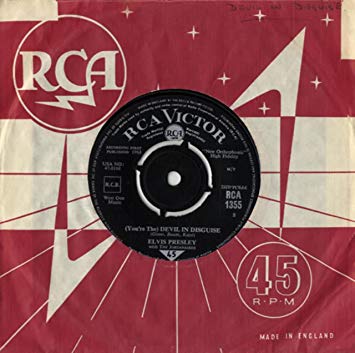
154. ‘(You’re the) Devil in Disguise’, by Elvis Presley

Oh hey, Elvis. You still here? You want one more go at the top, before your glory days are well and truly over? Go on then…

maxresdefault

(You’re the) Devil in Disguise, by Elvis Presley (his 14th of twenty-one #1s)

1 week, from 1st – 8th August 1963

I know this song, I love this song, I’ve been playing air guitar to it since I was a nipper. I know it’s a rocker, and I can’t wait to write a blog post about it. But, to hear it coming after Elvis has bored us into submission with his recent #1s: (‘Good Luck Charm’), (‘She’s Not You’), or scared us off completely: (‘Rock-A-Hula Baby). Well, it’s like a real shot of adrenalin.

It starts off sedately: You look like an angel, Walk like an angel, Talk like an angel… But I got wise… I love the filthy, twangy guitar that sounds like a motorbike revving. And then boom! You’re the devil in disguise, Oh yes you are, Devil in disguise…

It’s a song about a girl that just can’t be trusted… You fooled me with your kisses, You cheated and you schemed, Heaven knows how you lied to me, You’re not the way you seemed…

His band are tight, and Elvis really lets loose. It’s good, nay great, to hear him really go for it after his half-arsed recent efforts. I think the fact that this disc wasn’t from a bloated film soundtrack helped here. And, if this is the end of Elvis as a chart-humping global icon (he will only have 2 (two!) further UK #1s in his lifetime!) then what a way to go!

But, the piece de resistance in this record has nothing to do with Elvis himself. Step forward Grady Martin with his swooping, twanging solo, possibly the rocking-est solo to appear at the top of the charts thus far. Back when I was a lad, and harboured (very) short-lived dreams about playing the guitar, this was the first solo that I wanted to learn. Now I know that there are better, more accomplished guitar solos out there but still… There’s something about the rawness and looseness of this one, especially coming from way back in 1963.

Then it’s a pause – You’re the devil in disguise – Ba dum dum dum – and in comes the low-voiced man, Ray Walker, who Elvis saves only for his very best songs, to echo his Oh yes you are… And there we have it. The King’s 10th chart-topper in just over two and a half years. Off the top of my head, I wouldn’t have guessed that Elvis and The Beatles crossed paths at the top of the charts, but they did. Here. Just the once. (Actually twice, but that’s a story for another day…) I like to think he had heard those young upstarts, and that’s what’s pushed him to really give it his all on this disc. It’s not perfect – it’s a bit Vegasy and Elvis’s voice is still in crooner-mode – but I love it. And, at the end of the day, that’s all that matters…

71O9RISCggL._SX355_

Just because – he is Elvis F’ing Presley after – let’s go all Buzzfeed and rank his post-army #1s. In ascending order then, with double ‘A’-sides split apart:

‘Wooden Heart’ (ugh) >>>>>>> ‘Rock-A-Hula Baby’ (woah) >>>>>>> ‘Good Luck Charm’ (meh) >>>>>>> ‘It’s Now or Never’ (controversially low?) >>>>>>> ‘She’s Not You’ (so-so) >>>>>>> ‘Surrender’ (silly but decent) >>>>>>> ‘Return to Sender’ (soft-spot) >>>>>>> ‘(You’re the) Devil in Disguise’ (yep) >>>>>>> ‘Little Sister’ >>>>>>> ‘Can’t Help Falling in Love’ >>>>>>> ‘His Latest Flame’ >>>>>>> ‘Are You Lonesome Tonight?’

There you have it. Let me know in the comments if you agree or think I’ve lost my faculties. For The King, this is over-and-out for a while. Elvis has not quite left the building, but he’s gone for a long walk. It’ll probably do him some good…

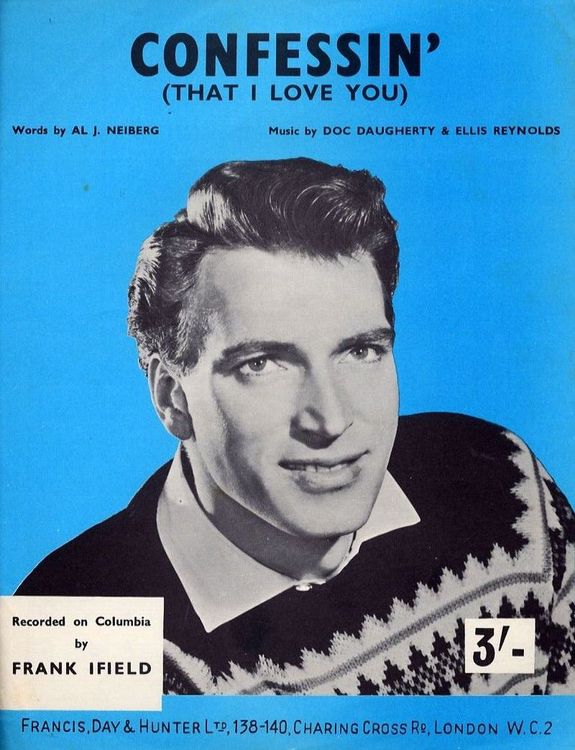
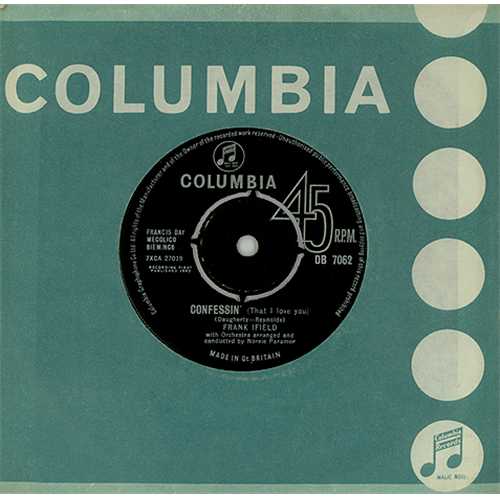
153. ‘Confessin’ (That I Love You)’, by Frank Ifield

In my last post, I indulged in a bit of metaphor-making and compared the Merseybeat wave that was sweeping the charts to a meteor – a mop-topped meteor that flattened all the musical dinosaurs who were clogging the charts. Except, as beautiful as that image is, reality gets in the way here. We briefly have to return to the old ways. The corpse, it seems, is still twitching.

im-confessin-that-i-love-you-featuring-frank-ifield

Confessin’ (That I Love You), by Frank Ifield (his 4th and final #1)

2 weeks, from 18th July – 1st August 1963

Frank Ifield, after dominating the latter half of 1962, still had enough in the tank to claim one final #1 single. The three he’s had so far have ranged from dull (‘The Wayward Wind’) to demented (‘Lovesick Blues’), but none have been very good. Can ‘Confessin’’ save the day?

It starts with a smooth rhythm – a bossanova? – and, naturally, a harmonica. And then the syrupy tones of ol’ Frank. I’ve said it before but it bears repeating – for all his many faults, this guy could sing. I’m confessin’ that I love yo-ooou, Tell me do you love me to-ooo, I’m confessin’ that I need you, Honest I do… Need you ev’ry moment…

It’s a lot more understated than his previous chart-toppers, even his trademark yodelling works here, in that it fits in with the lilting rhythm of the song and doesn’t just sound like him showing off. I kind of like it… I mean, I’ve forgotten it pretty much as soon as it’s done, and the lyrics are a kind of nothingy mulch about how much he loves a girl, and how he hopes she returns his feelings: I’m afraid someday you’ll leave me, Saying can we still be friends… To suggest that it has redeemed the chart-topping career of Yodelling Frank, however, would be a step too far.

If I’ve learned anything over my past four Ifield-based posts, it’s that this will be an old song done up to suit modern ears. It’s what Frank did. And in fact, ‘Confessin’ (That I Love You)’ dates further back than any Ifield #1 has done so far. It’s had the treatment from pretty much everyone, many of whom we’ve met before on this countdown: Tony Bennett, Rosemary Clooney, Doris Day, Perry Como, Frankie Laine, Kay Starr, Dean Martin and Johnnie Ray, as well as others like Judy Garland and the wonderfully named Chester Gaylord, who had the original hit way back in 1930.

FRANK_IFIELD_CONFESSIN+(THAT+I+LOVE+YOU)-294599

It’s a perfectly nice record, but one that I doubt would have come anywhere near the top of the charts had it been Ifield’s first release. It definitely needed the goodwill and borrowed lustre of his earlier, much bigger hits to drag it to the summit. Way, way back – when I wrote about Frankie Laine’s follow up to the monster-hit ‘I Believe’ – I invented the idea of a shadow-hit, a hit record kind of like those tiny birds that hang out picking the flies off hippos, and this is definitely what’s happening here.

And so ends the chart-topping career of Frank Ifield. He burned brightly but oh-so briefly – his four #1s squeezed into just under a year. I must admit I made a grave error when I got excited about Elvis doing four-in-a-year and struggled to find any other act that had managed it… Our Frank was hiding right here under our very noses. But that kind of sums up his career and his legacy, as I’d say he’s been pretty much forgotten. He was bulldozed from collective memory by The Beatles et al, and now rarely gets mentioned… He had one more Top Ten hit following this, and has been inducted into both the Australian Music Hall of Fame and, more importantly, the Coventry Music Wall of Fame. In the eighties he contracted pneumonia, which left him unable to yodel… He’s still going, though, aged eighty-one.

Frank Ifield, then, ladies and gentlemen. First Australian to top the UK charts, the Great Yodeller, forgotten superstar of the 1960s… A round of applause, please. And onwards.

https://www.youtube.com/watch?v=h_WnqnfLU1c

Follow along, and listen to every #1 covered so far, on my Spotify playlist: