We are only four #1 singles into the 1970s, and we already have a contender for the worst chart-topper of the decade. Prepare yourselves…
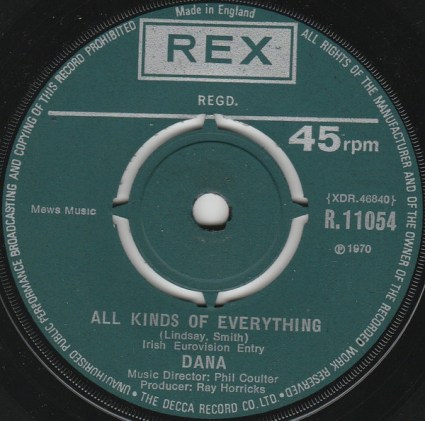
All Kinds of Everything, by Dana (her 1st and only #1)
2 weeks, from 12th – 26th April 1970
The intro comes in like the theme-tune to an educational show, aimed at nursery school kids. You brace for something bad, but nothing can quite prepare you for just how bad it’s going to be. Snowdrops and daffodils, Butterflies and bees, Sailboats and fishermen, Things of the sea… The entire song is a list. A list of the things that remind the singer of her special someone. Seagulls, And aeroplanes, Things of the sky… (Seagulls? Who sees a seagull and thinks of their beloved? Maybe he saved her from one that was trying to steal her chips?) All kinds of everything, Remind me of you…
Literally everything reminds her of him. Insects, the wind, wishing wells, morning dew, neon lights, postcards, grey skies or blue… Everything. It just doesn’t work. These are lyrics that could have been written by a ten-year-old (though, actually, I teach ten-year-olds, and it’s insulting of me to think they couldn’t write something better than this.) The only way this song works is if the singer is a wide-eyed child, no older than thirteen.
And, to be fair, Dana does have a very innocent, childlike voice. She sells the drivel that she’s singing, in her lilting Irish accent, and sounds like she believes in it… (*Edit* She was eighteen when ‘All Kinds of Everything’ was released. Far too old.) Things take a slightly creepy turn when she starts to sing of dances, romances, things of the night… And you think, be careful Dana, I know what happens to young Irish girls that find themselves ‘in trouble’. I’ve seen ‘Philomena’…
This was a hit thanks to the Eurovision Song Contest – an evening famous for terrible music. But not this type of terrible. Eurovision is over the top, camp, cheesy glitz. We’ve had one winner hit #1 so far – Sandie Shaw’s ‘Puppet on a String’ – as well as Cliff’s ‘Congratulations’, which took the runners-up position. Neither of those records were very credible, but they were fun. This, though, isn’t interesting terrible or fun terrible… It’s just terrible terrible. And yet… it won. The rest of Europe heard ‘All Kinds of Everything’ and thought, yeah, go on then.
‘All Kinds of Everything’ was Dana’s first big hit, though she had been releasing music since 1967, and it gave Ireland their first Eurovision win. She would have hits in Ireland, and in Europe, throughout the seventies, but her star slowly waned. By the eighties she had turned to more traditional, Christian music before she was elected as a member of the European Parliament for Connacht-Ulster in 1999. She still records music (in 2007 she released an album called ‘Good Morning Jesus!’, no less.)
Well then. It’s been a scattergun start to the seventies. Like I said, we’re only on the 4th number one and we’ve already had some catchy, no-nonsense pop, a grizzled actor and a genuine classic at the top. And now this… The charts come and go in peaks and troughs. We’re definitely hitting a bit of a trough through the tail-end of ‘69 and into the seventies. But then, the golden days of the swinging sixties couldn’t last forever, could they? We will wait with bated breath for the 1970s to spring fully into life…
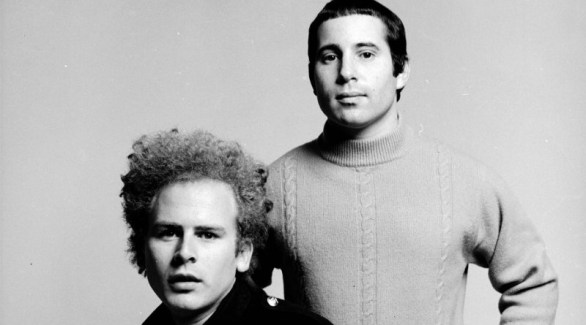
A couple of times already, I’ve written about pop music as hymn. ‘Hey Jude’ was one. Here’s another. The one, and only, British chart-topping single for America’s foremost pop duo. (Sorry Don and Phil, Hall and Oates…)
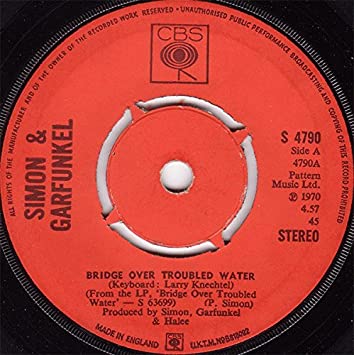
Bridge Over Troubled Water, by Simon & Garfunkel (their 1st and only #1)
3 weeks, from 22nd March – 12th April 1970
I’m only going to write good things about ‘Bridge Over Troubled Water’, but I have to get off my chest first and foremost that I didn’t always like this song. It was a big presence in my childhood – my parents are big fans – but for a long time I thought it was a bit proper, a bit overwrought, a bit… too much like a hymn! Art Garfunkel certainly does enunciate his lines properly (the cut-glass ‘t’ in when tears are in your eyes…) and, if you were being cruel, he does sound a little like a choir-boy.
But you’re allowed to make dubious musical choices when you’re young (*cough* Kid Rock *cough*). I have since come to see the error of my ways. This is an undeniable classic, from the understated confidence of the opening piano, to the giant crescendo of an ending.
And, fittingly for a song that sounds angelic, the lyrics are apparently sung by an angel. Someone looking out for you, someone who’s on your side. Like a bridge over troubled water, I will lay me down… They will follow you even at your lowest ebb, down and out on the streets, as darkness comes. Theories abound that the voice singing is that of heroin, the drug, and that the listener is an addict, which would be a spectacular twist in such a Christian sounding song. Simon and Garfunkel have always denied it.
After two verses of just voice and piano, in come the drums, like gunshots in the distance. And we start to build… I think the moment that this goes from being a great song and becomes one of the greatest is when Art’s voice dips: Oh, If you need a friend… Then the chorus comes in, and what was a simple ballad has grown into something massive without you even really noticing. Suddenly it’s ending with strings, and cymbals, and what sounds like fireworks. Suddenly it’s midnight on New Year’s Eve.
It’s superb. It’s timeless. It’s a classic. To think I used to prefer ‘Cecilia’. Seriously, though, I think ‘Bridge Over Troubled Water’ does sometimes lose something in its ubiquity. Twice in the past few years – decades after it originally hit #1 – the song has reached the top of the UK charts in the form of well-intentioned but fairly dreadful charity singles. It’s kind of easy to lump this record in with other easy-listening, uplifting MOR hits, but that would be a mistake.
And, like many of the best pop songs, there’s a friction working under the surface of ‘Bridge Over Troubled Water’. Simon and Garfunkel weren’t the best of friends by this point, and would split up later in the year. Simon apparently resents the fact that he wrote their biggest hit but Garfunkel gets remembered for singing it. When he performed it on his farewell tour, in fact, he introduced the song by saying “I’m going to reclaim my lost child.”
Actually, I have to confess that I’ve been slow to realise the merits of not just this song, but of Paul Simon and Art Garfunkel’s entire back-catalogue. I was force-fed them on childhood car journeys and, while I’ve come to recognise that ‘The Sound of Silence’, ‘Mrs. Robinson’ and ‘Homeward Bound’ are great, and ‘The Boxer’ a work of art, I still find the likes of ‘I Am a Rock’, ‘America’ and ‘Wednesday Morning, 3 A.M.’ a bit twee. I can’t stand their version of ‘El Condor Pasa’. And part of me is still seven-years-old, and still loves the outright catchiness of ‘At the Zoo’ and ‘Cecilia’. In fact, there probably is no other act about which I am so undecided. I genuinely have no idea whether or not I like Simon and Garfunkel! I do definitely like ‘Bridge Over Troubled Water’, though, and definitely think you should press play below and enjoy it one more time…
Time for a Top 10… Usually I rank the ten best singles from a particular artist (last time it was The Kinks) but I thought I’d fiddle with my criteria a little, and rank my favourite #1 singles from an entire decade.
Starting with the singles chart’s very first decade. Back where it all began, when rock ‘n’ roll was but a twinkle in Elvis’s eye. The list is in chronological order – not ranked in order of preference – and to choose the songs I went back and read through my recaps to see which ones I dug at the time, live, as it were…
So, without further ado, the ten best #1 singles of the 1950s, according to me:
1. ‘Look at That Girl’, by Guy Mitchell – #1 for 6 weeks in Sept/Oct 1953
Only the 12th-ever number one single, from one of the decade’s biggest chart stars, and a runner-up in my first recap. This was the very first whiff of rock ‘n’ roll at the top of the UK charts (a very faint whiff, but still) and I think it appealed more than it probably should have because I’d waded through so much Eddie Fisher and Mantovani to get to it. Still, a catchy, upbeat tune. As I wrote in my original post:
“It sounds to me as if a battle is taking place here, between traditional easy-listening and the burgeoning rock ‘n’ roll movement. On the one hand you’ve got the usual twee backing singers and floaty trumpets, parping away at the end of each line; on the other you have the hand claps and the guitar solo.”
2. ‘Such a Night’, by Johnnie Ray – #1 for 1 week in April/May 1954
Johnnie Ray was known for his emoting, which lent him two spectacular nicknames: ‘The Prince of Wails’ and ‘The Nabob of Sob’. But for his 1st of three #1s he was overcome with a slightly more enjoyable emotion… lust! By far the sauciest number one of the pre-rock era, I awarded it ‘Best Chart-Topper’ in my 1st recap. I’d go as far as saying it was the best #1 single ever… Until 1957 came along. My original post is here:
“…what makes it, and elevates it to a classic, are Ray’s vocals. Like Doris Day before him there’s an effortlessness to his voice that draws you in and yanks you along. But his voice is nothing like the clean-cut, honeyed tones of Miss Day. ‘Such a Night’ isn’t being sung here – it’s being ridden, it’s being humped… it’s being performed!”
3. ‘Mambo Italiano’, by Rosemary Clooney & The Mellomen – #1 for 3 weeks in Jan/Feb 1955
I remember noting, back in the early days of the charts, that it felt like the girls were having all the fun. Guys were being boringly earnest – Al Martino, Eddie Fisher, David Whitfield all proclaiming overwrought, undying love over heavy orchestration. Meanwhile Rosemary Clooney, in her 2nd #1, was singing in cod-Italian about fish bacalao (which is Portuguese, but whatever.) It’s a song that resonates to this day, with a 00s remix and a 2011 pastiche by Lady Gaga. I named it a runner-up in my first recap:
“…while this is a mambo record, sung by an easy-listening singer-slash-actress, this is rock ‘n’ roll. It may be fun and funky, but it just about manages to retain an air of cool around all the silliness. While we were waiting for Bill Haley to come along and kick-off things off, the ideals and attitudes, if not the actual sounds, of rock ‘n’ roll were being sneaked in right under our noses.”
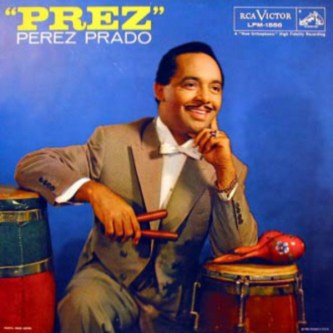
4. ‘Cherry Pink and Apple Blossom White’, by Perez ‘Prez’ Prado & His Orchestra – #1 for 2 weeks in April/May 1955
Another saucy slice of Latin pop, which I named the very best song in my 2nd recap! Again, my opinion of it was probably exaggerated because of all the pre-rock easy-listening mulch surrounding it. It is catchy, though. Just you try not swaying along. Can’t be done! I tried summing up the record’s appeal in my original post…
“…it allows Janet and John from Southend to draw close and to feel one another’s bodies, taught and trembling from two and a half minutes of intense mambo.”
5. ‘Dreamboat’, by Alma Cogan – #1 for 2 weeks in July 1955
The 3rd #1 from 1955, making it officially the best year of the decade… (Hmm…) ‘Dreamboat’ is just a spectacularly fun pop song, sung with a giggle and a wink by perhaps the biggest British female star of the pre-rock age. As I wrote at the time:
“…there isn’t much else to ‘Dreamboat’ -it’s a fun little ditty. Cogan sings it well, with the perfect pronunciation we’ve come to expect but also with a light, playful touch that’s been missing from many of the number ones so far.”
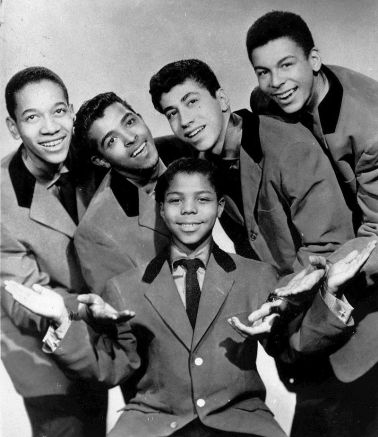
6. ‘Why Do Fools Fall in Love’, by The Teenagers ft. Frankie Lymon – #1 for 3 weeks in July/Aug 1956
Regrets, I have a few… One of them being that I named this classic as a runner-up to Perez Prado in my 2nd recap. What was I thinking? ‘Cherry Pink…’ is great and all, but this is timeless. The first number one by kids, for kids – the Teenagers were all, you guessed it, teenagers – is one of the catchiest, golden pop moments of all time, let alone the decade. As I wrote…
“… it’s just a great song. A summer smash. It oozes New York city: steam, water spraying from a sidewalk valve, the sun blasting down, the Jets and the Sharks… (I dunno. I grew up in small town Scotland.)”
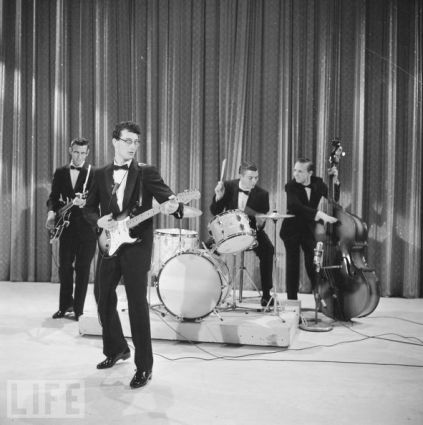
7. ‘That’ll Be the Day’, by The Crickets – #1 for 3 weeks in November 1957
Perhaps the most obvious choice of the ten… What else needs to be said. Press play, gasp at the spectacular intro, and enjoy two and a half minutes of rock ‘n’ roll perfection…
“…Buddy Holly’s voice dances and flirts – toys, almost – with the listener. He coos, he pauses, he growls… The Crickets play tightly, but also very loosely. There’s a great, rough-around-the-edges feel to this record that contrasts with the polished cheese of Paul Anka’s ‘Diana’, whose bumper run at the top this track ended.”
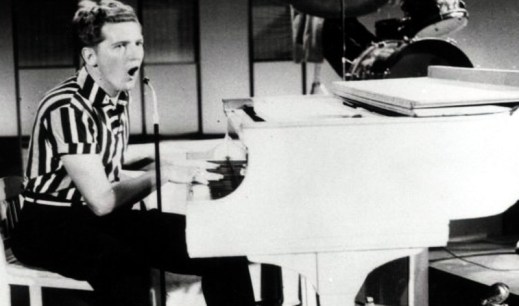
8. ‘Great Balls of Fire’, by Jerry Lee Lewis – #1 for 2 weeks in January 1958
But… I didn’t name ‘That’ll Be the Day’ as one of the very best chart-toppers. Oh no. In my 3rd recap, that honour was reserved for The Killer. On any given day, I could wake up and prefer ‘Great Balls…’ to ‘That’ll Be the Day’, or vice-versa. What’s the point in debating? These two records were nailed-on to make my 50’s Top 10. Pure rock ‘n’ roll greatness…
“…It’s just an absolute blitz, an assault on the senses, a two-minute blast which takes rock ‘n’ roll up another notch.”
9. ‘Who’s Sorry Now’, by Connie Francis – #1 for 6 weeks in May/June 1958
A spot of schadenfreude in the decade’s sassiest #1 single. Connie got dumped, and is now taking great pleasure that the tables have turned on her ex in his new relationship. You had your way, Now you must pay, I’m glad that you’re sorry now… Who says girls in the 50’s were all sweetness and apple pie? The twang in her voice when she launches into the final verse is something to behold. As I wrote at the time…
“A lot of the female artists we’ve met previously on this countdown have been cute, and flirty, and fun to listen to – Kitty Kallen, Kay Starr, Winifred Atwell… But no girl has brought this level of spunk to the table.”
10. ‘Dream Lover’, by Bobby Darin – #1 for 4 weeks in July 1959
Last up – a record that encapsulates everything great about the 1950s, mixing rock ‘n’ roll with swing, doo-wop and a touch of pre-rock crooning, to create pop perfection. Another runner-up to Jerry Lee in my 3rd recap, but there’s no shame in that. In my original post, I wrote:
“…I don’t want to really write any more about this record. I want to leave it there. Minimalist. This is where easy-listening and pop collide to create a seriously classy song.”
And there we have it! The ten best #1 singles of the 1950s!
The seventies’ second number one… is not what I was expecting. Not by a long stretch.
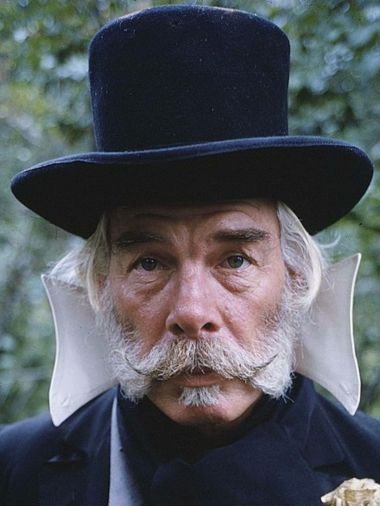
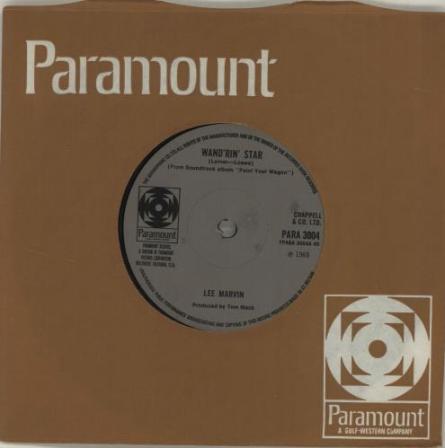
Wand’rin’ Star, by Lee Marvin (his 1st and only #1)
3 weeks, from 1st – 22nd March 1970
For a start, it’s got one of the longest intros to a number one single, surely, ever. A gentle, countryish rhythm, some horse hooves clip-clopping, and lots of humming. For a full minute and fifteen seconds. They hum through an entire chorus and verse! Apparently the radio-edit was shorter, but it seems that the single version was the full four and a half minutes, with the added humming. I can’t find a shorter version anywhere.
Finally the vocals come in. And my, what a voice. Chiselled straight from granite, like a statue come to life. A series of deep vibrations, rather than actual words. I… Was born… Under a wand’rin’… Star… The singer is a traveller, one born to roam. Wheels are made for rollin’, Mules are made to pack, I’ve never seen a sight that didn’t look better lookin’ back… Harmonicas trill in the background, while the slight rhythm carries, and on. The wagon keeps headin’ west…
‘Wand’rin’ Star’ is a showtune, that much is clear from the first listen (it’s the backing singers that give it away) and Lee Marvin an Oscar-winning actor. He sung (whispered, grunted, grumbled… I can think of so many better verbs for his performance than plain old ‘sung’) this in the character of Ben Rumson, a gold prospector, in the movie version of ‘Paint Your Wagon’.
To be fair to Marvin, he perks up a little in the verses. I especially like the third, in which he appeals to anti-social people everywhere: Do I know where hell is? Hell is in ‘Hello’… Heaven is ‘Goodbye’ forever, It’s time for me to go… He’s happiest alone, heading somewhere new. Home is a place best dreamt of. There’s something quite romantic in the song’s cynicism.
In the following chorus, he lets the final ‘star’ flop out of his mouth, as if he’d like to go back to sleep, and you presume that’s that. But no, the song keeps plodding along, Marvin keeps chewing his tabaccy. It’s almost a lullaby – parents of the time could have used this record, and Marvin’s spectacularly sonorous voice, to get their babies to sleep.
‘Wand’rin’ Star’ could have been a hit in the early-fifties, for someone like Frankie Laine. That’s the kind of territory we’ve temporarily slipped back into. The musical version of ‘Paint Your Wagon’ did debut in 1951, in fact, though the movie version had been released just the year before this single hit #1. It is apparently a ‘not very good film’, though one I’ve never seen, which didn’t make a lot of money. The soundtrack, though, made up for it. If you’ve ever wondered what Clint Eastwood would sound like singing a song called ‘I Talk to the Trees’ then check it out (he’s got a surprisingly light voice!)
Lee Marvin stuck to the acting after this, never releasing another single. Which means we’ve had two one-hit wonders in a row! He passed away in 1987, with full military honours thanks to his service in WWII. To be fair: an Oscar, a #1 single, several military medals… a life well-lived. ‘Wand’rin’ Star’ has an equally interesting postscript, including a cover version by Julian Clary (if you don’t know who he is then please, please follow this link) and being played at Joe Strummer’s funeral.
The first #1 of a new decade, and it’s a good ‘un. I love the simple, growling riff that starts us off, that grows and grows, has some horns added to it, and then…
Love Grows (Where My Rosemary Goes), by Edison Lighthouse (their 1st and only #1)
5 weeks, from 25th January – 1st March 1970
She ain’t got no money, Her clothes look kinda funny, Her hair is kinda wild and free… Rosemary is a bit of a manic pixie dream girl – or a bit of a hippy, as they might have said at the time – who turns guys’ worlds upside down. Oh but love grows, Where my Rosemary goes, And nobody knows like me…
It’s a soaring pop song, one that seem to be constantly heading upwards, one that pushes all the right pleasure receptors in your brain and makes you smile. I might even go as far as to describe it as euphoric. Rosemary talks funny, and nobody knows where she came from, but she casts a spell. I imagine a girl in a floaty dress, with flowers in her hair, turning the world from black and white into technicolour as she skips past…
It’s a cheesy song, but one that stays on the right side of cheesy. Any song that includes a line like I’m a lucky feller and I just gotta tell her… is flying close to the wind, but ‘Love Grows…’ gets away with it. By the time we get to the end, which sounds a bit like a refrain of the main melody with extra strings and horns, I’m ready to say it. It’s pop perfection.
I’m not sure if this is simply because I know it’s the first number one of the 1970s, but something about this disc sounds new. Yes it sounds like some of the late-sixties bubblegum records – ‘Dizzy’, ‘Sugar Sugar’ – and the like, but it also sounds like the next step. A glossier, poppier take on sixties rock. But that might only be because I’m expecting it to be the next step… Either way, it’s a great start to the decade.
Edison Lighthouse were a London-based band – mildly surprising, because they sound very American to my ears – and ‘Love Grows…’ was their biggest hit by far. Their second highest charting single, ‘It’s Up to You, Petula’ made #49, which means they are officially one-hit wonders. Their lead singer, Tony Burrows, had a long career beyond the band, recording with Brotherhood of Man, who we’ll meet before long, and singing backing vocals for Elton John and Cliff Richard among others. Also, Edison Lighthouse are probably the only chart-topping act to be named after an actual lighthouse (Eddystone Lighthouse, in Devon.)
Records like this are, at the end of the day, what the pop charts are for. It’s interesting when strange hits make it to the top, ones that push boundaries – for better or worse – but there will always be a place for well-made, catchy pop. Plus, we can now add ‘Rosemary’ to our growing list of girls names which have made #1, alongside *deep breath* Rose Marie, Josephine, Diana, Mary, Cathy, Laura, Diane, Juliet, Michelle, Eleanor Rigby, Bonnie, Lady Madonna, Jude (though that could be a boy), Lily and Yoko!
Listen back to every number one from the sixties (and the fifties) here:
And so the 1960s, the decade that’s given us so much fine, fine pop music, so much invention, so much sonic expansion, comes to an end. With Rolf effing Harris.
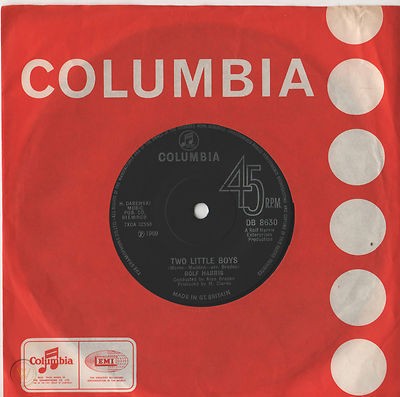
Two Little Boys, by Rolf Harris (his 1st and only #1)
6 weeks, from 14th December 1969 – 25th January 1970
Though in some ways, having a convicted sex-offender at #1 is actually a very appropriate introduction to the 1970s… Yes, let’s get this out the way at the start. Rolf Harris is currently serving a lengthy jail sentence for indecently assaulting several underage girls. (Of course, he’s not the last sex-offender that we’ll meet on our journey through the charts.) I won’t make light of it, because it’s not something to make light of.
To the song, then. Is it a novelty? Is it a ballad? Is it traditional pop? Music hall? All of these things? It’s a tale, as the title suggests, of two little boys. We open on a summer’s day, a back garden somewhere in suburban Australia. (Harris sounds extremely Australian here, especially given that he doesn’t really sing the song as much as he talks us through it.) Two little boys had two little toys, Each had a wooden horse… One boy, Jack, breaks his toy, and starts crying, upon which his little buddy, Joe, offers him a go of his own horse. When we grow up we’ll both be soldiers, And our horses will not be toys… If this were a movie we’d be rolling our eyes at some pretty heavy-handed signposting…
Fast-forward many years. The boys are now soldiers, at war. Cannon roared loud, And in the mad crowd, Wounded and dying lay… One of the little boys. But what’s that? From the fray dashes a horse. Yep, little boy number two… Did you think I would leave you dying, When there’s room on my horse for two…? The roles are reversed: Joe is now in peril, and Jack comes to his rescue.
It’s utter sentimental crap, perfect for the grannies at Christmas. But at the same time, goddamit, it tugs at something. It hits you right in the feels, for want of a better expression, when the marching drums and trumpets fall away, and Harris near-whispers: Can you feel Joe, I’m all a tremble… Perhaps it’s the battle’s noise? But I think it’s because I remember, When we were two little boys… Then we end with what sounds like ‘The Last Post’. It’s a celebration of male friendship, of non-romantic love, even if it does play to the very outdated idea that men can only express affection to one another on the battle, or sports, field.
‘Two Little Boys’ was written many years before, way way back in 1902. The lyrics about ranks so blue make me think it’s set in the US Civil War. Which automatically puts it high up the table of the ‘oldest’ chart-toppers. You’ve got ‘It’s All in the Game’, originally from the 1910s, ‘Lily the Pink’ from the 1870s, ‘Cumberland Gap’ from the mid-eighteen hundreds, and ‘I See the Moon’, parts of which date from the 1780s.
It’s a song that brings about conflicting feelings. Cheesy; but somehow touching. Familiar, but also not a song you can play in public these days… In fact, it’s odd to look back at Rolf Harris’s career from a 2020 vantage point. Growing up in the nineties he was still a constant figure on TV – he sketched, he sang, he cracked jokes, he did his weird wobble board and played his didgeridoo. He was as Australian as Lamingtons (his biggest hit in the UK prior to his sole chart-topper was the Top Ten ‘Tie Me Kangaroo Down, Sport.’) And then he was disgraced and, to be honest, erased from history…
I was half-expecting to not find ‘Two Little Boys’ on Spotify, remembering the furore that R Kelly’s music caused when they reinstated it, as if he was the first pop star with a seedy past. But it’s there; and that’s only right. Harris is a convicted child molester, but his music was, and in some circles probably still is, popular. If people feel uncomfortable listening to it – completely understandable – they can choose not to. But the decision not to listen should be ours, not Spotify’s or HMV’s. That’s my tuppence-worth, anyway…
But enough of that, we should be focusing on the positives! We’re about to jump into the 1970s, the decade of glam, of disco, of punk and new-wave. I’m excited. You should be excited. Hey! Ho! Let’s go!
Listen to every number one from the 1960s (and the 1950s) here!
The second last #1 of the 1960s brings up one of its biggest hits. Eight whole weeks at the top, tying with Elvis’s ‘It’s Now or Never’ (1960) and The Shadows’ ‘Wonderful Land’(1962) for the honour of longest-running chart-topper of the decade. And when you hear the chorus, you begin to understand why…
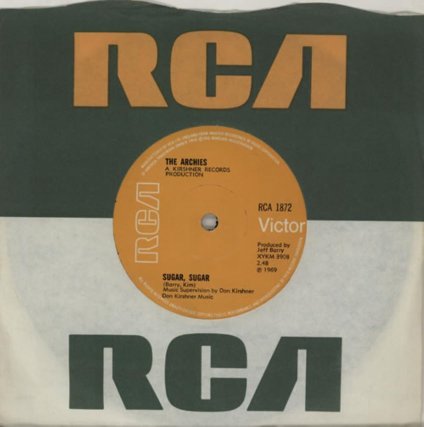
Sugar, Sugar, by The Archies (their 1st and only #1)
8 weeks, from 19th October – 14th December 1969
Sugar – do-do-do-do-do-do… Awww honey, honey – do-do-do-do-do-do… You are my candy girl… And you got me wanting you… It’s a chorus that everyone can sing, imprinted on our collective consciousness. In fact, to call it a ‘chorus’ isn’t very accurate – it is pretty much the entire song. As a record, it is undeniably catchy…
But then so are crabs. To be honest – ‘Sugar, Sugar’ is annoying, it’s simplistic, it’s basic… It’s bubble gum, and then some. Candy floss, sherbet and a huge dose of saccharine for good measure. I just can’t believe the loveliness of loving you… I just can’t believe the wonder of this feeling too… After a couple of listens you start to get a sugar-headache.
It’s one of pop music’s great clichés – love as candy. We’ve already had ‘Sweets for My Sweet’ at #1, and there will be more to come. ‘Candy Girl’, ‘Sweet Like Chocolate’, ‘Sugar Baby Love’… You can make quite the list… ‘Pour Some Sugar On Me’ (a classic, I won’t deny), ‘Brown Sugar’ (a filthy Stones’ take on the theme.) You catch my drift…
There are glimmers of hope here: the low-key verses contrast nicely with the all-out bubble gum of the chorus. And the ‘ad-libs’ towards the end are fun. Pour a little sugar on me honey… Aw yeah… (maybe a young Def Leppard were listening.) All in all though, and I say this as someone who loves pop music, ‘Sugar, Sugar’ is a bit much. I’m glad when it’s over.
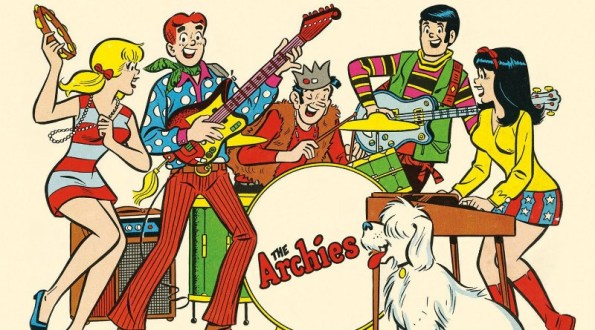
Adding to the sickly effect is the fact that The Archies were a cartoon band, plus a dog, that featured in their own TV variety show, ‘The Archie Show’. To me, they look like the ‘cast’ of ‘Scooby-Doo’ went and formed a band. Their records were recorded by session musicians, several of whom quit when they didn’t get any royalties from their hits. Despite the fact that just two weeks ago we had simulated orgasms at #1, I’d have to say that ‘Sugar, Sugar’ is the more offensive record.
In fact, this is perhaps the icing on the cake for the cynical second half of 1969. We’ve had horrifying visions of an apocalyptic future, and now an equally pessimistic vision of the future of pop music. We’ve had a pre-manufactured band from a TV show at #1 already, but it feels very unfair to compare The Monkees to this… They were real musicians who quickly broke away from their confines. Here you can’t help picturing a cynical record executive laughing and chucking wads of dollar bills in the air… “Who needs real people? Who needs real instruments? It’s mine! All mine!”
Or maybe that’s too much. We’ve had so much amazing music hit number one over the past decade, so perhaps we can cut this record some slack. It what it is, and what it is is fine in small doses. Assembly-line bubblegum is here to stay, and we’ll have to get used to it as we delve into the 1970s…
After all the in-your-face sex and apocalyptic predictions of the past few #1s, it’s nice to hear the gentle piano and bass intro of ‘I’ll Never Fall in Love Again’. The musical equivalent of closing your eyes and taking a deep breath.
I’ll Never Fall in Love Again, by Bobbie Gentry (her 1st and only #1)
1 week, from 12th – 19th October 1969
Not that this record is all sweetness and light, though. The title kind of gives that away. What do you get when you fall in love…? A guy with the pin to burst your bubble… Bobbie is convinced that she’s done with love. That’s what you get for all your trouble…
I love her voice – all tired and husky. It lends a perfect edge to possibly the best rhyming couplet ever to feature in a #1 single: What do you get when you kiss a guy…? You get enough germs to catch pneumonia, After you do he’ll never phone ya… Bacharach and David – racking up another UK chart-topper here – added the line after Burt had been hospitalised with the flu. It does make sense when you realise that this is a B&D number, with its gently soaring melody. They had written it for a musical called ‘Promises, Promises’, and Dionne Warwick had had the hit version of this song in the States.
You could add ‘I’ll Never Love Again’ to our run of recent cynical number ones – crushing the closing months of the swinging sixties – but for one line: So for at least, Until tomorrow… Who knows? She might just meet the man of her dreams tomorrow morning… And I’d argue that there’s something very late-sixties-positive about a young female artist singing about her love life in a matter-of-fact way: I’ve been there and glad I’m out… Women’s Lib reaching the top of the charts right here.
The fact that Bobbie Gentry is a woman is worth noting in itself. She’s the sole female chart-topper of 1969. In fact, in the past three years, only Bobbie, Mary Hopkin, Sandie Shaw and Petula Clark have topped the singles charts as solo females (Esther Obarim, Nancy Sinatra and Jane Birkin did so by duetting with men.) It really is surprising how few women topped the charts throughout the sixties, compared to later decades… I would work out the percentage, if I had any kind of mathematical ability.
Bobbie Gentry is also another artist whom I racially-profiled as a kid… Add her to the list along with Chris Farlowe and Georgie Fame. She isn’t black, she’s another white singer with a bit of soul in her voice, an American Dusty. My first exposure to her was through the superb ‘Ode to Billie Joe’, which was her biggest US hit – a gothic novel in a four-minute pop song – which shockingly only reached #13 in the UK… As nice as ‘I’ll Never Fall in Love Again’ is, it’s no ‘Ode to Billie Joe’.
But it is nice. Better than nice. It’s a great, late-sixties pop song with a hint of country. Bobbie Gentry has become very reclusive in her later years, not recording, performing or giving interviews since 1982. She lives to this day, people believe, in Memphis. And with that, we reach the penultimate number one single of the 1960s…
We end our run of apocalyptic #1s at two, and turn to another of human kind’s most primal concerns. From death and survival, to sex… Though if the end of the world were nigh, you could probably do a lot worse than closing the curtains, dimming the lights, and slipping this disc onto the turntable…
Je T’Aime… Moi Non Plus, by Jane Birkin and Serge Gainsbourg (their 1st and only #1)
1 week, from 5th – 12th October 1969
I mentioned Peter Sarstedt’s ‘Where Do You Go To…’ as a French #1. (Well, it was set in France, and the melody sounded French.) But this is the French #1. For a song to sound any more French, Edith Piaf would need to be singing ‘Frere Jacques’ on top of the Arc De Triomphe.
‘Je T’Aime…’ is a record that you picture in soft focus. All pinks and whites, scattered glasses of champagne with raspberries in them. The organ drones, the drums woozily keep time, and the strings flutter around the edges. I particularly love the filthy growl in the bass just before the main riff. Meanwhile Jane Birkin and Serge Gainsbourg breath, whine, mutter, whisper, and moan… Do everything but actually sing.
The lyrics are all en Francais: Je t’aime, Je t’aime, Oui je t’aime… sings Jane. I love you, Yes I love you! Moi non plus… mutters Serge. Me neither. Jane: Oh, mon amour… It’s been written off as nonsense – ‘I Love You, Me Neither’ – but I think it shows that the singers only have lust on their minds. From now on I’ll write the lyrics in English, even though they sound much better in French…
Like a vacillating wave, I go, I come and go, Inside of you… Ooh la la! Potent stuff. Even worse if you translate the Inside of you line literally. Entre te reins = Between your kidneys. Kind of gross. By the end, Birkin is faking a pretty convincing orgasm. At least, we think she’s faking… At the time there were rumours, or some well-contrived publicity, that ‘Je T’Aime…’ was a chart-topping single with live sex (!) on it.
Even today, in our cynical world, a record like this would raise eyebrows. In 1969, there was a fair amount of controversy. The record was banned, obviously, from radio, except in France, where it could be played after 11pm. The Vatican excommunicated the Italian label exec. who released it. Gainsbourg was unrepentant, claiming that it wasn’t about sex, but about the impossibility of true love. Others have argued that it is a feminist song, thanks to the line at the end when Birkin breathes: Non! Maintenant! Viens! (No! Come! Now!) She is in control of the love-making.
At the same time, while ‘Je T’Aime…’ is still a fairly attention-grabbing record, it also comes across as very camp and kitschy. I’m sure most people were buying it for a laugh, rather than as a soundtrack to romantic nights in. It’s also suffered the same fate as, say, ‘The Good, The Bad and The Ugly’, in that it’s become a cliché – a piece of music to play over a certain scene: in this case one involving a comical seduction. I’m not sure if or why anyone would want to sit down today and listen to it. Plus, at four and a half minutes it goes on for much longer than it needs to. But… In 1969 people lapped it up. ‘Je T’Aime…’ had already reached #2, been banned, then re-leased to make #1!
Birkin and Gainsbourg were a real-life couple when they recorded their sole chart-topper. She was twenty-three, he was forty-one. Their daughter is the actress Charlotte Gainsbourg. Serge had originally recorded it with Brigitte Bardot, but her husband had stopped them from releasing it. I know very little about their other recordings. Birkin still sings and acts to this day; Gainsbourg meanwhile is a legendary figure in France – provocative and boundary-pushing. It’s sad that most English speakers know him solely for this record, his chain-smoking and for the famous TV interview in which he told a young Whitney Houston that he wanted to ‘fuck her’ (his words.) He died in 1991 after years of alcoholism.
A notable #1 then – the first in a foreign language, the first to feature simulated sex, the first to get somebody excommunicated. And suddenly we’re three chart-toppers away from the 1970s!
Yee-hah! Break out the moonshine, we’re off down the Bayou for a rowdy rock ‘n’ roll shindig with CCR!
Bad Moon Rising, by Creedence Clearwater Revival (their 1st and only #1)
3 weeks, from 14th September – 5th October 1969
I love me some Creedence. And I love that they are the unlikely owners of a UK #1 single. Perhaps the most American band ever; that didn’t hold them back from hitting it big on the other side of the Atlantic. And while it does feel a bit odd that CCR was able to top the charts here; it does make sense that they’d do so with what’s probably their catchiest single.
Catchy, but also terrifying. Zager and Evans kicked us off down an apocalyptic path with our last #1, ‘In the Year 2525’, and John Fogerty and co. keep it up here. I see a bad moon rising, I see trouble on the way, I see earthquakes and lightning, I see bad time today… Something terrible is on its way… Rivers are overflowing, hurricanes are a-blowing. This song has possibly the biggest contrast between melody and lyrics of any chart-topping single. The tune: rough and ready rockabilly. The lyrics: Don’t go round tonight, It’s bound to take your life… There’s a bad moon on the rise…
It’s a short and sweet record, one that breezes in and out in just over two minutes. Apparently it was inspired by a scene involving a hurricane in an old movie, but Fogerty also claims to have written it on the day that Richard Nixon was elected president. For a decade that has been so swinging, so iconic, we’re heading for a sour and cynical finish. Maybe we have to look beyond the charts for the answer here –this is a product of a world where a whole generation of Americans were dying in Vietnam, men were landing on the moon, and Kennedys were getting shot…
By the final verse, things are getting very intense. Hope you’ve got your things together, Hope you are quite prepared to die… It’s all a bit much, and then we crash to an end. We open our eyes and breathe a sigh of relief that we’re all still here. The end hasn’t arrived, yet… Over and out from Creedence Clearwater Revival. Sadly this is their only #1 single, though we should just be glad that they managed even one. In their home country, they had far more hit singles – ‘Proud Mary, ‘Green River’, ‘Travellin’ Band’, ‘Lookin’ Out My Back Door’ and this record all hit #2 in 1969 / 70. Yet a Billboard #1 eluded them…
I love this track, in all its swamp rocking, apocalyptic glory. But, if you do find it all a bit much, a bit depressing, you can just do what John Fogerty does occasionally in concert: change the words of the chorus to There’s a bathroom on the right…
If the world were ending, you could do a lot worse than soundtracking it with this playlist:














 The UK Number Ones Blog