358. ‘Sad Sweet Dreamer’, by Sweet Sensation

One thing that becomes clear the longer this trawl through the charts goes on… If a hot new sound makes its way across the Atlantic – be it rock ‘n’ roll, Motown, or disco – it won’t be long before the Brits are trying it out for themselves.
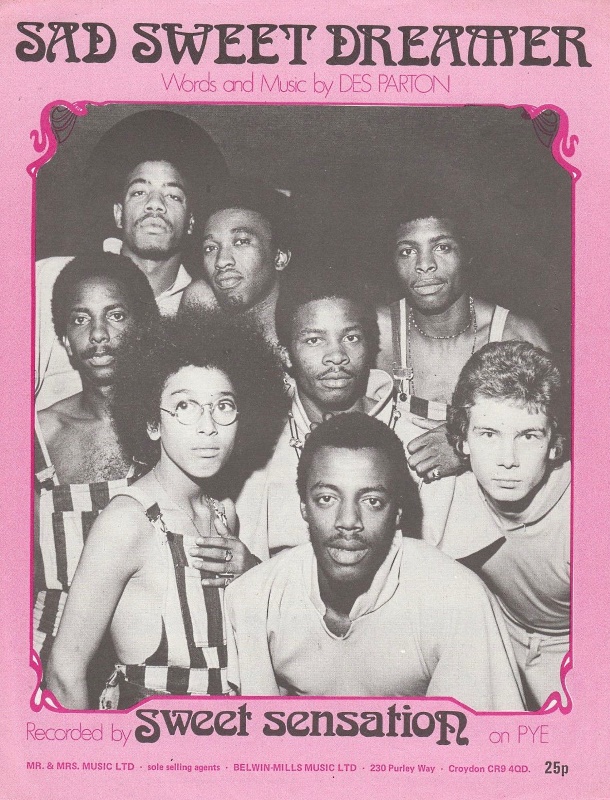
Sad Sweet Dreamer, by Sweet Sensation (their 1st and only #1)

1 week, from 13th – 20th October 1974

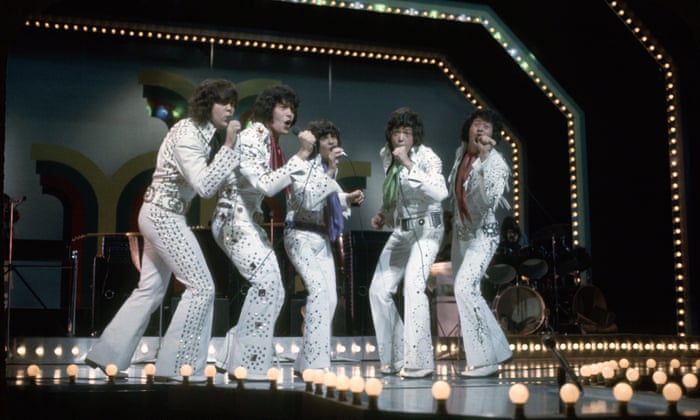
I was genuinely surprised to find out that Sweet Sensation were a UK based band, from Manchester, so drenched is this record in the Philly-soul sound. Ooh-wah-wah-ooh-wah-wah-ooh… We’ve got strings, saxophones (a proper ‘Baker Street’ sax-riff), and that wonderful, trademark chukka-chukka disco guitar. Sad sweet dreamer, It’s just one of those things you put down to experience… That chorus is sung by the band, in response to the lead singer’s tale of heartbreak.

Been another long night and I’ve missed you girl… I was also genuinely surprised to discover that the lead vocals are not being sung by a woman, so soft and gentle is the falsetto. (That and the fact they’re singing about a girl… Which would have been very progressive for 1974.) Marcel King was just seventeen years old when this hit #1, which makes sense both in terms of how young he sounds and in the way he’s cast as the lovelorn teen: the sad sweet dreamer. I’ve been thinking about you girl, All night long…

I like this record. It’s a grower – a sexy, glossy, sophisticated disco-soul track, from what I am now naming ‘The Disco Fall’ (gettit, like a ‘disco ball’??) There’s something slightly suspect about bands whose name and biggest hit share words. It screams ‘novelty ahoy’! (Think Las Ketchup with ‘The Ketchup Song’, or Mr. Blobby). But in the case of Sweet Sensation’s ‘Sad Sweet Dreamer’ I think it’s just a coincidence. They were, however, very nearly one-hit wonders. The follow up to this made #11, and that was that.

Some interesting titbits about this record. Sweet Sensation sprang to national attention by winning a TV talent contest, ‘New Faces’. Which means we can add them alongside Peters and Lee, and Paper Lace, in this category. But ‘Sad Sweet Dreamer’ feels like a ‘real’ record – if one record can indeed be any realer than another. It fits right in with earlier, high-quality chart-toppers from The Three Degrees and George McCrae in shaping the sound of late-74.

It was also produced by one Tony Hatch, whose wife Jackie Trent had enjoyed her very own #1 single back in 1965. She even features as a backing vocalist here, scoring her 2nd chart-topper by proxy. And finally, ‘Sad Sweet Dreamer’ is another one of those records that is nowhere to be seen on Spotify… unless you want a ropey cover from a band called The Top of the Poppers. Meanwhile, a completely unrelated band called Sweet Sensation can be found, offering their brand of late-eighties, Hi-NRG dance-pop, if that’s your bag…

357. ‘Annie’s Song’, by John Denver

Finally, we get a respite from all the disco, by lurching as far away from the dance hall as possible.

Annie’s Song, by John Denver (his 1st and only #1)

1 week, from 6th – 13th October 1974

I didn’t think I knew this one… Until after ten seconds, when the vocals begin: You fill up my senses, Like a night in a forest… Of course I know this. It’s an easy listening classic. Like the mountains in spring time, Like a walk in the rain… A girl – Annie, we might presume – stimulates John Denver in ways that normally only nature does. You fill up my senses, Come fill me again…

I have to admit, I remain unconvinced by that line. It just sounds… odd. (Yes, I am well aware that my mind is in the gutter.) And I have to admit, I remain unconvinced by this song. By this entire genre of acoustic, singer-songwriter balladry on the whole. It is just not my cup of tea. Whenever one of these #1s comes along, as they will do from time to time, I will endeavour to put my prejudices aside and judge fairly.

It might not be disco, but it is still a very American sounding record. The Billboard charts of the mid-seventies were choc-a-bloc with soft, countryish rock like this. For whatever reason, ‘Annie’s Song’ was one of the few that managed to break through to the top across the Atlantic. (I had my suspicions that this was a posthumous chart-topper, which would maybe have explained why it made it to the top, because I knew that John Denver died in a plane crash. Except that was in 1997…)

As the song progresses, the production becomes more and more overblown. In come strings, and mandolins, and melodic hums from the backing vocalists. The lyrics also become a little OTT: Let me drown in your laughter, Let me die in your arms… Maybe I’m giving myself away as completely unromantic, but he is laying it on a little bit thick.

‘Annie’ was Denver’s wife at the time, and he was inspired to write the song while on a ski-lift in Aspen, Colorado. He claimed he skied back down the mountain and wrote it in an hour. Colorado was the inspiration for much of his music – he used the capital as his stage name, and was named the state’s poet laureate. When he did indeed die in a plane crash, his ashes were scattered across the Rocky Mountains.

What amazes me is that this was John Denver’s one and only hit record in the UK. He was a huge chart star in the States – four number ones to his name – but a bona-fide one-hit wonder in Britain! His most famous songs that aren’t ‘Annie’s Song’ – ‘Take Me Home, Country Roads’ and ‘Leaving on a Jet Plane’ – were hits, though, for Olivia Newton-John and Peter, Paul and Mary. A chart quirk, then; and probably the most prolific one-hit wonder in UK chart history!

356. ‘Kung Fu Fighting’, by Carl Douglas

Good Lord, we did fall hard for disco in the summer of 1974, didn’t we! It suddenly feels like I’m covering the charts of a completely different country, so quickly has the musical landscape changed.

Kung Fu Fighting, by Carl Douglas (his 1st and only #1)

3 weeks, from 15th September – 6th October 1974

‘Kung Fu Fighting’ becomes the third disco #1 in four, which means that disco was cool for precisely two songs. Because this record, for all its many good points, is not ‘cool’. It’s – let’s be honest – ridiculous. Woah-oh-ho-ho… everyone knows the intro, the slow build up, the Oriental riff… Woah-oh-ho-ho…

And then click. Disco time. Everybody was kung fu fighting… Huh!… Hah! Those kicks were fast as lightning… (There seems to be no consensus on whether it is ‘those kicks’, ‘those kids’ or ‘those cats’. I’ve always thought it was ‘kicks’ – it makes sense in a song about a martial art – so I’ll stick with it.) This was the era of the classic Hong Kong Kung Fu movie – Bruce Lee, ‘Enter the Dragon’ and all that – and the songwriters seized the zeitgeist, mixed it with the up and coming new club sound, and scored a ginormous number one hit all around the globe.

Even in 2020, it is a song that most people will know. I’m not sure lines like they were funky Chinamen from funky Chinatown… would pass the censors these days, mind, especially when coupled with the aforementioned ‘Oriental riff’. (Though the way they manage to translate the riff into disco strings is probably the best bit of the whole song.) Come verse II, we meet funky Billy Chin and little Sammy Chong… he said, ‘Here comes the Big Boss’, let’s get it on… I mean, it’s dumb, but you’ll struggle to argue that it’s not fun.

Actually, it’s a hard song to really place. It’s a little too hip to be a novelty, but it’s way too silly to be treated as a serious pop record. Let’s treat it, then, as a slice of classic cheese. Throw it on at the end of a wedding disco and watch people fly. Literally, in some cases. Meanwhile, twelve-year-old me still has a massive soft spot for the Bus Stop version, which reached #8 in the late ‘90s, and which takes the disco of the original, ups the Kung Fu sound effects, adds rapping and a manic Eurodance beat to create something… Well, let’s just call it ‘something.’

Perhaps unsurprisingly, there was nobody of Chinese origin involved in the making of ‘Kung Fu Fighting’. Carl Douglas was Jamaican, while producer Biddu (a disco pioneer) was British-Indian. Douglas is almost the very definition of a one-hit wonder… alas the follow-up to this – ‘Dance the Kung Fu’ – made #35 (while he was also credited on the Bus Stop version.) To his credit, he is still happy to perform the song live, more often than not in his red Shaolin monk’s uniform, and if he’s proud of his biggest hit then who am I to judge?

Should’ve Been a #1… ‘Crazy Horses’, by The Osmonds

I’ve done a few posts like this before, but thought I’d start making it more of a regular feature. Having just featured Donny and co’s sole UK chart-topper – the decidedly so-so ‘Love Me For a Reason’ – we might as well visit their first big British hit.

‘Crazy Horses’, by The Osmonds – #2 in November 1972

I had heard of ‘Crazy Horses’ long before I ever listened to it. Aged twelve or so, I was the proud owner of the ‘A-Z of Behaving Badly’, a spin-off book from the ’90s sitcom ‘Men Behaving Badly’ (Wiki link provided, if you have no idea what I’m on about). Said book named ‘Crazy Horses’ as one of the best songs for singing loudly on your way home from the pub…

In those pre-internet, iTunes, Spotify days… amazing to think of it actually… I went years without ever knowing what the song sounded like. It sounded cool: ‘Crazy Horses’. But it was by The Osmonds, who were lame, so it mustn’t have been that good…

How wrong I was. ‘Crazy Horses’ is brilliant. One of the catchiest, zaniest, most enjoyable hits of the early seventies. Just watch the video below. How much fun is Jay Osmond having on lead vocals, doing the funky chicken! How much fun is Merrill having shrieking his way through the bridge! How much fun is Donny having making horsey noises on his keyboard! A lot of fun, is the correct answer.

I’ve seen ‘Crazy Horses’ described as metal. It’s not, but for The Osmonds it might as well have been. Their one, minor hit as a group before this had been the catchy-but-super-cheesy ‘Down by the Lazy River’. Just a few months before this made #2, lil’ Donny had scored his first chart-topper with the cloying ‘Puppy Love’.

Not only is ‘Crazy Horses’ ridiculous, and ridiculously catchy, it also has a message behind it. What a show, There they go, Smokin’ up the sky… ‘Crazy horses’ being cars, whose fumes are destroying the planet: Crazy horses all got riders and they’re you and I…! How woke is that, for 1972!

Unfortunately, some countries banned the record, as they thought all the talk of ‘horse’ and ‘smokin’ were… gasp… drug references! Which simply makes it even more rock ‘n’ roll, and even more amazing that The Osmonds were behind it.

So there you have it. After sitting through all the middling to awful #1 singles involving the Osmond brothers, we desperately needed to give their best song a moment in the sun. ‘Crazy Horses’ should definitely have been a number one!

355. ‘Love Me For a Reason’, by The Osmonds

It’s time. A little later than you might have expected, but The Osmonds have their number one single.

Love Me For a Reason, by The Osmonds (their 1st and only #1)

3 weeks, from 25th August – 15th September 1974

It’s every bit as cheesy and tinkling as you might expect. It soars, it swoops, it blinds you with the whiteness of its teeth. Suddenly the UK charts sound very ‘American’, with three glossy, shining number ones in a row. But while George McCrae and The Three Degrees were pretty cool… this one really ain’t.

Don’t love me for fun girl, Let me be the one, girl… Love me for a reason, Let the reason be love… For the second time this year, we come to a #1 that I first heard as a child thanks to an Irish boyband. I knew ‘Seasons in the Sun’ through Westlife’s cover, I knew this thanks to their predecessors Boyzone, who took their ‘Love Me For a Reason’ to #2 in 1994.

If love ever-lasting, Isn’t what you’re asking… I’ll have to pass, girl, And be proud to take a stand… Maybe I’m showing my prejudices here, but isn’t it usually girls that sing about love that lasts? The Three Degrees, for example, were just asking when they’d see you again. Or there was Freda Payne lamenting broken promises on her wedding night. Guys are usually happy with, well, something more instant. But, The Osmonds were good ol’ Mormon boys that needed more than just physical attraction (their words.) All of which culminates in the spectacular line: My initial reaction is, Honey give me love, Not a facsimile of…

Any song that can crowbar the word ‘facsimile’ into its lyrics cannot be all bad and, to tell the truth, this is a decent pop song with a highly singalongable chorus. It also has one hell of a key change towards the end, that sounds as if a sound engineer accidentally leant on a dial. And, even though I introed this post by suggesting that The Osmonds had waited longer than most for their shot at #1, ‘Love Me for a Reason’ was only their sixth chart hit in the UK. It feels like a longer wait because, unusually, the solo Osmond(s) topped the charts long before the band. Donny’s been there three times, and Little Jimmy (while not technically a member of ‘The Osmonds’ at this point) has summited once.

The band would go on releasing albums until the end of the seventies, before splitting up and moving into different ventures. Donny would be the most successful, with his sister Marie. But this is it for them, in terms of topping the charts as a group. Just the one. And I’m sure most would agree that, if they could choose the one Osmonds disc they would allow to top the charts, it wouldn’t be this one. It would be… Well, I might just do a separate post on that very soon. Watch this space…

354. ‘When Will I See You Again’, by The Three Degrees

As if to confirm that our last helping of disco-soul – George McCrae’s ‘Rock Your Baby’ – wasn’t a fluke, here’s another slice. Go on, you know you want to…

When Will I See You Again, by The Three Degrees (their 1st and only #1)

2 weeks, from 11th – 25th August 1974

This is an impossibly glitzy record – you can’t help imagine a shimmering disco ball slowly spinning above The Three Degrees as they sing – and, as with our previous #1, it’s supremely glossy. Back in the fifties, I used to write that American singers sounded so polished and mature, so sexy, next to our gurning music hall stars. So it is again. We were dancing like loons to ‘Sugar Baby Love’; they were coolly shimmying to records like this.

Hoooo…. Haaaa… Precious moments…. It’s a reboot of the classic sixties girl-groups – The Shirelles, The Ronettes and, of course, The Supremes. When will I see you again…? Lyrically, this is very close to ‘Will You Still Love Me Tomorrow’, with the singers asking if what’s just passed is the real thing or just a fling. When will we share precious moments…? It’s such a perfect pop song, so well put together, so smooth and silky, that I’m struggling to pick it apart. Maybe it’s one that simply needs listening to, and appreciating, and I can shut up. Post over.

It’s also a record that gets better as it progresses. I like it when lead singer Sheila Ferguson gets insistent: Are we in love, Or just friends… Is this my beginning, Or is this the end…? Enter a funky brass section, on top of the swirling strings, which I feel shouldn’t work but which does, wonderfully.

Apparently Ferguson really didn’t like ‘When Will I See You Again’ when it was first offered to the group. “I thought it was ridiculously insulting to be given such a simple song, and that it took no talent to sing it,” she said later. Not the first, nor the last, example of a singer not knowing a hit song even if it jumped up and bit them on the behind.

I’m amazed at how few big hits The Three Degrees enjoyed in the UK. This was the biggest of just five Top 10s. In the US – and this truly has me flabbergasted – this record reached #2… and then they never had a hit again! I didn’t know much about them, but The Three Degrees just sound like such a classic pop group. I’d have had them up there with the aforementioned sixties girl groups in terms of hit singles.

Still, as I’ve said before, if you’re gonna have a limited number of hits, you better make ‘em good ones. This is definitely a ‘good one’. It is also, by all accounts, one of Prince Charles’s favourite songs – the group performed it for him, in Buckingham Palace, for his thirtieth birthday. The man has taste. The Three Degrees are still a going concern, with one of the ladies whom you can hear on this record: Valerie Holiday. Of the other two, Fayette Pinkney, a founding member of the group, passed away in 2009, and Sheila Ferguson went solo in the ‘80s. There have been fifteen members in total but, for obvious reasons, only three at one time…

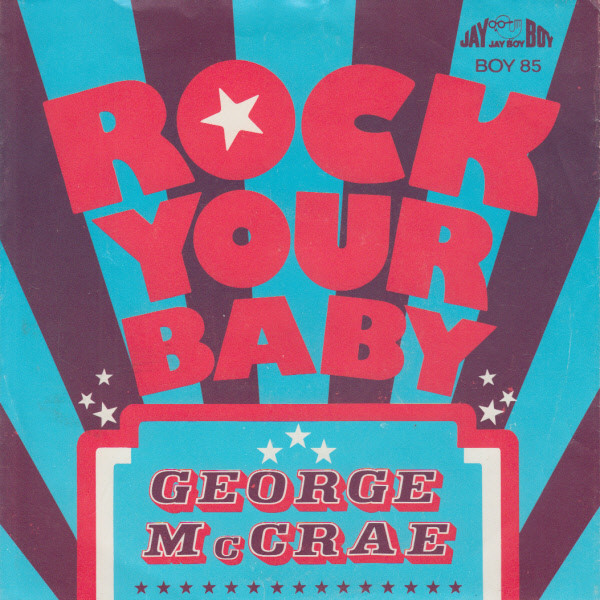
353. ‘Rock Your Baby’, by George McCrae

This next #1 arrives like a fluffy cloud, a soft pillow upon which you might rest your head after a long day. Satin bedsheets. Rose petals scattered. A heavy-breathed Sexy…. Smooth. As silk.

Rock Your Baby, by George McCrae (his 1st and only #1)

3 weeks, from 21st July – 11th August 1974

Woman, Take me in your arms, Rock your baby… The voice sounds as if it’s coming from on high, slightly out of focus, drenched in echo. Is he singing about dancing, or sex? Dancing then sex? There’s nothing to it, Just say you wanna do it… I’d go with sex. Especially with that chucka-chucka rhythm nudging us along, like the soundtrack to a classic, moustaches and chest-hair porno.

There’s not a huge amount to this record. It floats in then floats out. Chilled, funky, and soulful. Kids today would call it a ‘mood’. George McCrae’s voice is honeyed and high-pitched, especially when he reaches for the falsetto at the end of the Now let your lovin’ flow, Real sweet and slow… line. (Ok, there’s no way this song isn’t about sex…)

This is soul with a capital S, the sound that had been dominating US pop music for years, and that had made headway in the UK charts in the late sixties/early seventies, before getting turfed out the way by glam. But it’s back, baby. The backing track existed before the lyrics, recorded by a member of KC and the Sunshine band and using a drum machine when that was a very experimental thing to do. McCrae came along, added his vocals and scored a huge debut hit around the world.

But wait. A. Second. Calling this ‘soul’ isn’t telling the whole picture. ‘Rock Your Baby’ is something else too. One of those watershed moment that come along every so often, when a #1 single points to the future. A five letter future: D. I. S. C. O. The five most sneered upon letters in pop music…?

Not that I’ve got anything against disco. I’m really looking forward to writing posts on some of the decades later, cheesier disco hits. And I’ve nothing against this song. It’s cool, and catchy. Get this track down your headphones this while walking along the street and you won’t be able to stop swaggering. It sounds so much more grown-up, so much more sophisticated, when compared to the year’s earlier chart-toppers from Gary Glitter and – as much as do I love it – Mud. This is a disc your cool older sister would have been listening too while you were still blasting ‘Tiger Feet’.

George McCrae struggled to follow-up this monster hit – it was #1 everywhere – but he’s still alive and still performs, in his mid-seventies. Press play, then, and enjoy the sound of the summer of ’74. As we pass the midway point of the year, popular music gently ticks over into a new era…

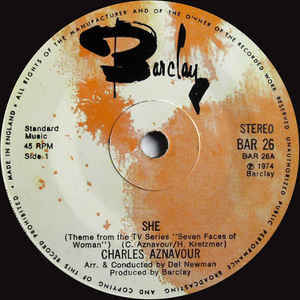
352. ‘She’, by Charles Aznavour

Un chanson, en anglais…

She, by Charles Aznavour (his 1st and only #1)

4 weeks, from 23rd June – 21st July 1974

It’s a simple ballad – a piano, a voice, not much else to start with – about an unnamed woman. She. A bit of a femme fatale, it sounds like. She may be the beauty or the beast, May be the famine or the feast… Not the most flattering lyrics for a love song, you might argue.

The words are crammed into each line, running on slightly, spilling over onto the next, in that way that French chansons do, a la Jacques Brel and Edith Piaf. She who always seems so happy in a crowd, Whose eyes can be so private and so proud… Meanwhile, when the drums come in, it starts to sound like a late Beatles ballad, a ‘Something’, or a ‘Long and Winding Road’.

Charles Aznavour was French-Armenian, and he sings this in heavily-accented English. I’m not sure it would work so well were it sung in straight-forward British or American tones. The Frenchness of it adds glamour, mystery, and romance – all the things that we pasty, repressed Anglo-Saxons associate, rightly or wrongly, with the other side of the channel. I knew this song through Elvis Costello’s late-nineties version and, looking back, it’s not as good simply because he isn’t French.

Not only was Aznavour French, he was also pretty old – he’d just turned fifty when ‘She’ hit the top of the charts, making him… I think… the second oldest male chart-topper, so far, behind Louis Armstrong. He sounds older, even, when he sings, and again this adds to the mystique, to the idea that his life has been plagued-slash-brightened by this alluring lady. It was recorded as the theme to a TV series: ‘Seven Faces of a Woman’ (which can’t have been very memorable, as it doesn’t have a Wiki page) and soared to the top of the charts as a result. Amazingly, this was Aznavour’s second and final chart hit in the UK. Mais, en France…

I would need another article to do his biography justice. A seventy year career taking in 1,200 songs… France’s Sinatra… ‘Entertainer of the Century’ ahead of Elvis… Seller of 200 million records… Performing until a few weeks before his death aged ninety-four! And that’s before you get to the non-musical portion of his life: he sheltered Jews during WWII, he was a National Hero of Armenia, as well as Armenian ambassador to Switzerland, an opposer of far-right politicians, a supporter of LGBT rights before that was the done thing… He sounds like quite the guy. And it just goes to show how insular our Anglo-centric world can be, given that I knew nothing of his life before writing this post!

Follow along with my playlist:

351. ‘Always Yours’, by Gary Glitter

When I first saw Gary Glitter’s third and final #1 looming on my list, I assumed it would be a ballad. ‘Always Yours’. A Glitterballad. A cod-Elvis croonathon. I was bracing myself…

Always Yours, by Gary Glitter (his 3rd and final #1)

1 week, from 16th – 23rd June 1974

Except, it’s another foot tapper. Glitter clearly didn’t do ballads. (OK, he did, they just didn’t get to number one.) I’m getting Mud (the that’s me, that’s me lines are straight outta ‘Tiger Feet’) through Shakin’ Stevens vibes. Also, hints of Adam Ant. Considering that the latter two acts are a decade away from arriving on the scene, we can conclude that Gary Glitter was a bit of an influence. He wasn’t always, I have to keep reminding myself, just a creepy paedo.

You know, I know, I’ll never never let you go… It’s a frantic record that races through its three minute allocation. The glitter stomp drumbeat has been sped up to raucous rockabilly levels. There are handclaps, pianos, and Glitter’s frenzied vocals. He certainly was an energetic performer. Al-ways Yo-ours…

As with all his #1s, you don’t have to look very hard before finding lines that sound dodgy in hindsight. I’m a scream, A teenage dream… he yelps. Which is rich, coming from a man in his mid-thirties. We’ve come full circle, from the days of thirty-something Bill Haley rocking around the clock to Glitter and Alvin Stardust dancing about in sparkly jumpsuits. When the kids have moved on you know a style is on its way out…

But ‘Always Yours’ is a perfectly reasonable slice of late-era glam. It is undeniably catchy; though I would rate it worst out of his three chart-toppers. I had never ever heard it before, and I probably never will again without choosing to. I won’t be doing a Gary Glitter Top 10, or a Remembering Gary Glitter when he passes. He has been jailed for possessing child pornography, for child sexual abuse and attempted rape. We’ll leave him here. (Actually, not really. We’ll have cause to mention him when we arrive at a couple of 80s #1s.)

It is interesting, however. Why has Gary Glitter been so completely erased from British pop music history, when others with similar allegations to their name haven’t? Plenty of huge stars from the sixties and seventies have their accusers… Jagger, Bowie… while Pete Townshend got caught ‘researching’ a book on child abuse. They all still get played on the radio. Is it as simple as Glitter got convicted? Then there’s Michael Jackson. Again, no conviction, but enough evidence and testimony for us to conclude that something unsavoury was going on at Neverland. His music’s still played, for the most part. Phil Spector, currently in prison for murder, will have his Christmas hits played this year; Glitter’s ‘Rock n Roll Christmas’ will not be getting a spin.

Does it then, ultimately, come down to snobbery? Are we willing to overlook artists’ indiscretions, as long as they make ‘good’ music? Gary Glitter was always a bit of a prat, a clownish character, who released disposable pop music. Same goes, to an extent, for R. Kelly, who in recent years has undergone a similar cancelling. I’m not advocating a rehabilitation of Gary Glitter. He’s clearly a nasty piece of work. I’m just amazed at how sudden and complete his fall from grace was. Even in the mid-1990s he was being sampled by Oasis on the opening track of the decade’s biggest album. He was due a cameo in The Spice Girls movie, which had to be re-shot last-minute following his ill-fated trip to PC World. Then, cut. Finished. One of Britain’s biggest pop stars was Britain’s public enemy number one. That, as they say, was that.

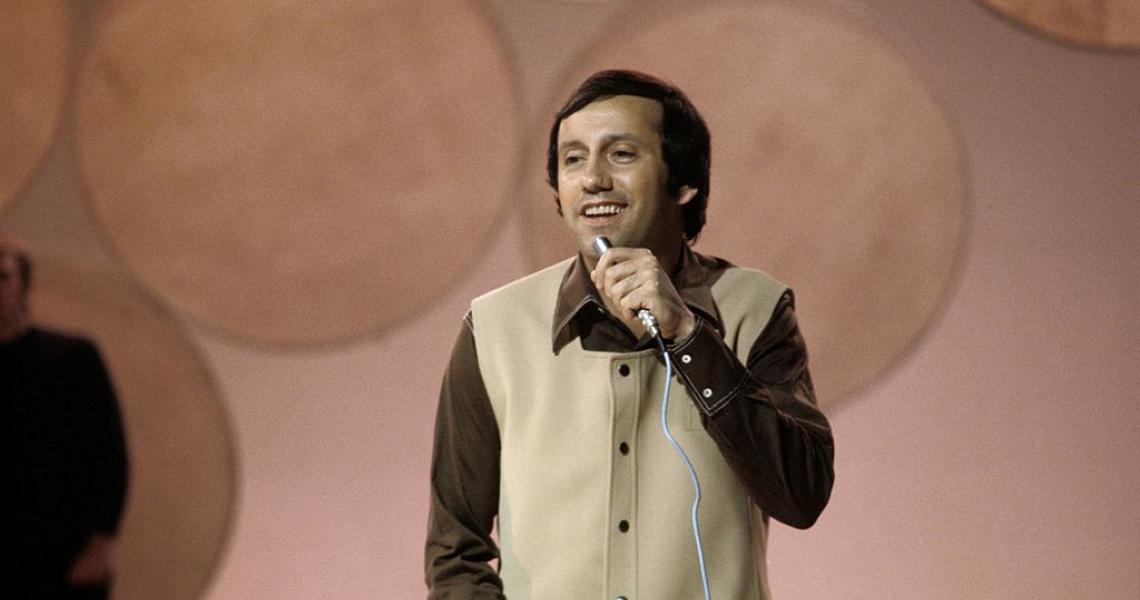
350. ‘The Streak’, by Ray Stevens

Oh Lordy. Did anyone order a country rock, spoken word, novelty song about a sprinting nudist…? Anyone? Anyone?

The Streak, by Ray Stevens (his 1st and only #1)

1 week, from 9th – 16th June 1974

No punches pulled: this is a song that makes your teeth clench. The mix of sound effects and voice acting, not to mention liberal use of a banjo, does not make for a relaxing listen. Then there’s a wheeee noise that SongFacts describes as a: ‘zipppp kazoo sound.’ Eeesh! It is a story told by two characters: a roving news reporter, and a slack-jawed yokel who, for some unspecified reason, is being followed by a streaker.

Oh yes they call him ‘the streak’, Fastest thing on two feet… Off he goes, around the supermarket, through the gas station, over to the basketball stadium… He’s just as proud as he can be, With his anatomy, He goin’ give us a peek… The yokel is appalled by ‘The Streak’, but the same can’t be said for his wife Ethel… No matter how much of a warning her husband gives her, she always ends up catching a glimpse…

I don’t want to sound like a po-faced prude, but… This song isn’t very funny. Its closest chart-topping companion would be Benny Hill’s ‘Ernie’, but at least that was witty and warm, and just plain old silly. ‘The Streak’, though, is brash, in your face, and just plain old irritating. The lowest point is the canned laughter – actual canned laughter – as if the producers deep down knew that it wasn’t in any way hilarious and needed to convince themselves.

Some of the lines are kind of clever, I guess: he’s always makin’ the news, wearing just his tennis shoes… and I do like the image of ol’ Ethel disobeying her husband to have a glance. By the end, she’s made her choice and has stripped off too. Ethel you shameless hussy! (Her husband’s words, not mine, and apparently mis-heard by many for something much ruder…)

I wasn’t around, but apparently there was a streaking craze in the mid seventies. In March ’74 alone there was a streaker at an Arsenal Vs Man City match, that Wikipedia debatably describes as ‘the first instance of streaking in English football’, and a streaker at a cricket test between Australia and New Zealand. Meanwhile, a ‘streaking epidemic’ was hitting US college sports. There was even a streaker at the 1974 Oscars! Clearly the world was ready for a hit single about running in the nude. And Ray Stevens delivered… I dunno, maybe you had to be there.

Stevens had been around since the fifties – a country singer-songwriter who flipped between serious and comedic singles at random. His two biggest hits before this had been ‘Ahab the Arab’ – a US #5 in 1962 – and the primary school hymn ‘Everything Is Beautiful’ – an actual Billboard #1 in 1970. An eclectic range, to put it mildly…

But back to ‘The Streak’. The main problem with this is that it is obnoxious. I’ve said it before – some novelties are novelties by accident, through experiment, trial and error. ‘Mouldy Old Dough’, for example, or even ‘Telstar’ – a glorious, weird outlier in the history of the charts. Other novelties set out from the start to amuse, entertain or, more often than not, annoy. Did anyone who bought ‘The Streak’ actually listen to it more than twice? Probably not. But there it is: a transatlantic #1 hit.