Two posts ago, as we endured B*Witched’s ‘C’est la Vie’, I hinted at an impending tween-pop takeover. Well, don’t say I didn’t warn you…
Because We Want To, by Billie (her 1st of three #1s)
1 week, from 5th – 12th July 1998
Was ‘tweenager’ a word back in 1998? Apparently yes – it was first used in 1949. So we can use it freely to describe this next #1. ‘Because We Want To’, by fifteen-year-old Billie Piper, is perhaps the ultimate tween-pop record: vital to anyone aged eight to twelve when it came out; anathema to anyone even slightly older.
Why you gotta play that song so loud? Because we want to… Why you always run around in crowds? Because we want to… This ode to tweenage rebellion is simplistic, dumb, and annoyingly catchy. The lyrics feel so forced that the modern Gen Alpha cyborgs that pass for children these days would laugh in its face. But the late ‘90s were a simpler time, and clearly this struck a chord with the youth of the day. (I was twelve, and I found it irritating and irrelevant, so I assume most of the 80,000 copies that sent it straight to number one were bought by kids significantly younger than me…)
As much as I don’t like this record, I will make one important distinction: it’s better than ‘C’est la Vie’. But the production is cheap and dated – opening with the quacking duck synths last heard on Whigfield’s ‘Saturday Night’ – and it thumps its way into your brain with its silly, chanty chorus. The middle-eight is the best bit of the song, and owes a debt to the Spice Girls: a mix of Mel B’s rap from ‘Wannabe’ and the chorus of ‘Who Do You Think You Are’.
And right there is the problem. The Spice Girls had been so successful in grabbing the attention – and the pocket money – of children across the world that we’re starting to see a whole range of lesser copycats spring up. First B*Witched, now Billie… Just be glad that Vanilla’s ‘No Way, No Way’ fell short. (Although, let’s be honest, that would have made an iconic number one…)
As with B*Witched, this breakthrough hit set Billie up for a short of burst of chart-topping glory, and she’ll return to these pages soon enough. ‘Because We Want To’ made her the second-youngest female to top the charts, and the youngest since Helen Shapiro in 1961. A lot was made at the time of Billie being the youngest artist ever to ‘enter the charts at #1’, but that seems like an pointless distinction when almost every record was entering the charts at #1 in 1998. Still, it’s an impressive achievement, surpassing anything I was doing aged fifteen (most of which wouldn’t be fit to publish in such polite company…)
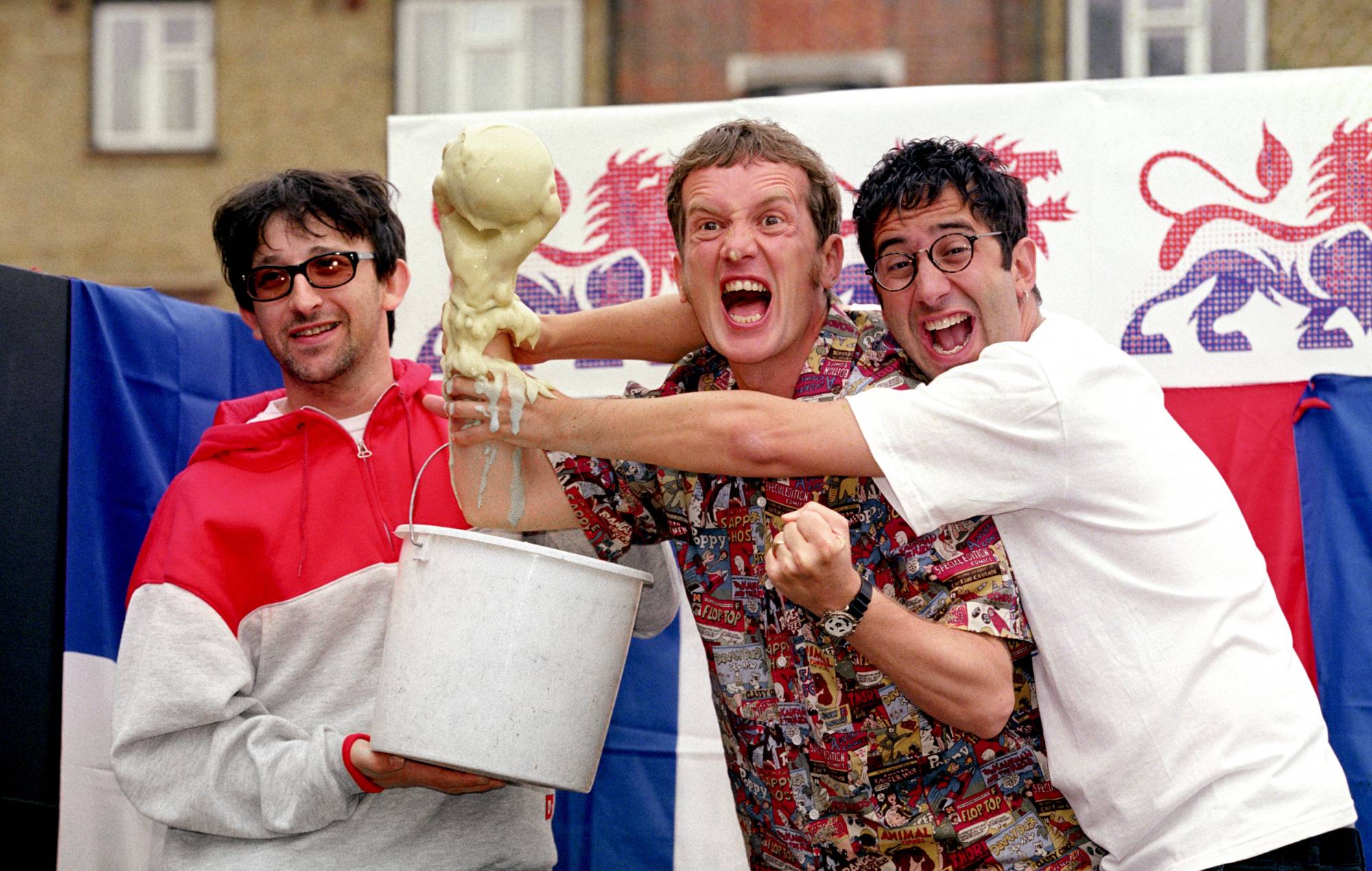
So successful was the original ‘Three Lions’, buoyed by England’s near miss at the 1996 European Championships, that the only logical thing for David Baddiel, Frank Skinner and Ian Brodie to do was re-record it for the next big international tournament: the 1998 World Cup.
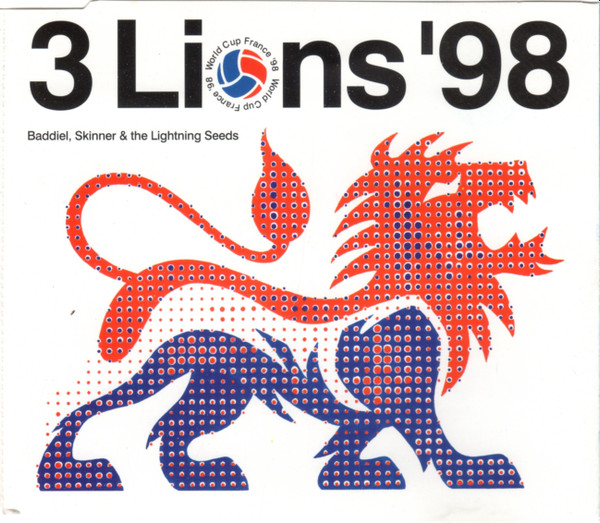
3 Lions ‘98, by Baddiel, Skinner & the Lightning Seeds (their 2nd and final #1)
3 weeks, from 14th June – 5th July 1998
It starts off very meta, with the Wembley crowd singing the original chorus, and Jonathan Pearce reliving Gareth Southgate’s missed penalty that lost them the ’96 semi-final. After that it’s business as usual, with the sound perhaps a bit beefier than the earlier version. The lyrics are different too, with the first verse focusing on how close England came two years before, and the second focusing on how this will be their year in France.
‘3 Lions’ has been accused, as I mentioned in my first post on the song, of being a bit arrogant by those who don’t want England to do well at international tournaments (i.e. most people who aren’t English). I would argue that the 1998 version is even more over-confident, as thirty years of hurt is now no more years of hurt (okay, thirty-two years of hurt wouldn’t have scanned well, but still….)
This isn’t a football blog, so in short: football didn’t ‘come home’ in 1998, Argentina saw to that by beating England in the round of sixteen. David Beckham, Diego Simeone and all that… In fact, ‘3 Lions ‘98’ was at #1 for longer than England were in the tournament. And football still hasn’t come home in the near thirty years since, though it has come closer recently (too close for comfort for this Scot…) Just last month England lost the Euro 2024 final to Spain.
And as much as I find it annoying as a modern cultural behemoth, I again cannot argue that ‘3 Lions’ isn’t a good song. The daddy of all football pop songs. Plus, the video is good fun, once more featuring Geoff Hurst, and Robbie Williams, a lot of Germans with mullets, and a bit of fun with the fact that Stefan Kuntz had scored Germany’s equaliser two years before.
Away from the football, there’s a serious question to ask here: is this a different song to the original ‘Three Lions’? I’d say it obviously is – different name, different lyrics, different production – and so make it chart-topper #793, and not just a re-entry of chart-topper #740. However, the OCC now combine the versions when the song starts climbing the charts every two years (it will make #1 again in 2018). This is something our blog will have to consider in the 21st century, with several former number ones preparing to re-top the charts. Do they count as separate records – therefore deserving of an entirely new post written about them – or are they the same record returning to the top decades later? ‘Bohemian Rhapsody’ has already been back to the summit, but that was twinned with a new song – ‘These Are the Days of Our Lives’ – and I treated it as a new number one. Something to consider, then, and I’d welcome the thoughts of any seasoned chart watchers out there.
‘3 Lions’ meanwhile has been re-released several times, and re-recorded several more. There’s a 2010 version with Russel Brand and Robbie Williams (singing this time) which made #21. There’s a 2022 Lionesses’ version, and a Christmas version to tie-in with the winter World Cup in Qatar. Thanks to England’s Euro 2024 run, it returned to #8 just a couple of weeks ago. It’s no exaggeration to state that this song is now up there with ‘Hey Jude’ and the aforementioned ‘Bohemian Rhapsody’ as one of the best-known, best-loved, best-remembered chart toppers of all time.
Ah Jaysus! If it isn’t one of the nineties most beloved pop ditties, so that it is…
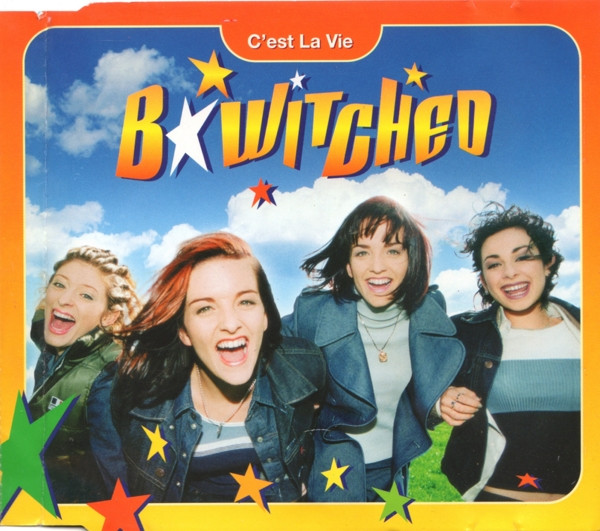
C’est la Vie, by B*Witched (their 1st of four #1s)
2 weeks, from 31st May – 14th June 1998
I don’t feel so bad putting on the ol’ stereotypical Irishisms, because this silly record is drenched in such nonsense. It may be one of the decade’s best-loved pop songs, but it got on my tits aged twelve and I’m glad to report that it still gets on them twenty-six years later.
Is it the nursery rhyme verses? Is it the perky production? Is it the Irishisms? (Get a loife… What are ye like…?) Or is it all of the above, plus the group’s horrific double-denim outfits in the video? Yep, it’s the whole shebang. This is bubble-gum so sweet and cloying that you want to spit it out after just five seconds.
And if you sit down to really listen to the lyrics, a fool’s errand with a song like this, then your distaste only deepens. Say you will, Say you won’t, Say you’ll do what I don’t, Say you’re true, Say to me, C’est la vie… They are words, words put together, put together because they form catchy rhymes, in English and in French; but they’re gibberish. Of course this isn’t the first pop song to make zero sense, so perhaps I’m being harsh. But even the innuendo – and I’m normally a big fan of innuendo – leaves me rolling my eyes. Do you ever get lonely playing with your toy…?I’ll show you mine if you show me yours… Oh lord, please don’t.
The closest this comes to passable pop is in the bridge, the huff and puff bit (this record is very heavy on the nursery rhymes). And that bit is undeniably catchy. But just as you begin to put together a defence for ‘C’est la Vie’, in comes the demented faux-Riverdance middle-eight and your case crumbles. Nope, nope, nope. Cover it in lead and chuck in the Liffey.
B*Witched were from Dublin, and had formed in 1996. Two of the four were twins, Edele and Keavy Lynch (sisters of Boyzone’s Shane Lynch), while the other two were their friends from dance and kickboxing classes. At least they didn’t go down the bland ballad route of their brother’s group (I should add a ‘yet’, as we have three more B*Witched #1s to get through). You can see what they were going for with the slightly watered-down version of fun and feisty girl power, but I wasn’t the right age for it in 1998 and I’m certainly not the right age for it now. I am, however – and without giving too much away – fully prepared to defend their next chart-topper as a lost classic.
We’ve had plenty of pop number ones in the past few years. But everything about ‘C’est la Vie’, from the production to the video, ups the cheese, the bubble-gum, the trashiness… call it what you will. And this record sets the tone for the next couple of years, in which the singles chart will be dominated by primary coloured, tween pop. And we can perhaps explore why that was as we get closer towards the end of the century…
As a final aside, and with the eyes of the world currently on Paris, I make this the 3rd number one single with a French title, after ‘Que Sera Sera’ and ‘Je T’Aime… Moi Non Plus’. Let me know if I’ve missed one.
It’s the end of May 1998, and I make our next chart-topper already the fourth this year to involve a reimagining of an older hit. This will be anathema to some – sampling, interpolating, remixing, call it what you will – but for me an inspired sample can be, well, inspired…
Feel It, by The Tamperer ft. Maya (their 1st and only #1)
1 week, from 24th – 31st May 1998
This takes the beat and the bells from The Jacksons’ 1981 disco stomper ‘Can You Feel It’, makes them even more stomping, and uses it as backing to a story of a spurned lover and her desire for house flattening revenge. It’s fair to say that What’s she gonna look like with a chimney on her…? is one of the year’s, if not the decade’s, great hooks. In fact, even just the way that vocalist Maya screams the ‘What!’ is a massive hook in itself.
The Jacksons are not the only sample here, as the two verses come interpolated from the wonderfully titled ‘Wanna Drop a House (On that Bitch)’, by Urban Discharge, released in 1995. What I like most about the lyrics is that they are thoroughly toxic, with the cheated woman forgiving her boyfriend and aiming her ire at the mistress. Well I’m not blaming you, But she’s still hanging round, And she’s so crazy you know man I just don’t trust her…
Nothing about this song, from the opening klaxon onwards, is subtle. The samples are in your face, the lyrics are preposterous, and the bit where everything slows down for no apparent reason is bizarre. But it’s a huge slice of dumb fun. Subtlety be damned. And yes there’s very little originality here, but I will point out that the one original moment is the ‘chimney’ line, and that’s the best bit. (One school of thought I found online is that ‘chimney’ is slang for a black eye… So she’s just going to punch the girl, not blow her house up.)
The Tamperer ft. Maya were an Italian production duo, plus US-born singer Maya Days. (Despite the ‘featuring’ credit, they never released a single which didn’t feature Maya.) This was their first release, and was a hit around Europe that summer. They followed it up with two further Top 10s, both involving bold samples. The brilliantly titled ‘If You Buy This Record (Your Life Will Be Better)’ used ‘Material Girl’, while ‘Hammer to the Heart’ borrowed ABBA’s ‘Gimme Gimme Gimme’ several years before Madonna did so to much fanfare.
In fact, their chart career ended after those three hits, and aside from a 2009 remix of ‘Feel It’ neither the Tamperer nor Maya have been seen since. And going by the comments underneath the YouTube video below, this is one of the ‘90s more forgotten number ones, with a handful of people around the world waking up each morning asking what that song about the chimney was called. I’d say we’ve had a mini-run of ‘forgotten’ #1s, from Aqua’s best song, to All Saints’ overshadowed covers, to Boyzone’s better-forgotten snoozefest. Up next though, a nineties pop ‘classic’ that, for better or worse, remains very much with us…
Another trip back in time then, with my second ever ‘Today’s Top 10’ (we went back to 1970 a few months ago – check it out if you have the time). This time I thought we’d go back to the summer of 1967… AKA The Summer of Love, in which for a few months the hippy ideal looked like perhaps becoming reality. Three very famous flower-power anthems topped the charts that summer, and all three are on this chart, dated 26th July-1st August 1967. But was the rest of the Top 10 as awash with peace and love? Let’s find out…
#10 – ‘Death of a Clown’, by Dave Davies (up 13 / 2 weeks on chart)
We start with a couple of big climbers, as Dave Davies’ debut solo effort enters the Top 10 this week. ‘Death of a Clown’ often gets classed as a Kinks’ song, and in fairness it does feature all four Kinks playing on it, and it did appear on the album ‘Something Else by the Kinks’. But it charted as a Dave solo number, with Ray contributing the la-la-la refrain, sung by his then wife. Its subject matter is that old rock ‘n’ roll chestnut – the grind of endless touring: I’m drownin’ my sorrows in whisky and gin… Dave Davies, who often chafed under his big brother’s domination of the group’s songwriting, had hoped that this song’s success (it would peak at #3) might lead to a solo album, but it didn’t. As a starter for our 1967 countdown it doesn’t scream ‘Summer of Love’, but Davies’ cravate in the video below is possibly the perfect encapsulation of the phrase ‘baroque pop’.
#9 – ‘Up, Up and Away’, by the Johnny Mann Singers (up 17 / 3 weeks on chart)
A bit more like it, now. An appropriately high climb for the Johnny Mann Singers going ‘Up, Up and Away’ in their beautiful balloons. It’s hardly the height of psychedelia, and it has much more of an upbeat, cabaret cheesiness to it, but it could also serve as a metaphor for indulging in some mind-bending substances. Most of the world knows it as a hit for the 5th Dimension but their version didn’t chart in the UK, leaving the coast clear for composer/arranger Johnny Mann and his singers.
#8 – ‘There Goes My Everything’, by Engelbert Humperdinck (down 2 / 10 weeks on chart)
Hang around the charts of 1967 long enough, and sooner rather than later you’ll come across Engelbert Humperdinck. He had two monster #1s, ‘Release Me’ and ‘The Last Waltz’, with this #2 smash sandwiched in between. ‘There Goes My Everything’ had been a huge US country hit for Jack Greene, before The Hump brought it to the pop charts. There’s more than a whiff of ‘The Green, Green Grass of Home’, a massive success for Tom Jones a few months earlier. Not very ‘Summer of Love’ but, let’s be honest, who could say no to a night of passion with this magnificent pillow-lipped crooner.
#7 – ‘A Whiter Shade of Pale’, by Procol Harum (down 3 / 10 weeks on chart)
Aha! Here we are then. One of the big three Summer of Love anthems, which had been at number one for six weeks and was now on its way down the chart. A stone cold, all-time classic which I’ve already named as one the Very Best #1s. Not much more to say, other than read my original post on it here, and give it a play regardless of how many times you’ve heard it before.
#6 – ‘See Emily Play’, by Pink Floyd (up 2 / 6 weeks on chart)
And if Procol Harum weren’t trippy enough, here is some true psychedelica from up and comers Pink Floyd. Written by founder member Syd Barrett, about a girl that he had seen in a forest while tripping on LSD. It is a deeply strange pop single, with lyrics about losing your mind, a demented harpsichord break, and a discordant, feedback-drenched solo. It was only their second single, and Barrett was opposed to releasing it as he didn’t think it was up to scratch. He would leave the band only a few months later, with mental health problems possibly brought on by drug use, and became a famous recluse. Pink Floyd meanwhile went on to release some of the biggest albums of the ’70s. They didn’t release many singles, though, and the next time they visited the Top Ten was with their surprise 1979 Christmas number one, ‘Another Brick in the Wall Pt. II’.
#5 – ‘She’d Rather Be With Me’, by The Turtles (up 2 / 7 weeks in chart)
Into the Top 5, with one of the decade’s great forgotten pop records, by one of the decade’s great forgotten pop groups. If the Turtles have made it into the public consciousness, then it’s for the single that they released just before this, the Billboard #1 ‘Happy Together’. Surprisingly for a song that constantly pops up in movies and on TV as shorthand for ‘The Swinging Sixties!’, ‘Happy Together’ only made #12 in the UK. Perhaps buoyed by that song’s greatness, ‘She’d Rather Be With Me’ went all the way to #4 later in August ’67. And for my money, it’s even better. Chunky production, unashamedly cheerful lyrics, cowbells, and a big, brassy marching band finish crammed into a little over two minutes. The Turtles would have one further Top 10, ‘Elenore’, which they wrote as a parody of ‘Happy Together’, but which manages to be even more ludicrously catchy.
#4 – ‘Alternate Title’, by The Monkees (down 2 / 4 weeks on chart)
Even The Monkees get into the spirit of the time, releasing a record as trippy as anything a better respected band might have put out. ‘Alternate Title’ is a very literal name for this record, as it was released elsewhere as ‘Randy Scouse Git’. (RCA refused to put it out in the UK with that name, as it sounded “somewhat rude to a British audience”.) Micky Dolenz had heard the phrase on the sitcom ‘Till Death Do Us Part’, which British audiences had somehow managed to watch without reaching for the smelling salts. If the Monkees were better respected, then the lyrics to this might warrant as much chin scratching as ‘American Pie’. It’s a bonkers record, with the verses telling the story of a party, referencing The Beatles (the four kings of EMI), the model – and Dolenz’s future wife – Samantha Juste (the being known as ‘Wonder Girl’), and Mama Cass in a yellow dress. The shouty chorus meanwhile represents the establishment yelling at the youth of the day (why don’t you cut your hair?!). And when I call it ‘bonkers’, I mean it in the best possible sense of the word.
#3 – San Francisco (Be Sure to Wear Some Flowers in Your Hair), by Scott McKenzie (up 2 / 3 weeks on chart)
On its way to the top, another anthem for the Summer of Love: an ode to the city where it all began. In fact, ‘San Francisco’ was written as promotion for the Monterey International Pop Festival, held in June that year. So it’s basically an advert… which isn’t super compatible with the hippy ethos, but hey ho. It worked, and young folks flocked to the city that summer, many with the requisite flowers in their hair. Of the three Summer of Love anthems, this one is perhaps the most stuck in that time, and hasn’t transcended to become an all-time classic. But it’s hard to argue with that sweet, wistful melody. Read my original post on it here.
#2 – It Must Be Him (Seul Sur Son Etoile), by Vikki Carr (up 1 / 9 weeks on chart)
Just to remind us that the singles chart is at heart a collection of songs ordered by cold, hard data, with no interest in the trends of the time, this was the #2 single as the Summer of Love reached its peak. American Vikki Carr provides the easy-listening filling between two hippy anthems, with a tune originally written and sung in French. In ‘It Must Be Him’, Carr – who has a lovely, strident voice – waits by the phone hoping her ex will call: Let it please be him, Oh dear God, It must be him, Or I shall die... I’d suggest Vikki might have played it a bit cooler, if only because all that talk of death and God probably brought this close to a BBC ban…
#1 – ‘All You Need Is Love’, by The Beatles (non-mover / 3 weeks on chart)
In the middle of a 3-week run at the top, this chart’s third, and perhaps ultimate, flower-power anthem. You can read my original post here. (I can’t remember what I wrote five years ago, but I’m sure it was largely positive!) Listening again now, I’m struck by how much fun this record is. From the opening bars of La Marseillaise, through Paul’s ‘all together now’s, the snatches of Bach, ‘Greensleeves’, and ‘In the Mood’, to brief glimpses of ‘Yesterday’ and ‘She Loves You’, the worthy message is dressed up in a lot of singalong fun. Brian Epstein, who would die just a few weeks later, described the band’s performance of the song for the ‘Our World’ television link-up as their finest moment.
So I’d say half the Top 10 for this week in July 1967 does the Summer of Love (and LSD) proud. The other half is more standard sixties: middle-of-the-road ballads, quality pop, and some high-grade crooning. Hope you enjoyed this detour, and I’ll do another one before the year is out.
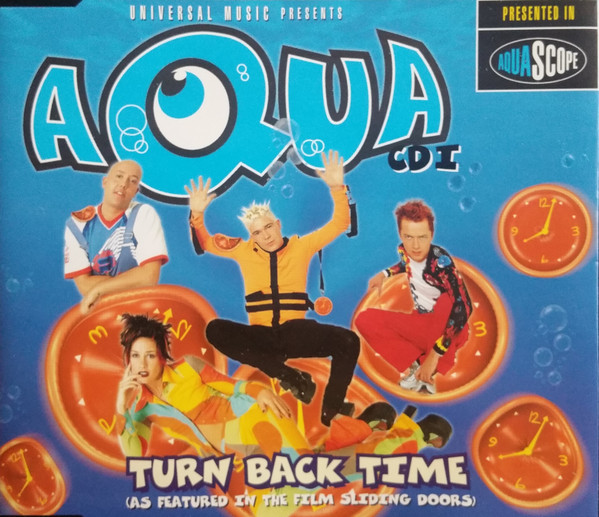
1997’s novelty act of choice surprise us yet again by returning for a 3rd number single. Not only that, the surprise is increased by the fact that this is a ‘proper’ song!
Turn Back Time, by Aqua (their 3rd and final #1)
1 week, from 10th – 17th May 1998
No Barbie and Ken here, no ayypeeay-eh-oh. This is classy pop. The chord progressions in the verses have a sweeping drama to them, with the feel of a Bond theme in places. Give me time to reason, Give me time to think it through… It’s sung from the point of view of someone who has cheated, and who is owning their mistake. Give me strength, To face this test of mine… Lene’s voice, so chirpy and borderline annoying on their earlier hits, is rich here, and full of emotion. I often struggle to believe ballad singers, but she sounds genuinely guilty, and repentant.
Away from the vocals, the production is smooth nineties soul-funk. And (of course) that late-nineties preset drum beat is there, buried beneath some cool horns that make me think of Ace of Base. Maybe it’s a Scandi-pop thing and – while it does mean I’m going to lean into some national stereotyping – there is something in the clean, coolness of this that feels very Scandinavian.
Seriously, this is an excellent pop song. If it were by Madonna, and not the goons that brought us ‘Barbie Girl’, then this would not be half as forgotten as it currently is. The only thing I regret is that René’s gravelly tones don’t get a look in. I’m not sure how they could have made that work – maybe a bit of baritone harmonising – but it’s sad that he has been sidelined after two star turns. The only questionable part of this record is the jarring break in the middle, when the smoothness is broken by urgent horns and a grinding industrial beat. It’s certainly a choice – presumably meant to show the mental turmoil of the singer – and it just about works.
‘Turn Back Time’ featured on the soundtrack to the Gwyneth Paltrow film ‘Sliding Doors’, which I’ve not seen but which has one of the most famous premises in movie history. The video features plenty of scenes from the film, and also has the band re-enacting the plot, with Lene constantly missing trains and lift doors on the London Underground. Meanwhile their black leather jackets are very late-nineties chic.
Aqua were worth one more Top 10 hit from their breakthrough album, then one more when they released their second LP in 2000 (the showtune-tastic ‘Cartoon Heroes’). They split for most of the ‘00s, but reformed in 2008 and remain together to this day. They belatedly returned to the Top 10 last year, when their signature hit was reimagined by Nicki Minaj and Ice Spice ahead of the ‘Barbie’ movie.
All Saints score their second number one in a row, with a much-maligned double bill…
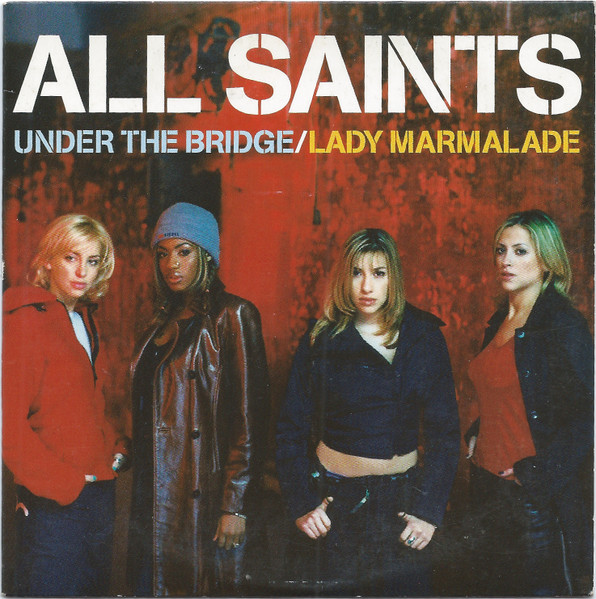
Under the Bridge / Lady Marmalade, by All Saints (their 2nd of five #1s)
1 week, from 3rd – 10th May / 1 week, from 17th – 24th May 1998 (2 weeks total)
I’m interested to see what I make of the first part of this double-‘A’. The official view from the playground in 1998 was that All Saints covering Red Hot Chili Peppers was a travesty. Silly girl groups trying to sing songs by proper, sweaty, socks ‘n’ cocks guitar bands was wrong, and no teenage boys had the guts to say otherwise.
But here I am, two and a half decades later and unencumbered by peer pressure. Free to admit that I’m not much a fan of the Chili Peppers (though ‘Under the Bridge’ is one of their better, less obnoxious moments). Free to discover that All Saint’s version isn’t actually that bad. I do like the stripped-back intro, and the off-kilter delivery of the verses. It’s something new – an interesting re-imagining of the original – which is the basic duty of a half-decent cover version.
Because it’s 1998 there are lots of scratchy turntable flourishes, and a crackly, old-time effect on the main guitar riff, both of which feel quite dated. And perhaps unsurprisingly for a song about someone’s relationship with heroin, several of the lines were changed and/or omitted. Anthony Kiedis was not a fan of All Saints’ version (“it looked like they didn’t know what they were singing about”), which is fair enough for a song so personal to him. You do wonder what the thought process was in choosing this as a cover, for surely they knew there would be a reaction from the rock snobs. (Though it should be noted that the guitar on this record is played by Mojo Magazine favourite Richard Hawley.)
So, this isn’t terrible. Not even close. I’m not sure why they needed to do it, and I have no idea why it’s five minutes long, but here we are. And not content with reinterpreting one much loved classic, on the other side of this double-‘A’ the girls have their way with Labelle’s raunchy disco standard ‘Lady Marmalade’. From heroin, to prostitutes…
This feels a bit more what you’d expect from a ‘90s girl group. A bit more basic, if you will, with a mid-tempo disco-funk beat that reminds me of the Spice Girls’ ‘Who Do You Think You Are’. But again they at least do something a bit different with it, removing most of the original verses and replacing them with saucy raps – My place or yours, Gotta be raw… Gotta get wet, Are you ready yet? – which cement their place as the edgier girl group of the day. Of course they keep the famous Voulez-vous coucher avec moi? line, but it’s rendered fairly PG by some of the smut around it. (I remember having an embarrassing conversation with my mum when this came on the radio, her asking if I knew what the French meant…)
The Labelle original had made #17 in 1975, which is surprisingly low. The original of ‘Under the Bridge’ had fared slightly better, reaching #13 in 1992. It’s fair to say that neither of these covers have usurped the originals in the public’s affections, while an even more popular cover of ‘Lady Marmalade’ will be along in a few years to overshadow All Saints’ effort. And personally, I much prefer the originals of these two hits. This is by far the weakest of the girls’ five number ones; but they aren’t the crimes against music that some may try to suggest.
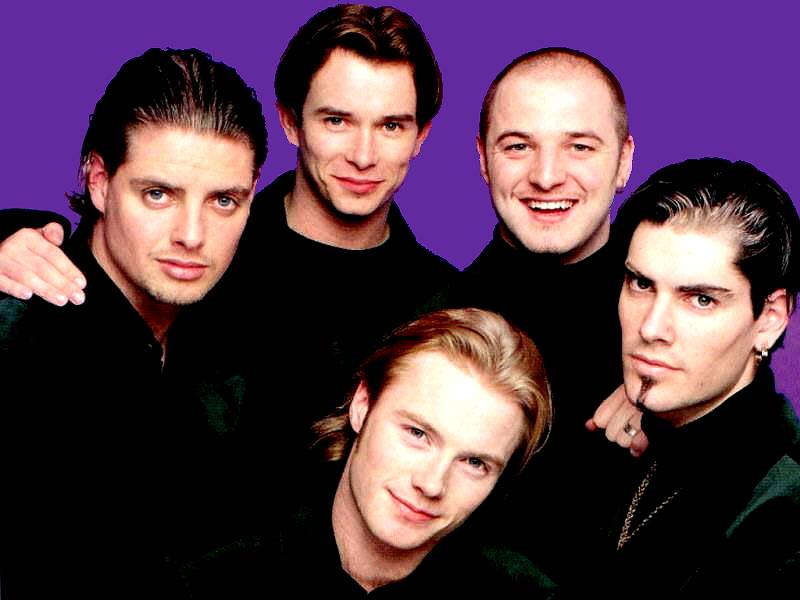
All That I Need, by Boyzone (their 3rd of six #1s)
1 week, from 26th April – 3rd May 1998
A dull, plodder from the nineties’ dullest, most plodding boyband. Yay! A mid-tempo ballad (shock, horror!) that floats past your ears fairly inoffensively. I’m struggling to remember if I’ve ever heard this before… I’m sure that I must have – I owned every ‘Now’ album between 1996 and 1999 – but I’m also sure that I’ve erased every memory of it in the intervening twenty six years.
Do I sniff the riff from the classic wimp-rock ballad ‘Right Here Waiting’? I think I do, plucked gently on an acoustic guitar. If that’s your inspiration, then you’re going to end up with something pretty insipid. Even groanin’ Ronan sounds bored as he meanders his way through the verses, as opposed to his usual constipated attempts at emoting.
And there’s that late-nineties computer generated drumbeat again. It’s starting to crop up more and more often, presumably preset into every Casio keyboard sold in 1998. In come the rest of the band for the chorus, and a lot of strings for a finish far grander than this song deserves. It’s not awful, nor is it Boyzone’s most offensive effort. But you’ll struggle to hum this five minutes after listening to it.
‘All That I Need’ was the third single from Boyzone’s third album, so we can assume that it took advantage of a quiet sales week to sneak a moment on top. That’s not to suggest they didn’t have fans – I went to school with a lot of them – but when you compare them to Take That, East 17, or the Spice Girls, there’s just something missing. More often than not that something was ‘fun’. In the video, the lads are dressed in some exotic crocodile skin jackets, ready to party. They just weren’t getting the material.
Still, Boyzone filled a niche, aimed at mums and grannies more than the kids. Nice Irish boys. And by 1998, four years and three albums into their career, they were nearing their boyband sell-by-date. Luckily for us all their manager, Louis Walsh, already had his sights on their successors: the T-1000 of granny-pleasing boybands, who will soon take the singles chart in their inhuman grip. Can’t wait!
Check this out… Just a couple of weeks after Norman Cook worked his magic on Cornershop’s ‘Brimful of Asha’, American house DJ Jason Nevins has his wicked way with a hip hop golden oldie…
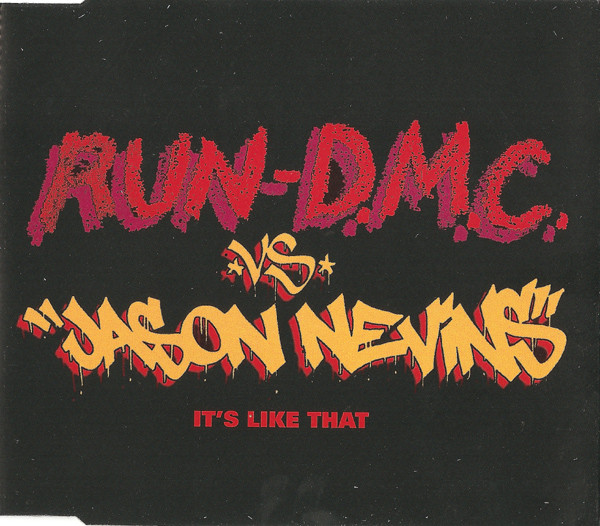
It’s Like That, by Run-D.M.C. vs Jason Nevins (their 1st and only #1s)
6 weeks, from 15th March – 26th April 1998
I remember this being huge, an omnipresent hit that spring. And six weeks at number one is a very impressive run for the late-nineties (only one song will beat that total in 1998). But listening now, I’m a bit stumped trying to work out why it was quite so popular… It’s a bit repetitive, a sledgehammer beat that goes on, and on, with a less stardust sprinkled by Nevins compared to Fatboy Slim. Some of the transitions are predictable, and the original Run-D.M.C. vocals feel off in the mix.
Not that it’s bad, or that I don’t enjoy it on a certain level, or that it doesn’t unleash a heady wave of nostalgia listening to it again in 2024. I just mean that I can’t really locate the reason that it became the year’s 3rd best-selling single and – even more impressively – the only record to ever hold a Spice Girls’ song off number one in the UK (this was released in the same week as ‘Stop’, which it beat to the top by well over 100,000 copies).
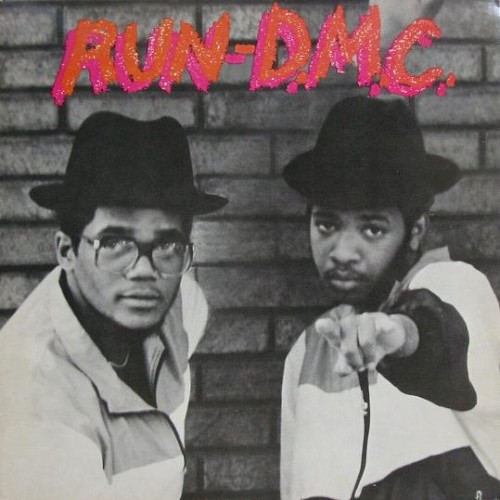
The original ‘It’s Like That’ had featured on Run-D.M.C.’s debut album in 1984, and was released as the LP’s first single. It’s a call-to-arms – a spikier, more cynical ‘What’s Going On’ for a new decade: Unemployment at record highs, People coming, People going, People born to die… Don’t ask me because I don’t know why, It’s like that, And that’s the way it is… What’s interesting about the original is that the 1998 hit is there, fully formed. If anything, the beat is even heavier. Nevins does little more than tart it up with a standard dance rhythm and some up-to-date flourishes (which admittedly is also what Norman Cook did on ‘Brimful…’, I just like that song better).
The one notable thing that Nevins does add is the sped-up Run DMC and Jam Master Jay! break, along with a bit off beatboxing. That’s the part I most remember, perhaps the hook that sold this as a hit. But in actual fact it last barely ten seconds, before that relentless beat comes slamming back in. (I always assumed that ‘Jam Master Jay’ was Jason Nevins, but he was actually the DJ in Run-D.M.C, who was sadly shot dead in 2002.)
Not surprisingly, this would be both Run-D.M.C.’s and Jason Nevin’s biggest ever hit. Nevins has only returned to the Top 10 one further time, although he’s gone on to work with stars like Nelly and Ariana Grande. For Run-D.M.C., this was their second Top 10, a decade on from ‘Walk This Way’ – in which they and Aerosmith fused rap with rock, much like Nevins was fusing rap and dance on this record.
Is it too early to call this the Age of the Remix? It is true that we’ve had two in quick succession, and that remixed hits will be more noticeable at the top of the charts as the century turns. I think it’s the fact that this is the first ‘versus’ record to make #1, as opposed to a plain old ‘featuring’ or an understated ‘&’. It feels so very turn of the twenty-first century (though a quick scan has shown me that there will actually only be a couple of other ‘someone versus someone else’ number ones between now and 2005.)
Of all Madonna’s thirteen number ones, ‘Frozen’ – her first in almost eight years – has to be the strangest…
Frozen, by Madonna (her 8th of thirteen #1s)
1 week, from 1st – 8th March 1998
It’s her longest for a start, and probably the least accessible. There’s no instant hook, as with ‘Into the Groove’, and no controversial gimmicks, as with ‘Like a Prayer’. Instead there’s a shimmering, undulating electronic beat, beefed up at intervals by strange, reverberating sound effects and drum fills. And there are the strings that add an air of grandiosity to the song, especially when they come to the fore midway through, like an ‘Arabian Nights’ film score. A Rolling Stone reviewer at the time described it as “arctic melancholy”, and I think that’s perfect.
Interestingly for Madonna, the lyrics are the least noticeable thing about ‘Frozen’. They seem to be about a lover who is closed off: You only see what your eyes want to see, How can life be what you want it to be, You’re frozen, When your heart’s not open… Or perhaps it’s more religious, with Madonna, who had begun taking an interest in Eastern spiritualism, singing as a sort of high priestess. The video would bear this interpretation out, Madge floating above a desert, all in black, as a sort of nun-slash-witch, before turning into a flock of crows, and then a large dog.
In fact, despite me claiming that this isn’t one of her gimmicky chart-toppers, the first thing that springs to mind when I think of ‘Frozen’ is Madonna – famously blonde for most of the past fifteen years – now with long jet-black hair. Always one for the visuals… The second thing I remember about this record is hearing it almost as often as ‘My Heart Will Go On’ at the pool bar in Lanzarote during my spring holiday that year.
And the fact that it was on such heavy rotation at the time perhaps proves that this isn’t as inaccessible as I suggested. In truth, there are just as many hooks here as in Madonna’s poppier numbers, they’re just buried in the trip-hop beats, and stretched out over six minutes. Of 1998’s seven number ones so far, three have now run on beyond five minutes – ‘Never Ever’, ‘All Around the World’, and this – while Celine Dion wasn’t far behind (and that one certainly feels longer than five minutes…)
Although this was her first number one since ‘Vogue’, Madonna hadn’t ever been away from the top of the charts. In fact, she’d casually racked up a further seventeen (!) Top 10 hits between ‘Vogue’ and now. At the same time, ‘Frozen’ was the lead single from her first studio album in four years, following a few years of compilations and soundtracks.
Undoubtedly then, we can class this is one of Madge’s famous re-inventions. She wasn’t just following current trends with William Orbit on production duty, she was setting them. Fifteen years is a lifetime for a female pop star, and this was a statement release, one that announced the Queen of Pop wasn’t going anywhere. ‘Frozen’ was an interesting choice for the lead-single though, especially considering that follow-up ‘Ray of Light’ is the much better remembered hit, but it makes for an interesting detour in Madonna’s chart history. This is her second and final ‘90s #1, making it by far her least successful chart-topping decade. However, she has five more ‘00s #1s to come, all perhaps owing a debt to how successfully she updated her sound here.











 The UK Number Ones Blog