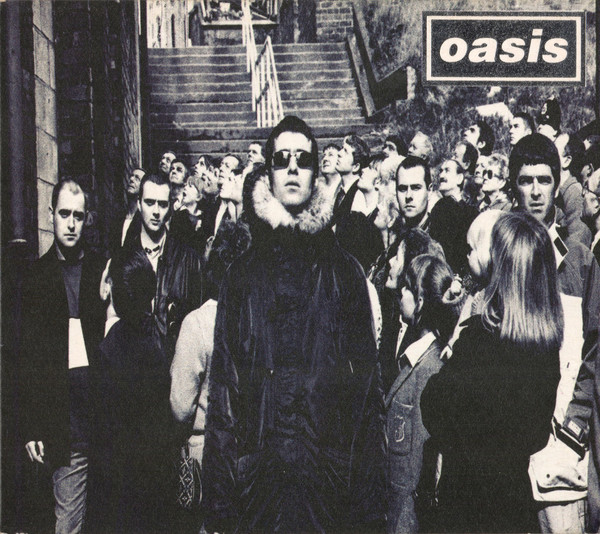
A few months after the highest-selling number one single of all time, a slightly different chart record falls. Oasis were planning to release the penultimate track from ‘Be Here Now’ as that album’s final single, a track that ran to well over nine minutes (long even by that bloated album’s standards). Surely, people assumed, there would be a single edit? But of course not. For this was Oasis, the biggest, boldest band in the land, and nobody could tell them what to do.
All Around the World, by Oasis (their 4th of eight #1s)
1 week, from 18th – 25th January 1998
In fact, the single version of ‘All Around the World’ drags things out even further than the album version, meaning that it runs to a staggering nine minutes thirty-eight seconds. You wonder why they didn’t just keep it going to the ten-minute mark… Still, it stands as the longest number one single ever, almost two minutes ahead of Meat Loaf in second place. But what gets overlooked in all the chat about how long it is, and how OTT ‘Be Here Now’ is, is the fact that this is a pretty good song.
It’s one of the album’s clearer, more instant moments. It’s a simple enough concept, with slightly jazzy, slightly Beatlesy (duh!) chord progressions. The simple concept is built upon, with layers of overdub and na-na-na-ing, until it grows into a thumping gospel track, with Liam chanting his mantra: I know what I know, It’s gonna be okay… We all know now that by 1998 Oasis were a coked-up mess; but this is Oasis at their coked-up best. I’ve always thought it very underrated.
Perhaps ‘All Around the World’ stands out as different to the rest of ‘Be Here Now’ because it was actually one of Noel’s earliest song writing efforts, with live performances dating back to 1992. I don’t imagine those early versions of the song sounded as gigantic as this, but it does have that early-Oasis theme of everyone getting along, making better days. Plus it has Liam chewing the life out of the word sheeeiiiiinnnneeee, which is a real Oasis 101.
Added to this early-nineties seed of a song were seven whole minutes of coda. Lots of key changes, lots of subtle rearranging of the na-na-nas. I particularly like the seismic shift around 5:30, before Liam comes back bellowing through a loudspeaker. Of course it’s too long – it’s a preposterous length for a pop song – and of course it’s self-indulgent. Plus, of course the Beatles’ references are way too obvious (‘Hey Jude’, for one, and ‘Yellow Submarine’ in the mesmerising animated video).
But as with ‘D’You Know What I Mean?’, and as with ‘Be Here Now’ on the whole, you do just have to sit back and admire the sheer bravado of releasing this beautiful, overblown nonsense, and then lament the passing of rock music that is this big. It’s a shame that a track of ‘All Around the World’s size is relatively forgotten among the Oasis back-catalogue, and that it sneaked a January number one when competition was scarce. By now, a backlash had begun against Oasis, as always happens when acts become that popular. It will be over two years before their next chart hit, as the band take a much needed breather after the wild ride of the Britpop years.
Into 1998, then. The penultimate year of the century, the 46th year of the UK singles charts, and one with a thus-far record thirty number ones. And to start off, there are a few questions that I need to know…
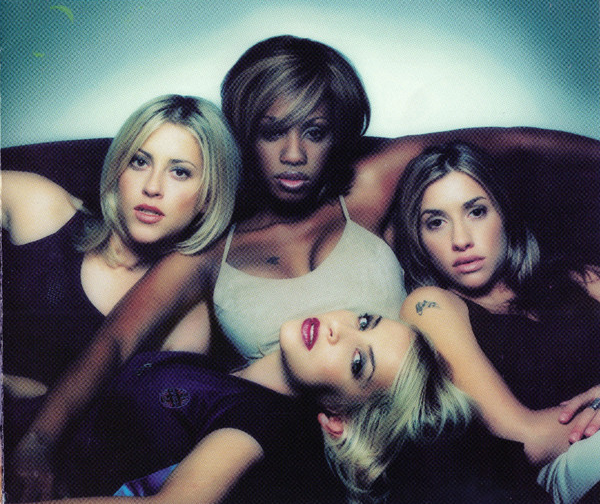
Never Ever, by All Saints (their 1st of five #1s)
1 week, from 11th – 18th January 1998
To be honest, an opening line that clunky could kill lesser songs off before they’ve started. A few answers that I need to know, surely, scans just as well. Anyway, ‘Never Ever’ quickly recovers from that shaky start, by bringing us one of the great spoken word sections. Anyone of my vintage can probably still recite it word for word…You can tell me to my face, Or even on the phone… as well as adding all the backing harmonies.
It takes the sassy soul vibe of 1997’s final chart-topper, the Spice Girls’ ‘Too Much’, and ups both the sass and the soul. All Saints have very good voices, and great harmonies, to the point where you’re tricked into misremembering this as an a cappella track. But their voices are also flawed, like the Spice Girls’, so that you can hear their accents and dropped consonants.
‘Never Ever’ isn’t a cappella, of course, and the production is period-perfect late-90s R&B squelch (this is what we must refer to it as from now on, and we’ll be hearing it a lot as the century winds down). It’s also let down slightly by further clunky lyrics (flexin’ vocabulary… the alphabet runs right from A to Z) and simplistic rhymes: Free from pain/ Goin’ insane… So low/ Black hole… So sad/ Feelin’ really bad… But hey, at least the words stick with you. And by the end, as the harmonies build and the organs start to swirl, you forgive it. The outro is just as good as the famous intro, slipping into a hip-hop beat as the girls’ voices are filtered and distorted.
Having a pop single run over five minutes (six and a half in its album version) is always a risk, spreading a few decent lines and a hook too thin. But ‘Never Ever’ lasts the distance, thanks to the strength of the voices and the melodies, and the way that they continue to build. And talking of being long-running, the song had a particularly slow journey to the top of the charts by 1998’s standards. It first charted in November, then hung around the Top 10 for seven weeks before finally reaching the top in the post-Christmas lull. It set a record for the highest ever sales before making #1 (770,000), and it’s current total stands at 1.5 million. It is the 3rd biggest-selling girl group single of all time in the UK. (You can guess the top two in the comments below…)
It feels simplistic to call All Saints the female East 17 to the Spice Girls’ Take That, but I’m going to do it anyway. The Spice Girls were chaotic and silly, whereas All Saints were all glowering stares, pierced tongues and nose-studs, shacking up with Gallaghers. They were the girls a couple of years above you in the corridor at school, definitely not to be approached under any circumstances. ‘Never Ever’ was only their second single, but it established them as the ‘other’ girl group of the day. In 1998, they’ll even have one more #1 than the Spice Girls. In fact, they’ll have five chart-toppers in just under three years, and all but one of them will be great.
If you’ve been paying attention, you might be expecting a recap in my next post. However I’ve decided that as the turnover of #1s is ever-increasing, and to stop my all-time awards getting too skewed towards the late-‘90s/early-‘00s, I’m going to do recaps after every fiftieth chart-topper until things slow down a bit, sometime around 2003.
Oi Oi! Here’s a Best Of for Britpop’s cheekiest chappies. And it’s got nothing to do with your Vorsprung durch Technik, y’know… For I haven’t chosen ‘Parklife’ as one of them. Nor have I chosen either of Blur’s #1s – ‘Country House’ and ‘Beetlebum’. What I have done is pick my favourite non-chart topping single (no album tracks allowed) from each of their nine studio albums, plus a couple of standalone singles for good measure. Off we swagger, then…
‘She’s So High’ – from Leisure
Blur’s first album stands out as something of an oddity. Apart from it clearly being Damon Albarn on lead vocals, they don’t sound like the Britpop icons that they would go on to become. ‘She’s So High’ was their first ever release, making #48 in October 1990. It’s very much a shoegaze single, lulling you in with its pounding drone and stoned vocals. It was twinned with ‘I Know’ as a double-‘A’, which is a more uptempo number with a funky Madchester beat. Both songs are a neat time capsule of what indie music sounded like at the dawn of the ’90s, long before anyone had heard of ‘Brit Pop’.
‘Popscene’ – non-album single
I’m cheating a bit here, as ‘Popscene’ wasn’t on any album, but it seems too important to miss off this list. It feels like the sound of Blur coming into their own, the Blur that would go on to become one of the decade’s biggest bands, and is a song that they were proud of and excited to release. When it stalled at #32, in 1992, they were disappointed, and blamed grunge for not allowing upbeat rock music to flourish. Which was sour grapes, even if they did have a point. However, ‘Popscene’ is now regarded as one of, if not the, first real Britpop single. One that would influence a whole genre with its mix of punk and glam, its energy and its snotty Britishness, even if its legacy isn’t reflected in its chart position.
‘Sunday Sunday’ – from Modern Life Is Rubbish
‘Modern Life Is Rubbish’ kicked off the Britpop phase of Blur’s career, and the album’s third single set the template for the sort of perky, Kinks-y hits that they would churn out by the dozen between 1993 and 1996. Many would say they surpassed it a year later on ‘Parklife’, but this song is saved by not having been bludgeoned into our skulls for the past three decades. Plus ‘Parklife’ also doesn’t have ‘Sunday Sunday’s frantic middle-eight, that sounds like a malfunctioning arcade game, or the big brass band that sees us home. The lyrics are no ‘Autumn Almanac’, but there’s charm here in its depiction of a lazy Sunday: He sings the Songs of Praise every week but always falls asleep… The three singles from the album all made the Top 30, and though a good case could be made for ‘For Tomorrow’, I think ‘Sunday Sunday’ best encapsulates Blur on the verge of becoming massive.
‘Girls & Boys’ – from Parklife
And massive they became, thanks to ‘Parklife’, and its lead single ‘Girls & Boys’. Sometimes Britpop gets written off as a regressive movement, a fin de siecle piss-up for the lads and ladettes. But that was just one half of it (the Oasis half). The other half was Brett Anderson’s floppy fringe and amyl nitrate innuendo, Jarvis Cocker’s knowing looks and camp asides. And of course Blur, singing about Girls who want boys, Who like boys to be girls, Who do boys like they’re girls, Who do girls like they’re boys… All over a squelching electro-disco beat, and a brilliantly cheap looking green-screened video. Yes, it’s a satire about 18-30s holidays, and could be viewed in a sneering ‘look at those plebs’ sort of way. But I don’t think you need to overthink brilliant pop like this.
All the singles from ‘Parklife’ could have been chosen, as all have a claim to being among Blur’s best. From the soaring lounge-pop of ‘To the End’, the ubiquity of the title-track, to the bittersweet ‘End of a Century’. But I’ll go with the lead-single, which made #5 in the spring of 1994, and really kicked Britpop into gear.
‘The Universal’ – from The Great Escape
‘The Great Escape’ gave Blur their first number one single, which also brought with it all the hullaballoo of the ‘Battle of Britpop’. But it was the album’s second single, a #5 hit in November 1995, which is the real highlight. It’s a sweeping ballad, more strings than guitars, about a future where technology has taken over. The looming end of the twentieth century was a theme that cropped up throughout Blur’s Britpop phase, never more so than in ‘The Universal’: No-one here is alone, Satellites in every home… Eerily prescient, perhaps, as we look back from our social media age. The video is similarly creepy, a tribute to a ‘A Clockwork Orange’, with Blur all in white, playing to a bar full of uninterested, and increasingly chaotic, yuppies. Can we also take a moment to appreciate Damon Albarn, already the ’90s best-looking frontman, in mascara… (Fun fact: former Tottenham forward and BBC pundit Garth Crooks bought one of the all-seeing golf balls from the video at a charity auction in 1999).
‘Song 2’ – from Blur
I’m going for the second single from their fifth album, as the lead single made #1 and I’ve already covered it. And while I do like ‘Beetlebum’, I probably would have chosen ‘Song 2’ because, well, it bloody rocks. It’s also perfectly named, as not only was it the second single, it is also exactly two minutes long, made #2 in the charts, and it is the second track on the album (the song’s title is a placeholder that they never bothered to change). Things had been going sour for Blur following ‘The Great Escape’, and it’s not much of an exaggeration to say that they helped kill off Britpop with the follow-up. Gone are the larking cheeky-chappies; it is much darker, grittier, electronic in places, and grungier… Speaking of which, since their ill-fated tour of the States in 1992, Blur had spoken out against grunge, and American rock, and some say that ‘Song 2’ was intended as a piss-take of the genre. They apparently had no idea that their label would want the song on the album, let alone want it released as a single. And of course, when it did come it out it became their best-known song in the US. Funny that… Going by Damon’s outburst when they played Coachella earlier this year, he still has some unresolved anger towards Americans…
(Also, an honorable mention to this album’s fourth single, ‘M.O.R.’, which also rocks.)
‘Coffee & TV’ – from 13
Second single from the album, again. ’13’ was even more experimental than ‘Blur’, coming out in 1999 with Britpop going through its death-spasms. The lead-single was the near eight-minute long ‘Tender’, which is a good song – a swampy, gospel oddity – stretched way too thin. It was famously (and rightfully) held off number one by ‘…Baby One More Time’. The follow-up was ‘Coffee & TV’, written and sung by Graham Coxon about his struggles with alcohol. It contains, for my money, one of the greatest opening lines of all time: Do you feel like a chain store, Practically floored… Plus there’s also the award winning video featuring Milky, the animated milk carton.
‘Out of Time’ – from Think Tank
In the four years between ’13’ and ‘Think Tank’, Graham Coxon had left the band and Damon Albarn had released a well-aclaimed and succesful album with Gorillaz. For their seventh album, the remaining three members decamped to Morrocco. ‘Out of Time’, the album’s lead single and Blur’s most recent Top 10 hit, features an orchestra from Marrakesh, who provide the eerie, ethereal sounds that swirl around this gorgeous song. It also features perhaps Albarn’s best vocal performance, so soothing and clear that it works as a form of ASMR. Following this album, and the subsequent tour, Blur disbanded for the better part of a decade. (A shout out too for ‘Think Tank’s second single, the completely different ‘Crazy Beat’, a sort of ‘Song 2’ on steroids.)
‘Under the Westway’ – non-album single
Since we had ‘Popscene’, we can have this one too. An out-of-the-blue release in 2012, of a song written by Albarn and Coxon for a charity performance. Perhaps Blur’s most melancholy ballad, written about a man sitting under the A40 flyover in West London. Think a 21st century ‘Waterloo Sunset’, but far less hopeful. And yet it’s beautiful, ending on a thumping piano note reminiscent of ‘A Day in the Life’. It is the band’s most recent Top 40 hit to date.
‘Ong Ong’ – from The Magic Whip
Blur reformed in the early 2010s, and went out on tour. A new album was not on the cards, however, until a festival they were supposed to be playing in Japan was cancelled, leaving the band in Hong Kong with time to spare. They booked a small studio in Kowloon, and bashed what would go on to become ‘The Magic Whip’ out in five days. ‘Ong Ong’ has a joyful bounciness to it that harks back to the goofiness of ‘Sunday Sunday’ and ‘Parklife’, but also has a middle-aged melancholy buried within. Plus I have somewhat personal reasons for choosing it, as it’s a cute tribute to my home of twelve years, a land of black kites and wishing trees (as well as tarmac that melts on hot, sunny days like today…)
‘St. Charles Square’ – from The Ballad of Darren
I have to admit to not being that enthused by Blur’s most recent album, last year’s ‘The Ballad of Darren’. The standout track by far was the second single, the grungey, crunchy ‘St Charles Square’. It’s a ghost story – theres something down here and it’s living under the floorboards – but they are the ghosts of Britpop past. Apparently ‘Tesco Disco’was a real unlicensed club, next to a Tesco in Notting Hill. Which is brilliant.
I hope you enjoyed this frolic through the best British band of the ’90s… (please do disagree with that statement in the comments below!) Up next we return to regular programming, starting out on 1998!
Happily preventing the Teletubbies from claiming a Christmas number one, the Spice Girls score their second of three festive chart-toppers in a row. And of the three, this is the best in my book…
Too Much, by The Spice Girls (their 6th of nine #1s)
2 weeks, from 21st December 1997 – 4th January 1998
It’s a ballad, of course (a girl group festive release will always be a ballad, there may be actual laws about this) but it’s not as straightforwardly sweet as ‘2 Become 1’, or as sentimental as the one to come next year. This is a sassy, soulful, fairly sophisticated, ballad that, with a little more oomph, could pass as a Bond theme.
It unfurls – that’s the perfect word – seductively, with plenty of horns and strings. Plus it has a couple of the Spice Girls’ best lines. As with all their good songs, they are the ones in charge, not the men. Unwrap yourself… Geri purrs… From around my finger… While in the middle-eight, Mel C unleashes the iconic: What part of ‘no’ don’t you understand, I want a man, Not a boy who thinks he can…!
When you add in her harmonies in the second chorus, Mel C here cements herself not only as the star of this single but as the official ‘Spice who could sing’. I think this might be one of the group’s less well-remembered number ones, and it certainly passed me by at the time – twelve-year-old me having given up on them after the manic ‘Spice Up Your Life’. But listening to it now, I might be tempted to place it as their 2nd best chart-topper, after ‘Say You’ll Be There’ (clearly the singles where Mel C was allowed to unleash are the best).
‘Too Much’ was the girls’ 6th #1 in a row, maintaining their 100% record – a record that stands to this day (though it has since been matched by Westlife). Their next release, ‘Stop’, would be their first and only single not to make the top. As I mentioned in my last post on the Spice Girls, the returns from their second album were clearly shortening, although they remained a global phenomenon. This is also their final number one as a five-piece, as by the time of their seventh chart-topper, Geri will have famously called it a day.
In my last post I mentioned that late-1997 saw extremely high singles sales. It’s hard to say, as records vary, but this may have been the ultimate peak for physical singles in the UK. In the run up to Christmas ’97 there was a week in which the entire Top 5 all sold over 100,000 copies, and in the all-time highest-sellers table four songs from the latter half of the year remain in the Top 50 (‘I’ll Be Missing You’, ‘Barbie Girl’, ‘Perfect Day’ and the record-holding ‘Candle in the Wind 1997’). Why this is I’m not qualified to say… Cut-pricing, cultural relevance, the ubiquity of CD players are all decent reasons. The quality of music, in my opinion, is not. The autumn of 1997 has seen a bit of a drop-off compared to the first half of the year. Whatever the reason, we head into 1998 with sales still high, and the turnover at the top ever-increasing…
Teletubbies Say ‘Eh-Oh!’, by The Teletubbies (their 1st and only #1)
2 weeks, from 7th – 21st December 1997
It’s a remix of the theme song to the biggest children’s TV show of the age: the Teletubbies. First aired in March 1997, by August it was reaching an audience of two million. I was one of them, I must admit, though I was a good decade older than the intended audience. I don’t know, there was just something grotesquely fascinating about the four… creatures (what the hell are they?) the grassy dome they lived in, the flowers that talked, the pink pancakes they ate… So huge was the programme that a spin-off single was inevitable, just in time for the Christmas number one race. They didn’t quite make it, but two weeks at number one plus over a million copies sold is pretty impressive.
Sadly, but not surprisingly, as a pop single this is utter garbage. It just about works as a theme-tune (though in these days of streaming you’d happily ‘Skip Intro’) but removed from the context of the show it sounds absolutely bonkers. And not good bonkers. There’s the babyish voices, the rather camp narrator, interludes in which some sheep sing ‘Baa Baa Black Sheep’ and a matronly old lady sings ‘Mary, Mary Quite Contrary’, and a prolonged bout of diarrhoea (which turns out to be the tubby custard machine, when you watch the video…) All set to a rinky-dink synthesised banjo riff.
At the same time, there’s not much point in getting annoyed about this. It is what it is. Crap, but also something of a time capsule, a glimpse back into those carefree, late-twentieth century days. You could raise an eyebrow at the ridiculous quantities of this record that were sold – well over half a million copies during its two weeks at the top – but then single sales were at their highest ever levels in late-1997, something we can perhaps explore in our next post.
The obvious comparison to make here is to cast your minds back four years, to Mr. Blobby’s similarly bizarre festive release. But Blobby’s song has an anarchic quality to it, a level of chaos and a tongue-in-cheek quality that ‘Teletubbies Say “Eh-Oh!”’ lacks. The only way you could find another level on which to enjoy this song is if you were seriously high.
Finally, I have to raise a hand and admit that I am, in my small way, to blame for this record doing so well. Or at least my younger brother is, as he bought me a cassingle copy for Christmas that year. I wonder how many other copies were bought as a joke, rather than for any love of the song. Teletubbies was only on our screens for four years (in its original run) but its cultural impact was massive. In fact, if you have a spare minute, why not remind yourself of the ‘Tinky Winky Controversy’, and feel a sense of relief that something so narrow-mindedly crazy couldn’t happen in today’s level-headed world…
After several Comic Relief #1s (I count four, at least), it’s time for the UK’s other annual charity telethon to get a look-in. I may be a fully paid-up British citizen, but I would struggle to explain the difference between Comic Relief and Children in Need. One’s for children, the other’s for… comics?
Perfect Day, by Various Artists
2 weeks, from 23rd November – 7th December 1997 / 1 week, from 4th – 11th January 1998 (3 weeks total)
At least the Children in Need number ones – and there are quite a few to come after this – don’t adhere to the same forced-funniness mantra that gave us Cliff & The Young Ones, or the dreaded Stonk. They tend to be genuine pop songs, co-opted for the event. Or, in classic charity single fashion, all-star singalongs like this one. In fact, this is probably the most impressive line-up ever seen for a charity single. ‘Do They Know Its Christmas?’ and ‘We Are the World’ eat your hearts out.
This take on ‘Perfect Day’ was first recorded as a promo for the BBC’s music coverage, and so covers a wide range of genres, from pop, to rock, to jazz, country and classical. We begin with Lou Reed, whose song this originally is. Of course, there are those who might raise their eyes at a famous ode to heroin being used by Auntie Beeb. But Reed has always denied that it is about drugs, rather that it is literally about a perfect day: Drink sangria in the park… Feed animals in the zoo… Then later a movie too…
Then it’s on to several massive names that we’ve met already on this blog: Bono, Elton John, David Bowie (who produced Reed’s original), Tammy Wynette, Tom Jones… Boyzone. And then lots of legendary names for whom this is their only glimpse of a UK #1 single: Suzanne Vega, Emmylou Harris, Shane MacGowan, Brett Anderson… Plus, there are people I don’t know much about but who are legends in their own right: the conductor Andrew Davis, the soprano Lesley Garrett, roots-reggae artist Burning Spear, blues artists Dr. John (whose pronunciation of ‘poifect’ is a highlight) and Robert Cray, plus a clarinet solo from jazz star Courtney Pine.
There’s even time for Huey Morgan from Fun Lovin’ Criminals, and the Joan Armatrading! Plus did I mention Lou Reed – on a number one single! And we can’t forget M People’s Heather Small, whose unsubtle reading of her your gonna reap what you sow line either makes or breaks the single, depending on your tolerance for her strident vocal style. Each star gets a line, barely a few seconds to make their mark, but the song hangs together remarkably well. It is somehow understated, despite the galaxy of names and different vocal styles on show (perhaps because it jumps from singer to singer so fast, even Bono isn’t allowed time to show-off…)
You might say this set a new standard for how to do charity singles. Maybe because it wasn’t originally intended to be used as a charity single… The fact that it remained in the Top 10 over Christmas 1997, then returned to the top in the new year, shows just how popular this record was. Sadly, the history books show that the standards set here weren’t adhered to. Children In Need will produce five more #1s, with several more from Comic Relief, and few will match the heights of this song. As a telethon, CiN actually outdates Comic Relief by several years, first broadcast in 1980. Surprising, then, that none of its earlier singles had ever charted higher than #24. Or not, when you see that its previous singles had been recorded by the likes of Sid Owen & Patsy Palmer, or Bruno Brookes and Jive Bunny. The previous year’s song had been ‘When Children Rule the World’, by something called the Red Hill Children, and had made #40.
Sadly for what may well be the ultimate novelty/charity number one, ‘Perfect Day’ has never been released on any digital platform thanks to the myriad copyright issues that so many different performers bring with them. It can only be enjoyed, then, in fairly grainy YouTube videos, as below.
One of the reasons that ‘Spice Up Your Life’, the Spice Girls hot new single, didn’t stay at number one for very long is perhaps because Spice mania was cooling off. But another is that one of the year’s (nay, the decade’s) biggest hits was waiting in the wings…
Barbie Girl, by Aqua (their 1st of three #1s)
4 weeks, from 27th October – 23rd November 1997
Hiya Barbie… Hi Ken… Before we get to the song’s subject, and the lyrics, we should note that otherwise this is fairly standard, late-nineties Eurodance beat and production. Synth strings and an airy keyboard line (I think the technical term is ‘Balearic’). Fill it with generic lyrics about reaching for the sky and living it large, and you’d have a standard dance hit, on a par with Whigfield’s ‘Saturday Night’, say. But the melody and the production are not why this was such a big hit.
‘Barbie Girl’ was so huge because of its subject matter, and how it somehow manages to be utterly dumb and yet quite clever; an annoying novelty and yet a total earworm. Take two of the song’s biggest hooks: Come on Barbie, Let’s go party… Ah, ah, ah, yeah… and Life in plastic, It’s fantastic… The first is stupidly simple, and yet it’s been in your head for the best part of three decades. The second is actually quite brilliant. The whole song succeeds because it constantly straddles this line between greatness and nonsense.
You could make too much of the song’s social commentary. It’s got some fun lines, and some borderline innuendo; but it’s hardly a feminist manifesto. The song’s best section is the second verse, because the way the beat rests before swishing into it is great, and because it contains the most ‘challenging’ lyrics. I can act like a star, I can beg on my knees… Barbie chirrups, before Ken ignores her with a Come jump in, Bimbo friend, Let us do it again… (Personally, René Dif’s gravelly, sleazy ‘Ken’ is the reason this song works. I think if it were all on Lene Nystrøm’s high-pitched ‘Barbie’ it would really start to grate.)
I think this also might be an example of the ABBA-factor, which I’ve mentioned before with non-English speaking acts. Because English wasn’t Aqua’s first language, the lyrics are perhaps simpler than someone with a native-level ability would have come up with. But this also means that the lyrics stick very easily. Aqua were Danish, and this was the third single from their debut album. They had been around since 1989, though the closest they’d come to success was as Joyspeed, with this truly spectacular happy-hardcore version of ‘Itsy Bitsy Spider’.
Mattel, the creators of Barbie, were not amused by this global smash, claiming that it besmirched the doll’s image and turned her into a ‘sex object’. They embarked on a five-year lawsuit, while Aqua’s label filed a countersuit for defamation. Both were dismissed, the judge wrapping up with the brilliant line: “Both parties are advised to chill.” By 2009, Mattel’s stance had softened, and they were using the track in adverts. By 2023, they had licensed the song for use in the ‘Barbie’ movie, as well as a remake by Nicki Minaj and Ice Spice. In fact, watching the video to ‘Barbie Girl’ now, it’s interesting to see just how similar it is to the world created for the movie.
You’d have gotten very long odds on Aqua having any follow-up hits, as this has ‘one-hit wonder’ written all over it. Well, not only did they not disappear, they have two further number ones to come…
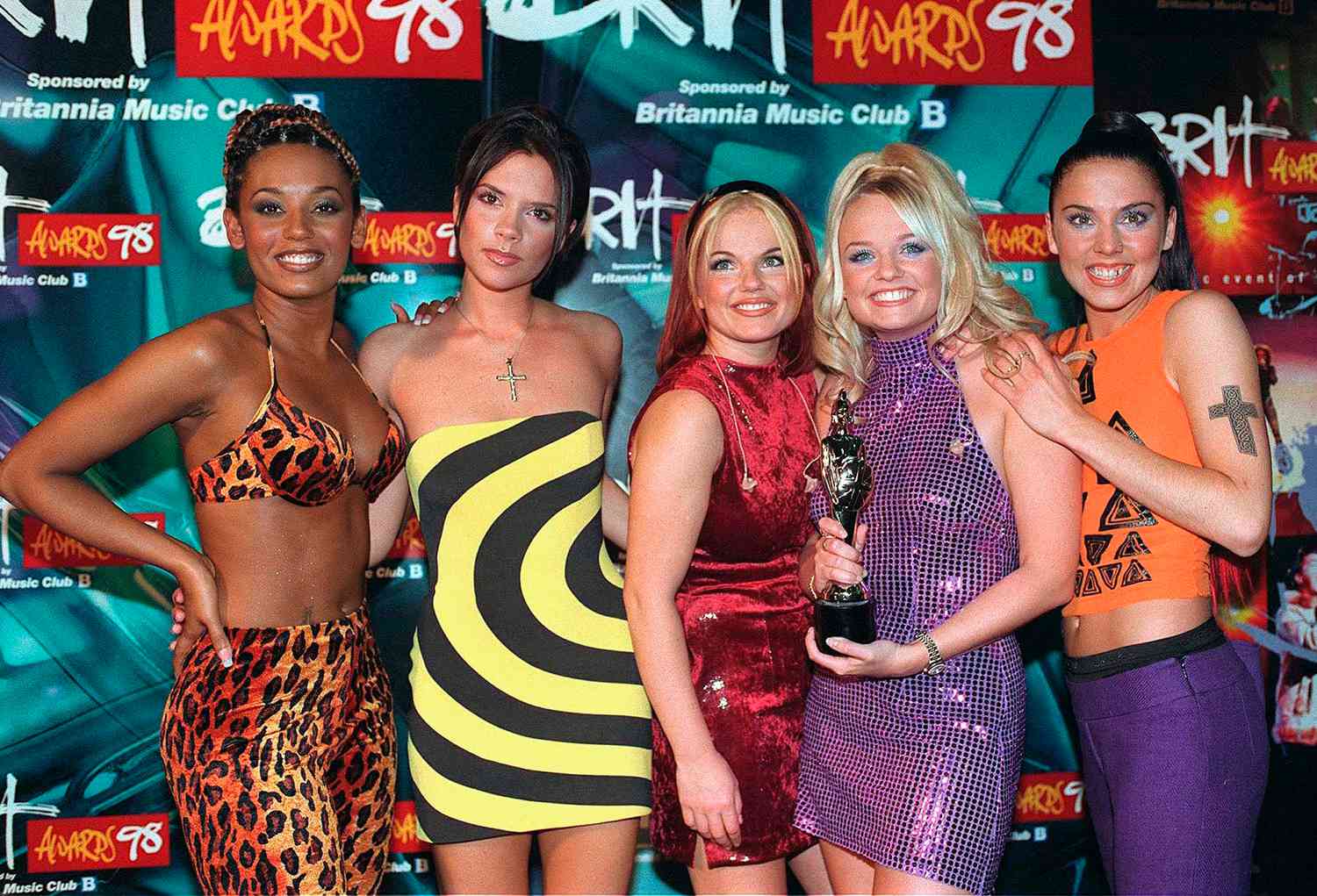
Just thinking about the Spice Girls’ schedule for 1997 makes me feel tired. Live shows, sponsorship deals, a movie, adverts, awards ceremonies around the world… And, of course, a second album to record and promote.
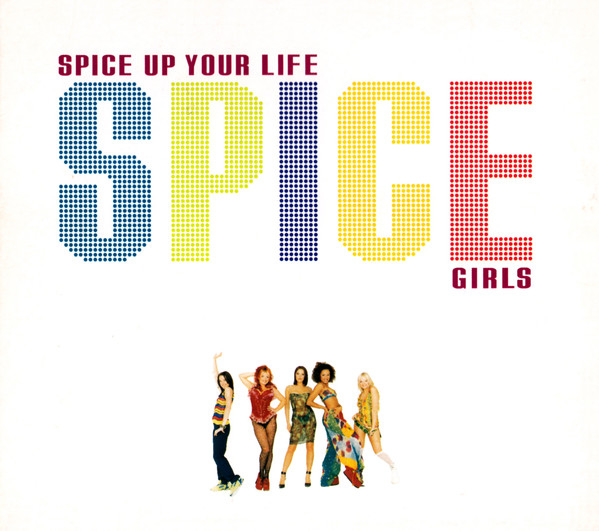
Spice Up Your Life, by The Spice Girls (their 5th of nine #1s)
1 week, from 19th – 27th October 1997
‘Spice Up Your Life’ is classic pop group lead single fare. It’s brash, it’s catchy, it has the name of the band in the title… In fact, it’s basically a call to arms for Spiceys everywhere: When you’re feeling, Sad and low, We will take you, Where you gotta go… set to a pounding, gyrating samba rhythm. People of the world, Every boy and every girl… Spice up your life!
I may have mentioned in previous posts how much of a fan I was of the Spice Girls’ first album. And I distinctly remember hearing ‘Spice Up Your Life’ for the first time… and hating it. It was annoying, it was chaotic, it felt like ‘Wannabe’ (never my favourite Spice Girls’ song) times a hundred. Maybe it was my age? I was almost twelve by this point, approaching the too-cool-for-school stage… Or maybe the song was just a bit naff?
Listening to it now, I’d say it was the latter (I’ve never been too cool for anything). By the second verse, the chaotic energy starts to rip the song apart… Kung Fu fighting, Dancing queen, Tribal spaceman, And everything in between… Then there’s the gibberish of the middle-eight: Flamenco, Lambada, But hip-hop is harder… While it’s perhaps best not to get into the yellow man in Timbuktu…
What does redeem it for me, slightly, is the fact that the chorus is an earworm, and provides its own dance moves: slamming it to the left, shaking it to the right. Plus, the song in its entirety doesn’t outstay its welcome. It blows in, upends your furniture, and blows out all in under three minutes. It charged straight to number one, of course, just as it looked like Elton John’s Diana tribute might stay there for the rest of the year (that was #1 on the Billboard charts well into 1998).
At the same time, ‘Spice Up Your Life’ only stayed on top for one-week, compared to the seven weeks of ‘Wannabe’. Although the ‘Spiceworld’ album was a massive seller, and the singles off it all big hits, it didn’t quite match the impact of its predecessor. In the video to this single, the girls descend in a spaceship to a post-apocalyptic world in which everything is ‘Spice’d. It’s visually impressive, even with the dated CGI, but you wonder what the thought behind it was. If you were starting to feel Spice Girl over-saturation, then that video wouldn’t have changed your mind…
So here it is. The biggest-selling single of all time. Where to begin…?
Something About the Way You Look Tonight / Candle in the Wind 1997, by Elton John (his 4th of ten #1s)
5 weeks, from 14th September – 19th October 1997
I suppose we should begin in Paris, sometime after midnight on Sunday 31st August, 1997. This isn’t really the place to go into the gory details – we all know what happened. I had the dubious honour of breathlessly breaking the news to my family, after an early morning trip to a campsite newsagents. The papers all screamed of a crash, though I’m not sure if they had confirmed the death. Anyway, radios went on and the tragedy unfolded.
Fast-forward to the funeral on September 6th, where Elton John, close friend of the Princess of Wales, performed a new version of his 1973 hit ‘Candle in the Wind’ in her honour. Straight after the service he went to the studio to record it, with Sir George Martin as producer. Seven days after that it had become the fastest-selling single in history.
Interestingly, though, ‘Candle in the Wind 1997’ is listed as the second half of this double-‘A’, and so we begin with the completely incongruous ‘Something About the Way You Look Tonight’. It’s a decent enough, mid-career, soft-rock ballad. Very MOR, AOR… whatever acronym you prefer. It rises to a pretty soaring peak, with squealing guitars and Elton giving a full-throated vocal performance, before ending with a strangely flat final minute or so.
It was the 2nd single from his ‘The Big Picture’ album, and the way it piggybacked its way on to the biggest-selling single of all time is actually quite funny. It had been released by itself on the Monday, but by Saturday had been combined with ‘Candle in the Wind’. If it had been left on its own, or perhaps if Diana had fastened her seatbelt, then ‘Something About the Way…’ would probably have been headed for a #24 peak. (Elton was still capable of a decent sized hit in the mid-1990s, but they were an eclectic mix. His most recent Top 10s before this had been a duet with Pavarotti, and a duet with RuPaul.)
On to the main event then, the real reason that people flocked to buy this record. The fact that this nonsense is the best-seller of all time is proof of just how much the nation lost its collective mind in the wake of Diana’s death. At its peak ‘Candle in the Wind 1997’ was selling an estimated six copies per second, with news bulletins telling tales of people frenziedly buying fifty or more CDs each. Released on Saturday 13th, by the next day it was announced as the new number one, having sold half a million in twenty-four hours. By the end of its first full week on sale, it had comfortably passed two million.
The lyrics also lay bare the madness surrounding Diana’s death. Goodbye England’s rose, May you ever grow in our hearts… (As an aside, why not ‘Britain’s Rose? It still scans, and she was Princess of the whole island. It really gets my goat when people – often Americans – talk about ‘the King of England’. There’s no such person!) You called out to your country, And you whispered to those in pain, Now you belong to heaven, And the stars spell out your name…
So they start off bad, and get progressively worse. The lowest point probably being the line about us always carrying a torch for the nation’s golden child… My feelings on the posthumous beatification of Diana, on the Royal Family, on the British public in general, aside (stories for another day and another blog…) it’s simply a bad rewrite. The music is fine – the original ‘Candle in the Wind’, and it’s lyrics about Marilyn Munroe, is a standout in Elton’s back-catalogue – but the new words are simplistic, trite and saccharine. It makes ‘I’ll Be Missing You’, 1997’s other elegiac hit, sound like Tennyson.
And I know that Elton was her friend, and that she did lots of charity work, and that the Queen was a bit hard on her (I’ve watched ‘The Crown’!), and that all the proceeds from this record went to a good cause… But still, none of that can change the fact that it’s a truly rotten song, the worst of Elton’s ten chart-toppers (okay, joint-worst with that Ladbaby drivel).
Yet here it is, with an unassailable lead at the top of the all-time sellers list. Over five millions copies sold, with ‘Do They Know It’s Christmas?’ lagging some million sales away, and ‘Last Christmas’ behind that. The glimmer of hope is that these festive hits will slowly catch up thanks to a month’s worth of sales and streams every December, but that won’t happen for many years, if it happens at all. For now, the biggest single ever remains a hastily-rewritten dirge for a dead princess, that nobody has actually listened to in twenty-five years, and an average soft-rock tune that came along for the ride.
A slight change in direction then, after Will Smith’s intergalactic, family friendly, summer blockbusting number one…
The Drugs Don’t Work, by The Verve (their 1st and only #1)
1 week, from 7th – 14th September 1997
This is surely one of the saddest chart-toppers in history. Not many hits have made the toppermost of the poppermost with lines such as: Like a cat in a bag, Waiting to drown… This time I’m comin’ down…
I suppose we have to class this as Britpop; but it also feels bigger, more timeless than that. And if it is Britpop (bearing in mind that the Verve formed as a shoegaze band, way back in 1990) then it is another song marking the comedown, more ‘Beetlebum’ than ‘D’You Know What I Mean?’ It’s interesting, actually, that the closing years of the decade will see (slightly) more rock chart-toppers than 1995-6, the peak years of Britpop.
As with Blur’s second #1, this one’s about drugs, and the bands’ struggles with them. I mean, it’s right there in the title. But added to that is the perhaps apocryphal story that it’s about watching a close family member die of cancer. The drugs don’t work, They just make you worse, But I know I’ll see your face again… Richard Ashcroft has never confirmed this, but has mentioned in interviews that this is now the song’s widely-accepted meaning. And he seems genuinely moved by this, the fact that he’s written a song that accompanies people through some of their darkest moments.
Despite all this, and despite me just calling it “one of the saddest chart-toppers in history”, it’s not a miserable song. The reverb, and the strings, give it a light quality, and I love the bluesy rasp to Ashcroft’s voice. The highlight is the middle-eight, the gorgeously soaring Cause baby oooh, If heaven calls… ‘The Drugs Don’t Work’ was the second release from their widely acclaimed ‘Urban Hymns’ album, and the strings in particular tie it back to the previous single, ‘Bitter Sweet Symphony’. That record is probably the Verve’s best remembered – especially as it was their only hit in the US – but it’s not a song I’ve ever loved. For me, this record, their sole number one, is their towering achievement.
So, I wouldn’t like to overly suggest that the success of ‘Bitter Sweet Symphony’, which had made #2 a couple of months earlier, was the reason for this making #1. This record deserves better than ‘shadow #1’ status. Perhaps more of a factor in this being such a big hit is the fact that it was released the day after the death of Princess Diana. Lots of sources have retrospectively claimed that her death, and the public’s need for something both maudlin and uplifting, meant it went straight to number one. Maybe that’s true, but again I’d give a song of this quality a bit more benefit of the doubt. ‘Urban Hymns’ went on to become one of the decade’s biggest albums, but its success caused the band to fracture. Ashcroft embarked on a successful solo career, and the next Verve album didn’t appear until 2008.
Anyway, if the public were desperate to mark Diana’s death by purchasing a CD single, they didn’t have to wait long for an even more appropriate song to come along…