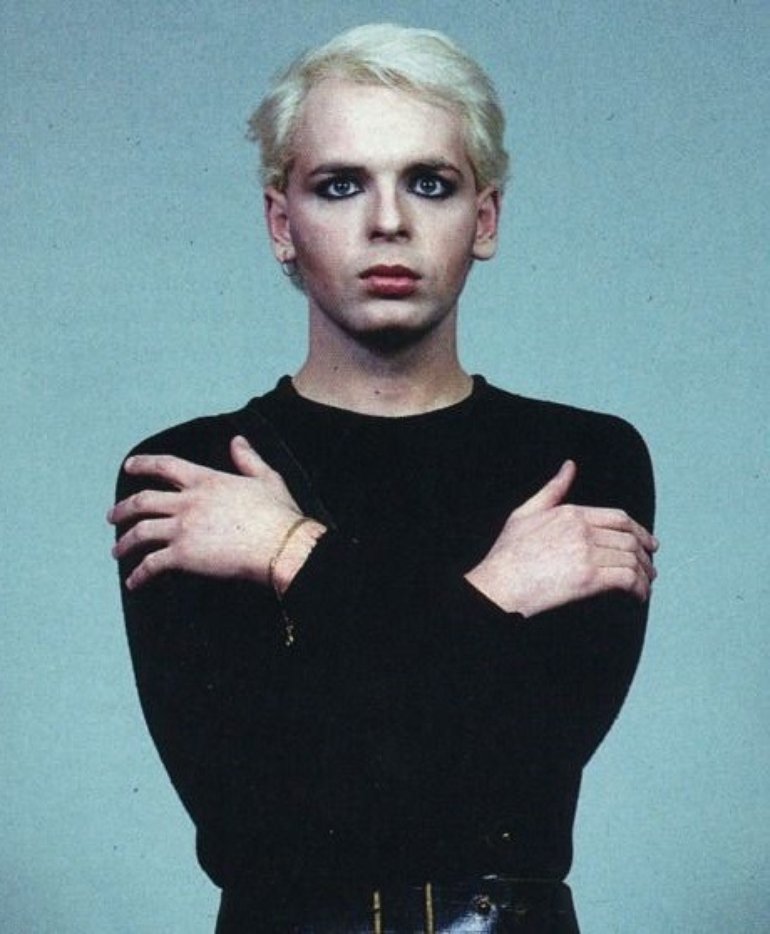
For our second On This Day feature, we start with a birthday. New wave, synth pop, goth rock legend Gary Numan celebrates his 66th today. He is probably best known for his solo number one ‘Cars’, but I’m going to link this to his slightly earlier chart-topper with Tubeway Army, the eerie, industrial ‘Are “Friends” Electric’.
Looking back, I think the period between 1979 and 1981 had some of the strangest, most un-commercial sounding #1s, and this has to be one of the strangest, most un-commercial sounding of the lot.
On this day in 2016, the world bid farewell to producer Sir George Martin. He is of course most famous for his work with the Beatles, but he also sat behind the desk on #1s for Billy J Kramer, Gerry & The Pacemakers, Cilla Black, and on the best selling single of all time, ‘Candle in the Wind ’97’. Here though is his first chart-topper, the completely unexpected, yet quite magical, ‘You’re Driving Me Crazy’, by the Temperance Seven.
While in 2003, March 8th saw the death of one of the first modern British pop stars, Adam Faith. He had two number ones, the second of which, ‘Poor Me’, also happened to be at the top on this day in 1960. I remember quite liking the dramatic strings and Buddy Holly-inspired vocals when I wrote my post on it, and it remains a striking number one record. Faith moved into acting, and remained on stage and screen right through to his death. And on the anniversary of his passing, it would be remiss of me not to quote his supposed final words: “Channel 5 is all shit, isn’t it?” Few truer words have ever been uttered.
The garage revolution picks up pace. All three so-called ‘garage’ chart-toppers that we’ve met so far, though, have been light and fluffy. Garage with the edges softened. Garages that you might find on a semi-detached house in a middle class suburb (Craig David did sing about a jacuzzi, after all).
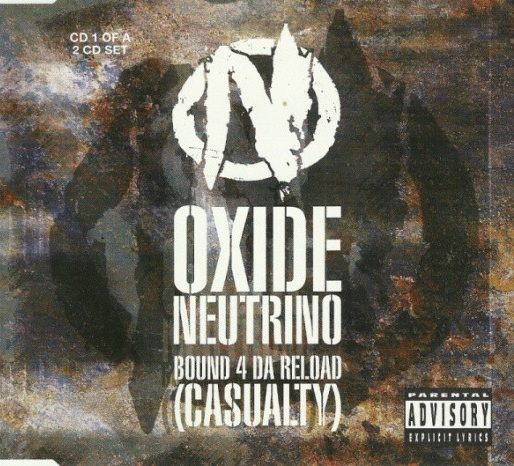
Bound 4 da Reload (Casualty), by Oxide & Neutrino (their 1st and only solo #1s)
1 week, from 30th April – 7th May 2000
Here though is some proper garage. A garage covered with graffiti on an inner-city estate. Sirens. Gun shots. The theme tune from a long-running BBC hospital drama… Okay, that last bit doesn’t sound too street, but the sample from the ‘Casualty’ theme lends this record its name. It adds a dramatic energy to parts of the song, and works interestingly well when repeated on staccato synths. And it’s the only good thing about this record…
The rest of this song is abrasive nonsense. Bound for da bound bound for da reload… is the hook, repeated over and over, against a simple two-step beat. There’s some rapping, toasting, scatting, call it what you will. There’s a jarring spoken sample from the film ‘Lock, Stock and Two Smoking Barrels’ (Ah! Shit! I’ve been shot…) I was fourteen when this came out, and yet hearing it now I feel like an old fogey. It’s borderline unlistenable.
Having said that, the sweary sample above meant that ‘Bound 4 da Reload’ received little radio play, and so this probably passed me by unnoticed at the time. It does mean that it becomes one of a handful of chart-toppers so far to have featured swearing, and only the second after The Outhere Brothers to feature an F-bomb. But we’re on the precipice of swearing in number one singles becoming commonplace. Glancing down the list I can see the imminent debut of a certain bleach-blonde rapper, which will contain more swears than any previous number one combined.
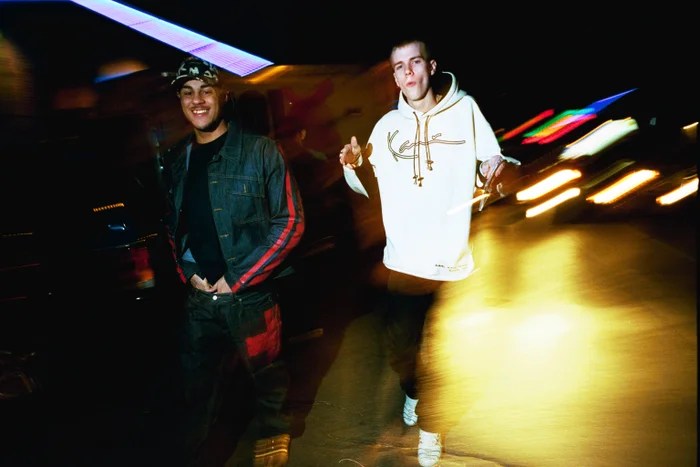
Oxide and Neutrino were members of garage/hip-hop collective So Solid Crew, a group of anywhere between nineteen and thirty singers, rappers, DJs and MCs. In just over a year the group will score their one and only chart-topper, but it is Oxide & Neutrino who struck first here. Leading me to wonder, is this the only instance of someone enjoying a solo number one before their group has had one…?
In my last post, I argued for garage as the sound of the new millennium. And it’s a compelling argument. But it wilts in the face of competition from the true, the one, the only sound of the year 2000… Random dance.
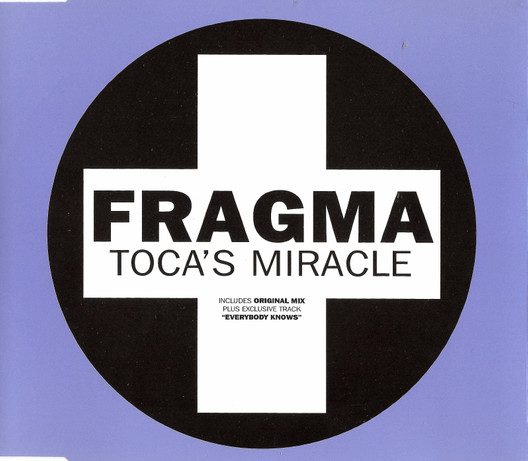
Toca’s Miracle, by Fragma (their 1st and only #1)
2 weeks, from 16th – 30th April 2000
Why is it so hard for dance acts to have longevity? Is it because their tracks are often based on samples, and have often been through multiple remixes, before they eventually make it big, making it hard to recapture whatever made it a hit in the first place when recording the follow-up? Or is it because it’s difficult for some faceless bloke behind a mixing desk to build up much of a fanbase?
Another question: who, or what, is a Toca? While my queries about dance music might need a more expert opinion, I can answer this second one. In Spanish, ‘Tocar’ means to touch. (It can also mean ‘a hole dug by a mouse’ in Portuguese, but I’m assuming that wasn’t the inspiration for this hit.) A British DJ by the name of DJ Vimto (juicy!) mashed 1998 hit ‘Toca Me’ (#11 in the UK) by German trance trio Fragma, with British singer Coco Star’s 1997 #39 hit ‘I Need a Miracle’. The illegally recorded results were picked up by DJs, and played in clubs to an enthusiastic reception. Luckily for Mr Vimto, Fragma and Coco Star liked what they heard, and were on board for a more legitimate recording.
I can pinpoint the exact moment that made ‘Toca’s Miracle’ such a big hit. The line in the chorus – It’s more than physical what I need to feel from you… They’re the usual semi-nonsense dance lyrics, but something in Star’s floaty melisma grabs the ear. It’s a hook that’s remained with us for the past twenty-five years, instantly identifiable even if I have very little love for the actual song. The rest of the record is fairly predictable, though admittedly I’m no connoisseur of ambient trance. It is a very well regarded track, however, and is seen as a game changer for Eurodance, setting the tone for the rest of the 2000s, through acts like Cascada, and Ultrabeat, and Basshunter.
The other thing I remember about this is the video, in which Coco Star plays in a game of women’s futsal. The scenes set in the changing rooms were very popular with the boys at school, though looking back it’s all quite PG, proof more of the untamed horniness of fourteen-year-old boys than of the video’s raunchiness. Interestingly, the only video now available on YouTube is of a 2008 remix, which might have something to do with Coco Star taking Fragma to court claiming that she had never received any royalties. The track was removed from streaming services too, until 2022 when the court case was thrown out.
Fragma managed a couple more Top 10 hits before disappearing from the charts. Coco Star has managed no hits other than this, and the song it samples. My question about dance acts not having longevity remains hanging… Perhaps the most interesting thing about this entire saga however is the fact that Coco’s ‘I Need a Miracle’ was written by Rob Davis, lead guitarist of glam rock legends Mud. Not a chart-topping connection many would have predicted, right? Amazingly, Davis will be go on to be involved in two further ginormous chart-toppers during the early years of the 21st century…
As mentioned, the video is not on YouTube due to copyright reasons. Even the video below may not be the actual chart-topping 2000 mix.
This is the original video, with a 2008 remix playing over it… (can only be watched on YouTube).
If the year 2000 has a defining sound – and I’m far from convinced that it does, with so many chart-toppers crammed into its fifty-two weeks – then UK garage would be a strong candidate.
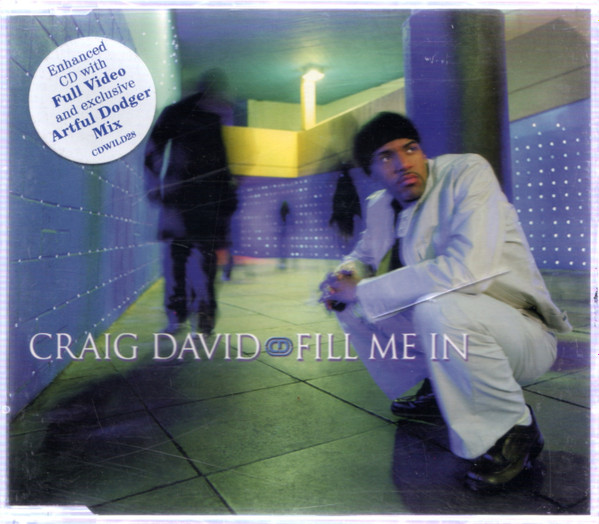
Fill Me In, by Craig David (his 1st of two #1s)
1 week, from 9th – 16th April 2000
These staccato, two-step beats have started to appear more regularly, with Shanks & Bigfoot last year, and to a lesser extent Gabrielle a few weeks ago. I never particularly liked garage at the time – it always felt too light, too airy, too difficult to grab a hold of. It dances around the beat, without ever committing to it. Garage makes me think of a hummingbird flitting from flower to flower, impossible to catch. A strange image for a musical genre, perhaps, but one that works for me.
And eighteen-year-old Craig David, Southampton’s most famous chart-topper, is an equally strong candidate for the year’s breakout star. He has a soft, honeyed voice, and controls this lyric-heavy song despite lacking what I would describe as ‘oomph’. (That’s what garage lacks – oomph!) It tells the story of a young couple trying to get jiggy in the face of her over-protective parents. Calls diverted to answer phone, Red wine bottle half the contents gone, Midnight return, Jacuzzi turned on… Can you fill me in? her folks ask.
Clearly Southampton is a bit posher than where I grew up, as I never knew anyone with a jacuzzi. The Wikipedia entry for ‘Fill Me In’ amusingly claims the song as a commentary on helicopter parenting, though I’m not sure there are many parents, helicopter or otherwise, that would be thrilled upon discovering their teenage daughter had been in a jacuzzi with the next door neighbours’ randy son, guzzling their wine. It is an interesting twist, however, to have a song about teenage lust told from the parents’ point of view.
Listening back to this now, a quarter of a decade later, and I’m more disposed to it than I was at the time. There’s something light, yes, but carefree too; though maybe that’s just nostalgia. As garage goes, this is way over to the poppier side of the genre. It owes as much to American R&B – TLC, Usher, Destiny’s Child and the like – as it does to UK MCs spitting rhymes on council estates.
Craig David had announced himself to the world as the vocalist on Artful Dodger’s ‘Re-Rewind (The Crowd Say Bo Selecta)’ right at the end of 1999. That is an era-defining single, although it fell just short of appearing in this countdown. (‘Bo Selecta’ is a phrase that will come to haunt David, but more on that later.) His second #1 is also a real cultural moment, leaving ‘Fill Me In’ in the strange position of being Craig David’s first chart-topper, but not one of the two songs everyone remembers him for.
A fifth number one single in less than twelve months, with the fifth and final single from their debut album, it’s…
Fool Again, by Westlife (their 5th of fourteen #1s)
1 week, from 2nd – 9th April 2000
…we know perfectly well who it is (the picture above probably helped). And there’s a reason why ‘Fool Again’ was the fifth single from the album. It’s average, and not just in a wider musical sense (which it obviously is). It’s average in a Westlife sense: not as good a pop song as ‘If I Let You Go’, but not guilty of the same musical crimes as their recent Christmas #1.
This was marketed as the ‘2000 remix’ of ‘Fool Again, as opposed to the 1999 original, and that probably eked out a few extra purchases from fans who already had the album. The only change I can make out, though, is the beefed up intro. The bridge really, really reminds me of a song that I just can’t quite put my finger on. The key change is massive, even by Westlife standards. The rest of the song descends quickly and happily into boyband schmaltz, rolling around in said schmaltz like a pig in shit.
Since they’re coming thick and fast, I’m going to keep track of Westlife’s many number one singles with my brand-new feature: Westlife Watch! (Hey, at least it will use up a paragraph every time I have to write about them). After five chart-toppers, the ranking currently stands at:
If I Let You Go
Flying Without Wings
Fool Again
Swear It Again
I Have a Dream / Seasons in the Sun
I feel that bottom song will take some shifting, but I have faith in Westlife’s abilities to serve up something bad enough with their nine remaining number ones.
I think it must be a record, having five number one singles from the same album. I can find no other examples, on the British charts at least. But perhaps here we should discuss Westlife’s management, and their clever release schedule. Louis Walsh had a smart knack of picking quiet weeks for his boys’ singles. ‘Fool Again’ made #1 with sales that would have fallen short in all but nine weeks of this chart year. This doesn’t apply to all of their chart-toppers, as many did debut on top with impressive sales, but they definitely padded their stats with some lucky number ones. ‘Fool Again’ fell to #8 the following week, which says it all.
At the same time, maybe it was also a case of other acts avoiding weeks when Westlife were releasing, especially after five chart-toppers in a row? It would have been a brave act that went up against this Irish juggernaut in 2000, when they were at the peak of their popularity.
As part of our drive to diversify, I’m going to start sprinkling my ‘Random Runners-Up’ at fittingly random points in the schedule (as opposed to devoting a week to them every year), and also tying them to the date on which I’m posting. And so, at number two in the charts on this day fifty-four years ago, we have something that sounds a little familiar…
The Pushbike Song, by The Mixtures
#2 for 4 weeks, from 31st January – 28th February 1971
The percussion and proto-beatboxing that the Mixtures, an Australian band, use here are the spit of Mungo Jerry’s monster hit from the previous year, ‘In the Summertime’. To complicate matters further, the Mixtures had already had a huge hit in their homeland with a cover of ‘In the Summertime’. (Their version had in fact knocked Mungo Jerry’s off number one). This was apparently brought about by a ‘pay for play’ dispute between Aussie broadcasters and record labels, leading to a surge of copycat cover versions of popular hits.
But what this tune lacks in originality, it makes up in catchy enthusiasm. The British public clearly enjoyed this sound as, fresh from making ‘In the Summertime’ the biggest selling single of 1970, they helped ‘The Pushbike Song’ spend a full month in the runners-up position in February 1971, behind George Harrison’s ‘My Sweet Lord’. Incredibly, the record that finally knocked them down to #3 was… ‘Baby Jump’ by Mungo Jerry.
And after all the many rock songs about hot rods and hogs, who would deny the humble pedal bike its moment in the sun? Round, round wheels going round, round, Down up pedals up down… Queen may have since recorded the definitive bike song, but The Mixtures made their own contribution to the cycling canon. They didn’t do much else mind, and are bona fide one-hit wonders on the British chart.
One Spice Girl replaces another on top of the charts. Off the top of my head, this might be the only time two former band members have traded places like this, but I am open to being proven wrong…
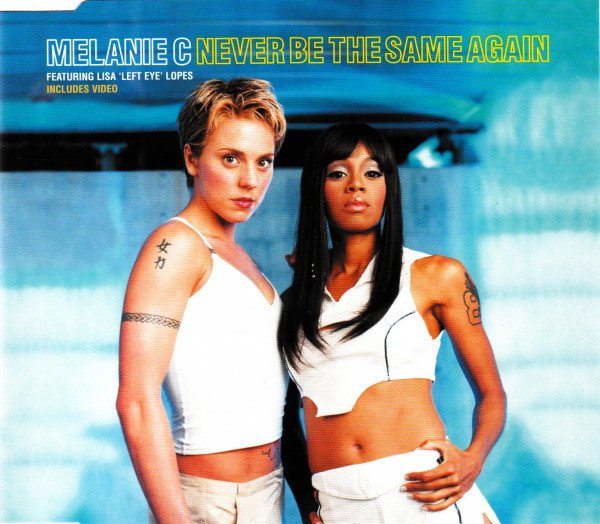
Never Be the Same Again, by Melanie C (her 1st of two solo #1s) ft. Lisa ‘Left Eye’ Lopez (her 1st and only #1)
1 week, from 26th March – 2nd April 2000
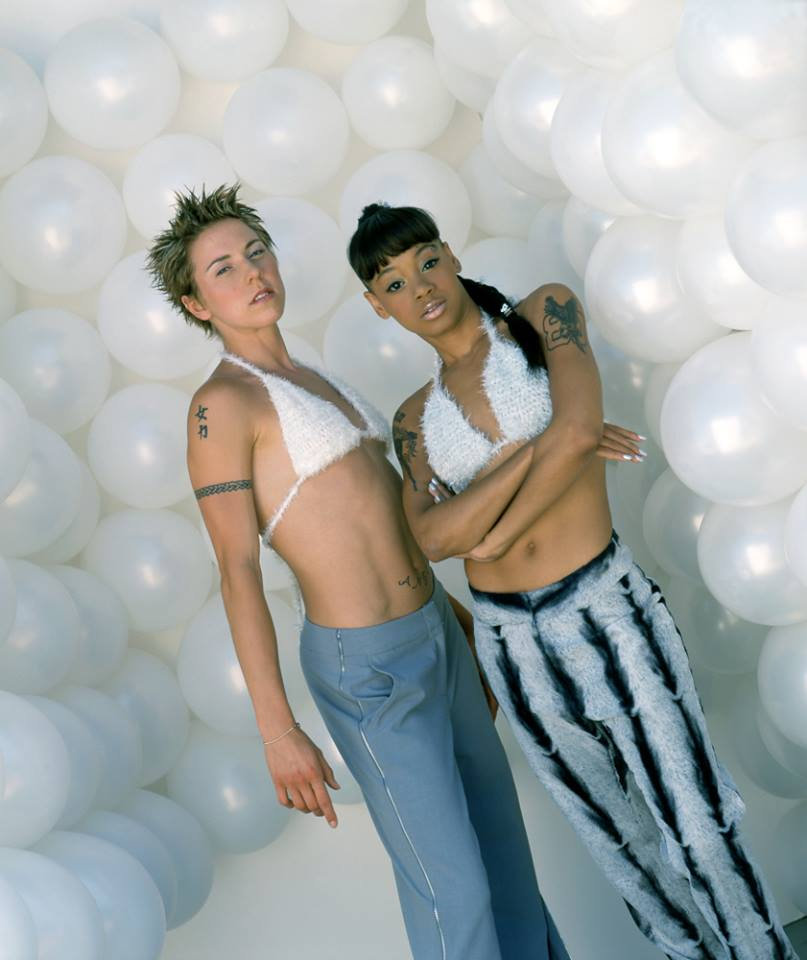
Anyway, Melanie Chisolm becomes our third Solo Spice. She was, famously, the Spice Who Could Actually Sing, and so perhaps we might have expected her first #1 to be a little more full-throated? This was her fourth solo single, after the grungy ‘Goin’ Down’ and the slightly dull ‘Northern Star’ had both made #4, while her Bryan Adams country rock duet ‘When You’re Gone’ made #3.
So, Mel C had had to wait, and it took a hip-hop detour to finally score her a chart-topper. It’s slow and slinky, with some cool drum-fills, and lots of record scratches (which even in 2000 every hip-hop record apparently had to have). It’s interesting how hip-hop still hasn’t yet become the dominant chart force that it eventually will. Not that ‘Never Be the Same Again’ is proper hip-hop, with Mel breathily singing her lines, and a very hooky, pop chorus.
No, the hip-hop is brought by the guest feature, the coolest guest feature since Mel B introduced us to Missy Elliott: TLC’s Lisa Lopes, AKA ‘Left Eye’ on account of her left eye being more ‘slanted’. She delivers a proper, sustained rap, the likes of which remains few and far between in the number one slot. It’s a bit basic, compared to some of TLC’s classics – The US to UK, NYC to LA, From sidewalks to highways… – but it ticks off all the requirements of a guest rapper slot. And it’s to their credit that both Mels managed to secure such impressive features.
The only disappointing thing about this well-produced, catchy but credible record, is that Mel C isn’t tested vocally. However she’s to be congratulated for trying out different sounds and genres on her debut album, while her second number one will be something completely different again. We can assume that her label decided to release a week after Geri’s ‘Bag It Up’ to avoid the girls being in direct competition, but for the record ‘Never Be the Same Again’ debuted with thirty thousand more sales than Geri had the week before.
As for Lisa Lopes, this was her 3rd and final solo hit in the UK – all of which were features – to add to the four Top 10s that TLC had scored in the ‘90s (‘No Scrubs’ was the highest, making #3). She died in a car crash in Honduras, in 2002, while on volunteer work.
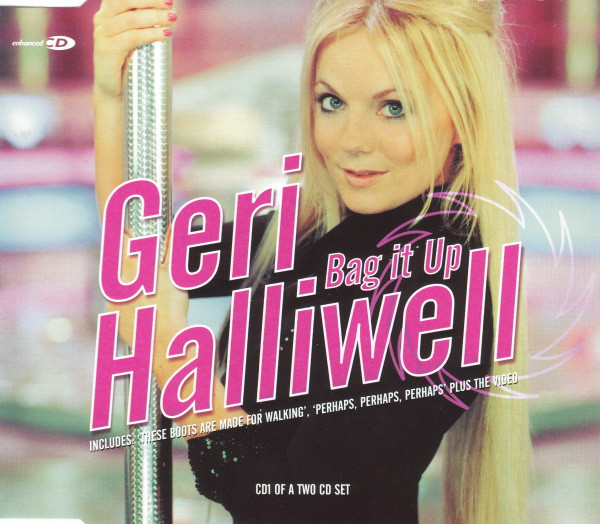
Bag It Up, by Geri Halliwell (her 3rd of four solo #1s)
1 week, from 19th – 26th March 2000
I overused the c-word in my post on Geri’s previous number one ‘Lift Me Up’, so I will endeavour to describe this record as anything but ‘camp’. Problem is, ‘Bag It Up’ opens with what may be the gayest line ever recorded: I like chocolate and controversy… Don’t we all, Geri.
What is this silly slice of disco-cheese about? Why is she treating her man ‘like a lady’? What the hell does I don’t take sugar on my colour TV mean?? It’s clearly some extension of the ‘Girl Power’ message, about how women don’t have to take crap from men. But like ‘Girl Power’ it falls apart under close inspection, and turns into the aural equivalent of a rowdy hen party entering a pub, even if the line Just a bad case of opposite sex… is wonderful.
Not that this record was ever meant to be closely inspected. It’s complete fluff. The video is even gayer, if such a thing was possible, as Geri advertises ‘Girl Powder’, which she uses to spike her boyfriend’s drink and turn him into a topless servant. She then dances around her factory with lots of pink-haired, six-packed oompah loompahs. Meanwhile, at that year’s Brit Awards, she performed the song after emerging from between a giant pair of legs.
Musically it sounds much like the Spice Girls’ ‘Who Do You Think You Are?’, in its poppy, nu-disco beats. In fairness, all three #1s from Geri’s debut solo album have brought something a bit different to the party, while remaining utterly disposable pop. I don’t mean that to be rude, either: I love Geri, and I love disposable pop.
What I might have questioned, had I been a bit older in 2000, was Geri’s relentless pursuit of gay icon status. It’s fun and all, but if anything it’s a little too much. She’d secured it anyway, what with being a literal Spice Girl, and so didn’t have to try so hard. I wonder if in the end it cost her some longevity. (As I write this I’m just remembering that her final chart-topper will be a cover of ‘It’s Raining Men’…)
Still, ‘Bag It Up’ is fun, and Geri was admirably serious about not taking herself seriously. Compared to self-obsessed modern pop, it’s been very refreshing to revisit the time when she was the biggest female pop star in the land.
Hurray! Our first random dance hit of the new century! From the mid-nineties onwards these have become a common occurrence, and they aren’t letting up in the early years of the 2000s.
Don’t Give Up, by Chicane (his 1st and only #1) ft. Bryan Adams (his 2nd and final #1)
1 week, from 12th – 19th March 2000
This is blissed-out, late-afternoon by the pool sort of dance. Background dance, if there is such a thing. Which begs the question, how did this middling record end up on top of the charts? What’s the USP? Is it the fact that it’s rock music’s Bryan Adams croaking his way through it?
Maybe it was a bigger deal than it seems now, a middle-aged rock star appearing on a fresh dance track. Nowadays nobody bats an eyelid at a rock-cum-dance remix. I initially wondered if it was a sample of an old Adams’ track, but no – it was written by Adams in 1999, then mixed and produced by Chicane (British DJ Nicholas Bracegirdle). Vocally, Adams does a Cher and is heavily vocoded and autotuned. And yet, you can instantly tell it’s him. I never would have pegged him as having such a distinctive voice.
Other than the novelty of Bryan Adams’ featuring on it, there’s not much here to catch the ears. It picks up a bit from the midway point, with some higher tempo trance touches, but it remains fairly repetitive. I can’t escape the feeling that this sounds like the sort of remix that would usually have been tucked away as the third track on a CD single.
Perhaps the success of this record was due to the fact that Chicane had been responsible for the single edit of Adams’ 1999 #6 single ‘Cloud Number Nine’ (a much better song than this). View ‘Don’t Give Up’ as the follow-up and its success starts to make more sense. Chicane didn’t have too many big hits, but when they did it was usually with someone interesting. His single before this featured Máire Brennan, sister of Enya, while his 2006 hit ‘Stoned in Love’ was with Tom Jones.
Bryan Adams meanwhile was no stranger to chart success. This was his 11th Top 10 hit since arriving on these shores in the mid-eighties. It is interesting to see the difference in his two chart-toppers though, both in terms of their sound, and in their presence at the top. ‘(Everything I Do) I Do It For You’ holds the record for consecutive weeks at number one; while a decade later ‘Don’t Give Up’ squeaked a solitary week on fairly low sales, just over a thousand copies ahead of Madonna in the end.
It’s been a while since I did a ‘Remembering’ post, so here’s two for the price of one. Two big stars of the pre-Beatles age, both of whom died within a couple of weeks in February 1990.
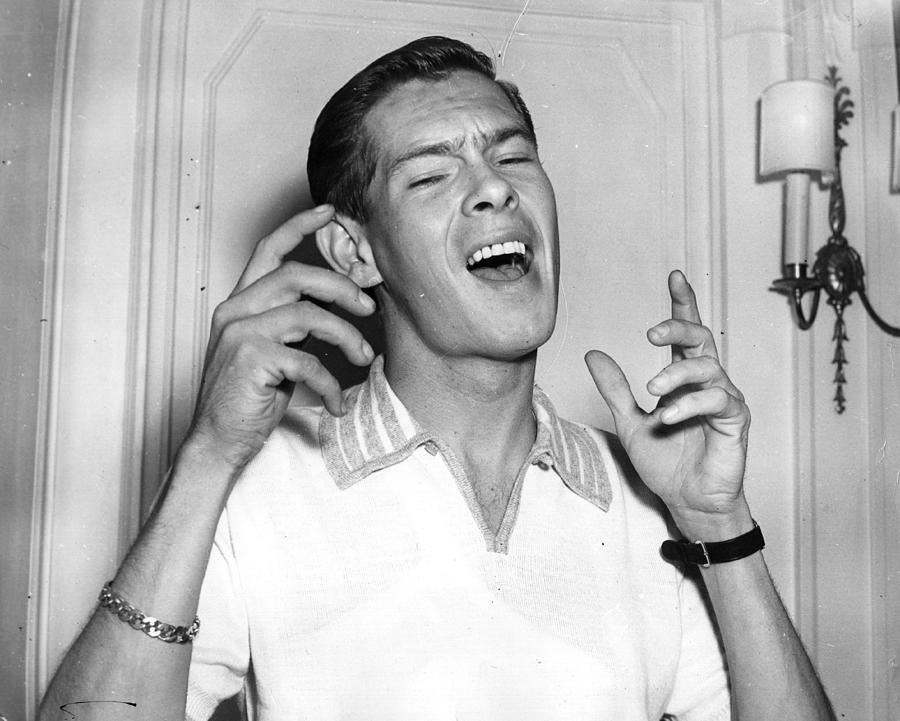
Before starting this blog, I knew Johnnie Ray by name and not much else. He after all is referenced in the opening line of ‘Come On Eileen’ (Poor old Johnnie Ray…) But I will now be forever grateful to him, for making the earliest years of the charts bearable, when it sometimes felt like one po-faced ballad after another, after another. His first #1 was the incredibly steamy (by 1954 standards) ‘Such a Night’, and he had a seven-week run with the whistle-tastic ‘Just Walkin’ in the Rain’ before ending things with the zippy ‘Yes Tonight, Josephine’. All three are well worth a listen if you’ve not heard them before, and proof that pop music could be fun in the prehistoric era. Below I’ll highlight a few of my other favourites of his.
Released in 1951, before Britain even had a singles chart, we can assume that ‘Cry’ would have been a multi-week number one. The missing link between Sinatra and Elvis, Ray’s wonderfully histrionic performance shows why he was known as the ‘Nabob of Sob’ and the ‘Prince of Wails’, surely two of pop music’s best nicknames. His exaggerated, stagey way of singing may have been linked to the fact that he was partially deaf.
‘Ain’t Misbehavin’ is a standard, recorded by everyone from Louis Armstrong and Ella Fitzgerald, to Robson & Jerome. And while I’ll admit to not having heard every version, I’d suggest that you’d struggle to find a performance more committed than Johnnie Ray’s. The man was the epitome of the phrase ‘sing it for the back row’.
Fond of a whistle, Ray made #10 with ‘You Don’t Owe Me A Thing’ in early 1958, a perfect example of how rock ‘n’ roll was making its presence felt in records that weren’t actually rock songs.
By the early 1960s, like so many fifties stars, Ray’s career had tailed off. It’s surprising that he managed to have a career in the first place, after he was arrested for soliciting an undercover policeman in a public toilet in 1951. Rumours about Ray’s sexuality continued, but didn’t seem to harm his sales until another arrest in 1959. He was openly bisexual to many in the music industry, and married a woman named Marilyn Morrison in 1952, who claimed she would ‘straighten him out’. They separated after a year.
Ray also had problems with alcohol, which worsened in the sixties. He would sporadically tour small venues and appear on television in the States, while commanding much larger audiences in the UK and Australia (where he remained most popular) right up until his death from liver failure on February 24th 1990. He was sixty-three.
Del Shannon scored his sole chart-topper a few years after Ray’s time at the top. And what a chart-topper it was. ‘Runaway’ is possibly the most inventive, most exciting, most propulsive #1 of that supposedly fallow period between Elvis and The Beatles. It made top spot in the summer of 1961, and features an innovative Musitron solo, making it arguably the first electronic hit. But even if that solo was played on a clapped out old piano it would take nothing from the record’s innate quality. Anyway, I discussed all this in more detail in my post on ‘Runaway’ here.
‘Runaway’ is so good that it tends to completely overshadow anything Del Shannon released afterwards. But ‘Little Town Flirt’ is another great slice of malt shop pop, making #4 in early 1963. He had a good line in heartbreak, and woman shaming, usually singing about runaways and flirts, and in ‘Hats Off to Larry’ he indulges in a bit of schadenfreude as his ex is dumped and left as heartbroken as he had been.
Shannon had a style, and came pretty close to shamelessly ripping himself off on some records (check out how close ‘Two Kinds of Teardrops’ is to ‘Little Town Flirt!) But on ‘So Long Baby’ he managed to recycle the energy of ‘Runaway’ into a deranged oompah beat and create a #10 hit that sounds both frivolous and terrifying.
Like Johnnie Ray, Del Shannon’s career slowed down towards the end of the sixties and into the seventies as he battled alcoholism. He worked with Tom Petty and Dave Edmunds, and by the ’80s he had sobered up and started something of a comeback. He worked with Jeff Lynne, and was touted as a replacement for Roy Orbison in The Travelling Wilburys. Sadly, though, he shot himself on February 8th 1990, apparently after having a negative reaction to the Prozac he was taking for depression. He was just fifty-five.








 The UK Number Ones Blog