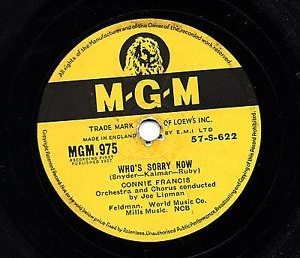
71. ‘Who’s Sorry Now’, by Connie Francis

s-l300

Who’s Sorry Now, by Connie Francis (her 1st of two #1s)

6 weeks, from 16th May – 27th June 1958

I really didn’t mean to set it up like that at the end of the previous post, truly I didn’t. It simply occurred to me that we hadn’t had a female singer at the top of the charts for a long old time and then, lo and behold, here we are…

Not since the 19th October 1956 – just shy of seventeen months ago – have we had a feminine voice on a #1 record. Since then sixteen different male singers, or male groups, have come and gone with twenty different number one singles.

And the differences between ‘Who’s Sorry Now’, and the last female-led chart-topper – Anne Shelton’s ‘Lay Down Your Arms’ – paint a very telling picture of how the landscape of popular music has changed in recent months. Because, basically, rock ‘n’ roll has happened. Anne Shelton hit the top around the same time as ‘Que Sera Sera’ and Frankie Laine’s big-band show tune ‘A Woman in Love’. ‘Lay Down Your Arms’ was a bizarre, military marching fruit-loop of a song that harked back to World War II, Vera Lynn and all that. Since then we’ve had Elvis, and Lonnie Donegan, and Buddy and Jerry Lee. And now Connie Francis takes all that rock ‘n’ roll attitude, and gives it her own, feminine twist.

Who’s sorry now? Who’s sorry now? Whose heart is achin’ for breakin’ each vow…? Miss Francis had her heartbroken, but the man who hurt her now has his own romantic troubles… Who’s sad and blue? Who’s cryin’ too? Just like I cried, Over you… There’s a twang in her voice, a sassy hiccup, and it gives the distinct impression that she’s struggling to dredge up much sympathy for her ex.

Is this a rock ‘n’ roll ballad? The slower tempo and the backing singers suggest that it is. If so, I make it only the second one ever to top the charts – the first being The Dream Weavers’ ever-so-dreary ‘It’s Almost Tomorrow’ from two years back. (I thought about including ‘Young Love’ as a ballad; but that was just a soppy little pop song – ballads need a little bit of emosh about them).

And ‘Who’s Sorry Now’ certainly gives us emotion. It’s a song of two halves. During the first, Francis’s voice lilts and coos. For the second, she whips it up a notch or five. Right till the end! Just like a friend! I tried to warn you somehow… The drums start whippin’, cymbals crash, and her voice almost snaps… You had your way, Now you must pay… Then she delivers the final, crushing blow… I’m glad that you’re sorry now… It is a moment!

Connie_Francis_1961

This is part torch-song, part clap-back. If I were a sassy black drag-queen, I would have clicked my fingers and shouted ‘Preach’ as this track shuddered to a halt. Alas, I am not; but I love this song all the same. This is a big stepping stone in music, make no doubt about it: this is paving the way for Madonna, The Spice Girls, and any other female act with even a smidgen of attitude. This is Beyoncé’s ‘Lemonade’ repackaged for the late fifties. A lot of the female artists we’ve met previously on this countdown have been cute, and flirty, and fun to listen to – Kitty Kallen, Kay Starr, Winifred Atwell, I’m looking at you. But no girl has brought this level of spunk to the table. Alma Cogan and Rosemary Clooney were having a great time on records like ‘Dreamboat’ and ‘Mambo Italiano’ but they were, ultimately, throwaway pop discs, with nothing like the bite of ‘Who’s Sorry Now’.

I love this song, and I love Connie Francis, and have done for a while. You can’t truly be into rock ‘n’ roll without having discovered Connie, Brenda Lee and the other female stars of the time. She was just twenty-one when this hit the top-spot, and in her pictures she sports a perfectly ‘fifties’ look: short curls an’ smokey eyes. But, on doing a little further research, I was surprised – nay, shocked! – to learn two things. One: that ‘Who’s Sorry Now’ was actually first recorded in 1923! And two: that Connie Francis was initially resistant to recording it. Luckily for all of us she did, and this version is completely different to the reedy-sounding 1923 version (which was an instrumental, for a start).

I shan’t wax too lyrical on Ms Francis just yet – we’ll be meeting her again before the year’s out, with an equally brilliant but completely different record. For now, I shall ask one more time… ‘Who’s Sorry Now? Not Connie. No sir… Preach!’

70. ‘Whole Lotta Woman’, by Marvin Rainwater

MARVIN_RAINWATER_WHOLE+LOTTA+WOMAN-570312

Whole Lotta Woman, by Marvin Rainwater (his 1st and only #1)

3 weeks, from 25th April – 16th May 1958

Our first encounter with a very specific sub-genre of pop hit: the ‘Ode to the Larger Lady’. From Queen’s ‘Fat Bottomed Girls’, through ‘Whole Lotta Rosie’ and ‘Baby Got Back’ – these songs are out there if you’re looking for them. And perhaps this is where it all began.

Although, this song might not be about a large lady at all. Is Marvin Rainwater really a chubby-chaser? Or is his girl just hard to please? The lyrics keep it ambiguous. Either way, this is pretty saucy stuff for 1958.

It takes a whole lotta lovin’ just to keep my baby happy, It takes a whole lotta kissin’ and a whole lotta holdin’ her hand… Mr. Rainwater sings. And the effects of this woman’s caresses are not quickly forgotten: Well when she loves me she loves me so hard, It almost makes me mad… She’s a handful, this lass. But Marv is up to the task: Cos she’s a whole lotta woman and she gotta have a whole lotta man… We get it buddy, we get it…

That’s pretty much it, lyrics-wise. This is fluff: goofy and silly. It rollicks by in two and a half minutes, and you’ll enjoy listening to it; but it won’t stay with you for very long afterwards. I’m tempted to call it a novelty record, given the subject matter, the singer’s name (Marvin Rainwater?) and the corny guitars and piano that lend yet another rock ‘n’ roll #1 a slight whiff of cheese. Plus, the ending is a super-basic – diddley diddley diddley diddley doo DUM DUM!

It turns out that Rainwater was as close to a one-hit wonder as you can get (i.e. a two-hit wonder). His only other UK chart success came from the follow-up to this record. He was 25% Cherokee – hence the vaguely Native American sounding surname – and liked to wear headdresses on stage. He lost part of a thumb as a teenager, and had to stop recording when his voice gave out. Hank Marvin of The Shadows adopted that very stage name in his honour. Marvin Rainwater – this was your life.

maxresdefault

I have to admit that I did know of this song before writing this post. As with a couple of earlier chart-toppers (‘Dreamboat’ was one, I think), ‘Whole Lotta Woman’ popped up as a Spotify recommendation and I enjoy listening to it whenever it appears on a shuffle playlist. Incidentally, what does it say about me that Spotify knew I’d enjoy this record…?

I mentioned, in my previous post, the ebb and flow around the top of the charts at this time. And again, after a few weeks of chilled easy-listening, rock is having a moment once again. The tide has washed back in, taking Perry Como with it. Poor Perry. It is worthwhile, though, pausing to reflect on how quickly things are moving right now. Five years earlier, in late-April 1953, the top-selling disc was the painfully twee and campy ‘(How Much Is) That Doggy in the Window’. Now we have a similarly silly record at the top, except it’s a 2nd wave rock ‘n’ roll disc (Or are we on the 3rd wave by now? I lose track) and much more concerned with sexually satisfying big women than it is with cute little pups. Fast-forward to the modern day, and the number one song from this week and the number one song from five years ago (Drake’s ‘In My Feelings’ and Avicii’s ‘Wake Me Up’) sound similar enough – without sounding anything like one another, but you know what I mean – that they could swap release dates and not raise too many eyebrows.

But, and this is something I’ve just realised, this may be a record about a woman, with the word ‘woman’ in the title; but it has been ages, and I mean ages – a whole year and a half – since we heard a woman’s voice at the top of the charts. Isn’t that amazing?

Except, oh… What do we have here…


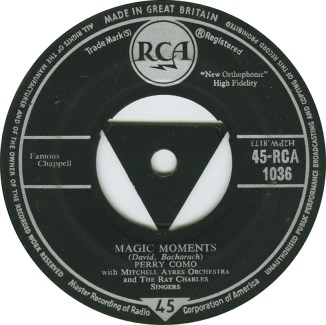
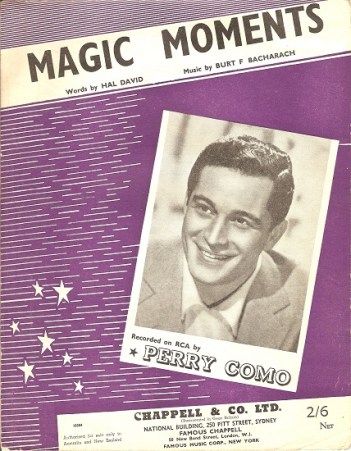
69. ‘Magic Moments’, by Perry Como

perry-como-magic-moments-1958-7

Magic Moments, by Perry Como (his 2nd of two #1s)

8 weeks, from 28th February – 25th April 1958

I’ve grown so used to describing this period in popular music history as the ‘rock ‘n’ roll revolution’ that I’m growing, quite frankly, bored of typing it (‘rock ‘n’ roll’ is actually a difficult phrase to type quickly – those two commas round the n, you see – and I will be relieved when I can start typing phrases like ‘New Wave’ and ‘Disco’).

And if I were to stop calling this the ‘rock ‘n’ roll era’, I’d be very tempted to re-christen it ‘The Age of Whistling’. Because I make this the sixth UK #1 in a little over a year to be very heavy on the whistling: ‘Just Walkin’ in the Rain’, both versions of ‘Singing the Blues’, ‘Butterfly’, ‘The Story of My Life’ and now ‘Magic Moments’ (and I’m sure I’ve forgotten about a few stray whistles elsewhere…) I suppose it’s cheap and easy to do. And I suppose it’s better than humming. But to me it creates an air of fake jollity around a song, a feeling of enforced fun – a sense that some red-faced, chain smoking record executive was yelling ‘Sound relaxed, dammit!’ just before they pressed record.

But, hey. At least the whistling is fairly sporadic here – after the first few bars Perry Como comes in with some very famous lines: Magic… Moments… When two hearts are carin’, Magic… Moments… Mem’ries we’ve been sharing… While this standard may have receded somewhat into the mists of time, surely everyone still knows the chorus. I can pinpoint the first time I became aware of this song – an advert for (I think) ‘Quality Street’ back when I was a lad – and it is one of those songs, along with, say, ‘Que Sera Sera’ or ‘I Believe’, that make up the background music of one’s life. It’s also another Bacharach and David number, hot on the heels of ‘The Story of My Life’, and while it’s a bit more memorable than Michael Holliday’s record it is still pretty bland in comparison to their later hits.

The best you can say about ‘Magic Moments’ is that it’s a very safe song: super laid-back and super-inoffensive. Como sounds like he recorded it from his bed, or at least from a very comfy armchair. Which kind of makes sense, as the singer of this song is supposed to be an older gentleman contentedly reflecting on happy times. The backing singers, meanwhile, are working overtime – taking on at least a third of the lines.

perry-como-magic-moments-1958

Away from the chorus, the verses flesh out just what the ‘magic moments’ were. Moments such as: The time that the floor fell outta my car when I put the clutch down… The way that we cheered whenever our team was scoring a touchdown… They are sweet little vignettes; lyrically quite modern in the way that they eschew grandiose statements about love for real life scenarios. There’s also a link here between this and Pat Boone’s ‘I’ll Be Home’ from a couple of years earlier, in the way that the song invokes cute images of small-town, suburban (super white and WASPy, obviously) America.

I’ve mentioned it before, but it bears repeating, how interesting it is to see the ebb and flow of the UK charts around this time; the old guard tussling with the new. You get a couple of very forward-looking, very cool, very new hits in ‘Great Balls of Fire’ and ‘Jailhouse Rock’ before the waves slowly recede and leave a saccharine blob like this beached at the top – for 8 (eight!) weeks. There are certain records that I can imagine having appealed to both young and old – ‘Diana’, for example – but I really struggle to imagine anyone under the age of forty buying this disc. Como himself was forty-five when this hit the top spot making him – and I’ve not checked this at all, but hey – the oldest chart-topper yet. Definitely one of the oldest. Probably.

Before we put the needle back into its holder for another post, let us bid farewell to the ‘King of Casual’. He has an impressive gap between his two #1s – ‘Don’t Let the Stars Get in Your Eyes’ (the 5th UK #1) and this (the 69th) – which is surely a sign of his enduring appeal. Though I do have to state that, personally, there is no contest as to which is the better song: the ever-so-jaunty ‘Don’t Let the Stars…’ all the way. Como will go on to have Top 10 hits as late as the mid-1970s – and would have had many more hits had the UK charts begun earlier than 1952 (his first US successes came in the early forties). A true titan of easy listening, he died, aged eighty-eight, in 2001.

68. ‘The Story of My Life’, by Michael Holliday

MICHAEL_HOLLIDAY_THE+STORY+OF+MY+LIFE-408385

The Story of My Life, by Michael Holliday (his 1st of two #1s)

2 weeks, from 14th – 28th February 1958

For the first time in a while, we pull up alongside a song I hadn’t ever heard before… Not since Lonnie Donegan’s ‘Gamblin’ Man / Puttin’ on the Style’ have I been able to approach a record with my ears fresh and untainted like this. What, then, do we have here…?

First things first – this is a big step back from the frenzied piano, and then snarling guitar, of the previous two #1s. It’s got the lilting acoustic guitar that sounds soooo 1957 (see ‘Just Walkin’ in the Rain’, ‘Singing the Blues’ and ‘Young Love’ for reference). It is a rock ‘n’ roll record; but super gentle rock ‘n’ roll – diluted and a little wishy-washy.

There are also some super cheesy touches – irritating whistles at the end of lines, some toodle-oohs and bum-bum-bums from the backing singers – which almost tip it over into pastiche territory. It’s very interesting, the fact that we have seen rock ‘n’ roll fragmenting before our very ears over the past few entries: Jerry-Lee Lewis and Lonnie Donegan have given us balls-out – dare I say real – RAWK. Elvis has given us superstar, super-polished rock. Paul Anka, and now Michael Holliday, are giving us what I’d call 2nd generation rock ‘n’ roll – pop music with rock touches, designed to appeal to the kids and their parents.

To the lyrics: Michael wants to write the story of his life: I’ll tell about, The night we met, And how my heart can’t forget, The way you smiled at me… Awwww. Basically his love is his life. But wait… They broke up! No wait… They made up! Safe, safe.

The story of his life isn’t quite over, though. It won’t be until – you guessed it – they get hitched. There’s one thing left to do, Before my story’s through, I’ve got to take you for my wife, So the story of my life can start… and end… with you… It’s nice. This is a perfectly nice, perfectly sweet and utterly forgettable record. I was actually shocked to discover, as I embarked on a little Wikipedia-ing, that ‘The Story of My Life’ was written by Burt Bacharach and Hal David, the first of this legendary duo’s songs to top the UK charts. A shock because, compared to the classics they wrote later in their careers, this is very, very meh. A big contender for the ‘Meh Award’ in my next recap, I’d say.

00000tmp

I’d hoped to pad this post out by delving a little into just who Michael Holliday was – as he’s someone I’d never heard – but I’ve just realised that we’ll meet him again, briefly, in a couple of years. Best hold something back for then. Suffice to say, he made the most of a short career – scoring two number ones out of only ten charting singles – before dying at the shockingly young age of thirty-eight. He has a nice, if unremarkable, voice on this nice, if unremarkable, record. Wiki sums it up best in their succinct entry on Holliday: ‘a British crooner popular in the late 1950s and early 1960s.’

Fin.

67. ‘Jailhouse Rock’, by Elvis Presley

ELVIS_PRESLEY_JAILHOUSE+ROCK+-+1ST-562625

Jailhouse Rock, by Elvis Presley (his 2nd of twenty-one #1s)

3 weeks, from 24th January – 14th February 1958

Ready? This is another song that grabs you from the get-go – just as ‘Great Balls of Fire’ before it – and for two and a half minutes gives you a good shaking. 1958 really did get off to a storming start in terms of chart-toppers.

But whereas Jerry-Lee Lewis grabbed us with his opening lyrics; Elvis here – or rather his band – grab us with their intro. With that guitar and those drums. Durrrr-durr (dun-dun)…, Durrrr-durr (dun-dun)… The most instantaneous intro yet? I mentioned, recently, the start of ‘That’ll Be the Day’, and that the jangly guitar there was iconic. ‘Jailhouse Rock’ kicks off in a much less subtle way; but since when has rock ‘n’ roll been about subtlety?

This is the Elvis that people think of in the early days; before GI Elvis, or Movie Star Elvis, or Comeback Elvis or Bloated Vegas Elvis. Jailhouse Rock Elvis, and that iconic picture of him in his black and white striped T, frozen, mid-yelp, on his tiptoes. Type his name into Wikipedia – go on… – and what is the picture that introduces one of ‘the most significant cultural icons of the 20th century’? In a way, I’m sad that this wasn’t his first ever UK #1 – rather than the nice but very understated ‘All Shook Up’. Imagine this snarling guitar announcing Elvis’s arrival at the top of the charts.

MV5BMTU3NTg5ODU3M15BMl5BanBnXkFtZTcwNzM5MDQyNw@@._V1_SY1000_CR0,0,790,1000_AL_

But… But, but, but. Those famous pictures of Elvis in a convict’s uniform (a very sexy, rock ‘n’ roll convict’s uniform, but still) gyrating outside the prison gates? They were promotional shots for the movie: ‘Jailhouse Rock.’ We are already in Movie Star Elvis phase here. ‘Jailhouse Rock’ was his 3rd feature film. The argument I put forward during his first stint at the top – that Elvis was ‘over’ before he got started, that if it ain’t his ‘Sun’ recordings then it ain’t worth shit – gains further ground here. Because this record is an early step into Cheesy Elvis. The music may be rocking; but the lyrics are nothing but a bunch of silly vignettes about prisoners dancing in a jail yard.

Let’s rock… Everybody let’s rock… Everybody in the whole cell block… Was dancin’ to the Jailhouse Rock… The warden throws a party, encourages everyone to get dancing, even if they have to dance with chairs, and madness ensues.

Two verses stand out for having more than a whiff of music-hall comedy to them – thereby somehow tying this classic record to the likes of The Stargazers’ ‘I See the Moon’, from the depths of the pre-rock era (that’s a connection I never thought I’d make). There’s the ‘gay’ verse, in which two prisoners – presumably male – proposition one another: Number 47 said to Number 3, Now you the cutest jailbird I ever did see, I sure would be delighted with your company, Come on and do the Jailhouse Rock with me… I’ve read some interpretations of these lines as a revolutionary moment in the history of popular music. Personally, I think the songwriters were just taking the piss.

And there’s the final verse: …The wardens lookin’ out, A chance to make or break… Bugsy turned to Shifty and he said ‘Nix Nix, I wanna stick around a while an’ get my kicks… They could have escaped, you see, but they were having such a good time. It’s fun, and silly, but I think it also gives this record slightly less authenticity when compared to immediate contemporaries such as ‘Great Balls…’ and ‘That’ll Be the Day.’

Still, though… this is an absolute cornerstone of music history. On Spotify, even today, ‘Jailhouse Rock’ is second only to ‘Can’t Help Falling in Love’ as Elvis’s most listened to track. And it was the first ever record to enter at #1 in the UK. That’s right. The sixty-five previous chart-toppers had all spent at least a week – often much longer – climbing to the top. Elvis barged right in there; he wasn’t waiting for no-one. And – give me a second as I put on my chart-geek hat – up until the 1990s entering at #1 on the UK Singles Chart was an honour reserved for the very biggest stars: Cliff, The Beatles, Elvis, Slade, Frankie Goes to Hollywood… um, Gary Glitter… or the BIGGEST records, like ‘Do They Know It’s Christmas’. In the ’90s it became de rigeur, and in the early ’00s it was the only way to arrive on the charts. Nowadays, in the streaming era, it’s become slightly less common once again. But in 1958 it was unheard of. Only Elvis was that big.

To finish, something that I’ve come to realise since starting this blog: that ‘pre-rock’ didn’t just mean ‘pre-Elvis’. I used to think that ‘Rock Around the Clock’ kicked off the rock ‘n’ roll revolution before Elvis took over. But I’ve now seen that The King was actually kind of late to the party. And it’s been good to give Johnnie Ray, Guy Mitchell, Lonnie Donegan and Tommy Steele a bit of recognition, even if it’s been to the detriment of a singer that I was pretty well obsessed with in my teenage years. He may have been The King of it, but rock ‘n’ roll didn’t begin, or end, with Elvis Aaron Presley.

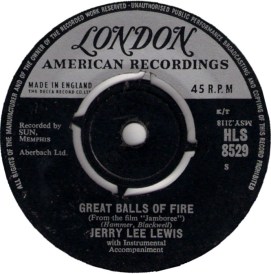
66. ‘Great Balls of Fire’, by Jerry Lee Lewis

jerry-lee-lewis-great-balls-of-fire-1957

Great Balls of Fire, by Jerry Lee Lewis (his 1st and only #1)

2 weeks, from 10th – 24th January 1958

My usual writing process for this blog – in case you’ve ever found yourself wondering – is to preview the next song after I finish writing a post. I listen once, take notes and can thus get straight into writing when I return. Except, upon lining ‘Great Balls of Fire’ up in Spotify and pressing play, my ability to take notes suddenly disappeared. I felt frozen, tied to the tracks, zapped by a Taser… This record seriously impairs your ability to think.

And I mean that in the best way possible. It’s not that it’s dumb, or monotonous, or anything like that. It’s just an absolute blitz, an assault on the senses, a two-minute blast which takes rock ‘n’ roll up another notch. I think everyone’s pretty familiar with the opening salvo:

You shake my nerves and you rattle my brain, Too much love drives a man insane, You broke my will, But what a thrill, Goodness Gracious Great Balls of Fire…!

Jerry Lee then sets off on what is basically GBH of a piano – he stabs, he pounds, he slides his fingers down the keys (a ‘glissando’, apparently, though that sounds far too delicate a term for the noises made here). He goes from high to low seemingly at random – though obviously not ‘at random’, you know what I mean – poking and prodding away. You hope he at least bought the piano a drink afterwards.

I mentioned in my post about The Cricket’s ‘That’ll Be the Day’ that we were entering a new phase in rock ‘n’ roll, one in which the kids were taking centre stage away from oldies like Guy Mitchell and Johnnie Ray. This record’s arrival at the top of the chart confirms it. Ol’ Johnnie may have dialled up the raunch on the wonderful ‘Such a Night’, but even that pales in comparison with ‘Great Balls…’ Lewis doesn’t just make the old pre-rock stars sound dated; this makes 1st generation rock ‘n’ roll, ‘Rock Around the Clock’ for example, sound slow and babyish. And it is an absolute palate cleanser – the tangiest of sorbets – after the schmaltzy ‘Mary’s Boy Child’ which preceded it!

Is this a lyrically shocking record? There are a few choice lines: Kiss me baby – Mmmh, feels good…! I wants to love you like a lover should…! C’mon baby, you drive me crazy! Not truly top-shelf stuff, but we are still in January 1958. No, actually I think the most outrageous thing about this record is the piano-playing. We get to the solo and it is an all-out attack – you can really picture Lewis standing hunched over the keys, as he did so famously, thumping and sweating away. It’s great to have both a completely piano-led rock ‘n’ roll number, as 1957 was a bit guitar heavy, and to tick another ‘Legend of Rock’ off our list. ‘The Killer’ won’t be back at the top of the charts again. In fact, he would only return to the UK Top Ten on two occasions following this. His career stuttered when he married his thirteen-year-old cousin (marrying thirteen-year-olds will do that to a career…), but he is still a-hoppin and a-bobbin to this day, aged eighty-two.

jerryleelewis22

Unlike Elvis and Buddy Holly, Lewis is not someone whose back-catalogue I’m terribly familiar with. I first truly became aware of ‘Great Balls of Fire’, as most people of my age surely did, through that scene from ‘Top Gun’ (Take me to bed or lose me forever!). Though I actually danced on stage to a ‘version’ of this song in a school play long before that – when I was but ten years old. The song was really a pastiche of loads of different rock ‘n’ roll standards, called ‘Surfin’ The Web’, but I’m sure I remember the line: ‘You shake my mouse and you rattle my keys…’ (It was the mid-nineties, when computers were still enough of a novelty that you could write comedic songs about them). I played a character called Rocky Rom: a doll competing against lots of other dolls for a boy’s attention. Rocky was a total brat, but he was the toy du jour, and quite confident of getting chosen. He didn’t, obviously. A tatty old teddy bear with one eye got the pick – it’s who you are inside that counts, kids.

A song truly has entered the public consciousness, you’d have to say, when it’s getting ripped off for primary school plays forty-odd years later.

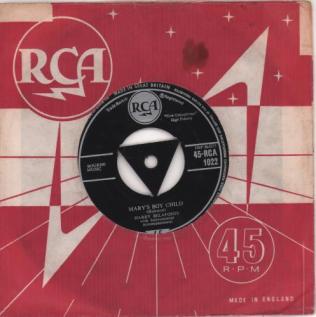
65. ‘Mary’s Boy Child’, by Harry Belafonte

HARRY_BELAFONTE_MARYS+BOY+CHILD+-+1ST-572716

Mary’s Boy Child, by Harry Belafonte (his 1st and only #1)

7 weeks, from 22nd November 1957 – 10th January 1958

Must we?

Maybe it’s because we are approaching mid-summer as I sit down to this, but I am really not in the mood to write a post about a Christmas song… Especially a song as dull as this one.

You surely all know it: Long time ago, In Bethlehem, So the Holy Bible says… Mary had a baby – one Jesus H. Christ – and the herald angels sang. The shepherds saw a star. Man will live for ever more… So on and so forth…

I am potentially the most-irreligious person going and so, to avoid offending any sensibilities, I will refrain from any cynical interpretations of these lyrics. Plus, Harry Belafonte is a titan, both of pop music and of the Civil Rights Movement, and to belittle this song (his only appearance at the top of the UK charts) would be to belittle the seventy-year career of a ninety-one-year-old man, who has achieved more in life than most of us could ever hope to.

Actually, talking of the Civil Rights Movement, the most notable thing about this record is how black it is. And how Harry Belafonte becomes, five years after its inception, the first man of colour to top the UK singles chart. And considering the sheer number of black male artists who have topped the charts – some of the biggest names in popular music history – that’s a pretty cool trail to blaze. He’s of course not the very first black artist to reach the top… So far we’ve had Winifred Atwell playing old-fashioned, white, music hall tunes on her piano, and The Teenagers with Frankie Lymon giving us a good dollop of Doo-Wop. And that’s been it. The charts are still very white. But here, Belafonte sings in a Jamaican patois (a heavily diluted patois, but still). And lines like: While shepherds watch their flock by night, Them see a shining star… are almost subversive in their flaunting of proper grammar! This is technically a Calypso record, but I struggle to hear anything particularly Calypso-ish about the strings and violins that swirl around Belafonte’s voice.

432466bq

Let’s treat this is an interlude, then – a moment’s respite from the advancing march of rock ‘n’ roll. The songs that top the charts at Christmas time are rarely reflective of current tastes (cough Cliff Richard cough cough Bob the Builder). Normal service will be resumed presently. Though to call this record’s stint at the top a ‘moment’ is a slight under-exaggeration (what is the opposite of an exaggeration?) It stayed there for seven weeks – hitting the top spot as early as the second last week in November! People clearly loved it.

Searching out the right version of this song has been a bit tough. Belafonte recorded various live versions, and an extended version in the early-60s, though the link below should be the song that topped the charts for Christmas ’57. But if you asked me what the best version of ‘Mary’s Boy Child’ is, I’d have to say Boney M’s!

64. ‘That’ll Be the Day’, by The Crickets

s-l300 (5)

That’ll Be the Day, by The Crickets (their 1st and only #1)

3 weeks, from 1st – 22nd November 1957

That intro…

I wish I could describe it, or transcribe the notes onto the page, and somehow do it justice. But I can’t. It kind of rolls, kind of cascades, and kind of jangles. And yet does none of those things. Just click on the video link below and listen for yourselves, if you aren’t already familiar with one of the seminal moments in pop music history.

I’ve been using that word a lot recently: ‘seminal’. Maybe I’ve been over using it. But it’s just so easy to stick in as I go. Pretty much every second record we come across at the moment is ‘seminal’. And, to be fair, they’ve had enough time to become so. We are listening to songs that topped the charts sixty-one years ago. That’s more than enough time to become ingrained and cemented – and in some cases mummified – in the popular psyche. And I suppose this is why it’s so common to compare old music favourably to its modern counterparts, because we grow up with these totems of musical history – the Elvis’s, the Holly’s, the ‘Rock Around the Clocks’ – and current pop stars are easy to cast as Johnny-come-lately copycats. But who knows? As I write this post the current UK #1 single is ‘Shotgun’, by George Ezra. And there’s every chance that that will be just as revered as ‘That’ll Be the Day’ in sixty-one years’ time. Every chance…

Anyway – to the record. That intro draws us into a song about – on first listen – a guy who hopes his love’ll never leave ‘im. Well, that’ll be the day when you say goodbye, That’ll be the day when you make me cry, You say you’re gonna leave, You know it’s a lie, Cos that’ll be the day-y-y, When I die… Except, wait a sec. He isn’t blindly hoping his girl sticks around; he’s pretty confident about it. He ‘knows it’s a lie’. You sit and hold me, And you tell me boldly, That some day I’ll be blue… Nope, Buddy says. That’ll be the day! The song title is actually a challenge: challenging his girl to even think about breaking up with him. Compare lyrics – if you dare – with Eddie Fisher’s ‘Outside of Heaven’, from way back in January 1953, to see just how far pop music has come in under five years. This is an arrogant record, a sexy record. This is rock ‘n’ roll!

13b76502b2e66b8af543e51889003212

Buddy Holly’s voice dances and flirts – plays, almost – with the listener. He coos, he pauses, he growls. I mentioned in my last recap that the rock ‘n’ roll records which we’ve featured so far have focused on the singer, rather than the band. Not here. The Crickets play tightly, but also very loosely. There’s a great, rough-around-the-edges feel to this record that contrasts greatly with the polished cheese of Paul Anka’s ‘Diana’, whose bumper run at the top this track ended. We have a solo, which is just as jangly as the intro, and I love the drums – especially in the second verse and final chorus: When Cupid shot his dart, He shot it at ya heart, So if we ever part, Then I’ll leave you… BA DOOM DOOM!

I’m going to term this period in music as the ‘2nd Wave of Rock ‘n’ Roll.’ We’ve had Elvis, now we’ve had Buddy. Whereas as earlier it was the oldies jumping on the rock ‘n’ roll bandwagon – your Kay Starr’s, your Johnnie Ray’s and your Guy Mitchell’s – now we are getting kids who have been weaned on rock, who’ve grown up and formed their bands knowing nothing but this cool new music. And ‘That’ll Be the Day’ is the perfect poster-song for this new movement – four kids from Texas playing their own songs, fast and loose.

As with Elvis, I know the music of Buddy Holly pretty well. When I was about twenty I – as everyone really should – bought his Greatest Hits and took it home to hear how modern pop music was invented. And I’d love to wax lyrical on him, but I’ll hold back for the simple fact that we’ll be hearing from him again soon. He’ll be dead by that time, but he will at least have one last hurrah at the top of the UK Singles charts (he should have had around twenty hurrahs, but that’s a story for another day…) The Crickets, though, will not be back at the top of the charts again and so I would recommend that you go away and listen to, in no particular order, ‘Oh Boy!’, ‘Maybe Baby’, ‘Not Fade Away’ and ‘It’s So Easy’. And anybody who thinks I’m exaggerating when I say that so much of modern pop lies in the two minutes twenty seconds of this record should listen to the ‘ooh-hoos’ Holly delivers at the end. The Beatles spent their first two years ripping that trick off.

It is nice, though, that so many of the major rock ‘n’ rollers of the 1950s are getting a moment in the sun (i.e. the chance to feature in this countdown). The Crickets just now, while Buddy Holly will also get a solo turn. Bill Haley’s been. Jerry Lee is up soon. Chuck Berry will get there eventually (how I am looking forward to writing about that particular number one!) There are some glaring omissions, though: no Little Richard, no Fats Domino, no Gene Vincent… The chart Fates can be cruel.

They wouldn’t have dared, however, keep a record as immense as ‘That’ll Be the Day’ from the top.

63. ‘Diana’, by Paul Anka

paul-anka-diana-columbia

Diana, by Paul Anka (his 1st and only #1)

9 weeks, from 30th August – 1st November 1957

In which we encounter the best opening line in pop music history. Or is it the worst? I can’t really tell…

Paul loves Diana, and has written a song for her. How does he begin said paean to his one true love? What is his grand opening declaration? It’s: I’m so young and you’re so old, This my darling I’ve been told…

Phew! I’ll bet there was no holding Diana back after she heard that. And the lyrics that follow aren’t much better. You and I will be as free, As the birds up in the trees… I love you with all my heart, And I hope that we will never part… Hold me darling, Hold me tight, Squeeze me darling with all your might… (If I could add a puking emoji right here, I would) This is pure pop-song-as-love-letter-written-by-fifteen-year-old. Elsewhere ‘me’ is rhymed with ‘see’, ‘my lover’ with ‘no other’ and ‘arms’ with ‘charms’… It’s by far the tritest, most banal, utterly cheesiest song we’ve met in this countdown.

But wait… It turns out that this song, which sounds like it was written by a randy fifteen-year-old, was written by… a randy fifteen-year-old! (OK, Paul Anka was sixteen when it was recorded and seventeen by the time it hit #1, but for the purposes of this next paragraph lets imagine he wrote it in his bedroom, aged fifteen). See, Paul had a crush on a girl at church, called Diana, and was thus inspired to write a song entitled ‘Diana’. Simple! Quite how old ‘so old’ is I can’t find any info on. She was probably only nineteen, but part of me really hopes Diana was a forty-five-year-old cougar.

paul-anka-diana-1957-3

Musically this record is super-diluted rock ‘n’ roll. It sounds like a pastiche of rock ‘n’ roll as recorded for the ‘Grease’ soundtrack. There’s a cheesy sax riff and some ‘doobeedoobees’ from the backing singers. Actually, to refer to this as a ‘rock’ song sounds ridiculous – I take back that last sentence. This is pure, bubblegum pop – a genre we haven’t seen too much of so far (strangely enough for the pop charts) – and I’d put it along with ‘Dreamboat’ and ‘Look at That Girl’, and perhaps ‘Butterfly’, as the purest ‘pop’ chart-toppers thus far.

Earlier I described Guy Mitchell’s ‘Rock-A-Billy’ as a sherbet dib-dab of a song – a song that you can’t resist despite knowing that it cannot be good for you. Well, if that was a sherbet dib-dab, then listening to ‘Diana’ is like drowning in a swimming pool filled with Coca-Cola. And, just as with ‘Rock-A-Billy’, as much as you want to dislike this utter cheese-fest it worms its way in and doesn’t let go. You’ll be belting it out in the shower after a couple of listens, trust me. Then again, I am a sucker for a catchy hook and a silly-but-simple lyric. It’s harder than you think to write a song like this, I’ve heard…

Anka’s voice is pretty strong too – it simultaneously sounds like the voice of a fifteen-year-old, and that of a middle-aged bloke. And by the time he belts out the champagne line: OOOOH, pleeeeeaaasseee stay-eee by me… Diana… you’re won over. Actually, the way he lowers his voice to sing her name does indeed sound like a kid trying to impress an older woman. It’s quite clever, in a way. Anka won’t have any more #1s, but when you’re debut single hits the top and stays there for nine weeks do you really need any more? He’s had a long chart career but is perhaps more famous as a songwriter, having written ‘It Doesn’t Matter Anymore’ for Buddy Holly and ‘She’s a Lady’ for Tom Jones. Oh, and ‘My Way.’ So he did alright for himself in the end.

To end, it’s perhaps worth noting how quickly rock ‘n’ roll has diversified since Bill Haley announced its arrival at the top of the charts. In quick succession we’ve had the raw, proto-punk of Lonnie Donegan, a low-key and slightly tropical sounding debut for Elvis Presley, and now this. After a run of very samey sounding #1s, we are getting a little more variety at the top. And I’m excited to hear what will come next!

62. ‘All Shook Up’, by Elvis Presley

elvis-presley-all-shook-up-that-s-when-your-heartaches-begin-hmv-pop-359--53154-p

All Shook Up, by Elvis Presley (his 1st of twenty-one #1s)

7 weeks, from 12th July – 30th August 1957

And so it begins…

Between the 12th July 1957 and the 6th February 2005, Elvis Presley will score 21 UK #1 singles… (The most any artist we’ve met so far has managed is four). He will spend 80 weeks at #1, 386 weeks in the Top 10, 1062 weeks in the Top 40, 1304 weeks in the Top 75… And that’s before we get started on the albums chart… Elvis won’t just dominate the UK charts; he’ll hump their brains out.

I feel like whatever way I introduce the ultimate pop star (rock star, performer, King of Whatever) it won’t be enough. I’ve already struggled to set the scene for Sinatra, and I’m sure I’ll struggle similarly when it comes to The Beatles, Michael Jackson and co. Best thing is, I think, to just jump straight into the song.

‘All Shook Up’ is actually a fairly low key start for Elvis. There’s a roly-poly riff, a little Hawaiian guitar and someone slapping on a cardboard box (?). There’s no solo, no change of pace, and it’s over inside two minutes. Although I knew what to expect from this song, it does sound a little underwhelming as the record that announced ELVIS PRESLEY’S!! ARRIVAL at the top of the charts. (Of course, this was far from being his debut single – it was Presley’s 7th Top Ten appearance – and I can’t help feeling that some of the singles that went before, such as ‘Heartbreak Hotel’, ‘Hound Dog’ or ‘Blue Suede Shoes’, would have made much more of a statement as his first #1).

What the minimalist production does do, however, is show off Elvis’s voice to perfection. We’ve got the now iconic I’m all shook up – uh huh huh… which impersonators will be doing dodgy copies of until the end of time. We’ve also got the beautiful moment at the end of either verse (not that this song really has ‘verses’, but still) when the instruments pause and we are left with nothin’ but Elvis: My heart beats so an’ it scares a-me to death…

My favourite bit of the whole song, though, comes towards the end. And it’s not a lyric or a guitar lick or anything like that. For a song that’s about the feeling of being in love, and of being all shaken up from falling in love, the lyrics are quite tame. Lots of knees shakin’ and tongues gettin’ tied and so on. But just before the second last I’m all shook up, in a moment of silence, Elvis lets out a little grunt – a tiny little orgasmic sigh – and in that moment we catch the merest whiff of the scandalous Elvis: the Elvis that was causing a moral panic, ‘Elvis the Pelvis’ who couldn’t be shown from below the waist on TV.

article-2256834-16BE3173000005DC-708_634x834

I suppose I should state from the beginning that I know every one of Elvis’s chart-toppers very well. There will be no surprises as far as he’s concerned. I bought my first Greatest Hits when I was around sixteen and never looked back and, while I don’t listen to him as often as I used to, he’s been a pretty constant part of my life’s soundtrack for near twenty years. But it will be interesting to listen to these records in a more critical way, to dissect them as the little pieces of history that they are.

Of course, there’s the well-trodden argument that even by 1957 Elvis had sold-out. Purists will tell you that he recorded all his best, his rawest and most compelling singles, during the Sun years, before he signed to RCA. And there’s some truth to that. There’s also some (a lot?) of truth to the notion that he recorded some utter drivel in the 1960s. But it would be criminal to discount the late-50s singles – utter cornerstones of pop music the lot of them – many of which we will be encountering on this countdown erelong. And ‘All Shook Up’ – while it has never been one of my favourites – deserves its place amongst them…

Uh-huh-huh!