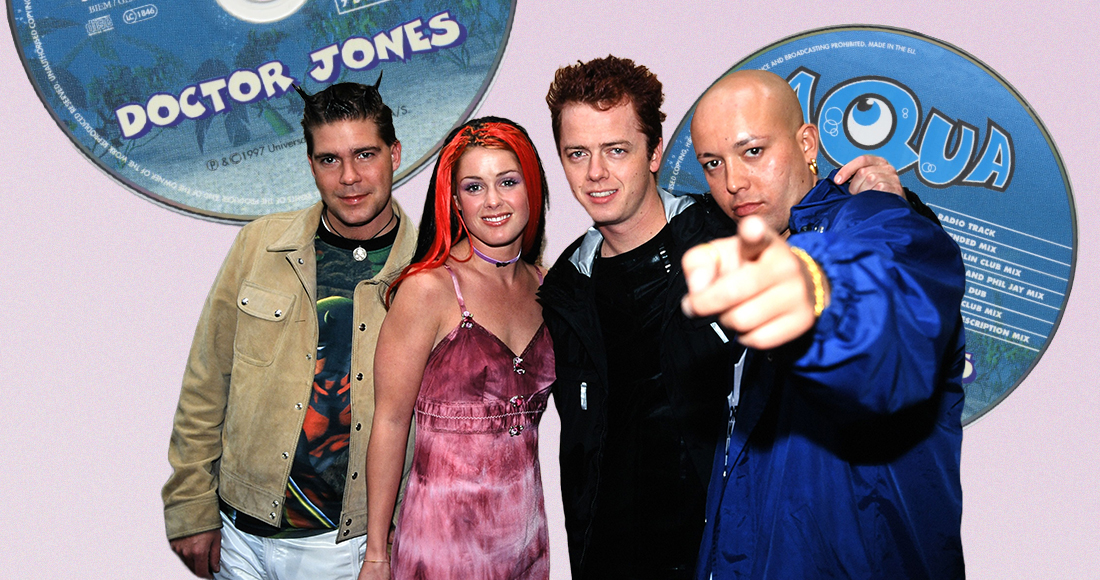
783. ‘Doctor Jones’, by Aqua

Aqua, looking for all the world like they’d be one-hit wonders, surprise us all by returning with not just a second hit, but a second number one.

Doctor Jones, by Aqua (their 2nd of three #1s)

2 weeks, from 1st – 15th February 1998

Perhaps the trick was that they stuck to a clear ‘if it ain’t broke’ formula. Female and male vocals, Eurodance production, about five different ultra-catchy hooks… The demand was obviously there post-‘Barbie Girl’. The tempo is increased from their earlier hit, giving this a proper Hi-NRG bounce to it. And like its predecessor, this single is also based around a pop culture icon.

The ‘Doctor Jones’ of the title is Indiana Jones, as made clear by the video in which Lene (formerly Barbie) and the other two members of Aqua plough through the jungle in search of René (formerly Ken). Doctor Jones, Doctor Jones wake up now… prattles the chorus, and he does wake up just in time to save his bandmates from being boiled alive. As with the ‘Barbie Girl’ video it’s good camp fun.

This whole endeavour, is of course, complete cheese, and if your tolerance for cheesy Eurotrash is low then this record certainly won’t be for you. I’m fairly immune to it, but the ayypee-aieeooaayyoo-ayypeeay-eh (I believe that is the official transliteration…) line in the chorus is annoying even to me. And sadly, René’s role is much less than it was in ‘Barbie Girl’, with his gravelly voice being used mainly to echo Lene’s lead.

It’s not as good as their biggest hit, or as memorable, but it does successfully manage the difficult balancing act of replicating what made the former such a big smash, recycling it cleverly, but without simply churning out ‘Barbie Girl Part II’. That’s quite a hard trick to pull off, especially when their first hit had had such massive success but had been filed away quite firmly in the ‘novelty’ drawer.

I’m starting to sound like quite the Aqua apologist. But it wasn’t just me, honest! 1998 was their year! Not only did they manage this second number one, they will soon manage a third. A third that will prove them capable of writing a proper pop song, and not just novelty dance numbers.

736. ‘Firestarter’, by The Prodigy

Right in the middle of the Britpop years, we finally get a proper punk number one!

Firestarter, by The Prodigy (their 1st of two #1s)

3 weeks, from 24th March – 14th April 1996

Obviously ‘Firestarter’ is not musically ‘punk’ – more techno-metal – but everything else is pretty on point. The aggression, the repetitive, nuclear siren riff, the nastiness of the lyrics: I’m the bitch you hated, Filth infatuated, Yeah…

Within the song’s opening ten seconds, it is already one of the grittiest sounding number one singles we’ve heard. Everything about it seems designed to put you on edge, to make your hairs stand on end – the harsh drums and bass, the abrasive riff, the metal on metal grinding rhythm. It’s not often a song this raw, this unapologetically hardcore, crosses over into huge mainstream success.

I was ten when this came out, but I remember it feeling and sounding dangerous. I’m the Firestarter, Twisted Firestarter… I’m pretty sure it made the evening news, amid fears around the arson-promoting lyrics and Keith Flint’s performance in the video, in which he flings himself about an abandoned tunnel, covered in piercings, with his memorable reverse-Mohican hairdo. Watching it now, it’s amazing to think that many stations refused to play it before the watershed – there’s no violence, no swearing, nothing sexual; just Flint’s unhinged performance. But, to be fair, it is terrifying, especially when he pauses to stare, dead-eyed into the camera (and perhaps quite poignant, now, knowing that he had his demons).

The Prodigy were already a hugely successful dance act, and had been scoring Top 10 hits since the early nineties. So the lead single from their third album was bound to be big. But ‘Firestarter’ was almost a reinvention – a heavier, rockier sound, presumably brought about by the fact that guitars were ‘in’ in 1996. Which brings us back to the troubles we’ve had in defining ‘Britpop’ recently: Prodigy weren’t Britpop – they were a dance act that pre-dated the genre – but it’s hard to argue ‘Firestarter’ and the subsequent ‘The Fat of the Land’ album weren’t huge Britpop moments.

We do have to acknowledge that much of this song is a patchwork of samples: from the Breeders, and a Chicago house group called ‘Ten City’. Even the ‘Hey! Hey! Hey!’ refrain is from Art of Noise. But if ever there were an argument against sampling being lazy, it is in a banger like this, the fact that the band heard something in those three wildly disparate songs and creating something fearlessly new.

And yet, I will say that, as great and thrilling as ‘Firestarter’ is, it’s neither The Prodigy’s best single, nor their most controversial. Their best will also make #1 before the end of 1996, while their most controversial was the 3rd release from ‘The Fat of the Land’, the ever-charming ‘Smack My Bitch Up’.

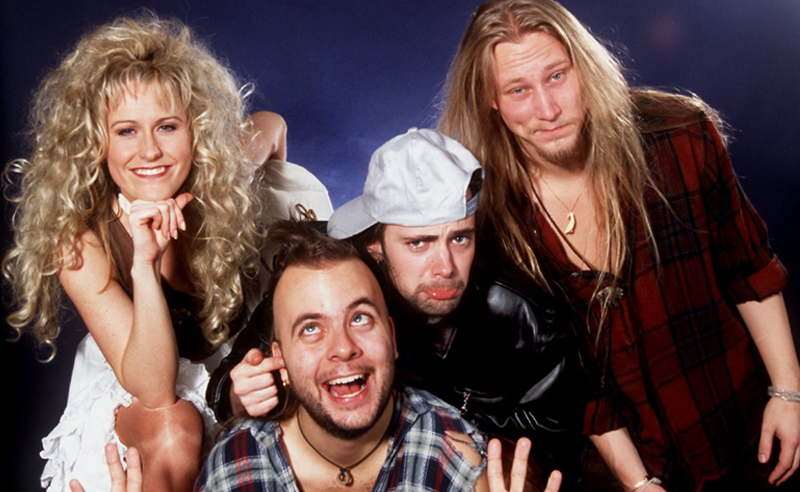
715. ‘Cotton Eye Joe’, by Rednex

We’ve just ticked over the exact midway point of the nineties, as we head into 1995. One of the most renowned years in British music, during which Britpop, and some of the nation’s best-loved bands, went mainstream. And yes, we will get to all that… But kicking off the year we have something much less fondly remembered.

Cotton Eye Joe, by Rednex (their 1st and only #1)

3 weeks, from 8th – 29th January 1995

This jaw-clenchingly, skin tighteningly bad piece of techno-bluegrass can only be explained as a hangover from the festive period, from New Year’s parties full of people too drunk to care what was blasting out over the stereo… Oh, who can I kid? By now it’s clear that the British public need no excuse to send utter dross to the top of the charts. ‘Cotton Eyed Joe’ is shit – so shit it was guaranteed to be massive.

It was a perennial at my school discos, but I didn’t like it aged nine and haven’t chosen to hear it for the better part of thirty years. You need a strong stomach to listen to it even now: the mix of banjos, fiddles and heavy synths makes me feel very tense, something the horse and gunshot sound effects don’t do much to alleviate, while the aggressive chanting makes me wonder if hell is actually being locked in an eternal barn dance.

The video builds on this theme – I’m genuinely not sure if they were going for something funny, or for something more like a horror movie. The Rednex all play straggly-haired, yellow-teethed, rat-fondling hillbillies, who appear to be subjecting a younger, prettier girl to a never-ending ride on a bucking bronco. I don’t say this at all lightly, but I would take ‘Mr Blobby’ over this scary mess.

Rednex were Swedish (not American, sadly) and had stage names like Bobby Sue and Ken Tacky. ‘Cotton Eye Joe’ was their first hit, and in the UK they would manage only one more of note: ‘Old Pop in an Oak’ which made #12. In Sweden they remained successful well into the 2000s, scoring chart-toppers there as late as 2008! The mind boggles… The album that their two biggest hits came from was titled ‘Sex and Violins’, which is possibly the only funny thing the band ever put their name to.

Sad thing is, the history behind ‘Cotton Eye Joe’ is quite interesting. It pre-dates the US Civil War, probably originating among black slaves in the cotton fields. Proposals for what the phrase means vary from someone being drunk, to someone with milky cataracts, to the contrast between black skin and white eyeballs. It was first published in 1882, and has been recorded in country, polka, and trad-Irish versions, as well as featuring in the movie ‘Urban Cowboy’.

All that history has been obliterated by the Rednex version, which became a worldwide hit and which we will all be hearing until our dying days. It even made the charts in the US, which was unusual for a Eurodance track, and became a sports event/kids’ party standard. In recent years, some sports teams have stopped playing it in their stadiums due to the song’s potentially racist origins. Usually I’m not a fan of cancel culture, but I’ll make an exception if it means never hearing this particular chart-topper ever again…

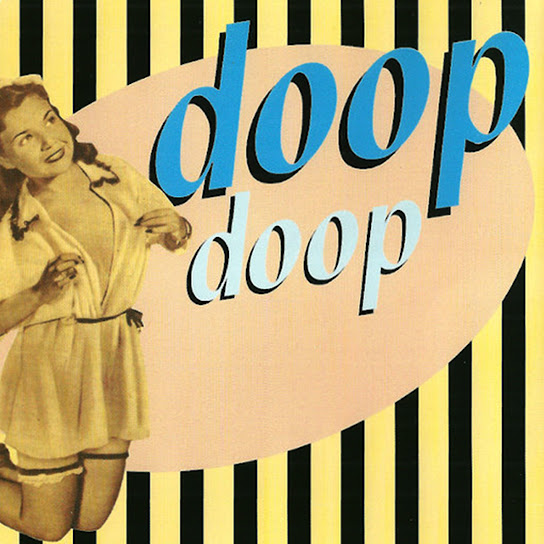
703. ‘Doop’, by Doop

And now for something a little different… Eurodance meets the Charleston.

Doop, by Doop (their 1st and only #1)

3 weeks, from 13th March – 3rd April 1994

More impressively, Eurodance meets the Charleston, and the results aren’t a complete disaster. ‘Doop’s merging of wildly disparate musical eras works. It’s fast, catchy, and fun – a novelty for sure, but not too irritating. It works its way right into your brain, thanks to its frenetic pace and puppy dog energy, and stays there…

It’s a completely instrumental track, apart from the doopy-doopy-do-do-doos which give the song its name. It’s the last instrumental number one since… I’m not sure, to be honest, but it’s been a good while. It’s also probably one of the last, as they’ve become rarer and rarer since their heyday in the late fifties-early sixties.

There’s not much to it – a big band sample stretched out over a techno beat. With the aforementioned doops, of course. The most complex thing about this record is how many remixes there were, and working out which one was actually getting airplay at the time. They all have a varying techno-to-Charleston ratio. The ‘Official Video’ on YouTube is the most modern, a dance beat interspersed with trumpet blasts. I prefer the more big band-heavy versions, such as the Sidney Berlin Ragtime Band mix, from the Maxi-CD release, or the Urge-2-Merge radio edit.

The best mixes are also the ones that keep proceedings down to the three-minute mark for, as fun as this tune is, it can get a little repetitive when stretched over seven minutes. Short and sweet is the order of the day here. Doop were, you’ll be shocked to realise, from the Netherlands, the one country that can rival masters Germany for Europop cheese. And let’s be honest, giving your debut single the same name as your band (or vice-versa) suggests that you’re quite happy in aiming for one-hit wonder status.

In fairness, Doop did manage a #88 follow-up hit with ‘Huckleberry Jam’, in which they tried the same trick using an old blues riff, while an earlier incarnation of the group, Hocus Pocus, made #1 in Australia with a song called ‘Here’s Johnny!’ Really though, this is real one-hit wonder stuff: a flash in the pan, bottled lightning moment, and I’m not sure this track has been played on the radio for years.

It was a trend-setter of sorts, though. I can’t think of many dance tracks that sampled pre-rock and roll music before Doop, but I can think of a few that came afterwards, including at least a couple of number ones. Anyway, I like it, as throwaway as it is. The NME disagree, though, naming it among their ‘25 most annoying songs ever’… Which seems rich given some of the crap they’ve championed over the years.

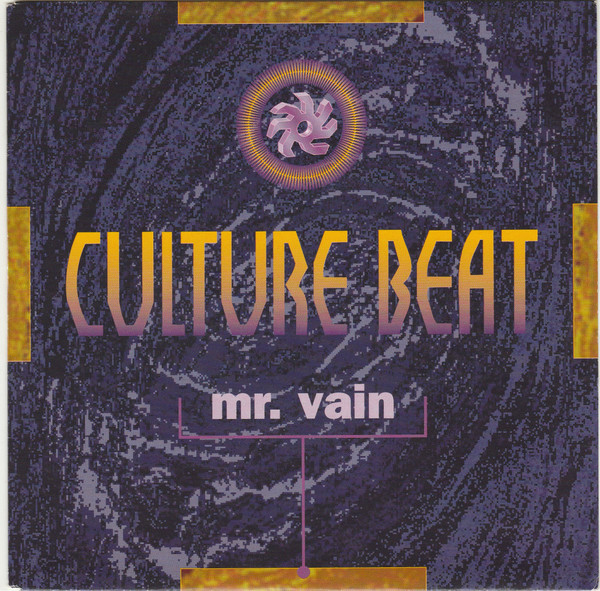
694. ‘Mr. Vain’, by Culture Beat

The intro to our next number one kicks in, and I’m struggling to tell if it sounds like something we’ve already met in our journey through the early 90s, or if it was simply copied into ubiquity in the years that followed…

Mr. Vain, by Culture Beat (their 1st and only #1)

4 weeks, from 22nd August – 19th September 1993

On the one hand, ‘Mr. Vain’ is cheesy, throwaway Eurodance – the soundtrack to many a summer holiday in Ibiza (the 1990s is littered with dance hits that made the higher reaches of the charts in early autumn, after everyone had returned home from a fortnight in the Med). On the other, it’s an astute slice of dance-pop so of its time it could be in a museum.

It follows a tried and tested formula: one girl who sings, one boy who raps, over a throbbing beat. It’s amazing how successful this was, over and over again, between 1990 and 1994. Snap!, 2 Unlimited, Culture Beat… ‘Mr. Vain’ is a both a cheap and cheerful rehash of ‘Rhythm Is a Dancer’, especially in the portentous intro, and a slightly less stupid take on ‘No Limit’, with its techno riff and juddering drum machine. It takes what was great about both those records, and creates a streamlined, optimised dance hit – perhaps the epitome of its genre.

Call him Mr Raider, Call him Mr Wrong… Away from the pulsing beat, there are lyrics that just beg to be chanted en masse. I know what I want and I want it now… A decade later, when I started going to nightclubs, this record would still get a regular spin, and girls would pick out their own personal ‘Mr. Vain’ among the strobes and the dry ice. Meanwhile, Mr. Vain responds in the rapped verses: Call me what you like, As long as you call me time and again…

I’m going to take bets on where Culture Beat were from. Place your chips…. There’s no way they were British – the thought didn’t even cross my mind, given that this is dictionary-definition Eurodance. I was tempted to go Dutch, or maybe Belgian… But no. They were a German creation, of course, from a producer with two rent-a-voices, keeping up a grand tradition that stretches all the way back to Boney M. For ‘Mr. Vain’, though, the large-lunged vocals are from a Brit – Tanya Evans – while the rap is supplied by an American – Jay Supreme.

They’d had a couple minor hits previously, but this one sent them into the stratosphere: a number one in eleven countries across Europe, setting them up for a year or so of follow-up Top 10s. In Germany their success lasted the better part of a decade, until a remake of their biggest hit, ‘Mr Vain Recall’, in 2003. Culture Beat remain a going concern, presumably touring festivals across central Europe every summer, with a completely different line-up, Evans and Supreme having left way back in 1997.

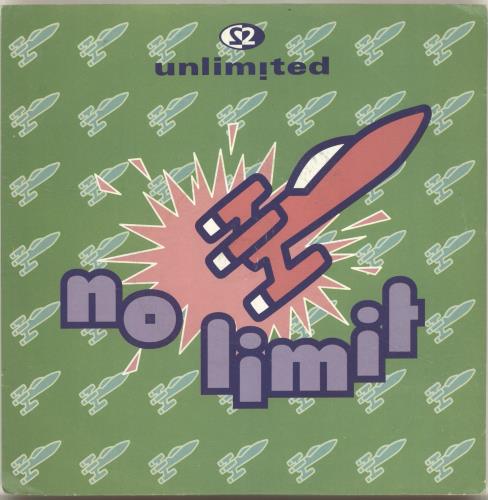
685. ‘No Limit’, by 2 Unlimited

I know that, in the real world, people don’t usually buy records just to get rid of the previous number one. They buy them because they like the song, or they like the singer, or because they found them in the Woolies’ bargain bin… But, after Whitney Houston had set up camp at the summit for the entire winter of 1992-93, the record that finally replaced it feels refreshingly… different.

No Limit, by 2 Unlimited (their 1st and only #1)

5 weeks, from 7th February – 14th March 1993

Let me hear you say yeah! Booting Whitney out the way is a proper slab of early nineties techno (or should that be ‘techno, techno, techno, techno’?) A sledgehammer synth riff, a breakneck tempo, minimalist lyrics, and a rap. Wham, bam, thank you ma’am. Job’s a good ‘un.

No, no, no, no, no, no, no, no, no, no, no, no, There’s no limit… I may have claimed in my post on Snap!’s ‘Rhythm Is a Dancer’ that dance tunes don’t need deep lyrics. But the lyrics to ‘No Limit’ make most dance tunes sound like ‘American Pie’. Lots of ‘no no’s, and a bit about reaching for the sky. The UK release even deleted the rap – a bit too wordy – and replaced it with some more ‘oh’s, and some ‘techno’s.

Is it wrong that I like this more than some (most…) of the earlier dance number ones? Records like ‘Rhythm Is a Dancer’, ‘Killer’, and ‘Ride on Time’ are lauded as classics, while ‘No Limit’ is hidden under the carpet like an embarrassing stain. Well I’m here to reclaim this song. Yes, it’s simplistic, bordering on moronic – three notes and a lot of shouting – but, damn it, it’s fun. I like dance music best when it has the aggression and energy of rock ‘n’ roll and, replace the synths with scuzzy guitars here and you’ve got yourself something pretty punk.

And I admit, I have a soft spot for this tune, because it’s one of the first pop songs that I was aware of at the time. I have distinct memories of this being sung, over and over, in my school playground. 1993 was the year I turned seven, and the songs that made number one started becoming more and more relevant to me. I apologise in advance for any self-indulgence as we head on through the tunes of my childhood, and will try to keep the reminiscing to a minimum…

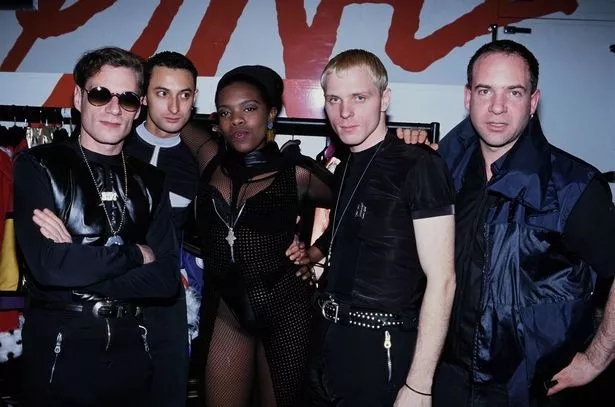
I’d have put good money on 2 Unlimited being German. Something about the sheer relentlessness of the beat, the ruthless efficiency of the lyrics… National stereotypes aside, most of the finest Europop (think Boney M, Falco and Snap!) has also been of Germanic origin. And I was close! They were Dutch/Belgian, and followed the Snap! formula of a male rapper and a female singer. Between 1991 and 1994 they scored eight UK Top 10s. I’m not sure any are better than ‘No Limit’ – they certainly had a formula, and stuck to it – so it feels right that this was their one and only chart-topper.

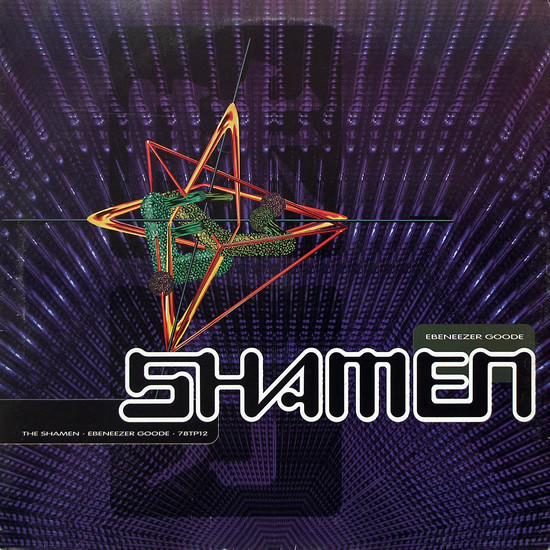
680. ‘Ebeneezer Goode’, by The Shamen

Hot on the heels of ‘Rhythm Is a Dancer’ comes another ‘90s dance classic…

Ebeneezer Goode, by The Shamen (their 1st and only #1)

4 weeks, from 13th September – 11th October 1992

And as magisterial as Snap!’s track was, ‘Ebeneezer Goode’ represents the flip-side of dance music in the early years of the decade. Aggressive and in-your-face, the opening voiceover sets the tone: A great philosopher once wrote… Naughty, naughty, Very naughty…. And off we go, cackling like Sid James…

Since forever, pop music and drugs have gone together. Sex and drugs and rock and roll, and all that. But no genre has ever been quite so entwined with illegal substances as electronic dance, and with one Class-A substance in particular. So when a track comes along by one of the big dance acts of the day, shamelessly celebrating said drug, and getting all the grown-ups’ knickers in a twist at the same time, you know it’s going to be a big old hit.

The clever bit here (I was going to use the word ‘genius’, but I think that would be stretching it slightly) is that the drug reference isn’t immediately obvious. ‘Ebeneezer Goode’, you might think, sounds like a character invented by Charles Dickens. Eezer good, Eezer good, He’s Ebeneezer Goode… A silly novelty song, parents around the country might have thought, as they heard it blaring from their teenagers’ bedrooms. Harmless nonsense. But, wait…

And like the teacher who’s twigged on far too late that the class is having a joke at their expense, the parents realise that the chorus could just as well be saying ‘E’s are good, ‘E’s are good… ‘E’s as in Ecstasy… And look, the song’s at number one already. It’s not big, and it’s not clever, but it is pretty amusing. Very naughty indeed…

But amid all the innuendo, the guffawing and the gurning, this is still a banger. The joke would have worn very thin, very quickly, if this wasn’t a good pop tune. I don’t think it’s quite up there with ‘Rhythm Is a Dancer’, and I don’t think you’d want to hear it all that often, but it’s a lot of fun. And it’s a significant number one because rave culture isn’t really represented at the top of the charts, despite being one of the big musical movements of the day, and while this is diluted, poppy rave, and it lost the Shamen a lot of ‘hardcore’ fans, it still counts.

It’s also, despite the modern sound, a treasure trove of peculiarly British references. We’ve got rhyming slang, and a shout-out to Vera Lynn, of all people: Anybody got any Vera’s…? Lovely… (‘Vera Lynns’ being rhyming slang for ‘skins’, which people used to mix cannabis and ecstasy) and a reference to ‘Mr Punchinella’ AKA Mr Punch from ‘Punch & Judy’. While  in the second verse there’s even a bit of sensible advice: But go easy on old ‘Eezer, ‘E’s the love you could lose… Pop pills responsibly, kids.

The BBC, always up for a good banning, initially refused to air the song, but relinquished when it became a huge hit. Hilariously, the week that ‘Ebeneezer Goode’ climbed to number one was the Corporation’s ‘drug awareness week’. On TOTP the band changed some of the lyrics, including adding a reference to ‘underlay’, which they explained as a ‘gratuitous rug reference’. Boom and indeed tish. It was far from the first hit song to reference an illegal substance – The Beatles were doing it twenty-five years earlier – but few had done it quite so shamelessly.

The Shamen were a Scottish band, formed in Aberdeen in 1985, and had been around since the very earliest days of house music. They started out making psychedelic pop, before moving to a more electronic sound. This wasn’t their first Top 10 hit, but it was so unexpectedly huge that the band decided to delete it while it was still on top of the charts, so that it wouldn’t come to define them. Sadly, though, it still did, and their hits grew smaller and smaller until they split in 1999. But, as founding member Colin Angus says, ‘Uncle Ebeneezer is still looking after me to this day.’ Whether he’s still dropping MDMA, or he’s talking about royalties, I do not know, but it seems fitting to end this post on a double-entendre.