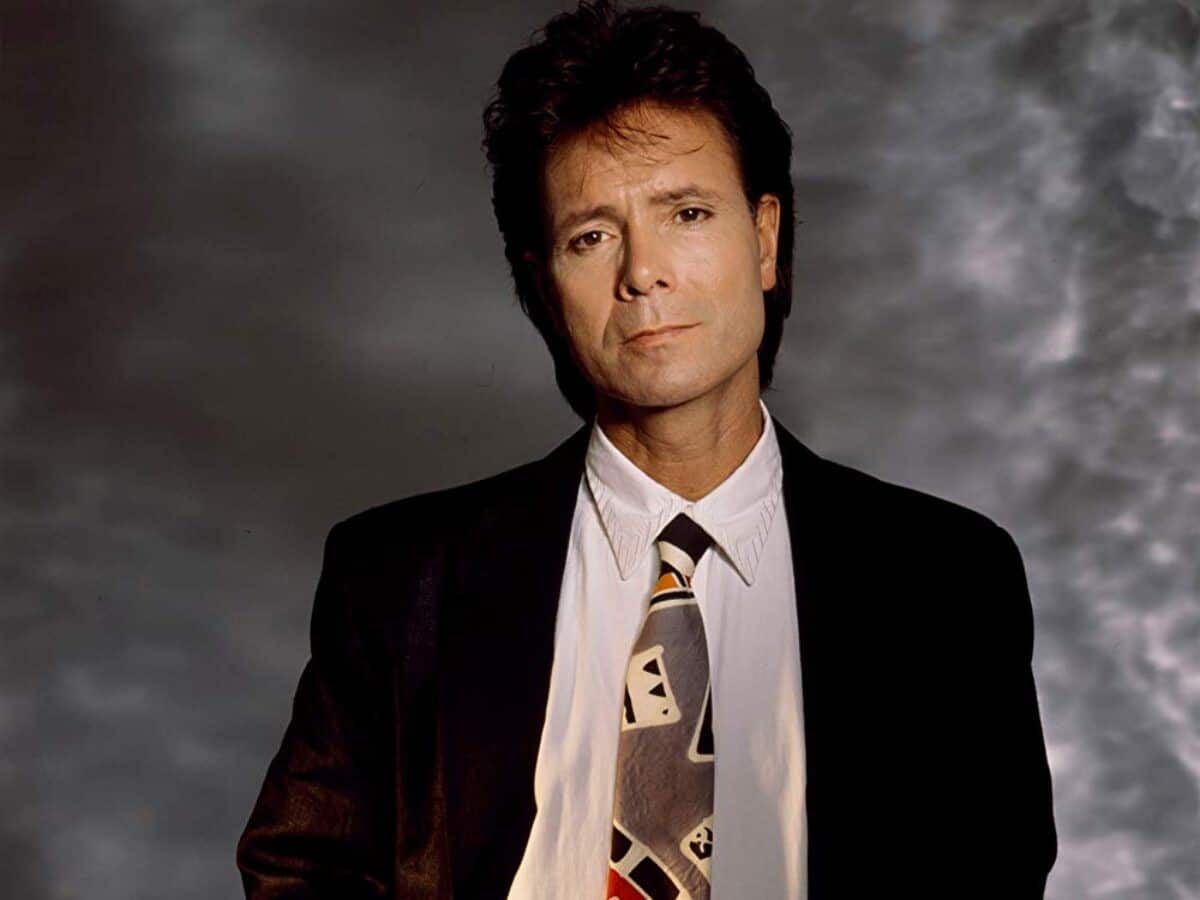
918. ‘My Sweet Lord’, by George Harrison

In the only occasion two posthumously released records (by two different artists) have made #1 consecutively, George Harrison replaces Aaliyah

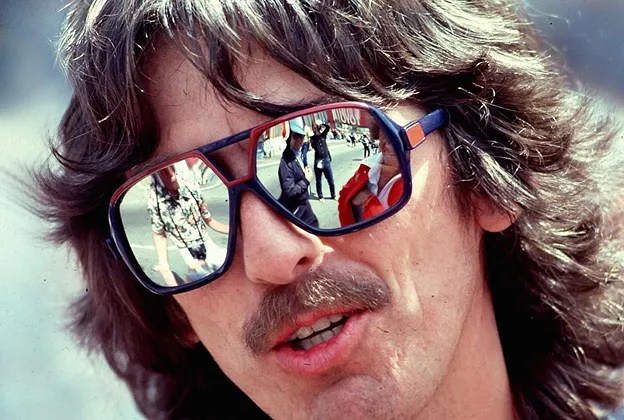
My Sweet Lord, by George Harrison (his 2nd and final #1)

1 week, from 20th – 27th January 2002

It would feel odd to review the song, as I already did so five years ago: ‘My Sweet Lord’ having spent five weeks at #1 in 1971. So, I’d rather direct you towards my original post, despite the fact that I was a bit harsh on it. I claimed it ‘doesn’t really go anywhere’ and, while I get what I meant, I now realise that that is entirely the point of the song. It’s a euphoric chant, a mantra, an incantation. It is a beautiful song, despite my complete irreligiosity. In my book, it is by far the best solo-Beatle number one.

Harrison had died from cancer in November 2001, and thus ‘My Sweet Lord’ was given a rerelease. It means that the line I really wanna see you Lord, But it takes so long, My Lord… now hits differently, assuming that it originally referred to a religious awakening. But it is a fitting, and obvious tribute.

And it is the fact that it was a deliberate release, as a tribute, that means I’m featuring this as the 918th number one single, and not a belated return for the 296th. Like ‘Bohemian Rhapsody’ before it, again rereleased following the death of its creator, ‘My Sweet Lord’ becomes only the second song to return to #1 in a rerelease (though BoRap was paired with ‘These Are the Days of Our Lives’).

This is something that needs clarifying as we move further into the 21st century. Soon there will be a series of Elvis rereleases making the top of the charts, and again they’ll be treated as ‘new’ number ones. However, when ‘Three Lions’, and then two Christmas perennials, return to number one later in the century they will not be gifted such special status as they are simply a case of the original hit returning to the charts. In fact, the streaming era has basically killed off the idea of the rerelease, as (almost) everything is now on permanent release via your streaming platform of choice.

Hope that makes sense. Anyway, let’s just enjoy this classic re-appearing at number one, completely out of place in the early ‘00s soundscape. It is also worth noting this fact: ‘My Sweet Lord’ remains one of only two truly solo UK #1s that any of the four Beatles enjoyed during their lifetimes!

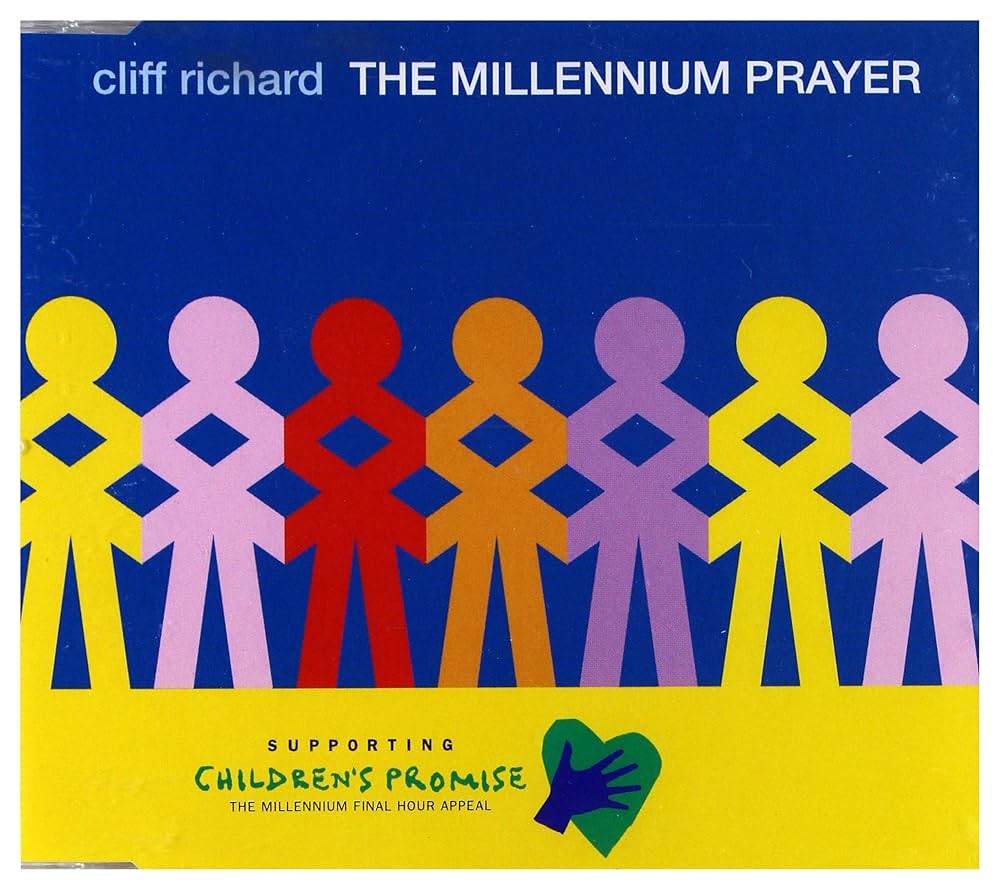
843. ‘The Millennium Prayer’, by Cliff Richard

And so, after forty and a half years, Britain’s most decorated chart artist bows out from chart-topping duty, with his sixty-fourth Top 10 hit, and fourteenth number one.

The Millennium Prayer, by Cliff Richard (his 14th and final #1)

3 weeks, from 28th November – 19th December 1999

In some ways it’s tragic that Cliff ends in this way, as he has been responsible for some great hits, and was arguably the nation’s first real homegrown rock star. But in other ways, it’s entirely fitting and predictable for Cliff, an artist who had long since given up caring about such concepts as relevance, and quality control, to leave us with ‘The Millennium Prayer’.

It’s a simple enough idea: the Lord’s Prayer set to the tune of ‘Auld Lang Syne’. A prayer for the new millennium, twinned with a world-famous new year’s melody. ‘Auld Lang Syne’ is a lovely tune, heartwarming and yet melancholy, and so on one level there is something bearable about this record. The production is fairly minimal, though very dated by 1999’s standards, with a marching drumbeat and a trumpet solo in the middle. There is, naturally, a gospel choir brought in towards the end.

What makes it less bearable are Cliff’s ad-libs, decorated with assorted vocal gymnastics that are, I suppose, impressive for a man approaching sixty. What makes this near-nauseating is the video, a live performance in which Cliff goes into full Messiah-mode, prancing around, arms stretched, surrounded by a children’s choir.

I’m a fairly irreligious person, and I’m being careful not to let my opinions on organised religion cloud my judgement of this song’s merits. But I’m hopeful that even the most committed Christians, who may agree with the song’s sentiments (and lovely sentiments they are, too), can recognise that this record is garbage. It makes Cliff’s two previous festive chart-toppers, ‘Mistletoe and Wine’ and ‘Saviour’s Day’, sound like masterpieces of subtlety and restraint.

In fact, can I just take a moment to rant against the concept of Christian rock in general? Christianity has centuries’ worth of hymns, psalms, carols… Plus, the entire gospel canon. Gospel music, sung by a choir, can be wonderfully moving, even for a heathen like me. But there’s something fundamentally wrong with Christian contemporary rock music, such a disconnect between the rock ‘n’ roll beat, the guitars, the long hair – the entire raison d’etre of rock and roll – and the churchy message. I have a sneaking suspicion that God, whoever they may be, really, really hates Christian rock. (Although having said all that, ‘The Millennium Prayer’ is almost entirely saved in my estimations by the fact that Jesus himself received a writing credit!)

My mum was one of the hundreds of thousands who bought ‘The Millennium Prayer’, making it both the year’s third highest seller, and the third biggest hit of Cliff’s entire career. I remember it sitting in our CD tower at home for years, but I never remember her playing it. I suspect this was the case for most of the copies sold. Christians around the country mobilised en masse to buy the record, probably multiple times, especially after it had been refused airplay by most (sensibly-minded) radio stations. Nowadays it’s a festive tradition for the charts to be stuffed with protest songs around Christmas: songs bought, downloaded, or streamed as a statement, not because anyone particularly likes the music. Was ‘The Millennium Prayer’ the first modern protest number one?

I billed this as Cliff’s farewell, and while he has no further number ones to come (he currently sits in joint-third position in the ‘most number ones’ table, behind only Elvis and The Beatles), he is still very much active and recording well into his eighties. The 2000s brought him four more Top 10s, while his most recent album, ‘Cliff with Strings’, made #5 just over a year ago. Despite his many musical mis-steps, the man is a living legend. (While anyone who claims that ‘We Don’t Talk Anymore’ isn’t his best number one is just plain wrong.)

Of course, Cliff was aiming for his third Christmas #1, and presumably the final #1 of the century, with this modern day hymn. He didn’t quite make it though, as he was held off by a record that we may discover to be every bit as irredeemable as ‘The Millennium Prayer’…

768. ‘I Wanna Be the Only One’, Eternal ft. BeBe Winans

Ooh Lordy. Hallelujah! When I listened to this gospel-pop classic for the first time in absolute yonks, I was dragged off on a wave of nostalgia. I struggled to make any notes. It was the biggest Proustian rush I’ve experienced yet, as we delve further into the chart-toppers of my childhood.

I Wanna Be the Only One, by Eternal ft. BeBe Winans (their 1st and only #1s)

1 week, from 25th May – 1st June 1997

But for a nostalgic moment like this to really hit home, the memory needs to be a good one. Proust loved his madeleines, and I realised how much I enjoy this record, one of 1997’s best #1s. It’s a perfect blending of soul, R&B, and gospel, with enough sass and enough honesty, enough fun and enough seriousness… I may be waffling slightly, but the point stands.

In fact, this song survived the moment that I found out that it had religious connotations (well, I mean, it is a gospel song). Aged eleven, I was beginning to question why I had to tag along with my mother to church every Sunday. It wasn’t so much that I was questioning the theology as much as I just wanted a lie-in but my mum, to her credit, let me make my own decision. By twelve I had stopped going. If any of the hymns we sang had had the heft of this tune, however, I’d have been in the front pew every week, hands to the sky.

The key changes at the end, for example, could convert the most atheist of hearts. In my mind I remembered at least five as the song soars to a conclusion, but there’s actually only two. The one complaint you could make about this tune is that it’s not exactly subtle, that it sledgehammers its point home. But honestly, that’s what a song like this needs. The start of the second verse, for example: Now you deserve a mansion… My Lord, you too… is a bizarre line – clunky almost – a ridiculous call and response moment; but also the best bit of the song.

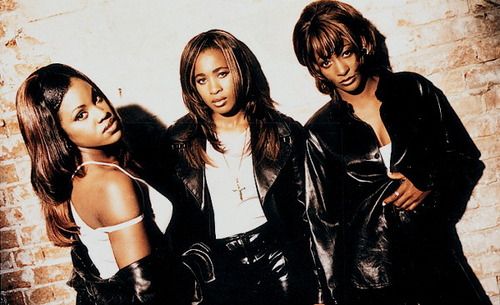
Eternal were probably the biggest British girl group in the first half of the 1990s. The only British girl group of the time, really, until the Spice Girls came along and opened the floodgates for the final years of the decade. They were a sort of British answer to En Vogue, two sisters and two others. Louise Nurding had left in 1995 to start a middling solo career, and to become one of the original WAGs by marrying Liverpool midfielder Jamie Redknapp. This was their 11th Top 10 hit since 1993, and they would only have one more before splitting in 1999. Fair to say, although they had some good pop singles, they peaked with this – a fitting record to become their only chart-topper.

Helping in that regard was BeBe Winans, an American soul and gospel singer, who had written and produced two of Eternal’s earlier hits. He provides the perfect counterpoint to the girls’ harmonies, giving the lyrics much more meaning than if they had been sung by just female voices. I’m not sure I’ve ever heard another song by him, but he left his mark.

‘I Wanna Be the Only One’ was the 2nd most played song on British radio for the year, meaning that plenty of people surely got sick of it. One of my key memories of the record is hearing it in a car park while eating an ice-cream, presumably sometime in May or June 1997, just at the moment I was getting interested in the charts (I believe that this was Track 1 on ‘Now 37’). Soon after that I would start faithfully writing the Top 40 down every week, trying to keep up with the live radio countdown in those pre-internet days. It’s not an exaggeration to say that if it hadn’t been for songs like this grabbing my attention at that formative age, I might not be writing this blog now.

753. ‘A Different Beat’, by Boyzone

Fresh from their first British number one, Boyzone set their sights on ‘global’ domination…

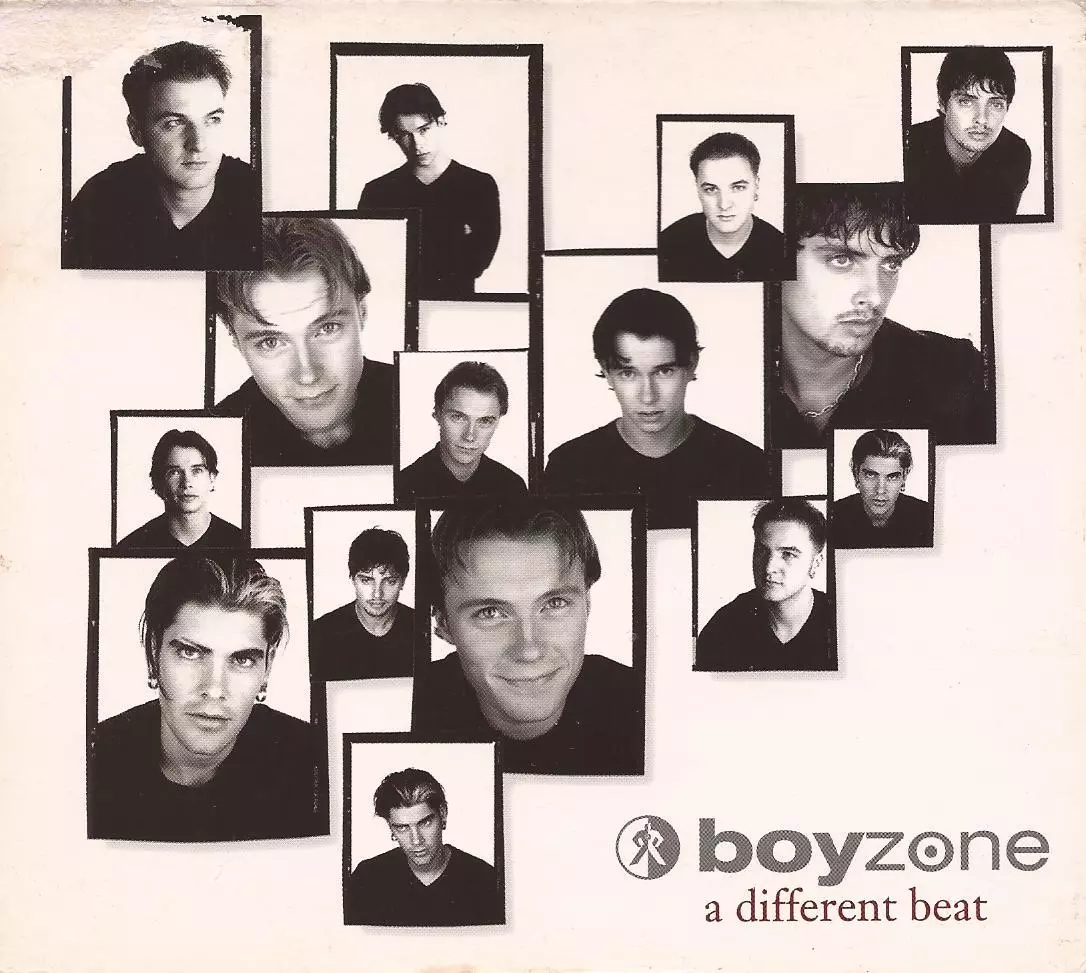
A Different Beat, by Boyzone (their 2nd of six #1s)

1 week, from 8th – 15th December 1996

By going down a new-age, world music path, that is. There have been few more distinctive intros to number one singles than this one, with its thunderclaps and African chants. This could be a very interesting song, we think, and hope… and are then left disappointed when it slides into much more predictable, pre-Christmas saccharine

The lyrics are very much of the season: Let’s not neglect our race… Life on earth be one… We are all grains of sand, apparently. At least it’s not Ronan Keating on lead vocals this time, as Stephen Gately’s clear and gentle tones guide us through the verses. Groanin’ Ronan, as we must now and forever refer to him, does get to let rip on the middle eight. He’s seen the rain fall in Africa, and touched the snow in Alaska… And let’s not get into how he pronounces ‘Niagara’, just so the line scans.

It’s easy to be cynical about songs like this, especially coming from bands as lightweight as Boyzone. I salute the message, even if the video – in which the lads descend from the heavens to dance with African children – gives off an iffy, white-saviour message. I have a feeling they were taking their cue from ‘Earth Song’, last year’s messianic Christmas Number One; but neither the song, nor the video, can compete with Michael Jackson’s irrepressible bombast.

This was the only one of Boyzone’s six chart-toppers that the band had a hand in writing, and one of only two that weren’t cover versions. It was also produced, in part, by Trevor Horn of Buggles fame. So, there are much blander offerings to come from Boyzone. There is a decent song buried in here – the title-line hook is good – but it’s smothered in far too much boyband dressing. And it doesn’t build to the big finish that a song like this needs to succeed; it just fizzles out to a simple drumbeat.

I’d assume they were aiming for the festive top spot with this release. But that was never going to happen, what with a record with an even more important message coming up next, and the third single from a certain female five-piece hovering on the horizon.

731. ‘Earth Song’, by Michael Jackson

You can approach this next number one very cynically, if that’s your thing, as there’s lots to be cynical about…

Earth Song, by Michael Jackson (his 6th of seven #1s)

6 weeks, from 3rd December 1995 – 14th January 1996

For his sixth solo UK chart-topper, the King of Pop, long-since divorced from reality, fully realises his Messianic potential. What about elephants? he demands of us, towards the end of this colossal track. Have we lost their trust? Pulp’s Jarvis Cocker certainly let us know what he thought, famously mooning Jackson’s performance of the song at the Brit Awards.

But, once your eyes have completed their rolling, and you stop to listen to ‘Earth Song’, then you can’t help but be impressed. You might not want to hear it every day, but the very fact that he conceived of, wrote, and recorded this track, and then managed to sell the message in a way that only Michael Jackson could – largely through the conviction in his whoops and hollers – is darned impressive. Like ‘You Are Not Alone’, this is a lullaby underneath all the dressing (Jackson intended it to be simple, so that it could be understood right across the world). But what dressing… When the drums and funky bass kick in it’s a bit of a moment, as is the gigantic key change. The last three minutes is basically MJ berating us about the state of the planet, accompanied by a wind machine and a gospel choir.

And, let’s be honest, much of what he’s singing about is true. It was true in 1995, and it’s true thirty years on. What about children dying?…Can’t you hear them cry?… Where did we go wrong?… Someone tell me why… It’s preachy, sure, but he ain’t wrong. Of course, though, sending this song to number one is a lot easier than actually changing our ways, and if Jackson truly thought this would make any difference to the fate of the human race then he was Wacko indeed.

The video too is every bit as OTT as you might expect. I can remember watching it on ‘Top of the Pops’ at the time, aged almost ten, and being captivated. Watching back now, it’s painted in very broad strokes, but it’s vivid, and memorable. Dead elephants, felled trees, someone clubbing a seal… Then through his sheer bloody star power, clinging to some tree stumps, Jackson undoes all the damage, and we live happily ever after.

At the end of the day, most people are more Jarvis Cocker than they are Michael Jackson. And most of the time, that is a good thing. ‘Earth Song’ is preposterous, and overblown, and now interestingly forgotten among his illustrious back catalogue. But it also delivers an uncomfortable truth, however clumsily the message is conveyed.

This was the 1995 Christmas #1, famously holding off The Beatles’ much feted ‘comeback’ single ‘Free As a Bird’ (they’ll manage their 18th chart-topper, eventually). It also wraps up a very odd, very underwhelming year, in which the charts have felt at odds with what people were actually listening to. One interesting thing, though, to chart geeks like me, is that 1995 was the year where singles suddenly started entering at #1. What was once a freak event, marking an act out as the very biggest in the land, was happening much more often. From ‘Back for Good’ to ‘Earth Song’, all but two #1s were held-back, heavily promoted songs that entered at the top. This will continue as the nineties progress, with the turnover of number ones increasing all the time as well.

730. ‘I Believe’ / ‘Up on the Roof’, by Robson & Jerome

Oh yes, time for more golden-oldies karaoke, from your granny’s favourites.

I Believe / Up on the Roof, by Robson & Jerome (their 2nd of three #1s)

4 weeks, from 5th November – 3rd December 1995

This time, they resurrect one of the very biggest number one singles. The biggest ever, if ‘weeks at number one’ is the metric we’re using. Frankie Laine’s original racked up eighteen weeks at the top way back in 1953. It was just the 9th #1, and it’s pretty amazing to think that its record still stands over seventy years on.

And for such a massive single, I feel it’s been a little forgotten (1953 was a long time ago, to be fair) and so it’s good in a way that it had another moment in the sun. And R&J’s take on it is… okay. Better than either of the tunes on their first single. It’s still cheap, still karaoke; but it doesn’t cloy as much, and builds to a fairly soaring climax. Maybe that’s testament to the quality of the song…

 Plus, it’s short – barely two minutes, like Laine’s version – and ‘shortness’ is ideal when these two take to the mic. Sadly, any mild positivity I can muster here is wiped out by the flip side of this disc: a version of The Drifters’ ‘Up on the Roof’ which takes the duo to new levels of tackiness. It is truly dreadful – synthy horns and horrible Disney princess tinkly bits. That this is a timeless classic’s only appearance at #1 (anywhere, as far as I can tell!) is genuinely criminal.

Equally criminal to some is the fact that this record held Oasis’s ‘Wonderwall’ at #2. However, thanks to Oasis not lacking for #1 singles, and thanks to ‘Wonderwall’s annoying ubiquity, I don’t class that an upset as heinous as this pair’s first single holding off ‘Common People’.

One thing I do notice, listening to these two songs, is that Robson & Jerome’s singing voices sound different. Better, more polished, than on ‘Unchained Melody’, or on ‘White Cliffs of Dover’. Whether this was the result of singing lessons, or something more sinister, I don’t know. Des Dyer, formerly of ‘70s band Jigsaw, made allegations that it was him singing on the records. He was paid off, and told to shut up. Much later, Mike Stock admitted that the duo’s vocal’s were ‘patched up’ by sessions singers.

Whether or not they were singing on these songs, it didn’t do them much harm. While not quite as successful as their debut, this record still made a month at #1 and reached almost a million sales. An album inevitably followed, on which they murdered The Beatles, The Monkees, The Walker Brothers, and Elvis, as well as ‘Amazing Grace’ and ‘Danny Boy’. At least they didn’t cling on at the top to become one of the worst Christmas Number Ones. For the King of Pop had other ideas…

666. ‘Any Dream Will Do’, by Jason Donovan

Jason Donovan’s final UK number one throws us a bit of a curveball… Musical theatre chart-toppers are generally few and far between, as are hit songs based on bible stories. But perhaps the strangest thing about this song is Jason himself…

Any Dream Will Do, by Jason Donovan (his 4th and final #1)

2 weeks, from 23rd June – 7th July 1991

Given a blind listening test, there’s no way you would peg this for the same guy who just two years ago was singing ‘Too Many Broken Hearts’. He sounds so proper, so refined. Not that he was a hellraiser back in his SAW days; but he’s gone full musical the-ay-tah, pronouncing every syllable and projecting his voice right to the cheap seats. My gran, whose main requirement in a singer was that you could ‘make out what they were saying’, would have approved.

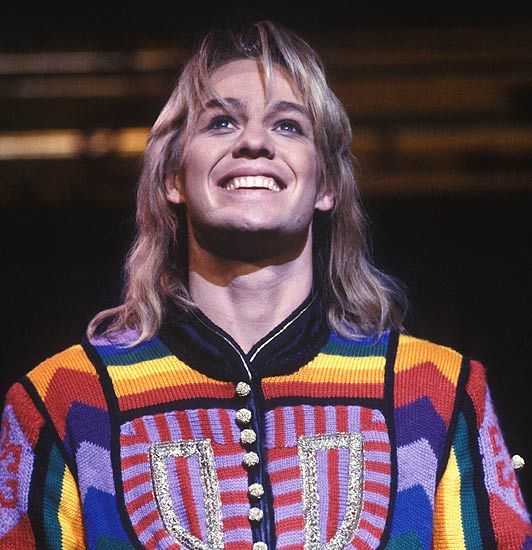
Away from JD, the record’s production is average, verging on cheap, and the kids’ choir in the background sounds phoned-in. It is of course from ‘Joseph and The Amazing Technicolour Dreamcoat’, an Andrew Lloyd-Webber/Tim Rice musical based on the story of Joseph, from the Book of Genesis. They had written it in the late sixties, but the show hadn’t had a run in the West End for almost twenty years before a revival, starring Donovan as the title character, turned it into one of Britain’s best-loved musicals. Lloyd-Webber, meanwhile, scored his second #1 in under a year, after bringing us Timmy Mallett and his infamous bikini

It’s a well-trodden path. A pop star’s hits begin to dry up and so they migrate to the stage. Not that Jason Donovan had fallen that far from his heyday – his second album had produced three Top 10 hits, though no #1s – but perhaps he could see which way the wind was blowing. It was a smart move, bringing him to the attention of a whole new audience, and gaining him a pretty unexpected swansong at the top of the charts.

If I’m honest, it’s hard for me to judge this song with any sort of impartiality. We have, in fact, reached a massive milestone. After five and half years of writing, and six hundred and sixty-six number ones (note the irony of a bible-based song being the 666th…) we arrive at the first chart-topper that I was actually aware of at the time. In fact the soundtrack to ‘Joseph…’ was the first CD I ever owned, while I went on a Sunday school trip to see the show in Edinburgh (though by that point I believe it was Phillip Schofield in the starring role).

And so, what would otherwise be a fairly unremarkable chart-topper, save for the odd coda it gave Donovan’s chart-career, takes on great significance. For me, at least. I can’t hear the soaring A crash of drums, A flash of light… line without picturing that old worn-out CD (although my favourite songs at the time were the country-ish ‘One More Angel in Heaven’ and the unhinged jazz-polka of ‘Potiphar’).

I’ve written before about Jason Donovan (and Kylie) being pop ground zero for older millennials like me. Kylie may have gone on to slightly bigger things – she’s literally back in the Top 10 as I write this, aged fifty-five, an absolute icon – but Jason has remained in the public eye for better (a plethora of stage and light entertainment shows) or worse (lawsuits and drug addiction). When I was a student, the mere suggestion that he might be making a private appearance at a nightclub would be enough to sell the place out. (It happened several times, and he never once turned up…) So here’s to you, Jason Donovan. Not many pop stars had a bigger impact on my formative years.

655. ‘Saviour’s Day’, by Cliff Richard

Appearing on a 3rd Xmas #1 in a row, and going full in on the nu-folk sound of the time: the one, the only, Sir Clifford of Richard.

Saviour’s Day, by Cliff Richard (his 13th of fourteen #1s)

1 week, from 23rd – 30th December 1990

It’s a Christmas tune, and yet it’s not really. No references to decking the halls or Santa Claus here, and not a sleigh bell in sight. I mentioned that, two years ago, despite ‘Mistletoe and Wine’ being unashamedly religious in tone, Cliff still kept the little secular touches that people expect from a festive chart hit. For ‘Saviour’s Day’, though, he’s gone full-on Christian contemporary.

Open your eyes on Saviour’s Day, Don’t look back or turn away… It’s proper judgement day stuff – some hardcore preaching. Life can be yours if you’ll only stay… Songs like this are usually tucked away on a niche Christian chart, so that regular people don’t have to hear them. But, because Cliff is the biggest solo star this island has ever produced (a bold statement, but I’m sticking to it!) he manages to take it to number one.

However actually, by the end, I’m pretty sure he’s toasting several different gods: the God of the Present, the God of the Past… Maybe he was going all Dickensian – rather than for a pagan, Earth-mother sort of vibe – but I’m not sure the Bible allows that kind of blasphemy. Though maybe God himself would think twice before disagreeing with Cliff.

I was expecting to dislike this. And there are certainly aspects of it that I can’t get behind. The lyrics, for a start. The electronic pan-pipes are also an acquired taste, while there are some horrible synth flourishes that make my hair stand on end. Plus, the video is ridiculously cheesy (or is that cheesily ridiculous?), featuring Cliff striking messianic poses on the chalk cliffs of Dorset. And yet, ‘Saviour’s Day’ has a corker of a chorus. And people who know much more about song writing than I do really rate it.

It’s probably better than ‘Mistletoe and Wine’ – though that too has a tacky charm – and it’s certainly better than Cliff’s fourteenth and final number one. (Thankfully we have some way to go before we meet that one.) What’s not up for debate is that this record gave him a chart-topper in every decade that the UK singles chart had been in existence: two in the fifties, seven in the sixties, one in the seventies, two in the eighties, and now one in nineties (plus one to come). It’s a feat that has never been matched, and perhaps never will.

625. ‘Like a Prayer’, by Madonna

And so we arrive at the biggest female pop star du jour, with her first big comeback. Setting herself up, in the process, to polarise and provoke throughout the 1990s and beyond…

Like a Prayer, by Madonna (her 6th of thirteen #1s)

3 weeks, from 19th March – 9th April 1989

It had been a couple of years without any new music from Madonna. In modern terms that’s a pretty normal, even fairly short, break (cf. Rihanna). But since the dawn of pop, stars had been expected to churn out several hits a year. That’s just one way in which this comeback monster hit feels like a game-changer: Madonna’s in charge from now on, setting her own schedule.

After an attention-grabbing guitar intro, a door slams shut. Life is a mystery, Everyone must stand alone, I hear you call my name, And it feels like home… Is she talking about God, or a boy? Or is God the boy? In comes the beat, and to be honest it’s quite predictable late-80s production: dance-pop synths with a squelchy bass. It’s catchy, it’s got a great hook, it would have been a big hit even without…

The video. Madonna cavorting with Jesus. Black Jesus. Burning crosses. Sexual Assault. A wrongful imprisonment. Racism… I’m not 100% sure what Madonna was going for, other than a checklist of things she knew would piss certain people off, but it did the job. The Catholic Church was up in arms, Pepsi (who used the song in an advert) was boycotted, MTV was the only TV channel to show the video… And of course it was a global smash hit.

From this distance, the controversy seems out of proportion: Madonna and Jesus barely kiss, while in the end she does the right thing and goes to the police… And the lyrics aren’t that outrageous either. Sure there’s a bit of innuendo – I’m down on my knees, I wanna take you there… – but ‘love as a religious experience’ is not exactly a new and shocking theme. And yet, as the recent Sam Smith controversy has shown, certain types are always poised and ready to get worked up over a music video.

‘Like a Prayer’ peaks for me when the gospel choir take over. And I don’t mean that as a slight on Madonna’s voice, as this is one of her better vocal performances. But it’s a bit too long as ‘just’ a song, without the video to distract. I wouldn’t have this in my Top 5 Madonna songs, personally. Whether that’s harsh, or testament to the strength of her long career, I’m not sure. I’d also put ‘Papa Don’t Preach’, and ‘Like a Virgin’, above it in the attention-grabbing stakes.

But there’s no denying this song’s reach and impact. I described it above as a ‘game changer’ in terms of inventing the idea of the pop star ‘comeback’ single. Then there’s the statement video. And the creative control that Madonna was clearly exercising. There’s a clear line from Madonna to pretty much every female pop star since: Christina, Britney, Gaga, Taylor Swift have all had their big statement pieces, their ‘I’m in control now’ moments. Is it too much to suggest then, that ‘Like a Prayer’ was the moment that the modern female pop star was born?

620. ‘Mistletoe and Wine’, by Cliff Richard

I am writing this post on January 25th, possibly the least Christmassy date in the entire calendar. The whole shebang just came and went a month ago, with any right-minded human needing a good long detox from festive music…

Mistletoe and Wine, by Cliff Richard (his 12th of fourteen #1s)

4 weeks, from 4th December 1988 – 1st January 1989

Though, let’s be honest, is there ever a good time for listening to ‘Mistletoe and Wine’? Even if this were Christmas Eve, it’s not a song I’d ever rush to write a glowing blog post about. Yet it crops up, year in, year out: in shops, on music channels, buried away on Christmas playlists.

Cliff is probably Britain’s best-known Christian, well him and the big Archbishop of C, so of course his Christmas songs have to go deeper than just singing about Santa, presents and snow falling all around us. (He does sing about those things in ‘Mistletoe and Wine’, presumably because he still wanted people to buy the record; he just mixes a bit of sermonising in with it.) A time for living, A time for believing, A time for trusting, Not for deceiving… Ours for the taking, Just follow the master… Meanwhile, the way he pronounces ‘Christian’ in the chorus, with that extra vowel, has always gotten on my nerves.

Watching the video for ‘Mistletoe and Wine’, which begins with Sir Cliff peeking into a sleeping child’s bedroom, you could be forgiven for thinking that he himself is the aforementioned ‘master’, not the man upstairs. The way he conducts his carollers, swaying around as if in raptures, arms outstretched in a messianic pose… It’s ridiculous. Not to mention ridiculously camp.

But… There is something cheesily charming buried within, especially the moment it swells towards the final chorus, and a choirboy comes in with snatches of ‘Silent Night’. There’s an ‘all together now’ music hall feel to it. Most Christmas music is ultimately quite naff, and yet we love it. This record is certainly one of the naffest, and yet it is well loved. And to give him his dues, Cliff was several decades ahead of Mariah and Bublé in setting himself up as a Christmas fixture when the regular hits began to dry up.

I think I’ve been pretty fair and open-minded when it came to Cliff’s eleven previous chart-toppers. Some I really enjoyed discovering (‘Please Don’t Tease’) while some are just undeniable milestones of British popular culture, deserving of our respect (‘Summer Holiday’ and ‘Congratulations’). Some I found dull as dishwater (‘The Next Time’) while at least one is a stone-cold classic (‘We Don’t Talk Anymore’).

As late as the early-eighties he was still scoring respectable pop hits, but this feels like the moment he lost his grip. He was, to be fair, almost fifty when it was released, and how many fifty years old pop stars are still able to have big hits? But from here on in, Cliff seems to have been playing to the gallery, giving the middle-aged ladies what they wanted, with no attempt to keep current. This would be a great place to sign off on Cliff, sending him to a well-earned retirement of gospel songs and old rock ‘n’ roll covers. But no… He still has two further festive #1s to come. And by the time we’re done with them, you’ll be begging for ‘Mistletoe and Wine’…