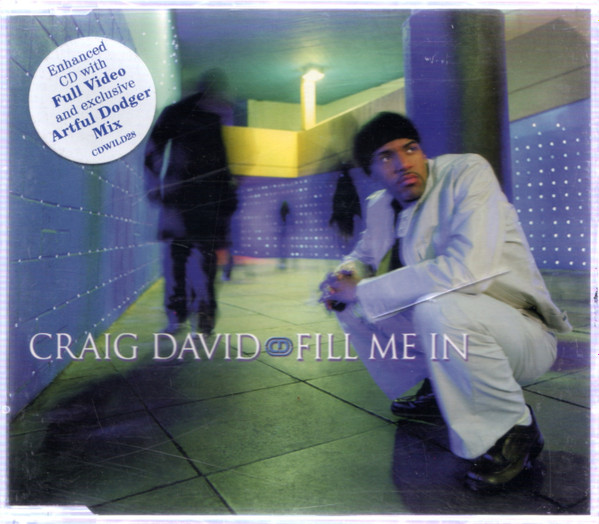
855. ‘Fill Me In’, by Craig David

If the year 2000 has a defining sound – and I’m far from convinced that it does, with so many chart-toppers crammed into its fifty-two weeks – then UK garage would be a strong candidate.

Fill Me In, by Craig David (his 1st of two #1s)

1 week, from 9th – 16th April 2000

These staccato, two-step beats have started to appear more regularly, with Shanks & Bigfoot last year, and to a lesser extent Gabrielle a few weeks ago. I never particularly liked garage at the time – it always felt too light, too airy, too difficult to grab a hold of. It dances around the beat, without ever committing to it. Garage makes me think of a hummingbird flitting from flower to flower, impossible to catch. A strange image for a musical genre, perhaps, but one that works for me.

And eighteen-year-old Craig David, Southampton’s most famous chart-topper, is an equally strong candidate for the year’s breakout star. He has a soft, honeyed voice, and controls this lyric-heavy song despite lacking what I would describe as ‘oomph’. (That’s what garage lacks – oomph!) It tells the story of a young couple trying to get jiggy in the face of her over-protective parents. Calls diverted to answer phone, Red wine bottle half the contents gone, Midnight return, Jacuzzi turned on… Can you fill me in? her folks ask.

Clearly Southampton is a bit posher than where I grew up, as I never knew anyone with a jacuzzi. The Wikipedia entry for ‘Fill Me In’ amusingly claims the song as a commentary on helicopter parenting, though I’m not sure there are many parents, helicopter or otherwise, that would be thrilled upon discovering their teenage daughter had been in a jacuzzi with the next door neighbours’ randy son, guzzling their wine. It is an interesting twist, however, to have a song about teenage lust told from the parents’ point of view.

Listening back to this now, a quarter of a decade later, and I’m more disposed to it than I was at the time. There’s something light, yes, but carefree too; though maybe that’s just nostalgia. As garage goes, this is way over to the poppier side of the genre. It owes as much to American R&B – TLC, Usher, Destiny’s Child and the like – as it does to UK MCs spitting rhymes on council estates.

Craig David had announced himself to the world as the vocalist on Artful Dodger’s ‘Re-Rewind (The Crowd Say Bo Selecta)’ right at the end of 1999. That is an era-defining single, although it fell just short of appearing in this countdown. (‘Bo Selecta’ is a phrase that will come to haunt David, but more on that later.) His second #1 is also a real cultural moment, leaving ‘Fill Me In’ in the strange position of being Craig David’s first chart-topper, but not one of the two songs everyone remembers him for.

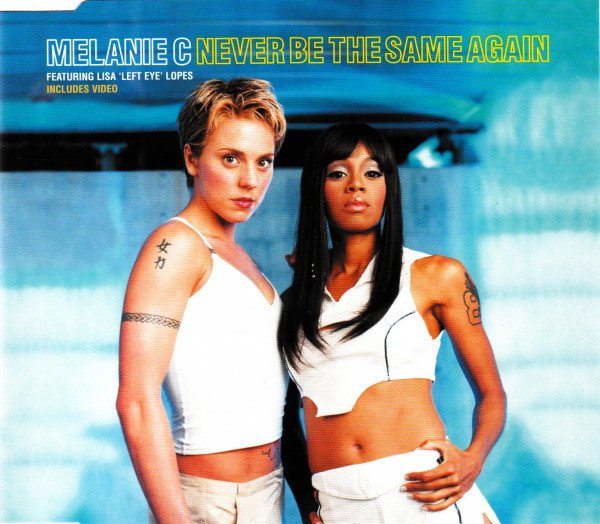
853. ‘Never Be the Same Again’, by Melanie C ft. Lisa ‘Left Eye’ Lopes

One Spice Girl replaces another on top of the charts. Off the top of my head, this might be the only time two former band members have traded places like this, but I am open to being proven wrong…

Never Be the Same Again, by Melanie C (her 1st of two solo #1s) ft. Lisa ‘Left Eye’ Lopez (her 1st and only #1)

1 week, from 26th March – 2nd April 2000

Anyway, Melanie Chisolm becomes our third Solo Spice. She was, famously, the Spice Who Could Actually Sing, and so perhaps we might have expected her first #1 to be a little more full-throated? This was her fourth solo single, after the grungy ‘Goin’ Down’ and the slightly dull ‘Northern Star’ had both made #4, while her Bryan Adams country rock duet ‘When You’re Gone’ made #3.

So, Mel C had had to wait, and it took a hip-hop detour to finally score her a chart-topper. It’s slow and slinky, with some cool drum-fills, and lots of record scratches (which even in 2000 every hip-hop record apparently had to have). It’s interesting how hip-hop still hasn’t yet become the dominant chart force that it eventually will. Not that ‘Never Be the Same Again’ is proper hip-hop, with Mel breathily singing her lines, and a very hooky, pop chorus.

No, the hip-hop is brought by the guest feature, the coolest guest feature since Mel B introduced us to Missy Elliott: TLC’s Lisa Lopes, AKA ‘Left Eye’ on account of her left eye being more ‘slanted’. She delivers a proper, sustained rap, the likes of which remains few and far between in the number one slot. It’s a bit basic, compared to some of TLC’s classics – The US to UK, NYC to LA, From sidewalks to highways… – but it ticks off all the requirements of a guest rapper slot. And it’s to their credit that both Mels managed to secure such impressive features.

The only disappointing thing about this well-produced, catchy but credible record, is that Mel C isn’t tested vocally. However she’s to be congratulated for trying out different sounds and genres on her debut album, while her second number one will be something completely different again. We can assume that her label decided to release a week after Geri’s ‘Bag It Up’ to avoid the girls being in direct competition, but for the record ‘Never Be the Same Again’ debuted with thirty thousand more sales than Geri had the week before.

As for Lisa Lopes, this was her 3rd and final solo hit in the UK – all of which were features – to add to the four Top 10s that TLC had scored in the ‘90s (‘No Scrubs’ was the highest, making #3). She died in a car crash in Honduras, in 2002, while on volunteer work.

837. ‘Genie in a Bottle’, by Christina Aguilera

1999’s second biggest pop princess launches…

Genie in a Bottle, by Christina Aguilera (her 1st of four #1s)

2 weeks, from 10th – 24th October 1999

Despite both being former squeaky clean Disney Mouseketeers, it felt from the very beginning that Christina Aguilera was packaged as the anti-Britney, the bad girl, the girl next door if you lived in a slightly dodgier neighbourhood… And listening to ‘Genie in the Bottle’, you can see why.

Compared to ‘…Baby One More Time’ its edges are sharper, its beats more streetwise and sassy, and its lyrics a lot more steamy. My body’s saying let’s go, But my heart is saying no… One thing I’d never really notice before is the dramatic squelchy synth riff that underpins the whole shebang, that I quite like. But it’s not got the oomph of the Max Martin produced ‘…Baby’, and it has probably not gone on to be remembered as equally iconic.

Yet once it gets to the chorus, it can compete with anything any member of pop royalty could come up with. Christina has standards, and isn’t going to just give it up for anyone. If you wanna be with me, There’s a price you have to pay, I’m a genie in a bottle, You gotta rub me the right way… Conservatives frothed a little at all the rubbing – Debbie Gibson of all people claimed that it was inappropriate for a teen idol, suggesting that she hadn’t been paying much attention to the previous five decades’ worth of pop history – but really, it’s a song about abstinence: My heart’s beating at the speed of light, But that don’t mean it’s got to be tonight…

Although in terms of UK sales and chart success Christina fared less well than Britney, she trumped her in one fairly essential area. Christina can sing. There’s not much in this record to prove that fact, but towards the end she starts letting loose with some of her trademark yeaheayeahs. And to be honest, it’s enough. Less is often more with Christina, the over-singers’ over-singer.

Despite just now claiming that she can’t sing, I will not often hear a bad word against Britney. And yet, I do think that Christina has lived somewhat unfairly in her shadow. Who, for example, remembers that she also kissed Madonna at the VMAs…?? (This is all from my Western-slanted viewpoint. She is arguably a much bigger name in the Latin world, having recorded half her output in Spanish). Christina and her team clearly disliked this one-sided comparison too, as for her second English-language album she will return with one of the great pop comeback tunes, a song that will make ‘Genie in a Bottle’ sound incredibly tame by comparison. Xtina awaits…

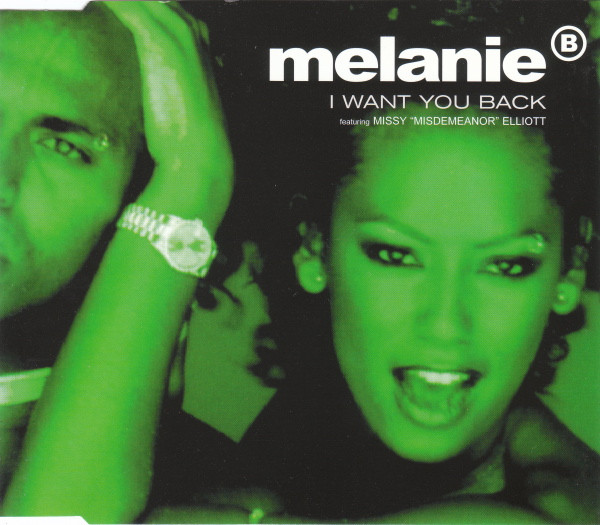
802. ‘I Want You Back’, by Melanie B ft. Missy Elliott

Straight on the back of Robbie Williams first solo #1, we have our first Solo Spice…

I Want You Back, by Melanie B ft. Missy Elliott (their 1st and only #1s)

1 week, from 20th – 27th September 1998

I’m not sure Mel B would have been many peoples’ choice for the Spice Girls most likely breakout star and, in truth, though she struck early she wasn’t the most successful of the five. But this is in fact the perfect solo Spice Girl number one: cool, edgy, and unlike anything the group had released in their two album career…

I’m the M to the E, L, B… Melanie Brown announces. As iconic raps go, it is not on the same level as her Now here’s the story from A to Z… moment in ‘Wannabe’, but it does the job. She tells the story of how she may think her ex is a bit of a dick, how he’s driven her to drink and distraction, but how she still wants him back…

The sharp strings and the ominous guitars over a hip-hop beat do sound pretty cutting edge for 1998, and a huge step away from what we’ve heard so far from the Spice Girls. But what roots this record in the late nineties is the very dated rap lingo. I admire the use of the term ‘wack’ in the chorus, but can’t help grimacing at lines like I know I talk mad junk, But I know what I want… And even though you’re a mack true dat, I want you back…

Still, bringing true street cred we have Missy ‘Misdemeanour’ Elliott on board, for her only credited appearance on a UK #1 single. (She will also feature, uncredited, on ‘Lady Marmalade’ in a few years time.) She does little more than spell out her name and then go ‘uh uh uh’, but hey. I think this might be the very first example of a pop star A ft. a rapper B record to make number one, with many to follow in the coming decades. To reduce Missy Elliott, a hip-hop pioneer, to the status of rent-a-rapper feels wrong though, and I do wish she’d been given more to do.

According to Mel B, this was Missy Elliott’s song, and she the one who invited the Spice Girl to duet on it. Incongruously, it also featured on the soundtrack to the Frankie Lymon biopic ‘Why Do Fools Fall in Love’. Elliott was far from a household name in Britain at this point, and wouldn’t make the Top 10 under her own steam until 2001’s ‘Get Ur Freak On’.

Mel B meanwhile peaked early in her solo career, and while she would go on to score two more Top 10 hits she will not be returning to the number one position without the help of her bandmates. ‘I Want You Back’ may not be the best remembered of the Spice Girls’ solo efforts, but I’d go as far as to say that it is not the wackest piece of music any of them have put their name to.

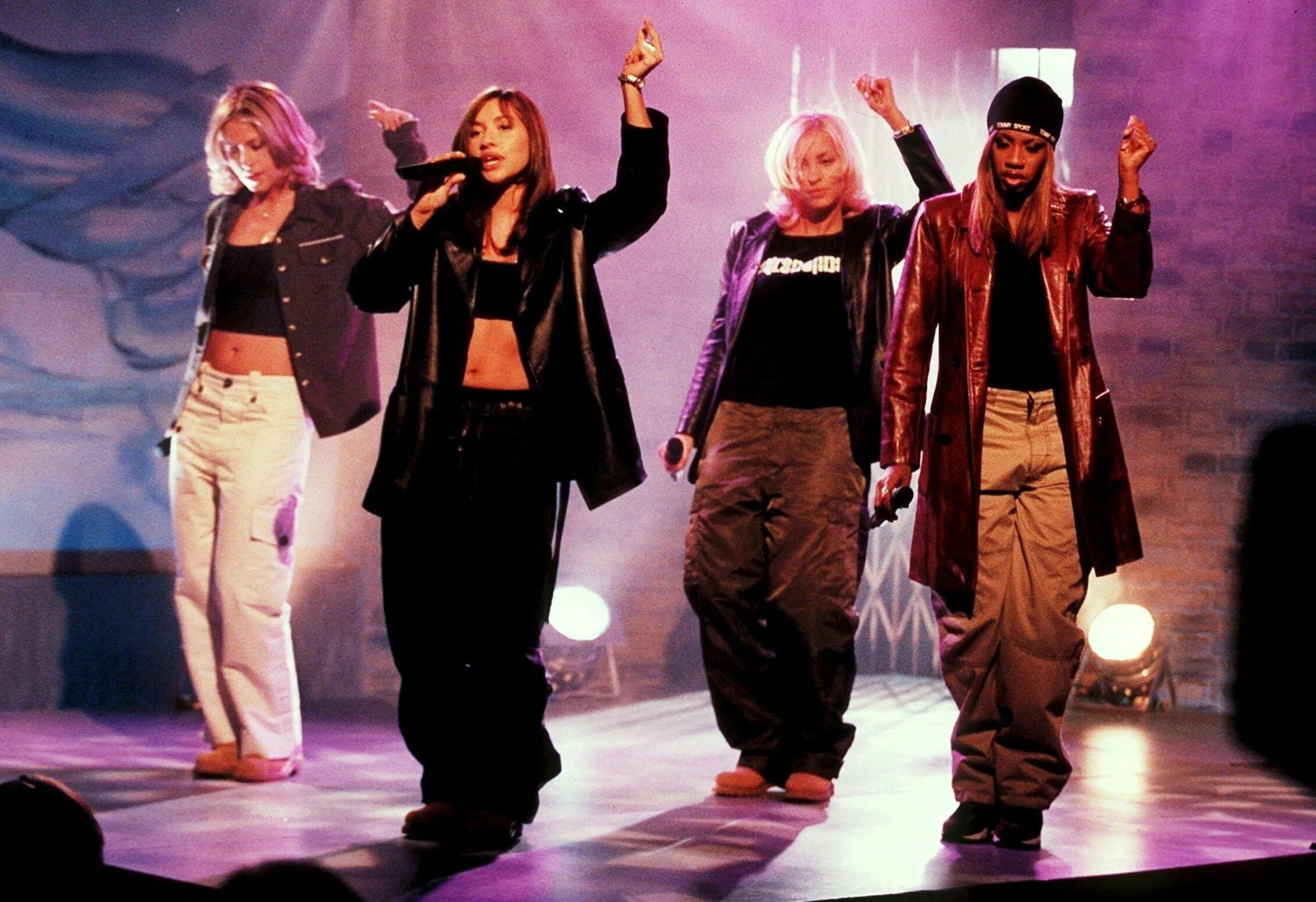
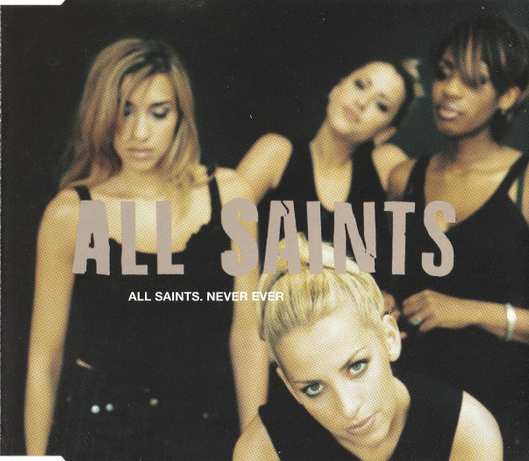
800. ‘Bootie Call’, by All Saints

Suddenly it’s eight hundred not out. We continue to cut a swathe through the chart decades, almost tipping over into a new century. But there’s still plenty of life left in the 1990s, as All Saints return to form…

Bootie Call, by All Saints (their 3rd of five #1s)

1 week, from 6th – 13th September 1998

I tried to make the best of their double-bill cover record, featuring interesting takes on ‘Under the Bridge’ and ‘Lady Marmalade‘. And while it wasn’t the horror show some might have claimed, it still wasn’t that good. So here’s their third number one of the year, making them 1998’s joint most successful girl group (the other one isn’t the Spice Girls). And it’s a fun record.

It’s also a strange record, despite the subject matter being very All Saints. Casual sex is the order of the day, and it’s worth stopping to note that while this song isn’t at all explicit, it’s only really been since the mid-nineties that chart-toppers have started to be this up-front about sex. Never stop giving good love, ‘Cause that’s what I call you for… the girls purr… You can bring it on with the rough stuff, I don’t want to be tamed… All Saints are, of course, in charge of the whole situation, reminding their guys: It’s just a bootie call… (Why, incidentally, not ‘booty’? Is ‘bootie’ a British spelling I don’t know about?)

The strangeness comes from the production, and the sound effects that hang all over this song like weird Christmas decorations. There’s what sounds like someone snoring, a man going ‘uh’ over, over and over (once you’ve noticed him in the mix he takes over completely), plus lots of vaguely sexual breathing and spluttering. The second verse is very rough around the edges, with the girls taking turns over their lines as if ad-libbing around a looped piano riff. It could be cool; but it could also sound half-arsed. It’s certainly not polished or softened, like so many of the recent tween pop #1s, so that’s something to be thankful for. The girls don’t forget that there might be children listening though, adding a line I assume to be about safe sex: Jimmy’s got to ride in your pocket, or lock him in your wallet…

‘Bootie Call’ isn’t as good as ‘Never Ever’, or either of the band’s two remaining chart-toppers. It’s a little gimmicky, and gets a little repetitive. But even as their fourth best number one, it’s pretty enjoyable. Plus it cements their place as the biggest British girl group of the day, as the Spice Girls continue to disintegrate.

Next up we have a much delayed recap, but before that we should cast our eyes back towards each of the ‘hundredth’ number ones. What’s interesting is that almost all of them represent a facet of British chart-topping tastes. All Saints are a good way to mark the girl-powered sass-pop of the late nineties, as were Chaka Demus & Pliers (700) a good way to mark the mid-nineties reggae revival. What’s interesting is that there are barely four and half years between 800 and 700, as the turnover of number ones increases, but more than six between 700 and 600, in which T’Pau represented for all the eighties power-ballads.

500 was Nicole’s ‘A Little Peace’ (Eurovision), while 400 was ‘Don’t Cry for Me Argentina’ (showtunes). Tony Orlando and Dawn’s ‘Knock Three Times’ represents nothing more than the British public’s ongoing love of middling cheese. 200 was ‘Help’ by the biggest band of all time, while 100 was Anthony Newley’s ‘Do You Mind’, highlighting the lull that came between rock ‘n’ roll and Merseybeat. And of course, Al Martino kicked the whole shebang off in 1952, repping for all the pre-rock crooners. It’s been a lot of fun so far – thanks to everyone who has come along for the ride – and rest assured I have no intention of stopping until we make it all the way to the present day.

795. ‘Freak Me’, by Another Level

Another boyband, another pop song, another sign that we’re now well into the late nineties…

Freak Me, by Another Level (their 1st and only #1)

1 week, from 12th – 19th July 1998

But unlike Billie Piper, there’s nothing tweeny about this raunchy record. Let me lick you up and down, ‘Till you say stop…  the Another Level lads beg… Let me play with your body baby, Make you real hot… All this over slick, modern R&B beats, and honeyed harmonising.

It’s very American, when you compare it to the more wholesome British boybands of the day (oh to hear Ronan Keating have a go with these lyrics…) And it had originally been a Billboard #1 in 1993, for US R&B group Silk, co-written by hip-hop/soul pioneer Keith Sweat. But Another Level were from London, with echoes perhaps of East 17 – Britain’s baddest boyband up this point.

‘Freak Me’ is, like I said, raunchy. There’s a decent soul-pop song in there amongst the gloop, and the chorus does enough to shine through. It’s also way too much. In the second verse, one of the boys announces: I like the taste of whipped cream, Spread it on top of me… They want to see the unnamed girl’s body drip, want to take a sip. Even Prince at his randiest would have thought twice about these clunky lyrics.

It reminds me of ‘I Wanna Sex You Up’, Color Me Badd’s 1991 chart-topper, in its unintentionally hilarious horniness. Which leads me to think twice about claiming that this isn’t a tween-pop record. Okay, perhaps the lyrics might have been lost on eight year olds, but I can imagine many a fifteen year old putting this one a make-out mixtape. It’s nowhere near as ‘adult’ as Another Level might have hoped.

This was Another Level’s second Top 10 hit – their first, ‘Be Alone No More’, had featured none other than Jay-Z – and they would enjoy seven in total during their short-lived, two album career. I have to admit that without the help of a search engine I couldn’t have named any of their other songs. In fact, the only other thing I know about Another Level is that one of their members, Dane Bowers, launched a mildly successful solo career, and almost managed a number one with Vicky Beckham. The rest of his post-Another Level career isn’t as impressive, dwindling down into lots of reality TV, a sex tape, and a jail sentence for assaulting his girlfriend. The other three members of the band don’t even merit a Wikipedia page…

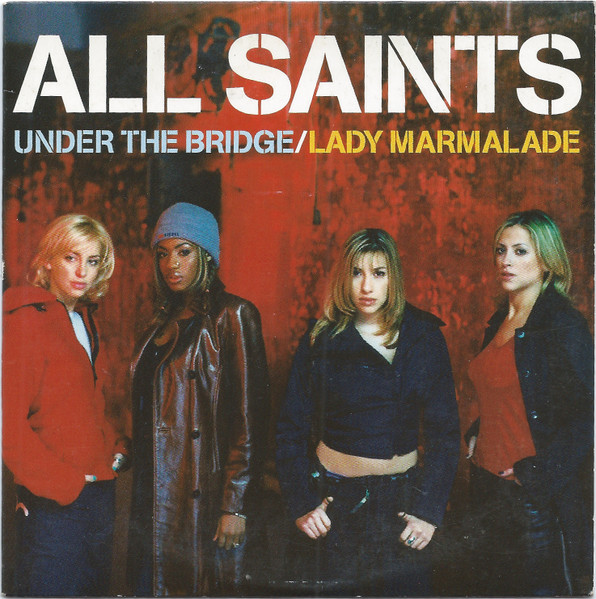
789. ‘Under the Bridge’ / ‘Lady Marmalade’, by All Saints

All Saints score their second number one in a row, with a much-maligned double bill…

Under the Bridge / Lady Marmalade, by All Saints (their 2nd of five #1s)

1 week, from 3rd – 10th May / 1 week, from 17th – 24th May 1998 (2 weeks total)

I’m interested to see what I make of the first part of this double-‘A’. The official view from the playground in 1998 was that All Saints covering Red Hot Chili Peppers was a travesty. Silly girl groups trying to sing songs by proper, sweaty, socks ‘n’ cocks guitar bands was wrong, and no teenage boys had the guts to say otherwise.

But here I am, two and a half decades later and unencumbered by peer pressure. Free to admit that I’m not much a fan of the Chili Peppers (though ‘Under the Bridge’ is one of their better, less obnoxious moments). Free to discover that All Saint’s version isn’t actually that bad. I do like the stripped-back intro, and the off-kilter delivery of the verses. It’s something new – an interesting re-imagining of the original – which is the basic duty of a half-decent cover version.

Because it’s 1998 there are lots of scratchy turntable flourishes, and a crackly, old-time effect on the main guitar riff, both of which feel quite dated. And perhaps unsurprisingly for a song about someone’s relationship with heroin, several of the lines were changed and/or omitted. Anthony Kiedis was not a fan of All Saints’ version (“it looked like they didn’t know what they were singing about”), which is fair enough for a song so personal to him. You do wonder what the thought process was in choosing this as a cover, for surely they knew there would be a reaction from the rock snobs. (Though it should be noted that the guitar on this record is played by Mojo Magazine favourite Richard Hawley.)

So, this isn’t terrible. Not even close. I’m not sure why they needed to do it, and I have no idea why it’s five minutes long, but here we are. And not content with reinterpreting one much loved classic, on the other side of this double-‘A’ the girls have their way with Labelle’s raunchy disco standard ‘Lady Marmalade’. From heroin, to prostitutes…

This feels a bit more what you’d expect from a ‘90s girl group. A bit more basic, if you will, with a mid-tempo disco-funk beat that reminds me of the Spice Girls’ ‘Who Do You Think You Are’. But again they at least do something a bit different with it, removing most of the original verses and replacing them with saucy raps – My place or yours, Gotta be raw… Gotta get wet, Are you ready yet? – which cement their place as the edgier girl group of the day. Of course they keep the famous Voulez-vous coucher avec moi? line, but it’s rendered fairly PG by some of the smut around it. (I remember having an embarrassing conversation with my mum when this came on the radio, her asking if I knew what the French meant…)

The Labelle original had made #17 in 1975, which is surprisingly low. The original of ‘Under the Bridge’ had fared slightly better, reaching #13 in 1992. It’s fair to say that neither of these covers have usurped the originals in the public’s affections, while an even more popular cover of ‘Lady Marmalade’ will be along in a few years to overshadow All Saints’ effort. And personally, I much prefer the originals of these two hits. This is by far the weakest of the girls’ five number ones; but they aren’t the crimes against music that some may try to suggest.

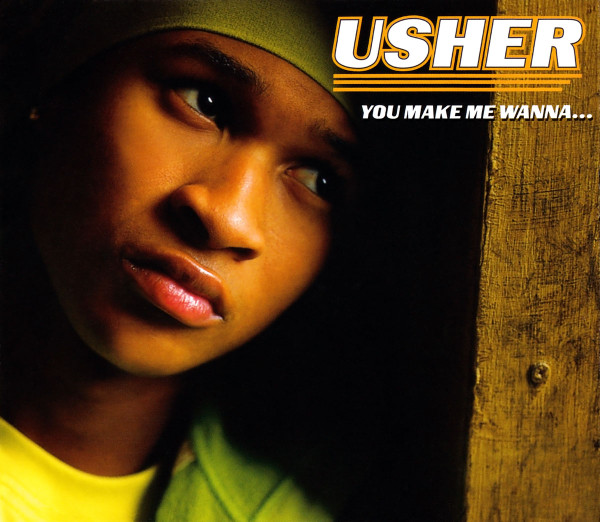
782. ‘You Make Me Wanna…’, by Usher

January 1998, but we take a quick step into the early twentieth century…

You Make Me Wanna…, by Usher (his 1st of four #1s)

1 week, from 25th January – 1st February 1998

Since the mid-1990s, the British charts have been very British-led. This sounds like an obvious statement, but hear me out. In 1996, the only American acts to top the charts were the Fugees, twice (one of which was, to be fair, the year’s highest-seller), and Deep Blue Something. Back in 1994, it was only Prince and Mariah Carey. 1993 saw honorary American Shaggy, Meat Loaf, and a Will Smith-Jazzy Jeff combo. Compare that to 1990, when seven US acts made number one…

Clearly the fact that European-style dance music and Britpop were the big musical movements of the mid-nineties meant that the States didn’t get much of a look-in at the top of the charts. But 1997 saw a reversal of that trend, with #1 hits from the rogues gallery of R. Kelly, Michael Jackson, and Puff Daddy, plus No Doubt, Hanson, and Will Smith. 1998 will continue this way, starting with an up and coming eighteen-year-old called Usher.

I’ll admit that I padded this post out with the preceding couple of paragraphs because I’ve never found this sort of late-90s, twitchy, minimalist R&B very interesting. It’s very modern, sounding more like what’s to come in the early ‘00s than what’s come before, and Usher’s vocals are impressive. I do like his freestyles towards the end of the song, where he sounds like a more muscular Michael Jackson. He certainly doesn’t sound like a teenager here.

But it largely washes over me without really registering. This was the sound of the Billboard charts at the time, and there’s a significance to it topping the UK charts now. It reminds me of some early Destiny’s Child tracks from the same time, with the same jerky, pizzicato production. But I like ‘Bills Bills Bills’ much more than ‘You Make Me Wanna…’, which I can only explain through the fact that Beyoncé just makes things better.

Still, it introduces one of the big names of modern pop music. This was Usher’s first British hit, though he’d have to wait a couple more years to become a huge chart force. He’ll have four chart-toppers over an impressive twelve-year span (with at least one genuine banger) and a Top 10 career that will last the best part of two decades.

Again, this January is providing an interesting mix of one-week #1s that might not have made the top at any other time of year. A slow-burn girl group classic, Oasis at their most overblown, and a glimpse into the charts of the future. On a personal note, ‘You Make Me Wanna…’ (why the ellipsis?) was my twelfth birthday number one. Meh. Had I been born a day later I could have claimed the cheesy tune that is to come…

780. ‘Never Ever’, by All Saints

Into 1998, then. The penultimate year of the century, the 46th year of the UK singles charts, and one with a thus-far record thirty number ones. And to start off, there are a few questions that I need to know…

Never Ever, by All Saints (their 1st of five #1s)

1 week, from 11th – 18th January 1998

To be honest, an opening line that clunky could kill lesser songs off before they’ve started. A few answers that I need to know, surely, scans just as well. Anyway, ‘Never Ever’ quickly recovers from that shaky start, by bringing us one of the great spoken word sections. Anyone of my vintage can probably still recite it word for word…You can tell me to my face, Or even on the phone… as well as adding all the backing harmonies.

It takes the sassy soul vibe of 1997’s final chart-topper, the Spice Girls’ ‘Too Much’, and ups both the sass and the soul. All Saints have very good voices, and great harmonies, to the point where you’re tricked into misremembering this as an a cappella track. But their voices are also flawed, like the Spice Girls’, so that you can hear their accents and dropped consonants.

‘Never Ever’ isn’t a cappella, of course, and the production is period-perfect late-90s R&B squelch (this is what we must refer to it as from now on, and we’ll be hearing it a lot as the century winds down). It’s also let down slightly by further clunky lyrics (flexin’ vocabularythe alphabet runs right from A to Z) and simplistic rhymes: Free from pain/ Goin’ insaneSo low/ Black holeSo sad/ Feelin’ really bad… But hey, at least the words stick with you. And by the end, as the harmonies build and the organs start to swirl, you forgive it. The outro is just as good as the famous intro, slipping into a hip-hop beat as the girls’ voices are filtered and distorted.

Having a pop single run over five minutes (six and a half in its album version) is always a risk, spreading a few decent lines and a hook too thin. But ‘Never Ever’ lasts the distance, thanks to the strength of the voices and the melodies, and the way that they continue to build. And talking of being long-running, the song had a particularly slow journey to the top of the charts by 1998’s standards. It first charted in November, then hung around the Top 10 for seven weeks before finally reaching the top in the post-Christmas lull. It set a record for the highest ever sales before making #1 (770,000), and it’s current total stands at 1.5 million. It is the 3rd biggest-selling girl group single of all time in the UK. (You can guess the top two in the comments below…)

It feels simplistic to call All Saints the female East 17 to the Spice Girls’ Take That, but I’m going to do it anyway. The Spice Girls were chaotic and silly, whereas All Saints were all glowering stares, pierced tongues and nose-studs, shacking up with Gallaghers. They were the girls a couple of years above you in the corridor at school, definitely not to be approached under any circumstances. ‘Never Ever’ was only their second single, but it established them as the ‘other’ girl group of the day. In 1998, they’ll even have one more #1 than the Spice Girls. In fact, they’ll have five chart-toppers in just under three years, and all but one of them will be great.

If you’ve been paying attention, you might be expecting a recap in my next post. However I’ve decided that as the turnover of #1s is ever-increasing, and to stop my all-time awards getting too skewed towards the late-‘90s/early-‘00s, I’m going to do recaps after every fiftieth chart-topper until things slow down a bit, sometime around 2003.

772. ‘Men in Black’, by Will Smith

The first half of 1997 was an interesting musical smorgasbord, with a quick turnover of number ones meaning we flitted gayly from genre to genre. During the second half of the year things will get slightly more predictable at the top of the charts, and records will start staying at #1 for slightly longer…

Men in Black, by Will Smith (his 1st and only solo #1)

4 weeks, from 10th August – 7th September 1997

Beginning with the year’s second big soundtrack hit. ‘Men in Black’ was the summer’s big popcorn movie, featuring Will Smith, Tommy Lee Jones and some aliens, which I thought I remembered fondly until I realised I was thinking of ‘Independence Day’, from the year before. I probably did see ‘Men in Black’ at the time, but it hasn’t remained with me.

The lyrics are geared towards the movie plot, which means unique lines like: Walk in shadow, Move in silence, Guard against extra-terrestrial violence… It reminds me of Partners in Kryme – one of the first hip-hop chart toppers – and their rhymes about which Teenage Ninja Turtle liked pizza (Michelangelo, of course). You could class this, and Puff Daddy’s ‘I’ll Be Missing You’ as a step back for hip-hop, after more innovative and respectable #1s by the Fugees and Coolio. But at the same time, this was a huge-selling, month-long number one, and another sign that rap had gone mainstream. (It was also, I believe, the first time that one hip-hop track had knocked another off top spot).

It’s based around ‘Forget Me Nots’, a minor hit in 1982 for Patrice Rushen. If it sounds familiar, then that’s because George Michael had sampled it a year earlier on ‘Fastlove’. The chorus was edited and sung by Coko, of the R&B group SWV, who really should have gotten a co-credit, so much does she bring to the show.

“Will Smith don’t have to cuss to sell records, but I do”, Eminem would famously rap a few years after this. It’s easy to be snobbish about Smith’s family-friendly approach to hip-hop (an NME review at the time labelled him the ‘Cliff Richard of rap’) but really, this is well-made, catchy pop. I don’t love it now, twenty-seven years on, but it was everywhere that summer, and was the #1 when I started high school. Plus the Bouncin’ with me, Slide with me… break is still great fun. File it under ‘fondly remembered’.

‘Men in Black’ was Will Smith’s debut solo single, featuring on his first solo album ‘Big Willie Style’ (tee-hee) and marked a return to music after he’d begun focusing on acting in the early-nineties. He has of course already featured at number one, as the Fresh Prince with Jazzy Jeff in 1993; while this song set him up for a good few years of chart success. He would have eight further Top 5 hits between now and 2005, including three #2s. Respect from the hip-hop community never quite arrived, but he had a great ear for a sample, and made some of the records that define the late-nineties for many people of my generation. He hasn’t released much new music since the mid-2000s, but remains one of Hollywood’s big hitters…