293. ‘Voodoo Chile’, by The Jimi Hendrix Experience

Our last number one had the title ‘Woodstock’, but didn’t really get going in terms of capturing the feel of the planet’s biggest ever music festival… But now… Now we have a song that people actually heard. At Woodstock. Performed by one of the weekend’s most famous acts…

1_m7nepYvCfBLqnI4WfkUcXA

Voodoo Chile, by The Jimi Hendrix Experience (their 1st and only #1)

1 week, from 15th – 22nd November 1970

It starts with a riff – a riff that everyone has heard – and a tickle from the drum kit. And then, the moment when the twangy, chicka-chucka intro to ‘Voodoo Chile’ cuts out and we slam into the brutally simple main riff is genuinely one of the most thrilling seconds in any chart-topping single. Hard rock from the ultimate rock star. A brilliantly heavy, undiluted record at the top of the pop charts.

Well I stand up next to a mountain, And I chop it down with the edge of my hand… If you’re ever feeling down, ahead of a tough day, I’d recommend putting this on in your headphones and stepping out of the door just as Jimi sings that line… Cause I’m a voodoo child, Lord knows I’m a voodoo child… It’s a badass song, with a badass message. I didn’t mean to take up too much of your sweet time, I’ll give it right back to ya one of these days… Haha… What exactly is a ‘voodoo child’? Dunno, but it doesn’t sound like something you’d want in the house.

Not that the lyrics make up much of this song. There’s an electrifying solo between the first and second verses. And then the whole second half is given over to some serious head-banging and wah-wah pedalling. It might sound like Hendrix showing off, if it didn’t sound so damn good. It’s controlled chaos, a record that sounds like a live-recording, bottled lightning. And it really makes use of your stereo speakers, with the riffs chasing one another left to right, back and forth…
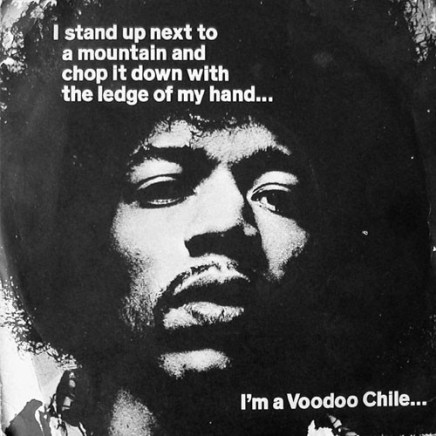
R-556557-1148199414.jpeg

(coolest single artwork so far, by far!)

God this is good. I knew ‘Voodoo Child’, of course, but it’s not in ‘overplayed’ territory for me. I really should listen to more Hendrix. By November 1970, when he grabbed his one and only week at #1, he was already dead, having joined the 27 Club two months earlier. The line: If I don’t meet you no more in this world, I’ll meet ya on the next one, And don’t be late…! makes it a very appropriate posthumous hit. It’s a shame that it took his death to get him to the top, though he had scored big, Top 10 hits consistently following his debut in 1966 with ‘Hey Joe’.

But who cares why this got to number one. Let’s just rejoice in the fact that it did. It ends abruptly, ricocheting to silence all of a sudden, and you get the feeling it could have been much longer. This ‘Voodoo Chile’ was based on a fifteen minute long, much more laid-back and bluesy, song of the same name that featured on his ‘Electric Ladyland’ album. This version was a reprise – the very last track on the LP – hence the ‘Slight Return’ on the track listing. It should actually be ‘Voodoo Child’, but the record company misnamed it when they released it.

While we wonder just what else 1970 has in store for us in this most schizophrenic of years, we should probably make a confession. At the start I billed this as the pinnacle of Woodstock, by its biggest star. Only problem is… Thanks to bad weather and technical issues, Hendrix actually went on stage at 08:30 on the Monday morning, after most people had begun to pack up and head home. The 500,000 strong crowd had dwindled to around 40,000. But what the hell, who cares. Let’s rewrite history, and imagine him playing this as the sun set, half a million extremely high people swaying along…

Find me on Spotify here.
275. ‘In the Year 2525 (Exordium and Terminus)’, by Zager & Evans

You see the title of this next #1 hit, and you prepare yourself for something special. We’re off to the year 2525… With a duo that sound like a second-rate magic act.

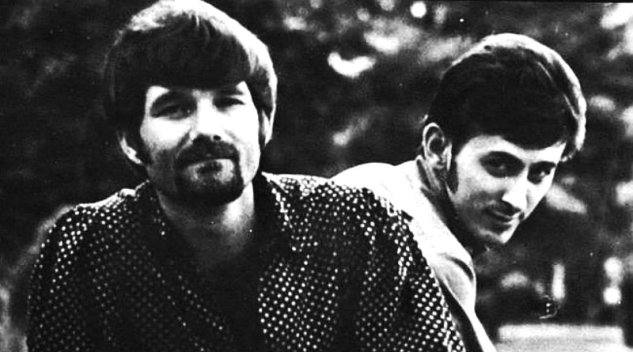
mainZAGER

In the Year 2525 (Exordium and Terminus), by Zager and Evans (their 1st and only #1)

3 weeks, from 24th August – 14th September 1969

It gets underway with a Spanish guitar and Mariachi-band backing. It reminds me of Dave Dee and Co’s ‘The Legend of Xanadu’, another Latin-flavoured glimpse into a strange world. In the year 2525, If man is still alive, If woman can survive, They may find…

In comes a relentless galloping beat, over which a terrifying vision of the future is unveiled. By the year 3535, you’ll be taking pills to tell you what to think, by 4545 you won’t need your teeth or your eyes… You won’t find a thing to chew, Nobody’s gonna look at you… In 5555, the machines will have taken all the jobs, rendering our limbs obsolete. And by 6565: Ain’t gonna need no husband, Won’t need no wife… You’ll pick your son, Pick your daughter too, From the bottom of a long glass tube… Woah-woah…

Fair to say it’s a pretty pessimistic view of the future. It has the air of a crazed evangelist, preaching angrily from his pulpit, as all the while the beat goes on, and on. The predictions change to years ending in ten, for rhyming purposes, as we go forward. And by 8510, God will have had enough, and will come down to rip it all up and start again. It’s a crazy record. I’m not sure I like it all that much, but it is entertaining…

The final verse is probably the most prescient. In the year 9595, I’m kinda wonderin’, If man is gonna be alive, He’s taken everything this old earth can give, And he ain’t put back nothin’… Woah-woah… Doesn’t that pretty much sum up the fears of 2020, with our rising temperatures, killer viruses and plastic-swilling oceans? In fact, Zager & Evans’ vision of the future hinges on its opening line: If man is still alive… Who here’s willing to put money on humans being around in 2125, let alone 2525?

ZAGER_&_EVANS_IN+THE+YEAR+2525-640089

We’re used to science fiction that looks into the near-future: ‘Back to the Future’ in 2015, ‘Terminator’ in 2029 and so on, so that we can chuckle when we reach the date in question and point out that none of what was predicted has come to pass. But who can actually get their head around the year 2525? It’s five hundred and five years away! And the year 9595, on which the song ends – it is practically impossible for the human mind to imagine that far forward in time. ‘In the Year 2525’ was nominated for a ‘Hugo Award’, for the best science fiction / fantasy works of the year, though, so who am I to question it?

Denny Zager and Rick Evans were a duo from Lincoln, Nebraska, and they are the purest of one-hit wonders. None of their subsequent follow-ups made the charts. This is their sole chart-topping single, on either side of the Atlantic (fittingly, it was #1 in the US as Neil Armstrong set foot on the moon.) Zager is still alive, but Evans sadly passed-away in 2018.

We’re drawing to the end of the 1960s, and this record is almost the direct antithesis of a lot of the positivity we’ve seen in pop music throughout the decade. In fact, 1969 has been a year for some pretty cynical chart-toppers: Peter Sarstedt’s cutting ‘Where Do You Go To…’, The Beatles sarcastic ‘Ballad of John and Yoko’, The Move’s melodramatic break-up in ‘Blackberry Way’. Now this anti-flower power anthem. Two years ago it was ‘All You Need Is Love’; now it’s all the ways in which we, as a race, are doomed…

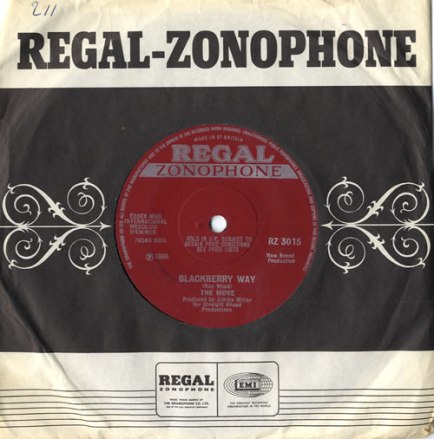
265. ‘Blackberry Way’, by The Move

This next #1 single is one that opens with a bang, right in the middle of the story. ‘In media res’, if you want to be fancy about it. Blackberry way, Absolutely pouring down with rain, It’s a terrible day…

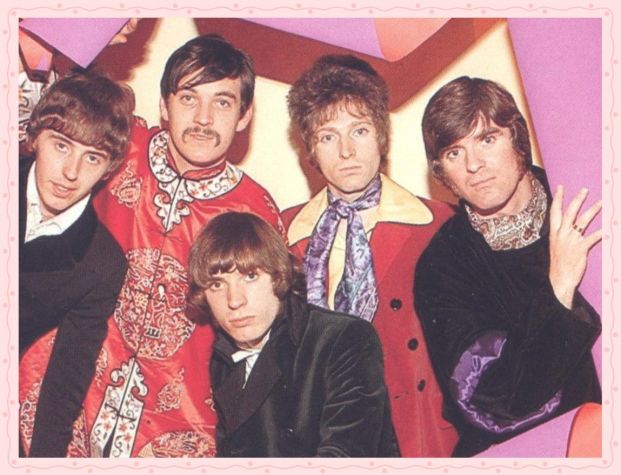
690428-the-move

Blackberry Way, by The Move (their 1st and only #1)

1 week, from 5th – 12th February 1969

I like the absolutely pouring down with rain line – it sounds very British. As the picture is filled in, you really can picture a dull suburban street – probably lined with bungalows – in the rain, as girl ends it with boy. So now I’m standing on the corner, Lost in the things that I said…

It’s a dramatic record. Make that melodramatic. The strings moan like the soundtrack to a haunted house. The drums are thick and portentous. As the singer makes his way from Blackberry Way, through the park and past the boating lake, where the boats float: just like myself they are neglected… Before each chorus, he asks himself: What am I supposed to do now? He gets on the train, with one final look over his shoulder, to see if she’s followed him… We can assume that she hasn’t.

This is kind of fun; if a little OTT. Even though it’s about heartbreak ,the scale of the song, and the lyrics about the mundane things he sees on his walk in the rain, keep it slightly tongue-in-cheek. Only occasionally does it get ahead of itself – what exactly does the line: See the battlefields of careless sins, Cast the to the wind… mean? I like the fact that it’s quite a psychedelic sounding song, but one describing a fairly everyday scene. No flower-power here. And I like the contradiction in the chorus: Goodbye Blackberry Way, I can’t see you, I don’t need you… Sure to want me back another day… Ain’t that just how a break-up goes…?

THE_MOVE_BLACKBERRY+WAY+-+SOLID-296795

The Move were a Birmingham band, that had already enjoyed four Top 5 hits before they scored their sole chart-topper. I always liked ‘Fire Brigade’ as a kid – it must have been on a sixties-hits tape we had lying around – and ‘Flowers in the Rain’ was famously the first ever song played on Radio 1. They were quite a sonically experimental band, mixing Spector-ish production with innovative sounds and effects. You can hear the instruments on ‘Blackberry Way’, straining to make themselves the most important part of the song over the vocals. It’s a record that bursts from the speakers…

Central to The Move was songwriter and singer Roy Wood, who we will meet again in the coming decade – a man who played a big role in shaping the sound of the seventies when The Move morphed into Electric Light Orchestra. Wood didn’t hang around long with ELO, though, leaving to form glam-rockers Wizzard. Luckily for all of us, we’ll meet both of his bands-to-be later in this countdown. Not many artists can claim to have been involved in three hugely successful, chart-topping acts… Kudos to Wood!

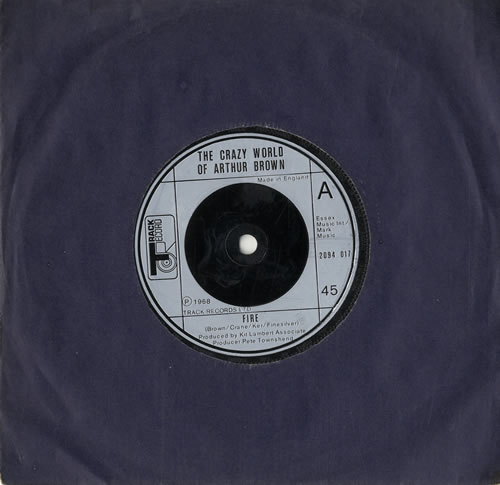
255. ‘Fire’, by The Crazy World of Arthur Brown

1968 strikes again! Our next #1 kicks off with a yell straight from the sulphurous pits. I am the God of hell-fire, And I bring you…! Well, they do say that rock ‘n’ roll is the devil’s music…

A8D9EE94-33C2-40A9-AD2A-FB394DE92EB0

Fire, by The Crazy World of Arthur Brown (their 1st and only #1)

1 week, from 14th – 21st August 1968

Fire, I’ll take you to burn…! As an opening statement, it’s pretty aggressive…. Fire, I’ll take you to learn…! Demonic horns and a Satanic organ, playing as if it were possessed, join in with the fun as the ground splits in two below our feet and we tumble into the roasting furnace. I’ll see you burn…

This is, and I mean this in the best possible way, a crazy record. The Crazy World of Arthur Brown certainly live up to their name. That it hit the top of the singles chart for a week in the summer of ’68 is something to be marvelled at, and enjoyed. It’s harsh, it’s angry… It’s an anthem dedicated to nihilism and arson: You fought hard, And you saved and earned, But all of it’s going to burn… Arthur Brown then launches into an Ohhh Noooo and a series of yelps and squawks that Axl Rose in his prime would have been proud of. Wiki lists ‘Fire’ as ‘psychedelic’, which it is… But that’s only telling a tiny part of the story. This is hair metal and shock-rock, Alice Cooper, Ozzy Osbourne and Iron Maiden, before any of that was a thing. Fire… To destroy all you’ve done…

The second verse slows down, like the soundtrack to an eerie, cheapo haunted mansion ride, before the grinding organ and horns snap back in and we head relentlessly towards the finish. We get crazed laughter, shrieks, the horns blasting ever stronger, before the winds of hell blow us on our way. You’re gonna burn…burn burn burn burnburnburn…! Apparently Brown used to perform this track while wearing a helmet that had been doused in fuel and set alight (see the pic above). Because of course he did…

ARTHUR_BROWN_FIRE-549906

They also say that the devil has the best tunes, but I’m not so sure about that being the case here. This is an amazing record, an experience; but not one that I’m desperate to repeat many more times. Perhaps it’s a truly awesome record… ‘Awesome’ in the literal sense of inspiring fear, as in the ‘awesome’ power of an atomic bomb.

I am convinced that there must have been some controversy around this disc hitting the top of the charts – that at least Mary Whitehouse and the Archbishop of Canterbury got their knickers in a twist over it – but can’t find much evidence online. It shows how far society had come in the decade or so since Elvis was getting cropped at the waist, I guess.

The Crazy World of Arthur Brown, largely Brown and organist Vincent Crane, are one-hit wonders in the truest sense. None of their other singles – either before or after – managed to chart in the UK. But their legacy lives on –  all the metal stars I listed above count them as an influence, while ‘Fire’ has been sampled by The Prodigy and Marilyn Manson. Arthur Brown still performs, aged seventy-seven, and still sets his helmet on fire…

I feel like I’ve been writing this at the end of nearly every recent post, but it bears repeating… What else has 1968 got in store for us? Surely it can’t get any weirder than this…?

https://www.youtube.com/watch?v=FaHEusBG20c

246. ‘The Legend of Xanadu’, by Dave Dee, Dozy, Beaky, Mick & Tich

Just what on earth was being pumped into the British water supply in early 1968? Trad jazz, Bonnie and Clyde, Eskimos and yodelling duos… Something pretty heavy duty was being passed around, by both record makers and record buyers, to induce this carnival of craziness. And it shows no signs yet of letting up. For we’re off to Xanadu!

61eoLpiILKL._SY355_

The Legend of Xanadu, by Dave Dee, Dozy, Beaky, Mick & Tich (their 1st and only #1)

1 week, from 20th – 27th March 1968

We open on a dusty Andalucian plain. Spanish guitars tremble, somebody mumbles something something esta es… Then wham. A whip cracks. Or somebody shoots a B-movie ray-gun. Whatever it is, it wakes up both you and this song. We’re in cartoon soundtrack territory. Imagine Scooby Doo on a far-away planet that looks a lot like Mexico. That sentence might sound crazy, but that’s where we are right now, with #1 single 246.

You’ll hear my voice, On the wind, ‘Cross the sand… For all the zaniness of the extra bits – the sound effects, the Mariachi band and what have you – the main melody of the song is pretty traditional. Old-fashioned even – something with a hint of 1961 about it. If you should return, To that black, barren land that bears the name of… Xanadu!

The lyrics, as far as I can follow, are about a spurned lover destined to see out his days in a forgotten land. I’m listening carefully, to see if there might be a metaphor hidden away in there – that the singer is actually just imagining himself in this black, barren land – but I can’t find any. This is literally a song about a far-off place called Xanadu, and a lonely man who lives there.

We arrive, of course we do, at a spoken word section that makes this song feel even more like a theme-tune. What was it to you that a man laid down his life for your love…? So wait… he’s dead? And Xanadu is some kind of afterlife? It ends with a question: Will you find your way back someday, To Xanadu…?

71vwdmJYYML._SL1280_

Not if I can help it, mate… I jest. I like this song. It’s grown on me over the past four or five listens. I now find myself swaying and shaking imaginary maracas as it ends. ‘The Legend of Xanadu’ is crazy – the craziest record yet this year (and that’s a high bar!) But I’m going to have to do some research to find out what on earth inspired this hit single and got it all the way to the top of the charts…

It’s not from a movie, nor is it the theme to a cartoon. It’s a stand-alone pop single by an already established band. More on them later. Research into ‘Xanadu’ takes you all the way to Inner Mongolia in the late 13th Century – a capital of China, used as a residence by the Khans and ‘discovered’ by Marco Polo, via the biggest private estate in the world from the movie ‘Citizen Kane’. In both these examples, Xanadu was an example of opulence and splendour; whereas in ‘The Legend of…’ it’s painted as a wasteland, a place of exile. And, famously, this won’t be the last chart-topping single to name-check it…

Dave Dee, Dozy, Beaky, Mick and Tich (with a name like that you couldn’t expect them to release normal music) were several years into their careers by this point, their biggest hits having been ‘Bend It!’, the superb, and really heavy for its time ‘Hold Tight!’, and ‘Zabadak!’ (which makes ‘Xanadu’ sound conventional.) They seem fun, loved an exclamation mark in their titles, and are a band I’m keen to listen to more of. Wiki lists them as ‘Freakbeat’, which I think sums up this song perfectly. Like so many bands we have met these past few years, Dave Dee and Co.’s chart success ended as the sixties drew to a close.

So we forge on, past the Eskimos, the Rockefellas and the Cinderellas, across the sands of Xanadu, to find out what 1968 has in store for us next. Whatever it is, it surely won’t be dull…

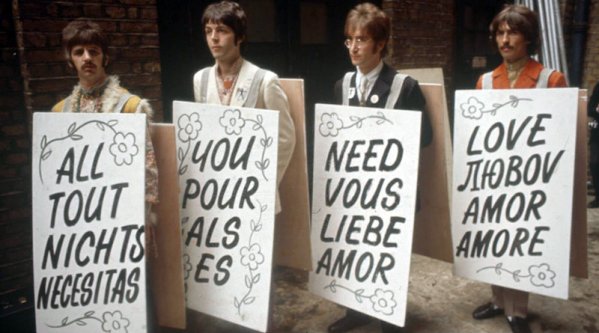
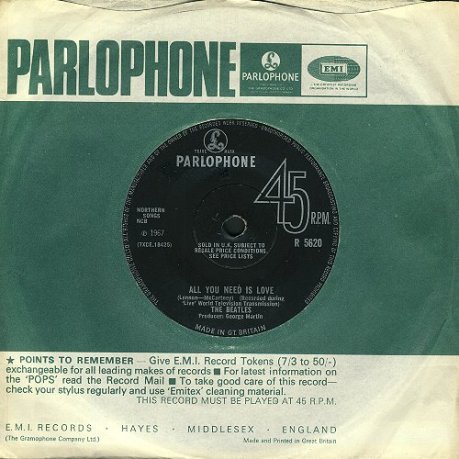
235. ‘All You Need Is Love’, by The Beatles

The top of the British Singles Chart has just endured its longest Beatles-less spell (at least, you know, until they split up and stop making music) but they are back! Though you could be forgiven for thinking that this is a completely different band.

The Fab Four were killed off a year or so ago. Since then they’ve hit #1 with the string drenched ‘Eleanor Rigby’ and the kids’ singalong ‘Yellow Submarine’. Before that came the bass-heavy garage of ‘Paperback Writer’. Both big steps away from the Beat sound that had made them huge. This single is another massive leap away, even compared to their innovation of ’66. This single opens with the French national anthem…

mainBEATLESLOVE

All You Need Is Love, by The Beatles (their 12th of seventeen #1s)

3 weeks, from 19th July – 9th August 1967

Because, why not? They’re The Beatles and they can do whatever the hell they want. ‘La Marseillaise’ doesn’t last for long, and soon we swing into a simple ditty. Love, love, love… and a mantra. Nothing you can do that can’t be done, Nothing you can sing that can’t be sung… On first listen it sounds like a hippy-dippy, peace (man!) anthem for the Summer of Love. But, actually… Nothing you can know that isn’t known, Nothing you can see that isn’t shown… It’s kind of negative. ‘Why bother?’ seems to be the message…

John Lennon allegedly kept the lyrics simple, as the song was to be debuted on TV screens around the globe for ‘Our World’, the first ever global tele-link. But, Lennon being Lennon, I sense a bit of needle in there. A bit of sarcasm, maybe? It’s definitely not as straightforward as it sounds. He later described the lyrics as ‘revolutionary propaganda.’ The chorus, though, is simplicity in action: All you need is love… Love is all you need.

Like ‘Good Vibrations’ – a record that spurred The Beatles on to greater experimentation – ‘All You Need Is Love’ jumps around all over the place, from national anthems, to drunken jazz in the chorus, to an electric guitar solo, to stabbing strings, with some music-hall ‘All together nows’ for good measure.

r5620

And then there’s the finale. Where it all just goes a little bit mental. We get horns from Bach (meaning the 18th Century composer has influenced two #1s in a row!), a snippet of Glen Miller’s ‘In the Mood’ and, naturally, ‘Greensleeves’. From revolutionary France, to WWII mess-halls, to Tudor England in one four minute pop song… And there are snatches of two other Beatles’ classics as well: ‘Yesterday’ and ‘She Loves You’. (Opening up an interesting sub-category: #1 singles that feature in other #1 singles…) All the while the band and guests whoop and holler until the whole messy shebang fades from sight. It sounds like the best party you’ve never been to.

Where to start analysing this? Why even bother? I certainly don’t feel qualified to go into any more detail. With other bands, and other singles, you can see where they were coming from, what they were trying to do, even how you might have done it better. Not with this song, not with The Beatles. It’s unthinkable, really. Throwing out singles that most bands would have built whole careers around, willy-nilly. Here’s ‘She Loves You’, there’s ‘Help!’, watch you don’t trip over ‘Eleanor Rigby’, or ‘Ticket to Ride’ over there in the corner… You’d like a song for a lame TV show? Here’s ‘All You Need Is Love’. And ‘Yesterday’, the song that they reference here – the song that has been covered over 2000 times, the song that has been voted ‘Best Song Ever’ on several occasions? They stuck that away on Side 2 of an album. Oh, The Beatles… Beatles, Beatles, Beatles…

But, just so that they don’t go getting too big-headed, too full of themselves – Paul and Ringo definitely read this blog, right? – I feel compelled to add that when they next appear in this countdown, it’ll be with what I personally think is the worst of their seventeen chart-toppers…

234. ‘A Whiter Shade of Pale’, by Procol Harum

And so we reach the summer of 1967, which you might also have heard of as The Summer of Love. Flower power. Tie-dye. Making love not war. (I dunno, really – I’m just hitting all the clichés.) If you can remember it, man, you weren’t really there…

Despite Britain being thousands of miles away from the pot-haze of Haight-Ashbury, somehow the singles chart managed to reflect, in real time, this cultural movement, with three heavyweight #1s between early June and early September. The first being this next one…

8e71278a9668608a2c28a7deebf1a9c5

A Whiter Shade of Pale, by Procol Harum (their 1st and only #1)

6 weeks, from 8th June – 19th July 1967

It’s a record that strides confidently into the room, with an unmistakeable organ riff and Spector-esque drums. (Apparently it owes a debt to J. S. Bach, this intro… I wouldn’t know much about that. I would simply describe it as ‘soaring.’) It’s rock, it’s progressive, it’s classical, it’s psychedelic… It’s everything and nothing. It just is.

It reminds me a little of The Moody Blues’ ‘Go Now!’, from a couple of years back, in its proggy, jazzy take on pop music. But not really. ‘A Whiter Shade of Pale’ is unique. It doesn’t really sound like the logical next step in the evolution of pop; more like a record that has arrived, nobody knows how or from where, to dominate until normal service resumes.

As much as it stands out musically, what has made this such a famous record are the lyrics. Just what on earth are they about? We skipped the light fandango, Turned cartwheels cross the floor… The first verse, at a push, can be seen as someone drunk at a party. The room was humming harder, As the waiter brought a tray… But surely a song this renowned can’t just be about getting pissed at a party, turning white, and chucking up?

Well, no. We’ve not got to the Chaucer-referencing chorus yet. Or the second verse… I wandered through my playing cards, And would not let her be, One of sixteen vestal virgins… Uh-huh… ‘Vestal virgins’ being a select group of young women locked away inside a temple in ancient Rome to tend an eternal flame (my undergrad degree in History not going to waste there…) I mean, I don’t want this post to go on forever and so I’ll spare you my interpretation of the lyrics. They are, what they are: pretty far out, man.

71fuv+dGY4L._SL1280_

Plus, boring lyrical analyses will just take away from the fact that this is a superb song – up there with earlier bizarro classics like ‘Telstar’ and ‘Good Vibrations’. A song that’s clever without being alienating, and weird without being off-putting. It’s a long song, at over four minutes, and oddly structured to boot – the two verses and two choruses sandwiched between long stretches of organ instrumental. I love the sweep of the organ every time the chorus begins, and the fact that it fades just seconds after the final, triumphant chorus begins. I love that there is a third and fourth verse that the band only play live. I love that they are called Procol Harum, after the ‘cat fancy’ name for their producer’s Burmese cat (I don’t even understand the reason behind the band’s name; let alone the name itself!)

Above all, I love that we’ve finally broken the cheesy, easy-listening slump that 1967 has brought to the charts. For the next three chart-toppers, at least, we’re back innovating, pushing the envelope of pop. Procol Harum, for all the brilliance of their debut hit, wouldn’t bother the singles charts too much afterwards. Their follow-up, ‘Homburg’, did hit #6 though, and is actually the first Harum song I ever heard, as it featured on the sixties compilation tape in my parents’ car that I must have mentioned twenty times by now. I guess the compilers couldn’t afford ‘A Whiter Shade of Pale’.

Anyway, I’m sure you are in no doubt about the brilliance of this record, but just to make sure… It was announced in 2004 that it was the record with the most radio/TV plays of the previous seventy years. It has sold more than ten million copies worldwide. Over one thousand cover-versions have been recorded… No doubt about it – ‘A Whiter Shade of Pale’ is pop royalty.

My hand-made Spotify playlist: