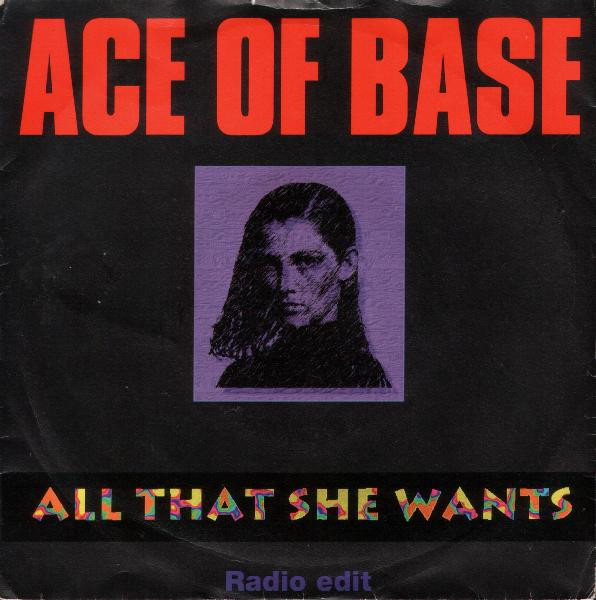
689. ‘All That She Wants’, by Ace of Base

Enter Sweden’s 3rd biggest-selling pop act… (Answers for 2nd place on a postcard… I’ll reveal it at the end of the post!)

All That She Wants, by Ace of Base (their 1st and only #1)

3 weeks, from 16th May – 6th June 1993

And in the grand Swedish tradition, it’s a male-female combo – two men, two women (though as far I can tell no marriages) – Ace of Base. With what I’ve always thought to be a deeply strange pop song.

There’s the sparse, ghostly intro, for example. And all the empty spaces in the song, where it’s just nothing more than a drum machine and a lumbering synth riff, and the low-key ending. It’s not your normal pop smash, even if it has more than a hint of dub-reggae – soon to be one of the dominant chart sounds – in the steady, hypnotic beat. And that’s before we dissect the lyrics…

All that she wants, Is another baby, She’s gone tomorrow boy… They tell the tale of a femme fatale, who prowls an unnamed beach looking for men… She’s the hunter, You’re the fox… And in that respect it’s great. Girl power! Fifteen years ago Brotherhood of Man told the story of a holiday resort lothario in ‘Figaro’, but Ace of Base flip it on its head. If it were sung by men it might be a bit cliched, but no. Go girls!

The problem I have with the lyrics is the fact that, as a kid, I took them literally. All that she wants, Is another baby… I thought she was wandering the beach looking for a man to get her pregnant. Which is weird, and I apologise; but having done some research I find I’m not alone. “As far as I can remember, ‘All That She Wants’ by Ace of Base is the only hit single ever to talk about a lady who uses men for stud service so that she can become an unwed mother,” said LA Weekly at the time. I like to think Ace of Base knew what they were doing, keeping the lyrics intentionally vague and menacing. Either way, I feel seen.
‘All That She Wants’ is definitely a grower. Even now, on my fourth or fifth listen, I’m remembering why it is such a good pop tune. I’m not sure what the hooks are – or perhaps it’s because there are so many it’s hard to pinpoint them – but it worms its way in and stays there. Just like Sweden’s biggest pop group, the one it’s impossible not to compare Ace of Base to… It’s not out of the question to imagine that, had ABBA been around in 1993, they might have been making records like this. And, like Agnetha and Frida, the girls here have similarly accented, idiosyncratic, but still very alluring, English.

This was only Ace of Base’s second chart hit, and what a hit. A number one across Europe, presumably unavoidable at beach bars from Faro to Faliraki in the summer of ’93, and a #2 in the US. It set them up for a run of Top 10s through the 1990s, including US #1 ‘The Sign’ and a cover of ‘Don’t Turn Around’, which Aswad had taken to the top in 1988. But permit me to give a shout out to my favourite Ace of Base tune, ‘Always Have, Always Will’, which takes everything you love about ABBA, Motown, sixties girl groups, and serves it up in pop perfection. Its #12 peak be damned!

This would be their only visit to the top of the charts, but they remain Sweden’s 3rd most successful act. ABBA are obviously the 1st, but what of the runners-up…? Well, it’s Roxette (another male-female act!), who never made it higher than #3 in the UK. Personally I’d have named garage rock loons The Hives as my second favourite Swedish act, but they’ve never come close to troubling the top of the charts.
670. ‘Black or White’, by Michael Jackson

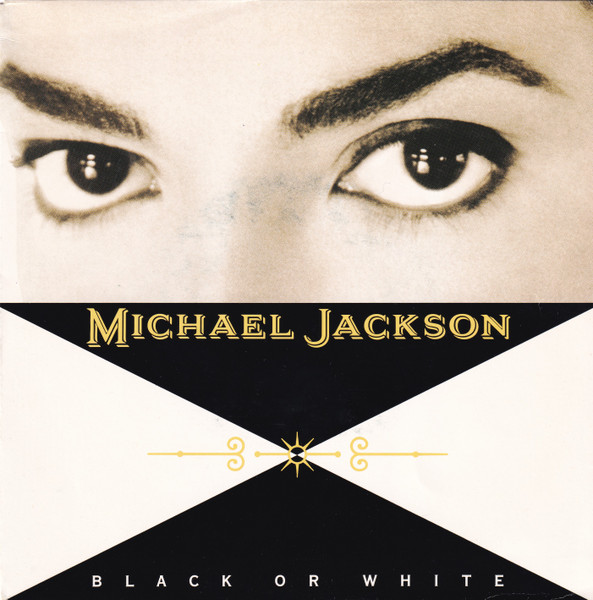
This next number one carries a lot of baggage: involving the singer, the video, the theme of the song… So much that it’s easy to forget that it’s actually quite a breezy pop tune, built around an actually quite cool riff. Compared to Michael Jackson’s big ‘80s hits – ‘Billie Jean’, ‘Bad’, ‘Smooth Criminal’ – it’s a lot more ‘pop’.

Black or White, by Michael Jackson (his 4th of seven #1s)

2 weeks, from 17th November – 1st December 1991

It’s also a very modern sounding song, moving from said pop, to rock, to rap, with a tribal drumbeat laid underneath, with effortless ease. By the middle of the decade it will be common for pop songs to incorporate a rapped verse, but this is one of the first chart-topping examples I can think of. The huge change in tone for the middle-eight sticks out like a sore thumb, but also somehow works too, and is our first glimpse into how this is more than just a nice pop song.

I ain’t scared of no sheets, I ain’t scared of nobody… Jackson spits (‘sheets’ referring to the white cloths of the KKK), and the rest of the song’s lyrics are similarly hard-hitting. Don’t tell me you agree with me, When I saw you kicking dirt in my eye… he sings, as the main riff kicks back in again. But the true classic line is kept for the rap: I’ve seen the bright getting duller, I’m not gonna spend my life bein’ a colour…

This being Michael Jackson, though, the message that it don’t matter if you’re black or white comes with a little extra baggage. Compared to the MJ that we saw in the video to his last UK #1 – 1987’s ‘I Just Can’t Stop Loving You’ – he looks a lot less… black. His nose, too, has changed beyond recognition. It would turn out to be a combination of plastic surgery, vitiligo and skin bleaching. In releasing a song called ‘Black or White’, you have to either marvel at Jackson’s confidence, knowing that he was going to invite comment and criticism, or suspect that he was becoming divorced from reality.

Still, he was the biggest pop star on the planet, and the music video premiered to the biggest audience ever. Like many of Jackson’s videos, it’s an eleven-minute piece of cinema. It opens in a suburban kid’s bedroom (the kid being child star du jour Macauley Culkin), before taking us on a tour of the world, as MJ dances with African tribesmen, Native Americans, Thai dancers and Cossacks before ending up on top of the Statue of Liberty. Nowadays you might label it as well-intentioned but clumsy. The most affecting part of the video is the simplest: the face shifting sequence, in which white men morph into black women into Asian men into white women.

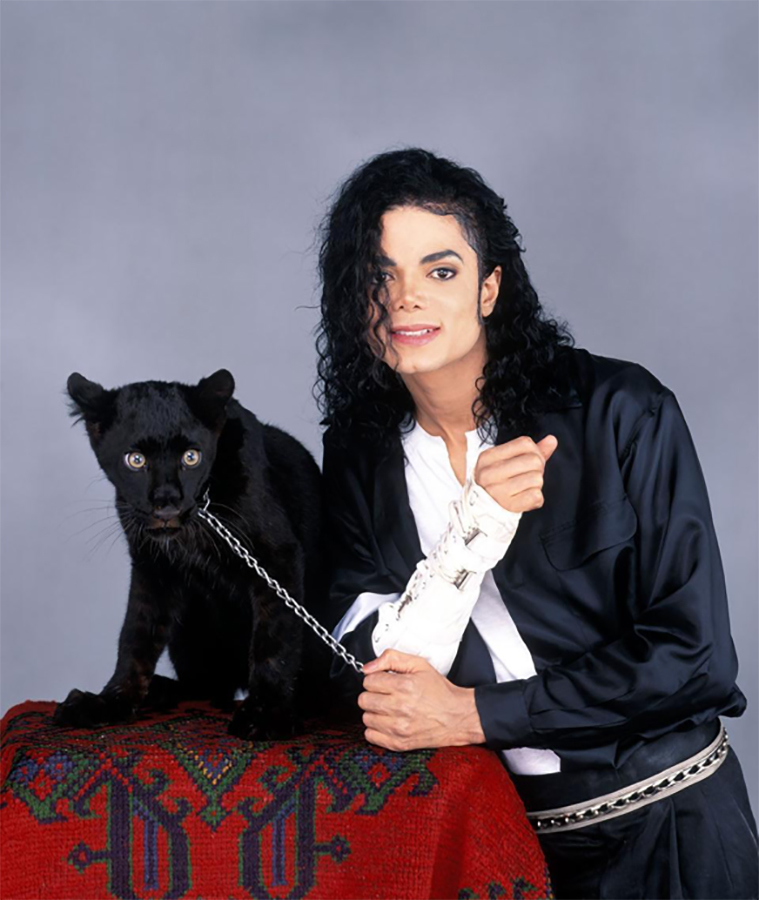
The song ends, but the video continues with a five minute long scene where Jackson morphs into a panther, then embarks on a vandalism rampage, smashing shop windows and car windscreens. He got criticism for this, and cut it from later screenings of the video. (Personally, I’d criticise it for being self-indulgent and pointless, rather than encouraging violence…) Years later he edited this section of the video so that he was smashing windows that had been spray painted with racist slogans to better explain his actions. Oh, yeah, and then the video actually ends by cutting to an episode of ‘The Simpsons’, in which Bart has just watched the video to Homer’s annoyance (handily harking back to Jackson’s alleged other #1 from earlier in the year).

It’s a complex beast, then, this single. On the one hand a breezy tune with a positive message, on the other a sign that the King of Pop might have been living up to the ‘Wacko’ nicknames. It was the lead single from ‘Dangerous’, his last truly great album (though one that still probably couldn’t quite live up to its 1980s predecessors). Despite that, the 1990s would end up being Jackson’s most successful decade of all for number one singles, with three more to come… And I’m going to spoil things by saying that ‘Black or White’ is probably the best.

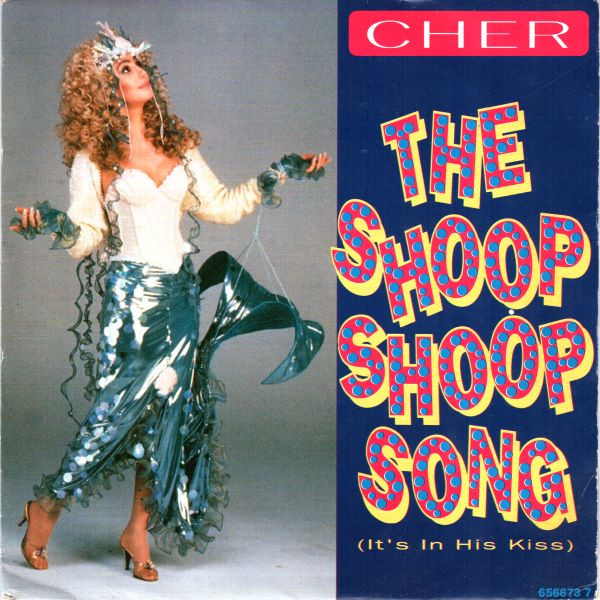
664. ‘The Shoop Shoop Song (It’s in His Kiss)’, by Cher

Twenty-six years after her first number one single, Cher finally claims her second. (That’s a record by the way, for longest gaps between chart-toppers, beating one set by The Righteous Brothers just a few months before. It would stand until the mid-‘00s, when Leo Sayer broke it. And it would stand as the record for a female act right through until 2022, when Kate Bush ran up that hill to #1.)

The Shoop Shoop Song (It’s in His Kiss), by Cher (her 2nd of four #1s)

5 weeks, from 28th April – 2nd June 1991

But we’re getting ahead of ourselves. A record breaker it may be, but what of the song? And why? Why, after all the ‘70s and ‘80s hits that Cher delivered, was it this camp and catchy cover of an old Betty Everett tune which brought her back to the top? It’s a pretty faithful cover, with lots of glossy production touches. It goes without saying that there’s more authenticity to the simple percussion used in Everett’s version; but there’s also something quite fun in the kitchen-sink approach taken to this cover. An approach typified by the way Cher over-sings pretty much every line, from the opening Does he love me? I wanna know! to the song’s most ridiculous moment: Oh no! That’s just his arms!

But she does it with such gusto, Cher in character as Cher, selling the impression that she was having a tonne of fun while singing it, and sweeping the listener along with her. It’s a mere notch above karaoke, but when Cher’s in this mood who cares? If I believed in the concept of ‘guilty pleasures’, then this would definitely be one of mine.

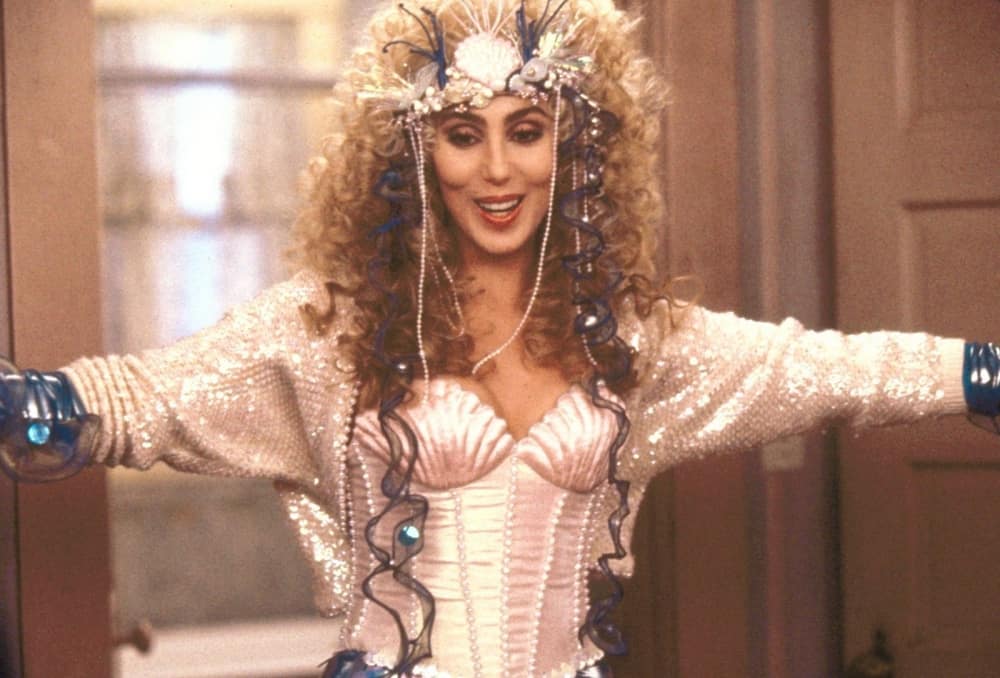
It was recorded for the soundtrack of the movie ‘Mermaids’, a film that seems pretty well-regarded but that – as with so many of these recent soundtrack hits’ origins – I have never seen. The video is cute, though, with Cher using the lyrics as a lesson to her two on-screen daughters, played by Winona Ryder and Christina Ricci.

As fun as this record is, I must admit myself surprised to find that this was Britain’s second highest-selling song of 1991. For a start, Cher was in her mid-forties when it made #1 – ancient in female chart-topping terms – while, for all its charms, it’s a fairly basic cover. Betty Everett’s original had only made #34 in the UK, though a disco version by Linda Lewis had gone Top 10 in 1975. Linda Ronstadt also had a habit of performing it live, on TV and in concert. Perhaps, then, it was the simple combo of a familiar favourite and the star power of Cherilyn Sarkisian. And the nineties would go on to be Cher’s best era by far for number one singles. She has two more to come, including one of the decade’s defining pop hits…

640. ‘Tears on My Pillow’, by Kylie Minogue

Kylie does Grease!

Tears on My Pillow, by Kylie Minogue (her 4th of seven #1s)

1 week, from 21st – 28th January 1990

Well, no. Kylie’s never done ‘Grease’ – though she’d have made a good Sandy – and ‘Tears on My Pillow’ only ever features in the background of the original movie. But this record certainly has that feel about it…

It’s the final UK #1 to be produced by Stock Aitken and Waterman… pause for a moment to cheer/sigh (delete as appropriate)… though you wouldn’t particularly know it. It’s a shame that they don’t bow out with a Hi-NRG banger, but the chart Gods can be cruel. Like Jason Donovan’s stab at the sixties on ‘Sealed With a Kiss’, this is nothing more than karaoke. At least the trio bow out with a big hit for their chief muse, the lovely Ms Minogue. And in the big ‘Jason Vs Kylie Retro Covers Contest’ there can be only one winner: this one, because it’s Kylie.

There has been a bit of a retro wave sweeping the charts over the final year of the ‘80s. There was Jive Bunny, of course, but also those sixties covers from Jason, and Marc Almond with Gene Pitney. ‘Tears on My Pillow’ had originally been a 1958 hit for Little Anthony & The Imperials – one which failed to chart in the UK but had made #4 in the US. (There has of course been a completely unrelated ‘Tears on My Pillow’ at #1 in the UK, for Johnny Nash in 1975. Off the top of my head, I think this is the second time two different songs with the same name have made #1, after ‘The Power of Love’…)

This was from the soundtrack to Kylie’s big-screen debut ‘The Delinquents’, a Romeo and Juliet-ish tale of teenage love in ‘50s Australia. Apparently the movie isn’t great, but it continues a trend of forgettable films accompanied by number one singles (‘Nothing’s Gonna Stop Us Now’, ‘When the Going Gets Tough’…) And it scored Kylie her fourth chart-topper in just under two years. Amazingly, this will be her sole nineties #1. A decade of fading chart fortunes, duets with Nick Cave, and a stab at something more alternative will keep her busy until a spectacular comeback in the early ‘00s. Still, she sneaks in, and in due course will join a select band of artists with #1s in three different decades.

If it feels like I’ve been padding this post out, blethering on about everything but the actual, largely forgettable, music then you’d be right. Let me pad it out a little more before finishing, then. Though I don’t remember this particular record, Kylie (and Jason) are pop ground zero for my generation: the first singers we remember from TV, from the playground, the first CDs we bought (more on that later…) The music may not have always been great, but this is nostalgic stuff for us older millennials. This rundown is suddenly getting quite real!

636. ‘You Got It (The Right Stuff)’, by New Kids on the Block

The 1990s, the decade that we are on the verge of entering, will mean many musical delights. Grunge, Britpop, blockbuster movie soundtracks, Girl Power, the Vengaboys… But you could argue that, ahead of everything, it will be the decade of the Boy Band ™

You Got It (The Right Stuff), by New Kids on the Block (their 1st of two #1s)

3 weeks, from 19th November – 10th December 1989

From beginning to end – literally, as the first and last #1s of the decade will be by a boyband – groups of three to five handsome young men in baggy jeans and backward-facing caps will dominate. Boyz II Men, Take That, Boyzone, Hanson, 5ive to name but a few. And all kicked off by five boys from Dorchester, Massachusetts.

Let’s take a moment, before we start dissecting this record properly, to thank the stars that it’s not a ballad. Wherever boybands go, a drippy love song is never far behind. But no, ‘You Got It (The Right Stuff)’ is a classic serving of late-80s R&B fused with hints of new jack swing. The drums ratatat, the synths swoosh, the bassline is actually pretty cool… It all sounds wonderfully dated. And, in true boyband fashion, the lyrics amount to some pretty nothings and some half-hearted innuendo. First kiss was a sweet was a kiss, Second kiss had a twist… What the ‘twist’ is, or indeed the ‘right stuff’ of the title, is never specified. It’s all dates and kisses, with one mildly risqué mention of being ‘turned on’.

The bridge is the most modern part of the record, a soaring template to be followed by every boyband to come. All that I needed was you, Oh girl, You’re so right… You can just picture the clenched fists as the Kids meet that line. And then there’s the hook in the chorus, the oh-oh-ohohohs that’s as catchy as it is annoying. The video – again, as was traditional for ‘90s boybands – sees them dressed like idiots, dancing like idiots, having a great time in a deserted bar. They then chase some girls around a graveyard, for reasons best left mysterious…

To suggest that New Kids on the Block (NKOTB if you’re in the know) were the first boyband is wrong. At the same time, defining a ‘boyband’ is like catching mist in a jar. If you go by the literal definition – boys in a band – then we’re going to go back to the Crickets, at least. If you insist on the manufactured aspect of it, then we start at the Monkees. But what of the Jacksons and the Osmonds? What of New Edition? Bros? (And I was only mentioning acts we’ve met earlier in this blog.)

Let’s say NKOTB are the first ‘modern’ boyband, then. They were managed by Maurice Starr (also the mastermind behind New Edition) and composed of four school friends led by Donnie Wahlberg (brother of actor Mark) and a younger boy, Joey McIntyre. Unlike some boybands, the path to success hadn’t been smooth for NKOTB: they’d been together since 1984 and were on the verge of being dropped by their label before ‘Please Don’t Go Girl’ made #10 in the US. ‘You Got It’ was the second single from their second album, and their first chart hit in the UK. They’d go on to have nine more Top 10 singles between 1989 and 1992, including one further #1 coming up very soon.

And so we enter the era of the (modern) boyband. And for a taster, ‘You Got It (The Right Stuff)’ is neither a classic of the genre, nor terrible. There are much better boyband chart-toppers to come, and much worse.

631. ‘You’ll Never Stop Me Loving You’, by Sonia

We’re fresh from a recap – a recap that I dubbed the ‘Stock Aitken Waterman Recap’ due to their domination of the past few months’ chart-toppers – and as we crack on with the next thirty those synthesised drumbeats can only mean one thing…

You’ll Never Stop Me Loving You, by Sonia (her 1st and only #1)

2 weeks, from 16th – 30th July 1989

Yes, they’re not done yet! The production team get their sixth (!) #1 of the year, while it’s only July. And while the Euro-disco beat and the tinny synths are by this point very familiar, I do sense that this is a step up from their previous #1s with Kylie and Jason, which were starting to feel phoned-in.

It’s got a cooler, dancier production to it, not the relentless, in-your-face cheese of ‘I Should Be So Lucky’ (though the verses do bear a resemblance), or ‘Never Gonna Give You Up’. Swap Sonia’s girl-next-door charms for a proper dance diva and this mightn’t have sounded out of place at the Hacienda. Listen to the eight minute extended mix, where there are long stretches in which the beat is left to do its thing and it starts to sound dangerously like a proper dance record.

‘You’ll Never Stop Me Loving You’ also has a great hook in the chorus: It doesn’t really matter what you put me through, You’ll never stop, Me from loving you… with a brilliant key-change tease on the ‘never stop’. It reminds me of the records SAW did with Donna Summer; though Sonia’s voice, as fine as it is, can’t quite compete with the Queen of Disco.

The only thing I can’t quite get behind is the caterwauling ‘solo’, in which the vocals are looped into something of a grating mess. Still, if the sign of a good pop song is that you’re singing along before the first play has finished then this is officially a good pop song (because I was). It was Sonia Evans’ debut single, reaching #1 when she was just eighteen. Between 1989 and 1993 she’d have eleven Top 30 hits, and even represent the UK at Eurovision, though none of her subsequent singles rose higher than #10.

And just like that, we reach the end of SAW’s golden age. They’re still on production duties for two upcoming #1s, but ‘You’ll Never Stop Me Loving You’ was the last chart-topper that they would write. They may well be a bye-word for late-eighties cheese but, while I have found some of their stuff slightly repetitive, their short burst of complete chart domination has been impressive. And when you see the act that’s about to dominate the second half of 1989, Stock Aitken and Waterman might not be such a terrible thing after all…

629. ‘Sealed With a Kiss’, by Jason Donovan

From an extremely harrowing chart-topper, to one as lightweight, as ephemeral, as they come…

Sealed With a Kiss, by Jason Donovan (his 3rd of four #1s)

2 weeks, from 4th – 18th June 1989

I am glad that I don’t have to ponder life, death and injustice as I listen to Jason Donovan’s take on ‘Sealed With a Kiss’. I don’t have to think much at all, for this is basically karaoke. Perfectly good karaoke, I mean that as no slight on the singing abilities of Mr Donovan, but it’s karaoke nonetheless. The production (Stock Aitken Waterman yet again, as was almost mandatory in 1989) is exactly what you would hear in a Japanese karaoke booth: a cheap replication of the early-sixties original.

It is an odd choice of cover for the hottest young pop star in the country. The melancholy chords, the tempo, and the tone of the song feel very out of step for the Hi-NRG late eighties. I suppose, though, it’s a current teen idol singing a former teen idol’s hit from nearly thirty years before (the song tells the story of two lovebirds separated for an agonisingly long summer) thereby appealing to both kids and their parents. Yet part of me wishes SAW had tarted the song up in their usual tinny Eurodisco dressing – that might have been quite fun. As it is, the song washes past almost unnoticed.

‘Sealed With a Kiss’ had been a #3 hit in 1962 for Brian Hyland, his biggest British record, as well as making #7 on re-release in the seventies. (Hyland’s breakthrough hit, ‘Itsy Bitsy Teenie Weenie Yellow Polka Dot Bikini’ will also soon be reappearing at the top of the charts, in truly traumatic fashion… I can’t wait!) This cover gave Donovan his 3rd #1 in under six months, which is some going. For me, though, it’s a step down from the classic (yes, classic) ‘Especially for You’ and the perfectly fine ‘Too Many Broken Hearts’.

It was also the 3rd SAW #1 in a row, and I’m not sure how many (if any) other producers have done that. Plus, it’s the second consecutive cover of a golden-oldie to make #1. And, even more interestingly for chart nerds like myself, it was the second chart-topper in a row to enter in top spot. That had only happened once before, in 1973. Pre-1990, entering at the top pretty much announced you as the biggest act in the country (or a charity single). As we move into the 1990s, songs are going to enter at the top of the charts more often, and the turnover of #1s is going to increase. The ‘90s are going to take a while to get through, that’s for sure…

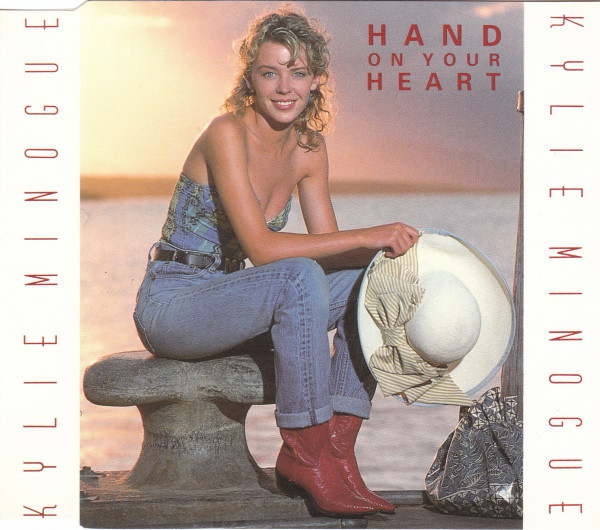
627. ‘Hand on Your Heart’, by Kylie Minogue

It’s only May, but here we are with the 3rd Stock Aitken Waterman #1 of the year (and there are still four more to come…)

Hand on Your Heart, by Kylie Minogue (her 3rd of seven #1s)

1 week, from 7th – 14th May 1989

And yes it’s SAW by numbers – it feels like they were getting lazier, or at least more complacent, by the hit – and for sure there are much better Kylie songs from the time that never made number one (‘Step Back in Time’ and ‘Better the Devil You Know’ spring instantly to mind) but, like Jason Donovan’s recent ‘Too Many Broken Hearts’, it’s hard to get very exercised by this, one way or the other.

It’s a pop song: relatively catchy and completely of its time. Not since the Merseybeat days of 1964, glam in ’73, or the height of disco in 1979, has one sound so dominated the British charts. I still think Kylie sounds a little strained: something about the pitch she’s singing in, and the speed of her delivery. By the time of her ‘comeback’ her voice had matured a lot, either through age or singing lessons.

There are flashes, though. The song takes the form of a stern lecture to her lover, demanding him to swear that they are through, and Kylie is at her best when she’s channelling her inner disco diva with the sultry Look me in the eye and tell me we are really through… and the snappy Why did we ever start? For the rest of the song, though, you can’t escape the feeling that both she and the production team are going through the motions. (Though it’s worth noting that at the same time as this was making #1, SAW were also releasing some of their best work with Donna Summer, and we can quietly imagine a parallel universe where ‘This Time I Know It’s for Real’ was the big chart-topping smash ahead of ‘Hand on Your Heart’.)

And… I’m not sure I can think of much more to say here. Apparently this was one of the first singles to sell well as a cassette, and would have had two weeks at #1 if there hadn’t been a problem with its pricing… But even I’m struggling to find that particularly interesting. Both the Kylie and the SAW bubbles will burst as the 1980s become the 1990s, but not quite yet. They’ll both be featuring again in this blog before long… In fact, Stock Aitken and Waterman will also helm the next #1, in very tragic circumstances.

625. ‘Like a Prayer’, by Madonna

And so we arrive at the biggest female pop star du jour, with her first big comeback. Setting herself up, in the process, to polarise and provoke throughout the 1990s and beyond…

Like a Prayer, by Madonna (her 6th of thirteen #1s)

3 weeks, from 19th March – 9th April 1989

It had been a couple of years without any new music from Madonna. In modern terms that’s a pretty normal, even fairly short, break (cf. Rihanna). But since the dawn of pop, stars had been expected to churn out several hits a year. That’s just one way in which this comeback monster hit feels like a game-changer: Madonna’s in charge from now on, setting her own schedule.

After an attention-grabbing guitar intro, a door slams shut. Life is a mystery, Everyone must stand alone, I hear you call my name, And it feels like home… Is she talking about God, or a boy? Or is God the boy? In comes the beat, and to be honest it’s quite predictable late-80s production: dance-pop synths with a squelchy bass. It’s catchy, it’s got a great hook, it would have been a big hit even without…

The video. Madonna cavorting with Jesus. Black Jesus. Burning crosses. Sexual Assault. A wrongful imprisonment. Racism… I’m not 100% sure what Madonna was going for, other than a checklist of things she knew would piss certain people off, but it did the job. The Catholic Church was up in arms, Pepsi (who used the song in an advert) was boycotted, MTV was the only TV channel to show the video… And of course it was a global smash hit.

From this distance, the controversy seems out of proportion: Madonna and Jesus barely kiss, while in the end she does the right thing and goes to the police… And the lyrics aren’t that outrageous either. Sure there’s a bit of innuendo – I’m down on my knees, I wanna take you there… – but ‘love as a religious experience’ is not exactly a new and shocking theme. And yet, as the recent Sam Smith controversy has shown, certain types are always poised and ready to get worked up over a music video.

‘Like a Prayer’ peaks for me when the gospel choir take over. And I don’t mean that as a slight on Madonna’s voice, as this is one of her better vocal performances. But it’s a bit too long as ‘just’ a song, without the video to distract. I wouldn’t have this in my Top 5 Madonna songs, personally. Whether that’s harsh, or testament to the strength of her long career, I’m not sure. I’d also put ‘Papa Don’t Preach’, and ‘Like a Virgin’, above it in the attention-grabbing stakes.

But there’s no denying this song’s reach and impact. I described it above as a ‘game changer’ in terms of inventing the idea of the pop star ‘comeback’ single. Then there’s the statement video. And the creative control that Madonna was clearly exercising. There’s a clear line from Madonna to pretty much every female pop star since: Christina, Britney, Gaga, Taylor Swift have all had their big statement pieces, their ‘I’m in control now’ moments. Is it too much to suggest then, that ‘Like a Prayer’ was the moment that the modern female pop star was born?

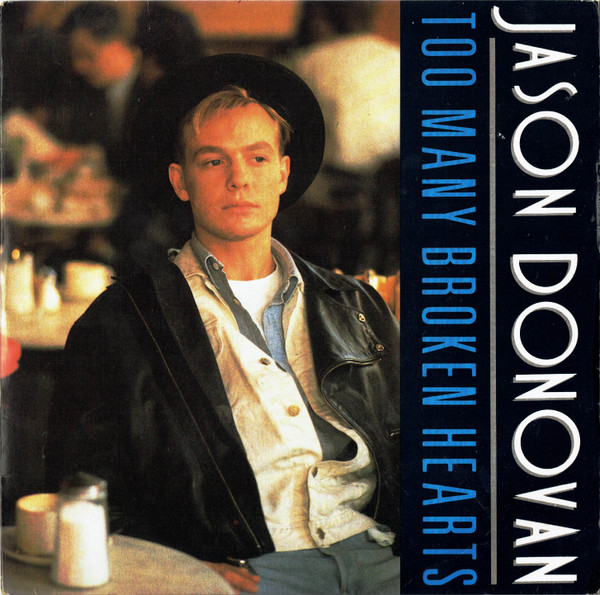
624. ‘Too Many Broken Hearts’, by Jason Donovan

After a very weighty number one, a seven-minute treatise on political violence in Ireland, we arrive at something a little lighter…

Too Many Broken Hearts, by Jason Donovan (his 2nd of four #1s)

2 weeks, from 5th – 19th March 1989

I do like the way we get teased at the start, as hard-edged guitars chime out – does anyone else hear the intro to ‘Welcome to the Jungle’?? But before we even have time to check that, yes, this is a Jason Donovan record, in comes the oh-so-familiar Stock Aitken Waterman beat. Of course.

Has there ever been a mashup of all the famous SAW hits…? They are all the same basic beat and tempo. Well in fact, yes, YouTube is your friend. There’s an eight minute mash-up of Kylie, Rick Astley, Bananarama, Sinitta and Sonia which I have to admit I enjoyed. (There’s a near twenty-minute long Part II, which I haven’t braved yet!)

What to make of Jason Donovan not making the cut for this mix? Was he not A-grade material? I can’t see a reason why this is any worse than the earlier SAW #1s, apart perhaps for SAW Fatigue (I think that ‘SAW Fatigue’ will be the catchphrase of our journey through 1989…) It’s perky, it’s catchy, the chorus is cheesy but it stays with you. The bridge is the best bit: You give me one good reason to leave me, I’ll give you ten good reasons to stay… Although, Pete Waterman claimed that he wrote it in ten minutes while on the toilet, so there’s that mental image…

The video is equally cheap and cheerful. Jason stares out from his log cabin, chops some wood, then strolls along a cliff top while strumming his guitar. His electric guitar. Maybe Slash took notes before filming the ‘November Rain’ video? (I was not expecting to make two Guns N Roses references in this post!)

The only thing I find that grates is Jason’s voice itself… He sounds a little strained, a little rushed. I think I said the same thing about Kylie’s ‘I Should Be So Lucky’, so perhaps it’s the production not getting the best out of its singers? Anyway, I can never get too exercised, in one way or the other, about disposable pop. The charts’ bread and butter. It’s a pop song. It’s catchy. It provides a reasonably pleasant diversion for three minutes of our largely humdrum existences. Next!