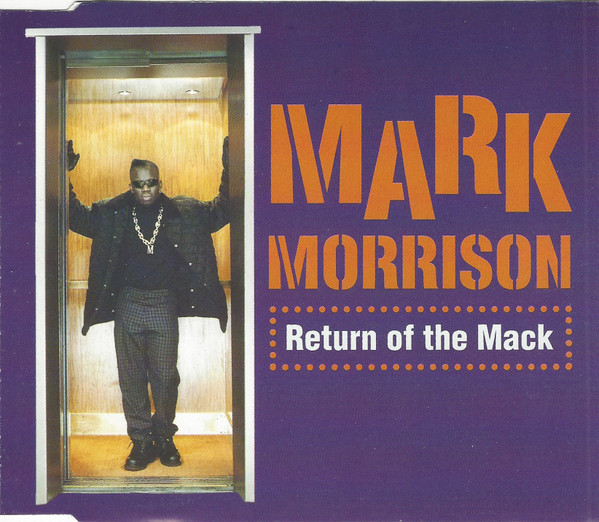
737. ‘Return of the Mack’, by Mark Morrison

I did say, a post or two ago, that we were hitting a golden vein of chart-toppers. In fact, Take That’s feeble swansong aside, 1996 has already been a vast improvement on the year before, and we’re only in April…

Return of the Mack, by Mark Morrison (his 1st and only #1)

2 weeks, from 14th – 28th April 1996

‘Return of the Mack’ is completely different from our last number one – the Prodigy’s searing ‘Firestarter’ – but it’s every bit as catchy. It’s slick, very mid-nineties R&B; but I don’t mean slick in a boring way. More in a supremely confident, honeyed, knows exactly what it’s doing sort of way.

You could easily believe that this was being sung by a US soul superstar, a Boyz II Men-Bobby Brown hybrid of some sort, apart from one detail: it’s actually quite fun, and doesn’t take itself too seriously. A lot of US R&B at this time was spotlessly honed to the point of being completely transparent and unmemorable. We had a taster of it when Michael Jackson’s ‘You Are Not Alone’ was at #1, but thankfully this sound never dominated the British charts like it did the Billboard.

I assume that the ‘Mack’ in the chorus is supposed to be Mark Morrison himself, and this self-referencing adds another layer of braggadocio to what is already a swaggering tune. He’s back, feeling better than ever, and ready to lord it over his ex… So I’m back up in the game, Running things to keep my swing, Letting all the people know, That I’m back to run the show… It’s not harsh to suggest that Morrison has a unique singing voice – high-pitched and nasal – and the way he enunciates certain words, like ‘swing’, adds another hook to the record.

We’re getting deep into the pop stars of my childhood now, and two things I remember about Mark Morrison were his very cool slanted mohawk hairdo, and the fact that ‘Return of the Mack’ was about his release from jail. Except, my mind is playing tricks on me… Morrison did do jailtime, for the always inadvisable crime of trying to take a gun onto an aeroplane, but not until a year after ‘Return of the Mack’ made number one.

Although he was released from his three month stretch just as the song started to climb the US charts, eventually settling at an impressive #2, so I wasn’t completely wrong. The fact that this up-tempo R&B did so well in the land of down-tempo R&B suggests that even Americans might have been growing weary of all the syrupy ballads. It was the first of an impressive five Top 10 UK hits from the one album (though, in the States, Morrison remains a one-hit wonder).

Gun-toting on aircraft wasn’t Morrison’s only brush with the law, and he’s also been in trouble for affray, assault, driving without a licence, suspected kidnapping, and for paying a lookalike to do his community service. An eventful life, then, though he has remained active in the music industry throughout. More recently, he seems to have been rediscovered by modern rap and R&B stars, being sampled by Chris Brown and working with Post Malone.

724. ‘Never Forget’, by Take That

For many, Take That peaked with ‘Back for Good’, their sixth and best-loved number one single. Where to go from there, then? Back to decent-but-unremarkable pop, such as ‘Sure’? Or do they get Jim Steinman, a kids’ choir, and a sample from Verdi’s ‘Requiem’, and throw together an extravagantly OTT remake of a track from their most recent album?

Never Forget, by Take That (their 7th of twelve #1s)

3 weeks, from 30th July – 20th August 1995

I’m sure you already know, but it was the latter. Trumpets of the type usually reserved for announcing royalty herald this next chart-topper. Angelic children’s voices telling us that we’ve come so far, and we’ve reached so high… Depending how you score on the Barlow-tolerance meter, this is either further evidence that Take That were not just another boyband… Or the sound of them, and their songwriter-in-chief, disappearing up their collective arses.

When all the choirs and the Verdi are done, and the song slips into a bog-standard mid-nineties soul-pop beat, it’s a little disappointing. Much of this song’s near seven-minute runtime is fairly mundane, but nobody remembers that. They remember the soaring chorus (that takes well over two minutes to arrive) and the extended fade-out, rather than the dull verses.

It’s now a standard boyband cliché: the song about how fame hasn’t changed them, or how fame isn’t everything it’s cracked up to be. This record might be where that trope stems from, as Howard Donald (on rare lead-vocal duty) announces weighty lyrics like We’ve had success, We’ve had good times, But remember this… while a slideshow of pictures from their childhoods plays in the video, interspersed with clips of them winning awards and generally being adored.

Again, if you have a cynical little mind (like I do) you could see this entire project as a massive humblebrag. My mind starts to wondering if Robbie left before or after ‘Never Forget’, as his voice is nowhere to be heard. But then he appears, eventually, to throw some ad-libs around in the long fade-out. Perhaps his diminished role is a clue as to why he did finally quit the band, post-recording but before ‘Never Forget’ was released. He’s had a fairly small role in all but one of their #1s (‘Everything Changes’), with nothing to suggest that he was going to be the huge solo star that he is.

I do like aspects of this single, just in case I’ve sounded too down on it. The sheer scale of it, the Jim Steinman-isation of it. The chorus is one of their very best, too. But by the six minute mark I’ve had my fill, and there’s a false ending that really tests the patience. Still, it was a huge hit – of course it was – and their seventh chart-topper in just two years. Yet it was the beginning of the end. Robbie had left, no further singles were released from the album, and there’s only a fairly limp Bee Gees cover to come before Britain’s biggest boyband are laid to rest. For a bit, anyway.

704. ‘Everything Changes’, by Take That

For their fourth #1 in nine months, Take That once again take turns at lead-vocal duty. We’ve had two Garys, one from Mark, and now a Robbie…

Everything Changes, by Take That (their 4th of twelve #1s)

2 weeks, from 3rd – 17th April 1994

Which gives a fairly throwaway pop song, a chart-topper more because of the band singing it than because of any innate quality the song might have, some significance. For here is the voice of the biggest British star of the coming decade… Though you might not have realised it at first, given the strange American accent he puts on for the album version’s intro…

On the single edit that bit is cut out, and we are rushed straight into another disco-tinged piece of retro-pop; the skinnier, sickly brother of ‘Relight My Fire’. I did wonder if ‘Everything Changes’ might have been a cover, as nobody under the age of sixty has ever used the term ‘taxicab’, but no – it’s a Gary Barlow (plus guests) writing credit. I guess they just needed the extra syllable to make it scan…

It’s perfectly serviceable pop. There’s nothing wrong with it (if we overlook the dated sax solo…) but neither is there much particularly memorable about it, apart perhaps from the for-ev-er… hook. There’s a reason why it was the fifth and final single from the band’s second album. There’s also a reason why it still made number one for a fortnight despite everyone already owning a copy of said album: Take That were bloody huge by this point.

While it might not have been his first lead vocals on a Take That single (I have little inclination to go back through their discography and check) it was definitely Robbie Williams’ first lead vocals on a #1. On their previous three, he very much took a back-seat. It felt strange to see him dancing gamely behind Barlow and Owen, knowing that he would go on to be bigger than any of them. But then, at the time, his departure was unexpected, and nobody would have bet on him having the success that he did.

Anyway, we’re getting ahead of ourselves. They’ve got a few more hits, and a few more chart-toppers, before he strikes out alone. And of the Take That #1s that have gone before, I’m starting to think I was a bit harsh on ‘Pray’… It’s head and shoulders above their other chart-toppers so far – as fun as ‘Relight My Fire’ was, and as strange as ‘Babe’ was. Quite possibly one of their very best…?

696. ‘Relight My Fire’, by Take That ft. Lulu

In their early years, in amongst the Hi-NRG pop and the ballads, Take That had made a habit of popping out covers of 1970s golden-oldies. A version of Tavares’s ‘It Only Takes a Minute’ had brought them to the Top 10 for the first time, while a pumped up take on Barry Manilow’s ‘Could It Be Magic’ gave them their first Top 5 hit.

Relight My Fire, by Take That (their 2nd of twelve #1s) ft. Lulu (her 1st and only #1)

2 weeks, from 3rd – 17th October 1993

‘Relight My Fire’, their second number one, was the pinnacle of their cover version days, and the final one before their ascent to superstardom. And it’s a perfectly fine piece of pop: complete cheese – though a nice camembert rather than plastic cheddar – and completely undeniable. It’s the ultimate soundtrack to Saturday evening family TV, to a kid’s birthday party at a Charlie Chalk’s, to a Butlin’s disco…

They don’t do anything clever with it, updating the disco beat and percussion for something more post-SAW, but otherwise keeping sensibly close to the Dan Hartman original. An original which hadn’t been a very big hit in the UK. I assumed it must have been a hit of some sort, as it just sounds so very ‘peak’ disco, but no. In the US, it had topped the Billboard Dance Chart for six weeks in late 1979; but in Britain people may not have been aware of it. (The female vocalist on the original was Loleatta Holloway, who we last heard being similarly uncredited on Black Box’s ‘Ride on Time’, while Hartman sadly died just a few months after this cover became a hit.)

I say Take That don’t do anything clever with their version of the tune, but actually… Roping in none other than Scottish pocket-rocket Lulu to belt out the Loleatta verse provided a clever bit of cross-generational appeal. And belt it out she does, as her rasping You gotta be strong enough to walk on through the night… is a clear highlight. She grasps with both hands this gold-plated chance at a chart comeback, also making sure she isn’t overshadowed by these young whippersnappers (though, amazingly, she was only forty-five when this made #1…)

It gave Lulu her first chart-topper a full twenty-nine years after her chart debut with ‘Shout’ – a record at the time. She had recently released her first album in eleven years, and this was her first Top 10 in almost twenty (not counting a re-release of ‘Shout’ in the ‘80s). But just as importantly as relaunching Lulu’s career, it announced to the world that Take That weren’t just teeny boppers aimed at twelve-year-olds. They were looking to become Britain’s foremost pop group, one that appealed to your mum, your granny, and your gay uncle (note Mark Owen’s crop top in the video, as well as Jason/Howard’s – who can tell them apart? – leather chaps…)

Come the end of the decade, all the boyband imitators that Take That had spawned would be trying the same thing. Off the top of my head, I can remember seventies covers from Boyzone, Westlife and 911 all doing very well in the charts, and I’m sure there were more. It’s songs like this which mean Take That are still filling stadiums across the country, thirty years on, with people of all ages looking for nothing more than a good night out. It’s easy to sniff (and sniff I do), but few do it better.

692. ‘Pray’, by Take That

Here we go then…

If we’re being reductionists, we can distil the entire 1990s down to four chart-topping acts. Oasis, of course, and Blur. The Spice Girls. And Take That. And of the four, it’s the boy band who make it to number one first. Can we finally declare that the nineties, after many a false start, begin now…?

Pray, by Take That (their 1st of twelve #1s)

4 weeks, from 11th July – 8th August 1993

This record actually sounds quite cool – a new-jack swing beat and some edgy horn samples – until the voice comes in. Gary Barlow. Was he ever cool? I’d assumed he must have been, because he was young and in a hot new boyband. But even here, in his prime, he looks like the annoyingly well-behaved cousin that your mum insists on comparing you to… Why can’t you start a hugely successful boyband like Gary…? I mean, who’s he fooling, in the video, writhing around on the beach with his shirt hanging open.

Anyway, this isn’t the time to launch head first into my feelings on Gary Barlow (we can save that for his ill-fated solo career). He may sing lead here, but there are four other boys involved. And, to be fair, they all do their share of topless writhing in the video: on the beach, in the surf, in a fountain, entwined in the fronds of a banyan tree. On the one hand it’s quite arty; on the other it’s completely gratuitous.

The song itself is a funny mix. It treads a similar path to the Gabrielle hit that came before it: the verses are slow, wordy, and strangely lacking in hooks, considering that this is a pop song aimed at teenage girls. Barlow has always had ambition, writing songs that go above and beyond what you’d expect from his genre. He’s also always had the annoying habit of pulling a great chorus out of his arse. Just in time it comes racing in… Before I even close my eyes… All I do each night is pray…

We’ve had a few American boybands warming up the number one slot before this, in the shape of NKOTB, Color Me Badd, and Boyz II Men. But in the UK at least, Take That are the boyband of the decade. Perhaps of all time (1 Direction might have something to say about that, but I can’t bring myself to check the actual sales figures…) Either way, we’re going to be hearing an awful – interpret that word however you wish – lot of them in the coming posts.

And although they are the boyband of the decade, ‘Pray’ isn’t one of their hits that has been played to death. Which means that it’s actually fine to hear this again, and to enjoy the moments that soar past the sludgy verses. Take That had had quite a slow rise to the top, compared to some other pop acts. Their first release, the Hi-NRG ‘Do What U Like’ made #82 in the summer of 1991, and they slowly shed the pop-dance, scored hits with covers of Tavares and Barry Manilow, and went a bit more sophisticated. Once ‘Pray’ made #1, the rest was history. Though few at the time could have imagined that their chart-topping career would span almost two decades…

689. ‘All That She Wants’, by Ace of Base

Enter Sweden’s 3rd biggest-selling pop act… (Answers for 2nd place on a postcard… I’ll reveal it at the end of the post!)

All That She Wants, by Ace of Base (their 1st and only #1)

3 weeks, from 16th May – 6th June 1993

And in the grand Swedish tradition, it’s a male-female combo – two men, two women (though as far I can tell no marriages) – Ace of Base. With what I’ve always thought to be a deeply strange pop song.

There’s the sparse, ghostly intro, for example. And all the empty spaces in the song, where it’s just nothing more than a drum machine and a lumbering synth riff, and the low-key ending. It’s not your normal pop smash, even if it has more than a hint of dub-reggae – soon to be one of the dominant chart sounds – in the steady, hypnotic beat. And that’s before we dissect the lyrics…

All that she wants, Is another baby, She’s gone tomorrow boy… They tell the tale of a femme fatale, who prowls an unnamed beach looking for men… She’s the hunter, You’re the fox… And in that respect it’s great. Girl power! Fifteen years ago Brotherhood of Man told the story of a holiday resort lothario in ‘Figaro’, but Ace of Base flip it on its head. If it were sung by men it might be a bit cliched, but no. Go girls!

The problem I have with the lyrics is the fact that, as a kid, I took them literally. All that she wants, Is another baby… I thought she was wandering the beach looking for a man to get her pregnant. Which is weird, and I apologise; but having done some research I find I’m not alone. “As far as I can remember, ‘All That She Wants’ by Ace of Base is the only hit single ever to talk about a lady who uses men for stud service so that she can become an unwed mother,” said LA Weekly at the time. I like to think Ace of Base knew what they were doing, keeping the lyrics intentionally vague and menacing. Either way, I feel seen.

‘All That She Wants’ is definitely a grower. Even now, on my fourth or fifth listen, I’m remembering why it is such a good pop tune. I’m not sure what the hooks are – or perhaps it’s because there are so many it’s hard to pinpoint them – but it worms its way in and stays there. Just like Sweden’s biggest pop group, the one it’s impossible not to compare Ace of Base to… It’s not out of the question to imagine that, had ABBA been around in 1993, they might have been making records like this. And, like Agnetha and Frida, the girls here have similarly accented, idiosyncratic, but still very alluring, English.

This was only Ace of Base’s second chart hit, and what a hit. A number one across Europe, presumably unavoidable at beach bars from Faro to Faliraki in the summer of ’93, and a #2 in the US. It set them up for a run of Top 10s through the 1990s, including US #1 ‘The Sign’ and a cover of ‘Don’t Turn Around’, which Aswad had taken to the top in 1988. But permit me to give a shout out to my favourite Ace of Base tune, ‘Always Have, Always Will’, which takes everything you love about ABBA, Motown, sixties girl groups, and serves it up in pop perfection. Its #12 peak be damned!

This would be their only visit to the top of the charts, but they remain Sweden’s 3rd most successful act. ABBA are obviously the 1st, but what of the runners-up…? Well, it’s Roxette (another male-female act!), who never made it higher than #3 in the UK. Personally I’d have named garage rock loons The Hives as my second favourite Swedish act, but they’ve never come close to troubling the top of the charts.

670. ‘Black or White’, by Michael Jackson

This next number one carries a lot of baggage: involving the singer, the video, the theme of the song… So much that it’s easy to forget that it’s actually quite a breezy pop tune, built around an actually quite cool riff. Compared to Michael Jackson’s big ‘80s hits – ‘Billie Jean’, ‘Bad’, ‘Smooth Criminal’ – it’s a lot more ‘pop’.

Black or White, by Michael Jackson (his 4th of seven #1s)

2 weeks, from 17th November – 1st December 1991

It’s also a very modern sounding song, moving from said pop, to rock, to rap, with a tribal drumbeat laid underneath, with effortless ease. By the middle of the decade it will be common for pop songs to incorporate a rapped verse, but this is one of the first chart-topping examples I can think of. The huge change in tone for the middle-eight sticks out like a sore thumb, but also somehow works too, and is our first glimpse into how this is more than just a nice pop song.

I ain’t scared of no sheets, I ain’t scared of nobody… Jackson spits (‘sheets’ referring to the white cloths of the KKK), and the rest of the song’s lyrics are similarly hard-hitting. Don’t tell me you agree with me, When I saw you kicking dirt in my eye… he sings, as the main riff kicks back in again. But the true classic line is kept for the rap: I’ve seen the bright getting duller, I’m not gonna spend my life bein’ a colour…

This being Michael Jackson, though, the message that it don’t matter if you’re black or white comes with a little extra baggage. Compared to the MJ that we saw in the video to his last UK #1 – 1987’s ‘I Just Can’t Stop Loving You’ – he looks a lot less… black. His nose, too, has changed beyond recognition. It would turn out to be a combination of plastic surgery, vitiligo and skin bleaching. In releasing a song called ‘Black or White’, you have to either marvel at Jackson’s confidence, knowing that he was going to invite comment and criticism, or suspect that he was becoming divorced from reality.

Still, he was the biggest pop star on the planet, and the music video premiered to the biggest audience ever. Like many of Jackson’s videos, it’s an eleven-minute piece of cinema. It opens in a suburban kid’s bedroom (the kid being child star du jour Macauley Culkin), before taking us on a tour of the world, as MJ dances with African tribesmen, Native Americans, Thai dancers and Cossacks before ending up on top of the Statue of Liberty. Nowadays you might label it as well-intentioned but clumsy. The most affecting part of the video is the simplest: the face shifting sequence, in which white men morph into black women into Asian men into white women.

The song ends, but the video continues with a five minute long scene where Jackson morphs into a panther, then embarks on a vandalism rampage, smashing shop windows and car windscreens. He got criticism for this, and cut it from later screenings of the video. (Personally, I’d criticise it for being self-indulgent and pointless, rather than encouraging violence…) Years later he edited this section of the video so that he was smashing windows that had been spray painted with racist slogans to better explain his actions. Oh, yeah, and then the video actually ends by cutting to an episode of ‘The Simpsons’, in which Bart has just watched the video to Homer’s annoyance (handily harking back to Jackson’s alleged other #1 from earlier in the year).

It’s a complex beast, then, this single. On the one hand a breezy tune with a positive message, on the other a sign that the King of Pop might have been living up to the ‘Wacko’ nicknames. It was the lead single from ‘Dangerous’, his last truly great album (though one that still probably couldn’t quite live up to its 1980s predecessors). Despite that, the 1990s would end up being Jackson’s most successful decade of all for number one singles, with three more to come… And I’m going to spoil things by saying that ‘Black or White’ is probably the best.

664. ‘The Shoop Shoop Song (It’s in His Kiss)’, by Cher

Twenty-six years after her first number one single, Cher finally claims her second. (That’s a record by the way, for longest gaps between chart-toppers, beating one set by The Righteous Brothers just a few months before. It would stand until the mid-‘00s, when Leo Sayer broke it. And it would stand as the record for a female act right through until 2022, when Kate Bush ran up that hill to #1.)

The Shoop Shoop Song (It’s in His Kiss), by Cher (her 2nd of four #1s)

5 weeks, from 28th April – 2nd June 1991

But we’re getting ahead of ourselves. A record breaker it may be, but what of the song? And why? Why, after all the ‘70s and ‘80s hits that Cher delivered, was it this camp and catchy cover of an old Betty Everett tune which brought her back to the top? It’s a pretty faithful cover, with lots of glossy production touches. It goes without saying that there’s more authenticity to the simple percussion used in Everett’s version; but there’s also something quite fun in the kitchen-sink approach taken to this cover. An approach typified by the way Cher over-sings pretty much every line, from the opening Does he love me? I wanna know! to the song’s most ridiculous moment: Oh no! That’s just his arms!

But she does it with such gusto, Cher in character as Cher, selling the impression that she was having a tonne of fun while singing it, and sweeping the listener along with her. It’s a mere notch above karaoke, but when Cher’s in this mood who cares? If I believed in the concept of ‘guilty pleasures’, then this would definitely be one of mine.

It was recorded for the soundtrack of the movie ‘Mermaids’, a film that seems pretty well-regarded but that – as with so many of these recent soundtrack hits’ origins – I have never seen. The video is cute, though, with Cher using the lyrics as a lesson to her two on-screen daughters, played by Winona Ryder and Christina Ricci.

As fun as this record is, I must admit myself surprised to find that this was Britain’s second highest-selling song of 1991. For a start, Cher was in her mid-forties when it made #1 – ancient in female chart-topping terms – while, for all its charms, it’s a fairly basic cover. Betty Everett’s original had only made #34 in the UK, though a disco version by Linda Lewis had gone Top 10 in 1975. Linda Ronstadt also had a habit of performing it live, on TV and in concert. Perhaps, then, it was the simple combo of a familiar favourite and the star power of Cherilyn Sarkisian. And the nineties would go on to be Cher’s best era by far for number one singles. She has two more to come, including one of the decade’s defining pop hits…

640. ‘Tears on My Pillow’, by Kylie Minogue

Kylie does Grease!

Tears on My Pillow, by Kylie Minogue (her 4th of seven #1s)

1 week, from 21st – 28th January 1990

Well, no. Kylie’s never done ‘Grease’ – though she’d have made a good Sandy – and ‘Tears on My Pillow’ only ever features in the background of the original movie. But this record certainly has that feel about it…

It’s the final UK #1 to be produced by Stock Aitken and Waterman… pause for a moment to cheer/sigh (delete as appropriate)… though you wouldn’t particularly know it. It’s a shame that they don’t bow out with a Hi-NRG banger, but the chart Gods can be cruel. Like Jason Donovan’s stab at the sixties on ‘Sealed With a Kiss’, this is nothing more than karaoke. At least the trio bow out with a big hit for their chief muse, the lovely Ms Minogue. And in the big ‘Jason Vs Kylie Retro Covers Contest’ there can be only one winner: this one, because it’s Kylie.

There has been a bit of a retro wave sweeping the charts over the final year of the ‘80s. There was Jive Bunny, of course, but also those sixties covers from Jason, and Marc Almond with Gene Pitney. ‘Tears on My Pillow’ had originally been a 1958 hit for Little Anthony & The Imperials – one which failed to chart in the UK but had made #4 in the US. (There has of course been a completely unrelated ‘Tears on My Pillow’ at #1 in the UK, for Johnny Nash in 1975. Off the top of my head, I think this is the second time two different songs with the same name have made #1, after ‘The Power of Love’…)

This was from the soundtrack to Kylie’s big-screen debut ‘The Delinquents’, a Romeo and Juliet-ish tale of teenage love in ‘50s Australia. Apparently the movie isn’t great, but it continues a trend of forgettable films accompanied by number one singles (‘Nothing’s Gonna Stop Us Now’, ‘When the Going Gets Tough’…) And it scored Kylie her fourth chart-topper in just under two years. Amazingly, this will be her sole nineties #1. A decade of fading chart fortunes, duets with Nick Cave, and a stab at something more alternative will keep her busy until a spectacular comeback in the early ‘00s. Still, she sneaks in, and in due course will join a select band of artists with #1s in three different decades.

If it feels like I’ve been padding this post out, blethering on about everything but the actual, largely forgettable, music then you’d be right. Let me pad it out a little more before finishing, then. Though I don’t remember this particular record, Kylie (and Jason) are pop ground zero for my generation: the first singers we remember from TV, from the playground, the first CDs we bought (more on that later…) The music may not have always been great, but this is nostalgic stuff for us older millennials. This rundown is suddenly getting quite real!

636. ‘You Got It (The Right Stuff)’, by New Kids on the Block

The 1990s, the decade that we are on the verge of entering, will mean many musical delights. Grunge, Britpop, blockbuster movie soundtracks, Girl Power, the Vengaboys… But you could argue that, ahead of everything, it will be the decade of the Boy Band ™

You Got It (The Right Stuff), by New Kids on the Block (their 1st of two #1s)

3 weeks, from 19th November – 10th December 1989

From beginning to end – literally, as the first and last #1s of the decade will be by a boyband – groups of three to five handsome young men in baggy jeans and backward-facing caps will dominate. Boyz II Men, Take That, Boyzone, Hanson, 5ive to name but a few. And all kicked off by five boys from Dorchester, Massachusetts.

Let’s take a moment, before we start dissecting this record properly, to thank the stars that it’s not a ballad. Wherever boybands go, a drippy love song is never far behind. But no, ‘You Got It (The Right Stuff)’ is a classic serving of late-80s R&B fused with hints of new jack swing. The drums ratatat, the synths swoosh, the bassline is actually pretty cool… It all sounds wonderfully dated. And, in true boyband fashion, the lyrics amount to some pretty nothings and some half-hearted innuendo. First kiss was a sweet was a kiss, Second kiss had a twist… What the ‘twist’ is, or indeed the ‘right stuff’ of the title, is never specified. It’s all dates and kisses, with one mildly risqué mention of being ‘turned on’.

The bridge is the most modern part of the record, a soaring template to be followed by every boyband to come. All that I needed was you, Oh girl, You’re so right… You can just picture the clenched fists as the Kids meet that line. And then there’s the hook in the chorus, the oh-oh-ohohohs that’s as catchy as it is annoying. The video – again, as was traditional for ‘90s boybands – sees them dressed like idiots, dancing like idiots, having a great time in a deserted bar. They then chase some girls around a graveyard, for reasons best left mysterious…

To suggest that New Kids on the Block (NKOTB if you’re in the know) were the first boyband is wrong. At the same time, defining a ‘boyband’ is like catching mist in a jar. If you go by the literal definition – boys in a band – then we’re going to go back to the Crickets, at least. If you insist on the manufactured aspect of it, then we start at the Monkees. But what of the Jacksons and the Osmonds? What of New Edition? Bros? (And I was only mentioning acts we’ve met earlier in this blog.)

Let’s say NKOTB are the first ‘modern’ boyband, then. They were managed by Maurice Starr (also the mastermind behind New Edition) and composed of four school friends led by Donnie Wahlberg (brother of actor Mark) and a younger boy, Joey McIntyre. Unlike some boybands, the path to success hadn’t been smooth for NKOTB: they’d been together since 1984 and were on the verge of being dropped by their label before ‘Please Don’t Go Girl’ made #10 in the US. ‘You Got It’ was the second single from their second album, and their first chart hit in the UK. They’d go on to have nine more Top 10 singles between 1989 and 1992, including one further #1 coming up very soon.

And so we enter the era of the (modern) boyband. And for a taster, ‘You Got It (The Right Stuff)’ is neither a classic of the genre, nor terrible. There are much better boyband chart-toppers to come, and much worse.