123. ‘You Don’t Know’, by Helen Shapiro

Rock ‘n’ roll is young people’s music. For the kids. At least it used to be, until all the rock ‘n’ rollers refused to die, kept touring well into their seventies, and the kids all started listening to rap. But indulge me… Rock ‘n’ roll is music for young people; and is at its best when being sung by young people. Like in this next chart-topper.

500x500

You Don’t Know, by Helen Shapiro (her 1st of two #1s)

3 weeks, from 10th – 31st August 1961

This is a song about heartache and longing. About dreaming of, pining for, obsessing over someone in the way that only a teenager can. Some lovely girl-band Woaah-oo-wooah-oo-woaahs lead us into a tale of a girl who has a big old crush… Although I love you so, Oh you don’t know, You don’t know, Just how I feel, For my love I daren’t reveal, I’m so, I’m so afraid, You might not care… The object of her desire passes by in the corridor, yet he has no idea of what the sight of him with another girl does to poor Helen. Oh honey, we’ve all been there…

I don’t know about you but I’m listening to this record, picturing Miss Shapiro lying on her bed, hair done up in a bee-hive, diary open as she pairs her first name with the surname of her crush over and over again, a solitary tear rolling down her cheek…

We don’t quite reach peak teen-angst, though, until the bridge: I would tell you, If I believed that you might care someday, But until then, I’ll never give this away… Isn’t that just perfect? Of course she’ll never actually tell him; because nothing in this world beats the exquisite pain of unrequited love.

This record could be awful. It could sound ridiculous to anyone over the age of seventeen. But it doesn’t; it stays on the right side of all the melodrama and turns out glorious. Calling it rock ‘n’ roll in the intro was slightly misleading – this is a classy jazz-pop-ballad, all bass and strings. And the fact that Helen Shapiro was really just fourteen when this disc hit #1 gives the whole affair true authenticity. Yes, really. Her voice might sound deep and honeyed, and like she’s had her heart broken a million times; but she was just a child when this sent her to the top of the charts. (Her only previous hit – from earlier in 1961 – had actually been titled ‘Don’t Treat Me Like a Child’).

helen_shapiro_you+dont+know-408359

This means that Miss Shapiro becomes, in a stroke, the youngest woman, and just the second-youngest artist of either gender, to top the charts. Only a thirteen year old Frankie Lymon back in 1956 can beat her – and that was with ‘Why Do Fools Fall In Love?’, another song about teenage heartache that benefitted from being sung by actual teenagers (very literally, what with Lymon’s backing group being ‘The Teenagers’.)

It’s been a while, actually, since we had a rock ‘n’ roll disc being sung by anyone over thirty. Cliff, The Everlys, Del Shannon, Johnny Tillotson, even Elvis, were all still well within their twenties while performing on recent chart-toppers. Gone are the days of Bill Haley, Guy Mitchell, Kay Starr and the like pretending to be kids to get hits. Helen S. takes it to another level here, though – and remains, to this very day, the youngest female solo artist ever to reach #1 in the UK.

To be honest, it’s just nice to hear a girl’s voice again on this countdown. As great and groovy as recent songs have been, it’s all been a bit of a sausage-fest! Miss Shapiro will grab another #1 very soon and so we shall hold back from any bio until then. For now, simply close your eyes and think back to when you were fourteen, scribbling the name of your crush on the back-page of your notebook, a dreamy look in your eyes and a bucket load of hormones churning around your brain… Woaah-oo-wooah-oo-woaah… Those were the days…
118. ‘You’re Driving Me Crazy’, by The Temperance Seven

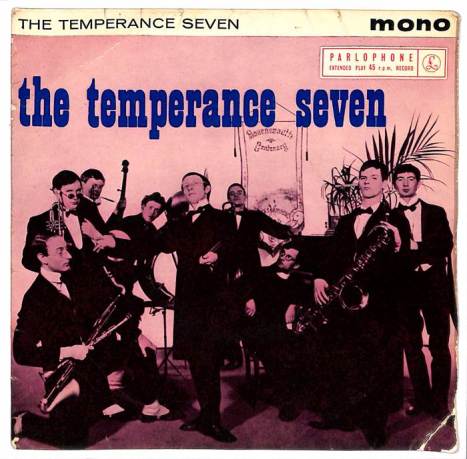
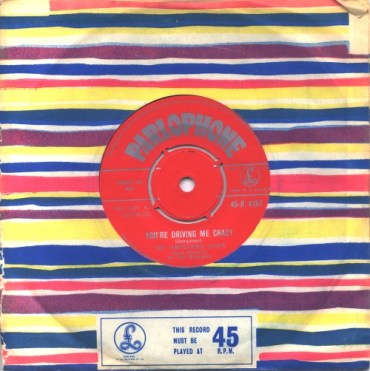
Attention, readers. Do not panic. Do not adjust your dials. We have not, I repeat not, somehow warped back in time to 1923. This is The Temperance Seven, and this record did indeed hit #1, in the UK, during the early summer of ’61.

SEV218 (275).jpg

You’re Driving Me Crazy, by The Temperance Seven (their 1st and only #1)

1 week, from 25th May – 1st June 1961

If I wasn’t already familiar with this song, I’d have assumed after the first minute or so that we were dealing with another instrumental. The first, and perhaps only time, that one instrumental record has deposed another from the top of the charts. But no. It’s just that the intro here is long and winding. Clarinets, trumpets, tubas (?)… I’m guessing there’s a sax in there somewhere too. This is a jazz record. Not jazz pop, or jazz rock, but proper, traditional Jazz. The sort that goes with flappers doing the Charleston, and gin rickeys. The sort of jazz that soundtracked all-night parties on West Egg. And we get a minute and ten seconds of this pure jazzin’ before a voice comes in…

You left me sad and lonely, Why did you leave me lonely? Lyrically, this is very simple number one. A girl is driving a man crazy… I’m burning like a flame, dear, I’ll never be the same, dear… The delivery is very knowing, extremely arch. It’s not really sung; more enounced with gusto. One pictures Noel Coward leaning against a mantlepiece, cigarette dangling lazily between two fingers, eyebrow raised… You, You’re driving me crazy… What did I do? Oh what did I do?… My tears for you, Make everything hazy… Clouding a sky of blue… The lyrics only last for a few lines, taking up barely a minute of song-time (and, at a second or two shy of four minutes, this is our longest number one so far.) It is listed as a ‘vocal refrain’, by a Mr. Paul McDowell, which only adds to the kitschy feeling.

The remainder of this record saunters along – very catchily, very jauntily… It’s an undeniably fun song. And I do like the fake-ending. But…

Something’s up here… Why is this jazz disc grabbing a week atop the charts in the post-rock ‘n’ roll era? Why is the ‘singing’ so camp? Why does this whole song feel as if it’s being delivered with a big, pantomime wink? Should I be listing this as a ‘novelty’, rather than a ‘jazz’ record? I probably should. The Temperance Seven were an Art School band, who claimed to have formed in 1904 in something called the Pasadena Cocoa Rooms… But they hadn’t – they got together in 1955 in Chelsea. They were darlings of the late 1950s London art scene, and performed at one point with comedian Peter Sellers on vocals. Imagine the cast of Monty Python in a revival of ‘Chicago’ and you’re halfway there. This record is, for want of a better description, a piss-take.

The+Temperance+Seven+Youre+Driving+Me+Crazy-552467

It’s cute, it’s meta… It’s deliberately aping 1920s jazz with its tongue lodged firmly in its cheek. It’s not like previous #1s – ‘Whose Sorry Now’, ‘Mack the Knife’ et al – where old songs were covered and rebooted. This is our first ‘retro’ #1 – a record that deliberately sounds old, foreshadowing the likes of Showaddywaddy and Shakin’ Stevens by well over a decade. And it’s a pastiche done very well – The Temperance Seven were all accomplished musicians – and so the record also works as a piece of simple nostalgia. It’s also worth noting that this record was produced by one… George Martin. Of Beatles-producing fame. And whiffs of The Temperance Seven do come through in some of the Fab Four’s stuff… Listen to ‘You’re Driving Me Crazy’, and then ‘When I’m Sixty-Four’, or ‘Honey Pie’ for example.

I’m in two minds here. I like the fact that it’s something completely different. It’s one of the weirdest number ones yet; probably one of the weirdest ever. It’s gloriously odd. It’s cool that this got anywhere near the top of the singles chart. But… There were countless ‘proper’ Trad-Jazz artists releasing records at this time. Kenny Ball, Chris Barber, Acker Bilk all had some huge hits – ‘Stranger on the Shore’ and ‘Midnight in Moscow’ and all that. Louis Armstrong was having a bit of a chart-renaissance, too. None of them got to number one, though. The jazz revival of the early 1960s is represented at the top of the UK charts, for a solitary week, by a bunch of art school kids having a bit of a laugh. And I’m not sure how I feel about that…

I am slightly biased, though. The first CD I ever bought – aged seven or eight – was a compilation full of Trad-Jazz classics. Lots of Barber, Bilk and Ball. I wanted to learn the saxophone. I wanted to be Satchmo. Even now I’ll put a Trad-Jazz playlist on when I want music that I don’t really have to listen to (and I mean that as a good thing). Nothing too experimental: no bebop, no improv… Just good, old-fashioned jazz (I did jazz-hands there as I typed that).

I have to say, though, moral quandaries over this record aside, 1961 has been an excellent year for chart-toppers. Pure pop, doo-wop, piano rags and now this… The only blot on the page – and it’s a sizeable one – has been the abominable ‘Wooden Heart’. Long may the variety, and the fun, continue!

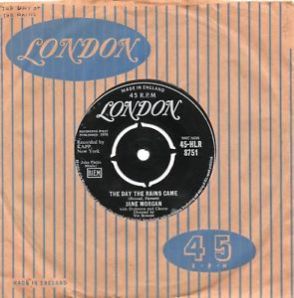
79. ‘The Day the Rains Came’, by Jane Morgan

So what do we have here, then, for the first #1 of 1959? Well, the intro is promising: trumpets, saxophones…? Some kind of brass section at least. Ba-da-da-da-da-da-da…Bum-bum-bum… I would describe it as an intro you could strip to, if that weren’t being slightly tasteless.

s-l300 (2)

The Day the Rains Came, by Jane Morgan (her 1st and only #1)

1 week, from 23rd – 30th January 1959

Does the rest of the song live up to this saucy promise? Well, no. Not if you truly were expecting some kind of chanson d’amour. The title kind of gives that much away. It’s a song about rain, flowers, and crop cycles: The day that the rains came down, Mother Earth smiled again… Now the lilacs could bloom, Now the fields could grow greener… Further lyrics follow about buds being born and rivers swelling.

It’s an extended metaphor of a song – all the nature that is blooming is mirrored in the love blooming between the singer and her beau. As the young buds will grow… So our young love will grow… Love sweet love… Morgan’s voice is prim and clipped, harking back to the era of Doris Day and Vera Lynn. She sings it crisply, and properly, but it does come across as rather old-fashioned. She’s no Connie Francis, that’s for sure.

It’s reminiscent in many ways of singers like Jo Stafford and Kitty Kallen, jazz-pop from the very earliest days of the chart. Listen to the bridge in particular, the lines that begin: A robin sang a song of love, A willow tree reached out to the heavens… and tell me that it doesn’t reek of 1954. And the ending… Oh the ending. Ms. Morgan absolutely belts it out – Raaaaiiiiinnn Sweeeeet Raaaaaaaaaaiiiiiinnnnnn! – in a way that nobody else on a chart topping record has done for years. Is this perhaps our first throwback record? The first chart-topper that is intentionally harking back to days gone by, years before acts like Showaddywaddy, Shakin’ Stevens and, erm, Oasis? It certainly wasn’t an old song, having been written, originally in French, and recorded in 1958.

EDZ_mereyjanemorgan

I don’t dislike this record. The instrumentation is great, with a real swagger to the drums and brass. It’s just a shame that the lyrics are so wishy-washy. It’s technically ‘The Day the Rains Came Pt I’, as Part II is the same song sang by Morgan in the original French. Which is better to listen to, in a way (as long as you don’t understand French), as you can imagine that she is singing the saucy lyrics that the music is crying out for.

This may also be the first occurrence in the UK singles charts of a ‘January Number One’ – a record that takes advantage of the usual post-Christmas drop in sales to sneak a week or two at the top. It was a regular thing from the seventies through to the nineties, and can still happen today – see Eminem’s ‘River’ from January this year. And I’ve mentioned before how much I admire a good ‘one song-one week’ chart-topping record. Jane Morgan hadn’t troubled the upper reaches of the UK charts, let alone the number one spot, before this and wouldn’t do so again. And – following on from Tommy Edwards, Lord Rockingham’s XI and Conway Twitty – I make her the fourth consecutive one (ish) -hit wonder chart topper!

To conclude, then. This is a nice enough diversion, a snazzy little jazz pop number; but one which sounds pretty out of place as the first #1 of 1959. Let’s get back on track, shall we…

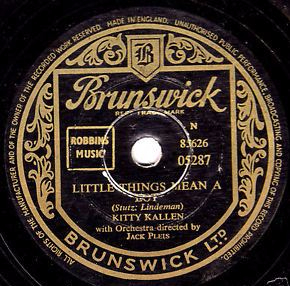
21. ‘Little Things Mean a Lot’, by Kitty Kallen

s-l300-1.jpg

Little Things Mean a Lot, by Kitty Kallen (her first and only #1)

1 week, from 10th to 17th Sept 1954

And so we arrive at mid-September, eight and a half months into 1954, and we have had but five number ones this year. In my capacity as a fully qualified chart geek, I have the means by which to compare and contrast this with other years. And, for example, by this point in 1953 we had had 10 #1s. By the 10th September 2000 (the year with the highest turnover of chart toppers in chart history) we’d had an unbelievable 30 #1s! And in 2017 we were back down to 10 #1s. Interesting? I’ll let you be the judge of that.

Anyway, the 6th number one of 1954 takes a low-key approach. Kitty Kallen has a dusky voice, and little in the way of accompaniment aside from a – thankfully understated – violin and something that tinkles (a timpani?). Oh, and there’s a trumpet. Still, though, this is a nice respite after the fervour of ‘Such a Night’ and the mini-operetta that was ‘Cara Mia’.

Lyrically, the idea is that small signs of affection are more important than grand gestures: Give me you arm as we cross the street… Call me at six on the dot… Touch my hair, as you pass my chair… Little things mean a lot… This girl don’t need diamonds or pearls, champagne, sables or such. No, Sir. Cos honestly honey, they just cost money. And since we’ve had song after song full of strangely metaphorical approaches to describing love – seeing little birds, talking to stars – as well as the usual soppy stuff – hearts melting, longing or breaking – this is an interesting detour. It’s cute and knowing, and quite ahead of its time. Modern love songs go in for a lot of the ‘savouring the little moments’ kind of stuff: sitting on the grass, drinking wine out the bottle, holding your loved one’s hair back as they puke (c.f. James Arthur, 2016). Perhaps we can class this record as ahead of its time.

Kitty Kallen 1944 Metronome Archive Photos

The only time that Kallen gets serious is for what is as close as the song gets to a chorus: Give me your hand when I’ve lost the way, Give me a shoulder to cry on… And she is guilty of singing these lines in a THIS IS THE IMPORTANT BIT SO I’M SINGING A BIT LOUDER way that literally everyone seems to be doing in 1954. But at least the ending is sedate: repeat the title, bit of trumpet, fade. Nice

And so that was Kitty Kallen’s first and only UK Number One. I like that – one song, one week. Done. Your name goes down in history. Had she stalled at #2 – perfectly respectable, that, a number two hit – I might never have heard of her. Not that she’s the first – we’ve already covered Jo Stafford’s and Lita Roza’s solitary weeks at the summit – and she won’t be the last. But, unlike Stafford and Roza, this was Kallen’s only ever UK hit. Ladies and Gentlemen, we have our first one-hit wonder. She was much more popular in the US, this being her fourth number one over there. It was her last, though. ‘Little Things Mean a Lot’ seems to have been pretty much it for Miss Kallen. And it almost goes without saying by this point that she died at the grand old age of ninety-six, just two years ago.

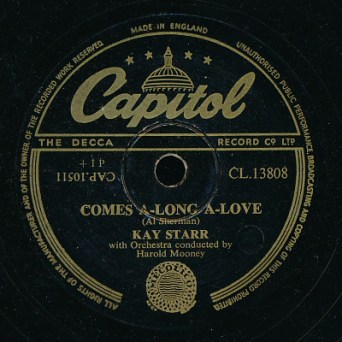
3. ‘Comes A-Long A-Love’, by Kay Starr

R-3253615-1392841568-2094.jpeg

Comes A-Long A-Love, by Kay Starr (her 1st of two #1s)

1 week, from 23rd to 30th January 1953

Snazzy! And jazzy! I really thought – and more fool me – that these pre-Rock ‘n’ Roll hits would be dull, twee, chaste… one step up the danceability chart from hymns, basically. How wrong I was. It wasn’t all bluebirds over the white cliffs of Dover.

Though bluebirds do feature in this song, they do so as a symbol of being in love and suddenly becoming aware of the world around you. Birds! Flowers! The sun! Comes A-Long A-Love suddenly though you never sang you’re always singing… Comes A-Long A-Love suddenly chimes you never heard begin a-ringing… The lyrical message being that falling in love will make you a better, livelier person.

Kay Starr’s voice is in complete contrast to the Jo Stafford record that went before. It’s husky, then sing-songy, she pauses where you least expect it and then rushes through tongue twister lines phrases like petty little things no longer phase you, which I’ll bet you can’t say five times fast. You might even say she’s flirting with the listener… And, yes, a quick search shows Ms. Starr was quite the little minx (that’s what they called them in those days). Those eyebrows! What didn’t they suggest! This song could be seen as a challenge – she’s daring you not to fall in love with her.

kay-starr-cropped

But again, it’s another song that paints love in a positive light. Three number ones in and nobody’s had their heart broken… Even lonely old Al Martino was hopeful that his lover would say ‘yes’. That’s something I’m going to look out for: the first ever reference to heartbreak in a UK number one hit. And, again, Kay Starr enunciates so damn well. This isn’t an easy song to sing, but she makes it sound like she’s ad-libbing her way through it. I’ve got to hand it to these old-timers, before the days of auto-tune, because they really could sing. Gran was right all along…

Some bits do jar, slightly. Starr uses ‘Mister’, and ‘Brother’, in a way that you wouldn’t these days. And the aforementioned reference to being in love and seeing bluebirds is a bit of a Disneyfied image. It must have been easy for songwriters, at the birth of modern pop music – love is great, you see bluebirds, do-bee-do – before people discovered cynicism. So far, though, all three number ones have been recorded by American artists. Perhaps that explains the saccharine sentiments! As everyone knows, Americans are sickeningly positive. How brilliant would it be, then, if the first UK recorded #1 turned out to be a piece of proto-Morrissey miserabilism…

One final thing I’ve noticed, while looking up these first three UK chart toppers, is how long they all lived. Jo Stafford died in 2008, aged ninety. Al Martino died in 2009 at eighty-two. Kay Starr died in November 2016, having reached a grand old innings of ninety-four. That means two of them outlived Michael Jackson, who wouldn’t have his first number one hit for another twenty-eight years. They were made of sterner stuff in those days, mind.

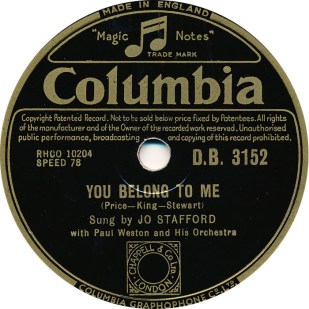
2. ‘You Belong to Me’, by Jo Stafford

jo-stafford-you-belong-to-me-1952-78
You Belong to Me, by Jo Stafford (her 1st and only #1)

1 week, from 16th to 23rd January 1953

On first listen, this sounds like the music that used to play between scenes in Dad’s Army. January 1953 was less than eight years after the end of World War II, I suppose, but this song just sounds so old. On the other side of the coin – this was less than fifteen years before Sgt Peppers! It’s genuinely amazing to think of how much popular music changed in such a short time.

However, without wanting to go off down that road just yet – this is a fairly nice, sedate little after-hours number. In complete contrast to the first chart topper, this is a track that holds back. A guitar strums, and some saxophones (trumpets?) flutter between the lines. Imagine a smoky club, little tables, couples whispering sweet nothings, gangsters and their molls quaffing champagne in the booths that line the walls. Though a quick image search of Jo Stafford brings up some fairly prim and proper pictures of her in buttoned-up blouses. None of her draped across a piano for the benefit of rowdy mobsters, unfortunately.

The premise of the song is that, no matter where her lover travels – the pyramids along the Nile, the market place in old Algiers, the jungle wet with rain – he should remember that he belongs to her and that, naturally, she will be alone and pining until his return. This being 1953, I’m guessing that he’s travelling the world as part of the military, rather than simply on a jolly, and that might explain the song’s popularity in the day’s of National Service, and the Korean War.

Jo_Stafford_color_photo_1948

Despite the song’s understated quality and the jazz-bar feel, though, Stafford is still enunciating the lyrics like she’s being graded on her diction. That’s what is immediately standing out as I listen to these early number ones. Sure they sound dated, and they have a simplistic take on romance (think about it, how many modern pop songs are about simply being in love, requited or otherwise?) but what comes across most is how clear the lyrics are. Rock and roll must’ve ruined the way folks sang!

While this was a one-week number one, the song actually hung in doggedly at number two for the whole of Al Martino’s run at the top. It could have all been so different! But at least Jo can hold claim to being the first ever female singer to top the UK charts, though she never did so again.