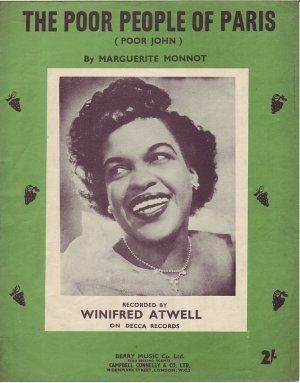
45. ‘The Poor People of Paris’, by Winifred Atwell

winifred-atwell-the-poor-people-of-paris-decca-78-s

The Poor People of Paris, by Winifred Atwell (her 2nd of two #1s)

3 weeks, from 13th April to 4th May 1956

Listening to a recording of Winifred Atwell playing the piano, I can’t help but picture her smiling. She must never have stopped smiling. Her 2nd #1, just like her first, is a spectacularly perky piece of music.

Unlike her first chart-topper, however, this isn’t a medley. It’s the one tune, blasted through in barely two minutes. It wouldn’t have felt out of place as one of the songs on ‘Let’s Have Another Party’, though. And by that I mean that it sounds exactly the same. The same ragtime style, the same boogie-woogie piano, and the same frenetic pace. As jaunty as both songs have been, I won’t be rushing to try out her Greatest Hits… I can guess what it will sound like.

Actually, there is one little moment of note here, musically. Midway through, as Atwell returns for a second run-through of the melody, a strange sound begins playing over her piano. It sounds like it could be an extremely high voice – a super-soprano, maybe – or someone whistling. Or that weird box (a Theremin, or a Moog synthesiser?) that’s used to make sound effects in Sci-Fi B movies. To me it’s a very sixties kind of sound, and I’m surprised to hear it popping up on a chart-topper this early – if that indeed is what it is. I’ve had a quick look online, but can find no answer to what the sound is…
c79de306b5573c71087ddd8fc38cd7fe

In lieu of writing any more about this record (Miss Atwell certainly got it over with in a manner that suggests she was bursting for the toilet, so we’ll keep it similarly brief) let’s look at the song in general. ‘The Poor People of Paris’ is a French song – quel surprise – recorded most famously by Edith Piaf as ‘La Goulante du Pauvre Jean.’ When it came time for the track to be adapted into English the man who did so misheard the ‘Jean’ from the French title as ‘gens’: hence the poor people of Paris. Tsk tsk. Us Anglophones and our terrible attempts at French, eh? He needn’t have bothered with his adaptation either, really, as pretty much everybody after Madame Piaf recorded the song as an instrumental.

I am glad that we’re seeing Winifred Atwell here again, don’t get me wrong. That a black woman could score not one but TWO #1s, and a score of other hits, at this time remains impressive. But the first time was always going to be the more significant and the choice of songs for the ‘Let’s Have Another Party’ medley made it very interesting. This record, however, just feels a little throwaway. Atwell’s legacy lives on in much more recent chart-topping singles though, as she was a big influence, apparently, in Elton John learning the piano.

On a final note… Do any other British chart-toppers include a capital city in their title? There must be one but – and I’m doing this completely off the top of my head here – I can’t think of any. All I can get is ‘New York, New York’ (neither a #1, nor a capital city), ‘London’s Calling’ (capital city – yes, #1 hit – no) and, um, Berlin. The band. You know, from ‘Top Gun’. Do comment if you can do any better than me on this…

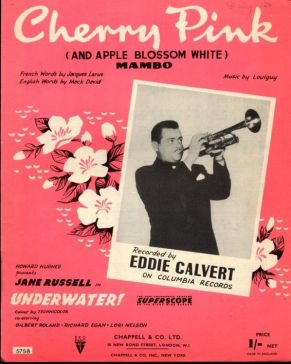
33. ‘Cherry Pink and Apple Blossom White’, by Eddie Calvert

maxresdefault

Cherry Pink and Apple Blossom White, by Eddie Calvert (his 2nd of two #1s)

4 weeks, from 27th May to 24th June 1955

And so, for the second time in chart history, two versions of the same song take their turn at the top. It’s not quite as dramatic as David Whitfield and Frankie Laine replacing one another with ‘Answer Me’ back in November 1953 (and then completing the ’50s chart bingo board by tying for the number one slot), but still.

You do have to wonder, once again, why people needed multiple versions of the same song. Was it a case of people buying every version of ‘Cherry Pink and Apple Blossom White’ going because they really loved the song? Or was it Team Perez Vs Team Eddie? As far as I’m concerned, there should only have been one winner…

This is the knock-off version, the Poundland version, the 2-bit ringtone version… you get the idea. It is the same tune: the same notes and rhythm without any of the oomph of Prado’s version. Calvert is trying all the same tricks, even doing the same drawn-out, low then high, note that Billy Regis did to such giddy effect on the original. (I know they are contemporaneous, but the Prado version will from now on be ‘the original’ to me) Even Calvert’s trumpet sounds different, reedy, not up to the task. Why on earth this lasted twice as long at number one is a mystery.

But… maybe it shouldn’t be. Calvert was British, for a start, not some moustachioed Cuban. And everything about this record that I’m filing in the ‘Against’ column – the fact that it’s a bit restrained, a bit stiff, a bit less raunchy – probably actually explains this version’s greater success. Calvert was from Preston, and he certainly did not go ‘Huh!’, ‘Ooh!’ and ‘Aah!’ during his records. Respectable households could drop this disc on to the gramophone after Sunday lunch safe in the knowledge that grandma wouldn’t be requiring the smelling salts.

cherry-pink-and-apple-blossom-white-eddie-calvert-jane-russell

There is a section, towards the end of this version, in which Calvert goes a little wild and takes it away from Prado’s version, which is commendable, but no. The ending of this version, in particular, is a complete damp squib. It’s not an awful #1 – a good tune is a good tune – but Perez Prado just did so much more with it. We won’t be hearing from Eddie Calvert again in this countdown, I’m not terribly sad to say. He burned brightly, but briefly, and didn’t have an awful lot of singles chart success beyond 1955.

It’s worth also noting here that we are in the midst of a film/musical soundtrack run here: two versions of ‘Cherry Pink and Apple Blossom White’, which featured in the Jane Russell movie ‘Underwater!’, as well as Tony Bennett’s Broadway hit ‘Stranger in Paradise’ sandwiched between. I suppose it would be hard to downplay the role cinemas had in influencing music buying tastes in the 1950s. Very few people owned a TV set, radio barely played any chart music… Films were one of the few places where people could actually hear current, popular music. Get your song in a film and hey presto! And it’s a trick that still works to this day.

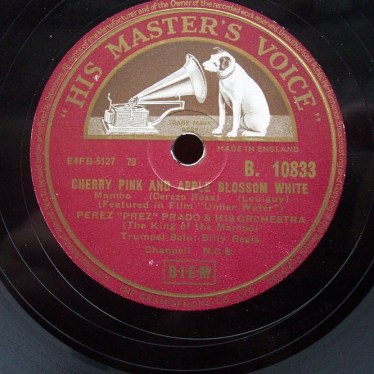
31. ‘Cherry Pink and Apple Blossom White’, by Perez ‘Prez’ Prado & His Orchestra

s-l1000

Cherry Pink and Apple Blossom White, by Perez ‘Prez’ Prado & His Orchestra (his 1st and only #1)

2 weeks, from 29th April to 13th May 1955

What a way to kick off the next thirty!

I’ve given instrumentals a hard time so far in this rundown. The lack of any lyrics creates a barrier, for me, between the song and the listener. You can listen to a Mantovani record and think “Isn’t that a nice melody”, but the fact that there are no words to tie it to a particular feeling or experience in your life means that the record is that step further removed from you. Like a film beautifully acted but in a language you cannot understand.

Having said all that… I’m going to prove myself massively wrong with this post. The fourth instrumental to top the UK Singles chart is also, by far, the sexiest record to top said singles charts. And there are no words. Well – there are no words aside from ‘Huh!’, ‘Hah!’ and ‘Oooh’. Which is a large part of this track’s said sexiness.

Following on from ‘Mambo Italiano’ (which wasn’t really a mambo, but hey), the UK was clearly in some sort of Latin fever in early 1955. Though perhaps not, as a quick glance at the chart for the week Perez ‘Prez’ hit the top shows only one other record that sounds vaguely Latino… A different version of ‘Cherry Pink and Apple Blossom White’ (which we’ll meet very soon at the top of the charts). But, for the purposes of this narrative, let’s say that the UK – finally casting off the shackles of rationing and wartime rubble – wanted to shake some booty and, while perhaps not quite ready for straight up rock ‘n’ roll, turned to some equally raunchy mambo. Further evidence towards my idea that rock ‘n’ roll didn’t just arrive with ‘Rock Around the Clock’ – it was slowly filtering in through Rosemary Clooney’s giggle, Winifred Atwell’s boogie and Johnnie Ray’s yelps. And Perez ‘Prez’ Prado’s trumpet.

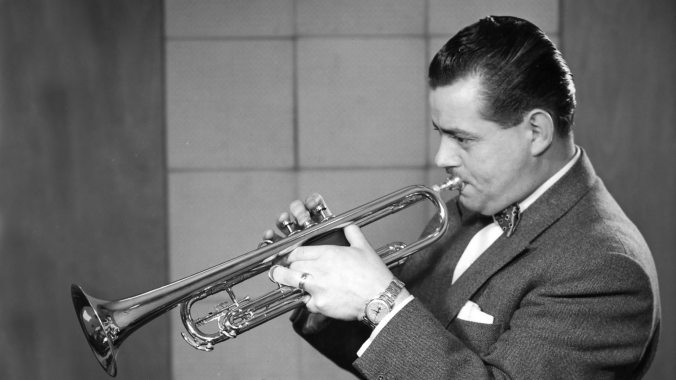
Except the trumpet that makes this record isn’t being played by the man on the credits. We’ll get to that in a second. First – this record has perhaps the most intense intro we’ve heard yet. Basically it’s BOOM BOOM BOOM BOOM BOOM BOOM BOOM on a load of trumpets and cymbals, before the rhythm kicks in. The lead trumpet was played by a man called Billy Regis, who absolutely makes this record by drawing out one note in particular over and over again, by sliding it down then up in a manner that sounds a little bit drunk, a little bit woozy, and that, most importantly, would allow a couple in a Southend ballroom to draw that little bit closer for a second, before the main melody jumped back in.

R-582429-1341876426-2330.jpeg

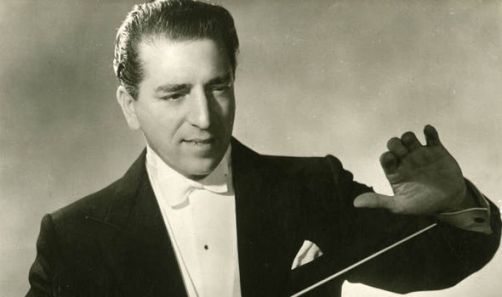
Prado was more of a conductor, I guess, and it is his ‘Huhs’ and ‘Hahs’ that can be heard as he exerts his charges to squeeze every drop of sexiness from their instruments (that sounded ruder than I intended – you know what I mean). There are also some other trumpets (I guess they are trumpets) playing notes so low that it’s almost obscene. I recognise them from Lou Bega’s classic cover of ‘Mambo No.5’, from another golden age of Latin music in the UK charts, which we won’t be getting to for a long, long time. Incidentally, Perez Prado recorded the original version of that song, too.

But the final word has to go to Billy Regis, whose trumpet ends the record. He reimagines the bombastic ending – from which so many earlier chart-toppers have suffered – and it works so much better without lyrics. THIS IS THE END OF THE SONG becomes DOOO DOOO (pause) DOOOOOOOOO, and it again allows Janet and John from Southend to draw close and to feel one another’s bodies, taught and trembling from two and a half minutes of intense mambo.

‘Huh!’ and, indeed, ‘Hah!’

26. ‘Let’s Have Another Party’, by Winifred Atwell

R-5006820-1381952789-2495.jpeg

Let’s Have Another Party, by Winifred Atwell (her first of two #1s)

5 weeks, from 3rd Dec. 1954 to 7th Jan. 1955

I wrote in the intro to my last post that Rosemary Clooney was finally getting our pulses racing – or our toes tapping, at least – and here comes Winifred Atwell to keep up the momentum.

It’s another piano-led song. Well, I say ‘piano-led’; it’s nothing but piano. Winnie and her piano, bashing out a selection of boogie-woogie and ragtime standards in extremely short order. According to Wikipedia we are getting classics such as ‘Broken Doll’, ‘Lily of Laguna’ and the ‘Sheik of Araby’ served up with a verse here, a snatch of chorus there, then on to the next one. I don’t recognise any of the featured tunes – though I’m pretty sure one of them was played by an ice-cream van in days of childhood yore.

It’s jaunty enough, but the effect of squeezing so many different tunes into a couple of minutes means it’s a bit of an odd listen. They’re all played in the same ragtime tempo, so there are no segues: it’s straight from one song into another with no time to draw breath, before we screech to a halt with dum-didley-dum-dum… dum-dum. But hey, it’s the first medley to top the charts, and off the top of my head, I’m not sure if there will be another one until Jive Bunny in thirty-five years’ time. On Spotify, the track is listed as having a Part I and Part II, the former being all of these old hits strung together while the latter is a much-more sedate number, even featuring a bit of guitar. I think, though I’m unable to confirm, that only the first part counts as the record that hit #1. Maybe Part II was the B-side.

1954-winifred-atwell-lets-have-another-party-1353313393-view-0

Anyway, all of this nonsense about which part is blah blah blah pales wildly into insignificance when it is revealed that Ms. Atwell was… black! Born in Trinidad & Tobago, before moving to the States and then to London, she becomes, a little over two years into their existence, the first black artist to hit the top of the charts. It’s a big moment, and worth taking a moment to reflect on this happening at a time when, say, landlords could stick a ‘No Blacks’ sign in their windows with impunity and, in the USA at least, Winifred Atwell wouldn’t have been allowed on the same public transport as her fellow chart-toppers. Just because this is the frothiest of throw-away records shouldn’t render it any less significant.

In fact, it’s almost ironic that she achieved this historic landmark with a medley full of old music-hall hits. The sort of hits that were big in even less enlightened times. The sort that might have been sung by men in black-face, to howls of laughter (seriously, Google ‘Lily of Laguna’ to see just what kind of song it is…) In a way, she is reclaiming them, and making them popular on her own terms.

And with that, I’ll descend from my high-horse, and conclude by saying that we will be hearing from Winfred Atwell again soon. She was huge in the early to mid-1950s (played for the Queen, didn’t you know!), and definitely seemed to have a winning formula. Hey, if it ain’t broke… ‘Let’s Have Another Party’ was the follow-up (somewhat inevitably) to ‘Let’s Have a Party’, and was followed up by another medley, the wonderfully titled ‘Let’s Have a Ding-Dong’. All good, (very) old-fashioned fun!


16. ‘Oh Mein Papa’, by Eddie Calvert

eddie-calvert-oh-mein-papa-1953-6-78

Oh Mein Papa, by Eddie Calvert (his 1st of two #1s)

9 weeks, from 8th January to 12th March 1954

Perhaps, as we tick over into 1954, we should pause once again to take stock. Just what kinds of records were topping the charts in these distant, misty, slightly-eccentric, pre rock days…?

Actually ‘distant, misty and slightly eccentric’ might just sum up most of the records I’ve described thus far. They have been surprisingly varied in style: from proto-rock numbers to gentle instrumentals, from jaunty novelties to brow-furrowingly earnest numbers about unrequited love. In a way, though, they’ve all been a bit similar too: all very safe, very chaste and very… twee? To my modern ears, anyway.

And so, onwards – to another mammoth hit. It’s the third time in just over a year that a record has racked up nine weeks at the top, and the latest record to do so is… a trumpet instrumental.

Now. There are lots of instruments that can carry an entire song: guitars and pianos, obviously, along with saxophones and violins. Drums cannot usually carry an entire song, but I wouldn’t like to say it was impossible. Tambourines definitely cannot. And nor, it would seem, can trumpets.

I’m struggling to write much about this song. There’s a trumpet. There’s a simple guitar rhythm, with some backing singers shrilly harmonising and occasionally chanting the song title. Oh, and there’s an organ. As I wrote in my post about the last #1 to involve an organ (‘Broken Wings’), it lends a cheap, Blackpool seafront kind of vibe to proceedings. I suppose it could go down as the first ever foreign language number one, but there is only one line. Oh Mein Papa. Which I believe translates as ‘Oh My Daddy.’ Oh my, Daddy, indeed.

The tune isn’t even interesting. The one other instrumental we’ve covered so far, Mantovani’s ‘Moulin Rouge’, at least had a melody that buried itself in your brain after a few listens. So this, with no words and no melody, to my ears at least, has little going for it.

There are lyrics to ‘Oh Mein Papa’, which I searched out and listened to, courtesy of our friend Eddie Fisher – whose version reached #9 – lyrics about how lovely the singer’s father was, taking him on his knee when he was a nipper… And I suppose, when this backstory is taken into consideration, Calvert’s lone trumpet, parping out its melancholy tune, takes on a little more resonance. But then, that’s the problem with instrumentals as a whole: without lyrics, are they songs or simply pieces of music? And yes, yes, you can come at me with Beethoven, Mozart and all that lot; but we’re talking about pop music here. Pop music should be immediate and relatable, and I’m not sure it can be without lyrics. Or, at least, it’s difficult for it to be so without lyrics. Anyway, who am I to say? This track lorded it over all comers for over two months.

p03t218h

Eddie Calvert himself, looks like an interesting character. He looks old-fashioned, even in contemporary photographs from the 1950s. His hair is heavily Brylcreemed and he has a roguish moustache (Oh nein, Papa!). He’s half jazz session musician and half black-market spiv. If you were given a choice of where he was from, and the choices were A) Chicago, Illinois or B) Preston, Lancashire, you’d go for A). But you’d be wrong. In almost every picture I’ve found he is clutching his trademark trumpet. He probably had a name for it.

11. The Song from ‘The Moulin Rouge’, by Mantovani and His Orchestra

s-l300

The Song from ‘The Moulin Rouge’, by Mantovani and His Orchestra (his 1st of two #1s)

1 week, from 14th to 21st August 1953

Ooh la la.

I’m less annoyed that this song helped deny Frankie Laine his record of consecutive weeks at the top. Mainly because Eddie Fisher had already done the damage; but also because this isn’t terrible.

But ‘not terrible’ isn’t really selling it either… So, let’s try again. It’s nice enough. Its pretty mellow. It’s cute. A bit heavy on the accordion, but yeah. Oh, and its an instrumental. The first ever instrumental to top the UK charts, back when instrumentals were much more of a thing than they are now.

I should probably stop getting excited about a record being the ‘FIRST EVER _____!’ to top the charts, because we’re only eleven songs in and pretty much every one of them is the first ever something. But still. This is the first ever film score to hit the top too, The Moulin Rouge being a film about Pigalle’s famously raunchy red-windmilled nightclub, starring Zsa-Zsa Gabor. And it’s the first ever #1 by a non American or Brit, Mantovani being Italian.

mantovani-663032

To the song. Well. If you’re writing a song about Paris, or France, what’s the first instrument that springs to mind? Mais oui. L’accordion. Trop cliché, non? Maybe it wasn’t a cliché in 1953. Maybe this song made it a cliché to soundtrack Paris with an accordion-led air.

There’s not much to it, really. It’s the same couple of refrains played over and over again, first by said accordion, then by violins. And as I was taking notes for this post, while listening to the track for the first time, I jotted down all that stuff about the movie, the soundtrack, the accordion, and ended it with the words ‘a bit dull.’

But now I’m on the 4th or 5th listen, I’m not so sure. It’s seeping into my brain through its repetitiveness, and actually its quite nice. Pleasant. I think the best word for it might be melancholic. It has a sense of longing for the past, of long-lost summer days beneath a sun-dappled beech tree. And I’m not just being facetious here – it really does conjure up that image in my mind. The song has a name, as you can perhaps see from the picture of the disc above: ‘Where Is Your Heart’, and there was a version with words doing the rounds. But that doesn’t really interest us here.

The song ends very sedately. Unlike the songs that have gone before it doesn’t build to a big, over the top finale. It simply melts away, and I respect that. I’m not sure what role the song played in a film about the world’s most famous strip club, though. It’s about as far removed from the can-can as you can get.

While I had never heard this song before, I had heard of Mantovani. And for a while I couldn’t quite remember how or why. But then it came to me. See, where I come from, Mantovani is rhyming slang for… well… fanny. Example sentence: “I’ve got some Tesco’s Finest aftershave on, I’ll definitely get some manto tonight!”

And what a legacy that is.

https://www.youtube.com/watch?v=aFhGS4z_PjI