938. ‘The Ketchup Song (Aserejé)’, by Las Ketchup

Ah, the classic autumn Eurotrash hit. Played in bars across Europe all summer, and belatedly making #1 in the UK after the leaves have started to fall…

The Ketchup Song (Aserejé), by Las Ketchup (their 1st and only #1)

1 week, from 13th – 20th October 2002

To Whigfield, Eiffel 65 and DJ Ötzi we can now add Las Ketchup, with this slice of Spanglish surf rock. And, of course, the accompanying dance routine. They were a Spanish girl group, three sisters, and this was their first hit. And call me cynical, but when your group and your first single share a title, and that title involves ‘Ketchup’, then it’s safe to assume you’re not aiming for longevity.

But also, call me surprised, because this isn’t at all as bad as I’d expected. It’s horribly catchy, sure, and largely nonsense (‘aserejé’ is not a Spanish word, nor is ‘buididipi’, nor ‘seibuinova’) with a chorus based on ‘Rapper’s Delight’, but it’s much more of a rock song than I recalled, with the guitars switching between eighties soft, and growling surf, rock. It’s not as in-your-face irritating as some of the Eurotrash that’s gone before and, despite its obvious disposableness, it still sounds like a real song.

This is all a revelation, presumably because sixteen-year-old me wrote this off as novelty crap without giving it a proper listen. I’d still not choose to listen to it, but couldn’t promise that it wouldn’t get me on a dancefloor in double quick time after a jug of sangria. And at least it came out when I was too old to be haunted by its dance routine at primary school discos, unlike ‘Saturday Night’ and ‘Macarena’.

My teenage aloofness has also caused me to miss how bloody massive this song was in 2002. It made #1 in twenty-seven countries, and Wiki lists it as being a chart-topper in every territory in which it was released except the US, Japan, and – the only European hold-outs – Croatia. It didn’t lead to any lasting success, however, and Las Ketchup are gold-star one hit wonders in the UK. Their last release was in 2006, when they represented Spain at Eurovision, finishing twenty-first with ‘Un Blodymary’, though they continue to perform.

One other thing that had passed me by regarding ‘The Ketchup Song’, as well as its relative quality and its success, was the fact that the gibberish lyrics are alleged in Latin America to be secretly demonic… ‘Aserejé’, some religious types argued, sounds like ‘a ser hereje’ (‘let’s be heretical’), with other lyrics supposedly referring to hell and Satanic rituals. The song was banned by a TV station in the Dominican Republic on these grounds… So, press play below at your peril!

657. ‘Sadeness Part 1’, by Enigma

If we thought that Iron Maiden scoring a heavy metal #1 was unexpected, then it seems positively mainstream compared with the intro of our next chart-topper.

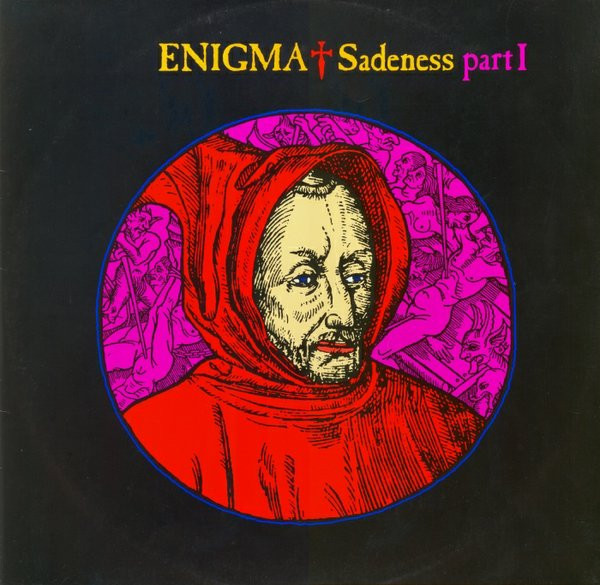
Sadeness Part I, by Enigma (their 1st and only #1)

1 week, from 13th – 20th January 1991

For how about some Gregorian chanting (in Latin, of course) to kick off 1991? Chanting that is mixed with a chilled-out dance beat, and then replaced by some electronic pan pipes. It’s the culmination of the new-age vibe that’s been infiltrating pop music over the past few years – think Enya, Simple Minds, even recent Cliff – and it means that this record sounds highly innovative and unusual; and yet truly dated.

A bit later a crunchy guitar comes in, while a woman mutters breathily in French, reminding me of Serge & Jane. These are the moments that lift this record above being something you’d hear in the background as someone performs an aromatherapy massage. I do like the drop, the do-doop-de-doo fill, too. It’s way beyond my usual wheelhouse – I have a deep distrust of anything that could feature in a ‘chillout’ playlist – but there’s enough going on here, a lot even, to keep things interesting.

The lyrics, such as they are, appear in Latin and in French. And if you were thinking a song this weird couldn’t possibly have banal lyrics about love and laughter then you’d be correct. It’s written in the form of an address to the Marquis de Sade (hence the title), the notorious 18th century French author and libertine responsible for some of the most outrageously explicit writing in history. (As an aside, I studied literature at university, and the only time we received a content warning, and were allowed to skip a text if we felt uncomfortable, was as we were about to read Sade’s ‘Justine’. There’s a reason the man gave his name to the term ‘Sadism’…) Anyway. Sade tell me, What are you looking for…? the song asks. Sade, are you evil or divine…?

I’m loath to label this as ‘not good’. When it comes to writing these posts, a record featuring chanting monks and pan-pipes, about a notorious sex-offender, is certainly more interesting to write about than your average dance hit. And it’s amazing how sophisticated dance music has become in the past couple of years, since the Hi-NRG heyday of SAW, and how quickly things have chilled out. But at the same time. ‘Sadeness Part 1’ isn’t something I’d ever incorporate into my daily playlists.

Enigma were a German ‘musical project’, helmed by German-Romanian producer Michael Cretu, and this was their breakthrough hit. And what a hit: number one across Europe, and Top 5 in the US. They struggled to match this success until the lead single from their second album, ‘Return to Innocence’, made #3 three years later. That record ditched the monks and went for more ethnic, tribal chanting.

Since then, Enigma have continued to record without particularly bothering the charts, including a 2006 concept album based on an imagined collision between the Milky Way and Andromeda galaxies. Because why not? Cretu’s greatest moment may have come long before Enigma and his championing of world music, though: he played keyboards on Boney M’s 1978 #1 ‘Rivers of Babylon’

569. ‘Rock Me Amadeus’, by Falco

Questions arise pretty quickly, as I listen to this next bizarre little chart-topper. Is it based on the ‘Beverly Hills Cops’ theme? Is it about Mozart? And most importantly: is it a novelty record…?

Rock Me Amadeus, by Falco (his 1st and only #1)

1 week, from 4th – 11th May 1986

Before answering any of those, I’m going to have to admit – I’m really enjoying this. It’s funky, throbbing, moody… and completely ridiculous. Despite it being ponderously slow, you can dance to it. I’m also most fond of synths when they are used in this clanking, industrial way; rather than for showy flourishes. It’s a record I knew by title, without ever having properly listened to.

It’s a German chart-topper, which isn’t unusual for the 1980s, when we’ve seen the likes of Kraftwerk, Nena, Nicole and The Goombay Dance Band reach the top. What is unusual is that Falco has done so while still singing in German. Rapping in German even! The harshness of the language complements the thumping synths, I think, in a way that wouldn’t work if this was in French, say.

On a more serious level, though, is the fact that Falco performs the song in German the reason I instinctively treated this record as a novelty? Are we guilty – yes I’m including you in this! – of English language snobbery, of discounting anything not in English as lesser and silly? Especially something in ze harsh, guttural sounds of das Deutsch? At the same time, Falco’s antics in the video show that ‘Rock Me Amadeus’ is at least meant to be fun, if not truly a novelty song.

Said video also definitively answers one of my other earlier questions: this is very much about Mozart. Falco plays the man himself – the song was inspired by the 1984 movie ‘Amadeus’ – as men in powdered wigs dance with leathered-up bikers. The lyrics tell the story of big Wolfgang as the original rock star, about his way with the ladies and his fondness for a tipple: He was a superstar, He was popular, He was exalted, He had flair… And everybody screamed ‘Come rock me Amadeus’…

Which leaves me with just one question to answer: does anybody else hear the ‘Beverly Hills Cop’ theme in the synth riff? I can’t find much evidence online that agrees with me, but I definitely hear it. That theme, AKA ‘Axel F’, will of course have its moment atop the charts, but the mere thought of it makes me shudder…

By the end this song has gone completely bat-shit, with Falco screaming, scatting and yodelling things to a conclusion. Not something you’d want to hear every day, but great fun if you’re in the mood. Falco – real name Johann Hölzel – was Austrian, like Mozart. The first Austrian to top the charts in both the UK and the USA, unlike Mozart (though he’d surely have had hit after hit had the charts existed in the 1780s…) In Austria, Germany and much of Europe he was huge, but in Britain he struggled to have much further chart success – though the follow-up ‘Vienna Calling’ did make #10. Sadly, and again much like the hero of this song, Falco died very young, in a car crash, aged just forty.

Advertisements

532. ’99 Red Balloons’, by Nena

A couple of posts ago, I was a bit down on 1984. Before it had even started, I was pooh-poohing the idea that it was all that great of a year. But… with this next chart-topper following on from the assault to all five senses that is ‘Relax’, maybe 1984 wasn’t such a bad year after all.

99 Red Balloons, by Nena (their 1st and only #1)

3 weeks, from 26th February – 18th March 1984

Not that I’m going to start claiming it as the best year ever – not yet anyway – but this is another great slice of synth-pop. The slow-building intro is quite similar to ‘Relax’, and it forms the background to a story of two people in a toy shop, buying a bag of red balloons… Set them free at the break of dawn, ‘Til one by one, They were gone…

And then the beat drops – one of the great beat ‘drops’, from before beat ‘drops’ were a thing – and we have an incredibly catchy, cheese-funk synth riff. And guitars! Punk rock guitars. Forget synth-pop; it’s synth-rock. It feels like an age since we’ve had actual guitars at #1, and they drive the song along through its story of nuclear armageddon. Ninety-nine red balloons, Floating in the summer sky…

The authorities see these innocent balloons and panic. This is what we’ve waited for, This is it boys, This is war… You don’t need a degree in 20th Century history to work out what concerns this record is tapping into. The Cold War was at its height: it’s still February, and this isn’t even the first chart-topper of the year to reference war. It won’t be the last either… Incidentally, the inspiration for the song was said to have come when the band went to a Rolling Stones concert in West Berlin, and watched balloons released on stage floating towards the Wall.

Nena were themselves from West Germany – ‘Nena’ being both the name of the band and of the lead singer, in a shades of Blondie. In fact, Britain was one of the few countries where the hit version of ’99 Red Balloons’ was in English. Across Europe and Australia, even in the US, the German original soared to the upper reaches of the charts. I do like Nena’s German-accented English, especially in the worry, worry, super scurry line, though there’s a forcefulness to the German version that probably comes from her being more confident singing in her native tongue (the drums are also heavier in the original, which is another pro).

In the end we’re left with something stark, both musically and lyrically. The driving beat and catchy riff vanish, leaving the echoey synths. It’s all over and I’m standing pretty, In this dust that was a city… The singer finds one last balloon. I think of you and let it go… It’s a powerful ending from a song that sometimes gets written off as a novelty (I was thinking the same before listening to it properly a few days ago…)

Nena (the band) had a few more years of success in Germany, but struggled to score many more hits in English-speaking countries. They split up in 1987, though Nena (the singer) has continued to record, and sometimes collaborates with her former bandmates. And so. I am left to reassess my opinions on 1984, and on synth pop in general. Except, oh dear…. Our next number one will go some way to proving why this year wasn’t so great after all…

Advertisements

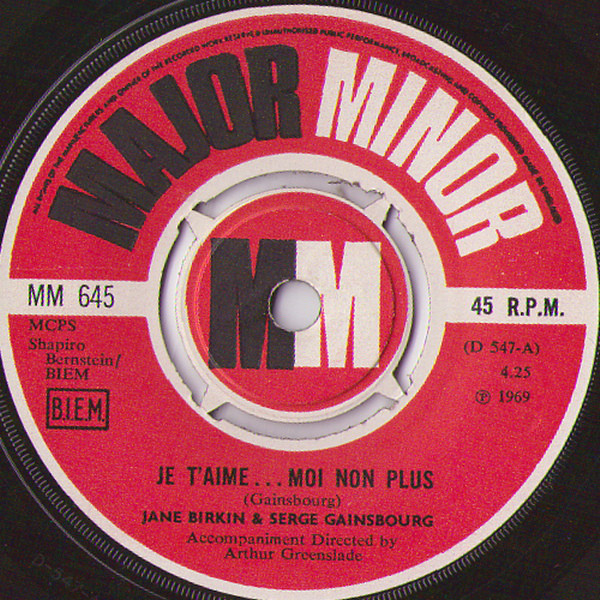
277. ‘Je T’Aime… Moi Non Plus’, by Jane Birkin & Serge Gainsbourg

We end our run of apocalyptic #1s at two, and turn to another of human kind’s most primal concerns. From death and survival, to sex… Though if the end of the world were nigh, you could probably do a lot worse than closing the curtains, dimming the lights, and slipping this disc onto the turntable…

4641

Je T’Aime… Moi Non Plus, by Jane Birkin and Serge Gainsbourg (their 1st and only #1)

1 week, from 5th – 12th October 1969

I mentioned Peter Sarstedt’s ‘Where Do You Go To…’ as a French #1. (Well, it was set in France, and the melody sounded French.) But this is the French #1. For a song to sound any more French, Edith Piaf would need to be singing ‘Frere Jacques’ on top of the Arc De Triomphe.

‘Je T’Aime…’ is a record that you picture in soft focus. All pinks and whites, scattered glasses of champagne with raspberries in them. The organ drones, the drums woozily keep time, and the strings flutter around the edges. I particularly love the filthy growl in the bass just before the main riff. Meanwhile Jane Birkin and Serge Gainsbourg breath, whine, mutter, whisper, and moan… Do everything but actually sing.

The lyrics are all en Francais: Je t’aime, Je t’aime, Oui je t’aime… sings Jane. I love you, Yes I love you! Moi non plus… mutters Serge. Me neither. Jane: Oh, mon amour… It’s been written off as nonsense – ‘I Love You, Me Neither’ – but I think it shows that the singers only have lust on their minds. From now on I’ll write the lyrics in English, even though they sound much better in French…

Like a vacillating wave, I go, I come and go, Inside of you… Ooh la la! Potent stuff. Even worse if you translate the Inside of you line literally. Entre te reins = Between your kidneys. Kind of gross. By the end, Birkin is faking a pretty convincing orgasm. At least, we think she’s faking… At the time there were rumours, or some well-contrived publicity, that ‘Je T’Aime…’ was a chart-topping single with live sex (!) on it.

R-1687183-1236951812.jpeg

Even today, in our cynical world, a record like this would raise eyebrows. In 1969, there was a fair amount of controversy. The record was banned, obviously, from radio, except in France, where it could be played after 11pm. The Vatican excommunicated the Italian label exec. who released it. Gainsbourg was unrepentant, claiming that it wasn’t about sex, but about the impossibility of true love. Others have argued that it is a feminist song, thanks to the line at the end when Birkin breathes: Non! Maintenant! Viens! (No! Come! Now!) She is in control of the love-making.

At the same time, while ‘Je T’Aime…’ is still a fairly attention-grabbing record, it also comes across as very camp and kitschy. I’m sure most people were buying it for a laugh, rather than as a soundtrack to romantic nights in. It’s also suffered the same fate as, say, ‘The Good, The Bad and The Ugly’, in that it’s become a cliché – a piece of music to play over a certain scene: in this case one involving a comical seduction. I’m not sure if or why anyone would want to sit down today and listen to it. Plus, at four and a half minutes it goes on for much longer than it needs to. But… In 1969 people lapped it up. ‘Je T’Aime…’ had already reached #2, been banned, then re-leased to make #1!

Birkin and Gainsbourg were a real-life couple when they recorded their sole chart-topper. She was twenty-three, he was forty-one. Their daughter is the actress Charlotte Gainsbourg. Serge had originally recorded it with Brigitte Bardot, but her husband had stopped them from releasing it. I know very little about their other recordings. Birkin still sings and acts to this day; Gainsbourg meanwhile is a legendary figure in France – provocative and boundary-pushing. It’s sad that most English speakers know him solely for this record, his chain-smoking and for the famous TV interview in which he told a young Whitney Houston that he wanted to ‘fuck her’ (his words.) He died in 1991 after years of alcoholism.

A notable #1 then – the first in a foreign language, the first to feature simulated sex, the first to get somebody excommunicated. And suddenly we’re three chart-toppers away from the 1970s!