Best of the Rest – Eurovision Top 10 Hits

Tomorrow marks that one day of the year in which Europe (plus some countries technically in Asia, and Australia for some reason) comes together to celebrate the joys of music. Or at least to celebrate the joys of cheesy riffs, simplistic lyrics, unhinged dance routines, and a whole load of camp. Yes, it’s the…

Held every year since 1956 (2020 excepted, thanks to COVID), Eurovision was invented through collaboration between seven nations’ broadcasting corporations, as a means of testing out the capacities of live broadcasting. The first contest featured just those seven – France, Switzerland, Italy, Belgium, West Germany, Luxembourg and the Netherlands – and was won by the Swiss. The UK made their first appearance the following year, when a public vote was brought in to help decide the winning song. Ever since then there have been plenty of complaints about political voting (usually from us Brits, when nobody gives us any points) with neighbouring countries, and nations with a shared ethnicity, trading points based perhaps more on kinship rather than on musical quality.

A maximum of forty-four countries can enter – qualifiers were introduced in the 1990s – and as of 2024, twenty-seven different nations have won the contest. Sweden and Ireland have the most wins with seven, and Britain holds the record for finishing second. Norway, meanwhile, holds the record for finishing last, and has ended with the dreaded nul points four times.

Eurovision is famous for launching the careers of ABBA, who won with ‘Waterloo’ in 1974, but it has also played a part in helping Celine Dion, Julio Iglesias, and Olivia Newton-John become world famous. Other legends to take part include Sandie Shaw, Cliff, Lulu, Bonnie Tyler, Engelbert Humperdinck, Nana Mouskouri and, um, Flo Rida. And of course we’ve already met plenty of Eurovision number ones during our chart-topping journey… Who could forget Dana, Brotherhood of Man, Bucks Fizz, Nicole, Johnny Logan, or Gina G…?

Part of the reason why I chose to do this post now is that in the 21st century there have been no further Eurovision chart-toppers. Plenty of songs have gone close, but none have made it to the top. And so, having covered all the Eurovision #1s in the regular blog, it’s time to check out the Best of the Rest. I’m only counting songs that made the UK Top 10, and have whittled a thirty-odd longlist down to ten.

‘Volare’, by Domenico Modugno (3rd place for Italy in 1958)

Probably rivalling ‘Waterloo’ as Eurovision’s most famous song, this was the first big Eurovision hit, making #10 in the UK and top spot in the States (it remains the only Eurovision chart-topper on the Billboard 100). Dean Martin’s version is now perhaps more popular, of the hundreds that have since been recorded, but this was the original. Ubiquity has not, and seemingly cannot, dull the laidback coolness of this classic.

‘Boom Bang-a-Bang’, by Lulu (joint 1st place for the UK in 1969)

Och, if it isn’t lovely wee Lulu. Nonsense song titles have long been a Eurovision cliché, and you have to think ‘Boom Bang-a-Bang’ helped in that. (We’ve since had winners titled ‘Ding-a-Dong’, ‘A-Ba-Ni-Bi’ and ‘Diggi-Loo Diggi-Ley’.) If it were just the verses, this wouldn’t have stood a chance of making the list, as they make Sandie Shaw’s ‘Puppet on a String’ sound subtle. But it is in that nonsense chorus that the song soars. Watch the performance above, and marvel at Lulu – the consumate performer that she is – selling the living daylights out of this tosh. She dragged it to a joint first place finish (the only time there’s ever been a tie) and to #2 in the charts. The contest was held in Madrid that year, and in true Brits-abroad fashion Lulu finishes her performance with a big ‘Olé!’ Who says we don’t try to learn the local languages…?

‘Jack in the Box’, by Clodagh Rodgers (4th place for the UK in 1971)

Lyrically this is ‘Puppet on a String’ Pt II – I’m just your Jack-in-the-Box, You know whenever love knocks, I’m gonna bounce up and down on my spring – and musically it’s not a million miles from ‘Boom Bang-a-Bang’. It didn’t do as well as either of those earlier entries (4th place in the contest, #4 in the charts) but I’d argue it’s a better song than both. Especially when, in the best music hall fashion, things slow down for a big, showstopping final chorus. Clodagh Rodgers, from Northern Ireland, received death threats from the IRA for representing the UK. (Interestingly, the year before Ireland had won through London-born Dana.) This was Rodgers’ third and final UK Top 10 hit. She sadly died just a few weeks ago, in April 2025, aged seventy-eight.

‘Beg, Steal or Borrow’, by The New Seekers (2nd place for the UK in 1972)

Going by my choices, the late-sixties to early-seventies was the golden age of British entries at Eurovision. A world away from the British acts that were setting the standard and pushing the envelope in those days when pop music was developing at a heady pace; it was a world of bubblegum, easy-listening, and schlager. Which was a wise choice, and why so many of those entries placed very high, such as this runner-up performance from 1972. (Pink Floyd probably wouldn’t have done well at Eurovision…) But representing the UK were acts that, while not the avant-garde, were still very famous names: Cliff, Lulu, Sandie Shaw, Clodagh Rodgers, and the New Seekers above. Going to Eurovision was seen as a big thing, a beneficial thing, whereas in the 21st century it is the reserve of the has-been, or of the unknown act looking for any sort of break they can get. Anyway, ‘Beg, Steal or Borrow’ is perfectly decent pop – better than the New Seekers’ saccharine Coca-Cola anthem, but not as good as their sadly forgotten second chart-topper.

‘Go’, by Gigliola Cinquetti (2nd place for Italy in 1974)

A case of right song, wrong time, as Gigliola Cinquetti’s gloriously sultry ballad came up against ABBA’s ‘Waterloo’. Still, it made the Top 10 in the UK (re-recorded in English, which means that I’m not technically choosing the Eurovision version, but hey ho…) The original has exactly the same melody and instrumentation, but is entitled ‘Sí’, which means ‘Yes’. Cinquetti had actually won the contest a decade before, aged sixteen, with a song entitled ‘Non ho l’etá’ (‘I’m Not Old Enough’), meaning she came close to becoming the first act to win Eurovision twice. In Italy, the song’s title caused drama as the contest coincided with a referendum on making divorce illegal (it having just been legalised a few years earlier) and authorities believed that a song featuring the word ‘yes’ sixteen times might subliminally influence the vote… Even the contest itself wasn’t broadcast in Italy until a month afterwards. In the end the divorce laws stayed, and Cinquetti also went on to host the contest in the 1990s.

‘Love Shine a Light’, by Katrina & the Waves (1st place for the UK in 1997)

It would be remiss of me not to include the song that last won the contest for Britain, almost thirty (30!) years ago now. ‘Love Shine a Light’ manages – just about – to straddle the line between genuinely inspiring and sentimental schmaltz (a battle that Eurovision songwriters have been waging ever since 1956). It provided an unexpected career coda for Katrina & the Waves, who had struggled for a follow up hit ever since their 1985 breakthrough ‘Walking on Sunshine’. ‘Love Shine a Light’ peaked at #3, beating even ‘Walking on Sunshine’, but the band split the following year.

You may have noticed a twenty-three year gap between our last two entries, after a run of sixties and seventies hits. There weren’t that many Top 10 hits from Eurovision in the eighties (apart from those that went all the way to #1), and I doubt many people could name any of the winners between Bucks Fizz and Katrina & the Waves.

‘Flying the Flag’ by Scooch (22nd place for the UK in 2007)

Making Steps look like the Velvet Underground, it’s Scooch! There are compelling arguments for this being Britain’s worst ever Eurovision entry, and I get it, I do… But I will never not enjoy this psychopathically tacky number. It’s too much, really, to even have been considered as a parody of a Eurovision entry; and yet we actually sent this to Helsinki in 2007. Where it finished joint second-last, with a grand total of nineteen points. The flying theme is taken to the extreme, with plenty of European capitals name-checked, and an impressive attempt to sexualise a pre-flight safety demonstration. One of the band’s job is solely to make saucy spoken asides ‘in character’ as a gay flight attendant, culminating in him making the lascivious offer to the captain: Would you like something to suck on for landing, Sir…? Whether it went over the heads (pun intended) of the audience I do not know, I’m just forever grateful that it happened. It seems to have been viewed more fondly in its home country, as the British public sent it flying all the way to #5 in the charts.

‘Calm After the Storm’, by the Common Linnets (2nd place for the Netherlands in 2014)

A much more sedate number now, from a Dutch country rock duo. This doesn’t tick any of the typical Eurovision boxes, and yet it’s a lovely, atmospheric ballad. The band had only formed the year before entering the contest, and ‘Calm After the Storm’ was their first release. Interestingly, this was only the 4th non-winning, non-British entry to enter the Top 10 (after ‘Volare’, and ‘Go’, and another Dutch entry from 1975), reaching #9.

‘Space Man’, by Sam Ryder (2nd place for the UK in 2022)

After years in the Eurovision doldrums, of Jemini (nul points), Scooch, Engelbert Humperdinck, and Blue, Britain finally finished strongly in 2022. (We probably would have won, had Ukraine not had the goodwill of the continent behind them.) For years people had claimed that it was all political: that Britain placed low because of Iraq, Brexit, and because we make such obnoxious tourists. But as it turns out, all we needed do was to enter a half decent song! ‘Space Man’ is a strong pop-rock single, that felt like we were finally taking the contest seriously again. I find Sam Ryder to be fairly irritating (I’ve seen him described as a golden retriever in human form, and am still unsure as to why that is a compliment) but I seem to be in the minority. ‘Space Man’ came agonisingly close to being the first Eurovision chart-topper in twenty-five years, only to be be beaten at the last by Harry Styles. Sadly, in the two contests since ‘Space Man’, the United Kingdom has reverted back to type and placed fairly low. Hopes are mixed, then, for Remember Monday this year.

‘Cha Cha Cha’, by Käärijä (2nd place for Finland in 2023)

The first and so far only song sung in Finnish to make the UK Top 10, we end our run down with ‘Cha Cha Cha’. And this, really, is what Eurovision is all about: it’s loud, brash, chaotic, camp. Terrible, and yet brilliant. A metal-dance-pop fusion, featuring a dance routine in which Käärijä rides his backing dancers while they do the human centipede. The song is apparently about getting drunk, specifically on pina coladas. But you don’t really need to understand the lyrics. The charm of this song, and of Eurovision in general, is getting behind songs you don’t understand, by artists you’ve never heard of, and celebrating being part of the smallest but most culturally diverse continent on the planet.

739. ‘Ooh Aah… Just a Little Bit’, by Gina G

One day I’ll do a feature on the #1 singles with the best intros – the likes of ‘Satisfaction’, and ‘I Heard It Through the Grapevine’. It’ll be a great blog post, attracting widespread acclaim… Except for one problem. I’ll feel duty bound to include ‘Ooh Aah… Just a Little Bit’.

Ooh Aah… Just a Little Bit, by Gina G (her 1st and only #1)

1 week, from 19th – 26th May 1996

You see, few intros hold more nostalgic power for me. Within two of these tinny notes – this synthesised siren demanding you report immediately to the dancefloor – I am ten years old again, at a primary school disco, among the flashing lights, and the dry ice that always smelled a bit like pee, high on Fanta and prawn cocktail Skips.

Yes, this is cheesy crap. But it is also magnificent. It is the final part of a holy trinity of Eurovision anthems – this, ‘Waterloo’, and ‘Making Your Mind Up’ – and the fact that it only finished in 8th place is truly shocking. It’s very camp – as any song with ‘Ooh Aah…’ in the title must be – and yet flirts with almost being cool. Lines like Every night makes me hate the days… and the way that the drum machine and the synths reach near-techno levels, for example.

You could be smart, and claim that this is ‘post-rave’ or something, but actually trying to give this record a clever label would be doing it a disservice. Something this gloriously tacky doesn’t need clever labels. In a nutshell, ‘Ooh Aah… Just a Little Bit’ sounds like Stock, Aitken and Waterman back in their chart-topping heyday, but only if the lads had just popped some Ecstasy and downed five bottles of Hooch.

Although she represented the UK at the Eurovision Song Contest in 1996, Gina Gardiner was Australian, from Brisbane. She had genuine dance music credentials, having been a DJ since the early ‘90s, and a member of the group Bass Culture. Post-Eurovision, ‘Ooh Aah…’ was a hit around Europe, and even made #12 in the US. It led to two further #6 hits for Gina, who released her last single in 2011, and hasn’t been active since. She apparently has her own record label, and lives in LA with her husband. I hope she’s happy, and would like her to know that her biggest hit still elicits an almost Pavlovian response from this man in his late-thirties…

Interestingly, Gina G’s is the first female voice to feature on a UK number one since Janice Robinson belted out her vocals on Livin’ Joy’s ‘Dreamer’, and the first woman to be credited on a UK chart-topper since Cher, Chrissie Hynde and Neneh Cherry well over a year ago. 1995 was very male heavy – and the worst year for number ones in quite a while. The remainder of 1996 promises more female voices, and thankfully much more enjoyable #1s.

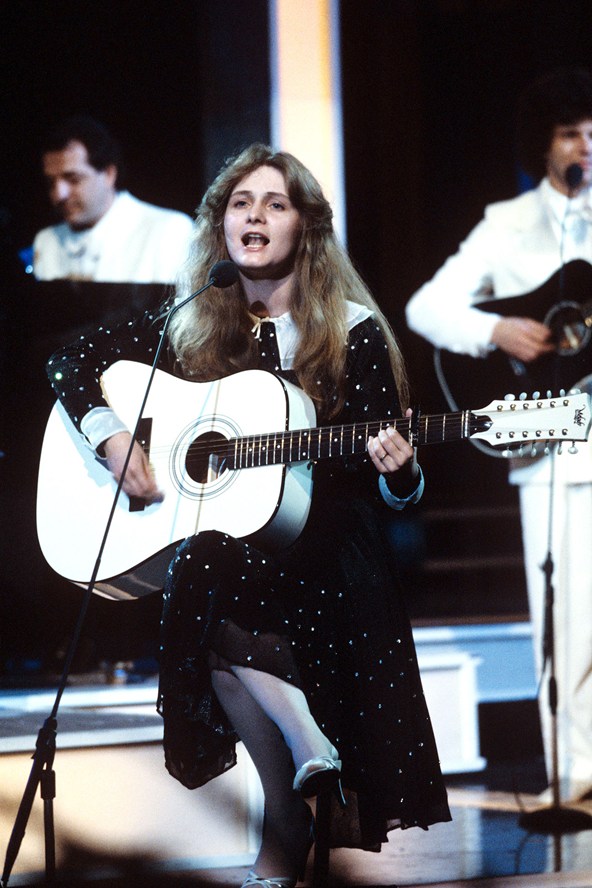
500. ‘A Little Peace’, by Nicole

For the third year in row, the song that won the Eurovision Song Contest also tops the UK singles chart. Unlike Bucks Fizz in 1981, though, the winner is not British. Nor Irish, as Johnny Logan was in 1980. Enter Nicole Hohloch, a seventeen-year-old German.

A Little Peace, by Nicole (her 1st and only #1)

2 weeks, 9th – 23rd May 1982

Just like a flower when winter begins… It’s jaunty, it’s cute, it’s pure Eurovision… Just like a candle blown out in the wind… And, oh no, I’m getting flashbacks… Just like a bird that can no longer fly… Dana flashbacks! Twelve years ago, another teenager won with a similarly saccharine slice of Eurocheese. ‘A Little Peace’ isn’t that bad – very few records are – but it still sticks in your throat.

The world is hard but, deep in her young heart, Nicole has a dream. A little loving, A little giving… For our tomorrow, A little peace… Straight on from ‘Ebony and Ivory’, it’s more happy-clappy ‘peace’ nonsense at the top of the charts. (Though I can tolerate this crap from naive schoolgirls far more than I could from Misters McCartney and Wonder, who should have known better…)

The nicest thing about this record is its gentle country lilt. It’s been a good while since we had a #1 that we could class as ‘country’. And I’d also like to mention Nicole’s excellent English. You’d think she was singing in her native tongue. (There is also a German version.) But, overall, this is a pretty forgettable record. And forgotten it pretty much has been – it’s nowhere to be seen on Spotify, for example.

At the time, though, this was huge. A first ever German Eurovision winner (perhaps the definitive sign that Europe had forgiven them for you-know-what?) and the biggest winning margin until 1997. Nicole continues to record and perform, she’s still only fifty-seven, though chart success outside of Germany has been limited. Plus, Nicole is already the 3rd German act to top the charts in 1982, after Kraftwerk and The Goombay Dance Band, and it’s only May!

Most significantly for us, ‘A Little Peace’ marks the 500th number one. Hurray! We are actually well over two-thirds of the way through our never-ending countdown! If only it were a slightly more auspicious song to mark the occasion. I’ll do a special post to celebrate this milestone in a couple of days, alongside some cover-versions of past chart-toppers, then it will be back to normal service. Thankfully, after two #1s and five weeks of preaching, the next number one is about, oh yes, randy schoolboys buying condoms…

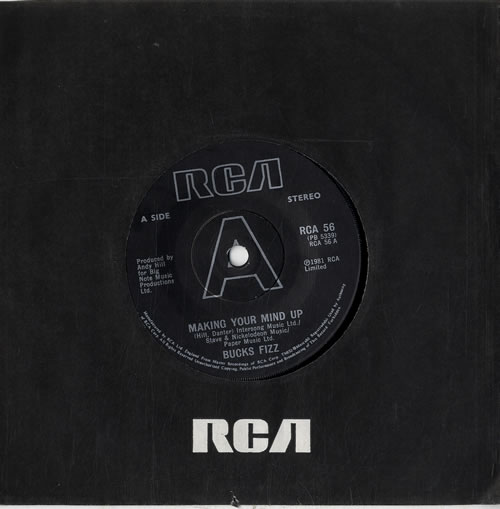
478. ‘Making Your Mind Up’, by Bucks Fizz

In which we arrive at what is perhaps the Ultimate Eurovision Song. Everything you want and need from a Eurovision winner is present and correct: stupidly catchy, key changes a-plenty, two guys and two girls, a memorable dance routine… and the whole thing as camp as Christmas.

Making Your Mind Up, by Bucks Fizz (their 1st of three #1s)

3 weeks, 12th April – 3rd May 1981

Not that, mind you, I’m claiming this as the best Eurovision chart-topper. Oh no, no, no. There’ll always be ‘Waterloo’ (and Gina G further down the line…) But if you shoved a microphone in someone’s face and screamed ‘Name a Eurovision act!’, half the British population, of a certain age, would say Bucks Fizz.

It starts with a chugging glam-rock drumbeat, and then in come some chugging glam guitars and you suddenly realise that we’re in the midst of a mini glam revival, what with this coming hot on the heels of Shakin’ Stevens’ rockabilly and an actual glam band’s belated #1. Meanwhile the lead guitars are kind of new-wave – seriously, detach them from the rest of this and they wouldn’t sound out of place on a Police record.

You gotta speed it up, And then you gotta slow it down… Not to suggest that this is anything other than a cheese-fest, though. And the lyrics verge from incredibly dumb to bizarrely suggestive. I have no idea if they were trying for innuendo with lines like: Don’t let your indecision, Take you from behind… and You gotta turn it up, Then you gotta pull it out… or if my mind is simply in the gutter.

(Apparently ‘Making Your Mind Up’ was released without a picture sleeve in the UK. Very 1960s…)

For the third time in eight years, a two-guys/two-girls combo won the Eurovision Song Contest. While Bucks Fizz were not ABBA, I’d say they were a step up from Brotherhood of Man. They were only formed a couple of months before entering the contest, but this smash kicked off several years’ worth of hits. And if the song wasn’t enough to win the contest, the band had a trick up their sleeve. In the 3rd verse, on the line: If you wanna see some more… the boys ripped the girls’ long skirts off to reveal much shorter skirts underneath! The continent gasped! I mean, the word ‘iconic’ is overused these days, but…

I have to say that, as revealing as the girls’ costumes were, watching the performance in full for the first time I can say that the boys’ white trousers weren’t leaving much to the imagination either. Bucks Fizz (even their name is ridiculous…) will be back atop the charts soon. Until then, you have two options: roll your eyes and pretend you’re too cool for school; or whip out your scandalously short mini-skirt and go for it. Make your mind up!

458. ‘What’s Another Year’, by Johnny Logan

Eurovision klaxon! It’s been a few years since we’ve had to sound it, but 1980 was one of those years when the winning record also went all the way on the pop charts…

What’s Another Year, by Johnny Logan (his 1st and only #1)

2 weeks, 11th – 25th May 1980

Some Eurovision singles have been classic – ‘Waterloo’, ‘Congratulations’ – other have been less classic – ‘All Kinds of Everything’, ‘Save Your Kisses…’. Into which camp, then, does ‘What’s Another Year’ slide into…? Well…

I won’t keep you on tenterhooks. It’s the latter camp. From the opening seconds, when a gratuitous, easy-listening saxophone riff rises up, you know where this record is heading. We’re back in David Soul territory: a handsome lad – think a slightly more rugged Donny Osmond – crooning his heart out. I’ve been crying, Such a long time, With such a lot of pain, In every tear… What’s another year? The tweens and the grannies must have lapped it up.

In my post on the previous #1, ‘Geno’, I repeated my belief that pop music, at the very least, shouldn’t be boring. ‘What’s Another Year’ is a well-produced, and well-sung, song… but it’s dull. And that sax… It comes back for a pure elevator-slash-lounge-bar solo, that is a horrible premonition of what’s to come in the middle of this decade. To be fair, the song isn’t actually about a lost love, but about the death of the writers’ mother, which does make it a bit more heartfelt in my eyes.

(I love the weeping eye in the corner of this sleeve, just in case you were in any doubt what type of song this was…)

Of course, this record won Logan, and Ireland, the Eurovision Song Contest. Johnny clearly felt that the continent hadn’t suffered enough, as he re-recorded his biggest hit several times, including in Spanish and German. (I think the version I listened to for this post was the original.) And he wasn’t done there… This man is Mr. Eurovision. He won it again in 1987, with ‘Hold Me Close’ (that made #2 in the UK, and is even slicker and limper than this one…) Then he went and wrote the 1992 winner, ‘Why Me?’ for Linda Martin, on top of having written the 1984 runner-up, ‘Terminal 3’, for the same woman. (Of all four songs, ‘Terminal 3’ is by far the best: a Bonnie Tyler-esque barnstormer.)

Ireland may have won Eurovision more times than any other country, but goodness they’ve done so with some utter tripe. Anyway, Johnny Logan struggled to score any non-Eurovision hits in the UK, but he’s had better luck in his homeland, releasing his latest album in 2017, and scoring Top 10 hits as late as 2013. And I might as well break it to you now… we will also be sounding the Eurovision klaxon in 1981. But, boy oh boy, that record will be everything that this one is not!

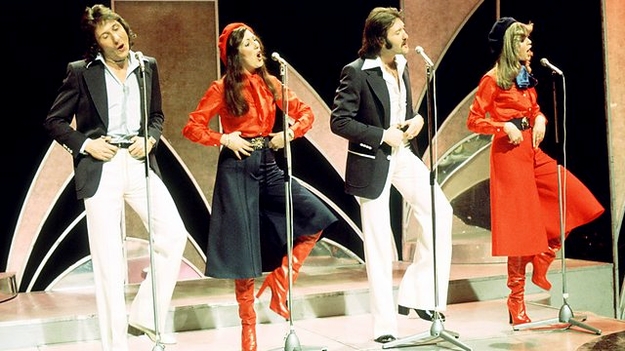
387. ‘Save Your Kisses For Me’, by Brotherhood of Man

Oh Lordy, it’s Eurovision time again. Our 5th Eurovision chart-topper. (We need some kind of advance warning system – a Eurovision siren that I can sound to prepare you, dear listeners, for what you are about to hear…)

Save Your Kisses For Me, by Brotherhood of Man (their 1st of three #1s)

6 weeks, from 21st March – 2nd May 1976

Not that every Eurovision entry is terrible, of course. For every ‘All Kinds of Everything’ (shudder) there is a ‘Waterloo’ (hurray). ‘Save Your Kisses For Me’ is, though, more towards the Dana end of the Eurovision-ometer. It is the easiest and the cheesiest slice of seventies pop-pap. I think this might actually be the very pinnacle of the genre, and that’s not a compliment.

Though it hurts to go away, It’s impossible to stay… We’ve got all the sentimental schlager themes going on here: separation, a man doing a man’s work, a cute woman pining at home… I’m getting whiffs of ‘The Green, Green Grass of Home’ and ‘Billy, Don’t Be a Hero’, minus all the war and executions. I’m also getting more than a whiff (an almighty reeking stench, to be honest) of Dawn’s ‘Tie a Yellow Ribbon…’ The melody is uncannily similar, and lead singer Martin Lee’s ‘tache and chest-hair combination is veryTony Orlando.

Save… Your… Kisses for me, Save all your kisses for me, Bye-bye baby, Goodbye… You don’t have to dig too deep for other chart-topping comparisons, either. The ‘bye-bye baby’ line sounds mighty familiar, while Brotherhood of Man’s two boys-two girls line-up was clearly following ABBA’s successful formula from two years earlier. And it worked. Not only did ‘Save Your Kisses For Me’ win the contest, it was the biggest single of 1976, and is still one of the biggest selling singles of all time in the UK…

There are a few things to like about this record. There’s a barroom piano, which always sounds good in singalongs like this, and some ridiculous trumpet flourishes. And at least it doesn’t take itself too seriously, which would be a disaster. I’m about to admit that I’m warming to this silly little record… Until, wait a moment. There’s a plot-twist in the very last line.

Won’t you save them for me… Lee croons… Even though you’re only three… The song ends as you’re still wondering what the hell just happened. Ah, of course. He was singing to his daughter all along. Awww… Actually, no. If I were scoring each #1, then that would have just knocked five points off this one’s total. And not because it’s unintentionally creepy – making you think he’s singing about his girlfriend only to find out it’s a toddler – but because it’s dumb. And it’s been done before. Gilbert O’ Sullivan did it in ‘Clair’ four years ago, and it annoyed me then, while Chuck Berry did it in ‘Memphis, Tennessee’ way before that… It is the pop song equivalent of a TV show playing the ‘It was all just a dream…’ card.

Whatever the reason, people clearly dug this kind of cute trick in the seventies. They launched this record to the top of the charts for six long weeks. And they launched the chart-topping career of Brotherhood of Man, who managed something that not many Eurovision acts (ABBA excluded) manage… follow-up hits. Follow-up chart-toppers, even. Save your kisses until then, then, as the Brotherhood will be back. I’ll have my siren up and running by then, to give you plenty of advance warning…

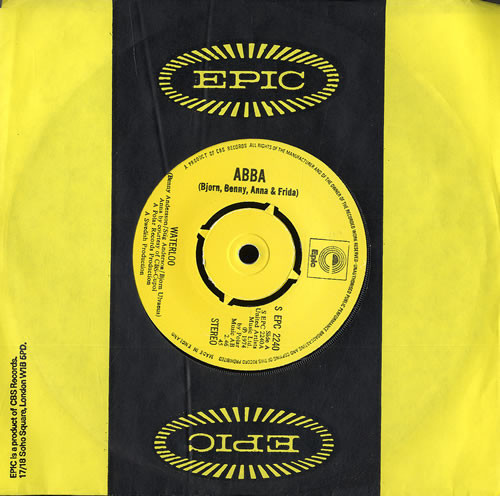
348. ‘Waterloo’, by ABBA

And entering, stage right: some genuine pop music legends.

Waterloo, by ABBA (their 1st of nine #1s)

2 weeks, from 28th April – 12th May 1974

Are ABBA the best pop group ever? Like, pure pop? Well, they get my vote. I will not hear a bad word spoken against them. And these days, you don’t often hear much bad spoken about ABBA – they’ve shaken off the image that they were fit only for gay bars and hen nights, and have assumed their rightful place in the pantheon. Everyone loves ABBA. But… I’m writing as if wrapping up their final chart-topper; not introducing their first. To business!

It is perfect, the manner in which Benny, Bjorn, Agnetha and Anni-Frid shoot out the blocks on their first #1. ‘Waterloo’ is not a record that takes its time to reveal its charms. It’s a wham, bam, thankyou ma’am sort of pop song. It won the Eurovision Song Contest, for God’s sake: a feat not often achieved through subtle means. The churning bass, the thumping piano… My, my! At Waterloo Napoleon did surrender…

For a band that specialised in camp melodrama, this opening line – comparing their love for someone to an 19th Century military leader’s last stand – is as camp and melodramatic as it comes. Oh yeah! And I have met my destiny in quite a similar way… Cue one of the catchiest choruses ever recorded: Waterloo! I was defeated you won the war, Waterloo, Promise to love you for ever more… (A big part of this song’s success, I think, is the way they pronounce the title in their Swedish accents: Wardahloo! With added emphasis on the ‘ooh’.)

It’s pointless looking for the hook here. The entire song is a two minute forty eight second long hook. The ridiculous saxophone licks, the woah-woah-woahs, the pounding piano ‘n’ drum intros to each chorus, something the band admits were ripped straight from Wizzard’s ‘See My Baby Jive’. ‘Waterloo’ is a huge, unashamed sugar rush of a song. Perfect, perfect pop.

In 1815, Napoleon Bonaparte was defeated once and for all, and exiled to the south Atlantic. In 1974, Agnetha and Anna-Frid give in and admit their love. As they put it in the song’s best line: So how can I ever refuse? I feel like I win when I lose! (The writers of ‘Mamma Mia – The Musical’ clearly gave up on trying to shoe-horn a song about a two-hundred year old battle into the story, and stuck in at the very, very end, as an encore.)

As a kid, this was my favourite track on ‘ABBA Gold’. It is no longer my favourite ABBA song, but it is the perfect first chart-topper for the band. They would go on to reach much greater heights of subtlety and sophistication; though it’s debatable whether they wrote a catchier hit. Meanwhile, it was also voted as the greatest Eurovision song for the contest’s 50th anniversary.

This hit proved to be a bit of a false start for ABBA, though. They struggled to follow ‘Waterloo’ up, in the UK at least, and we’ll have to wait almost two more years for their next #1. Once that arrives, however, there will be no looking back. It feels like we’ve entered a new phase in our journey through the chart-toppers… It’s the mid-seventies, and we’ve finally met the decade’s greatest band!

284. ‘All Kinds of Everything’, by Dana

We are only four #1 singles into the 1970s, and we already have a contender for the worst chart-topper of the decade. Prepare yourselves…

dana

All Kinds of Everything, by Dana (her 1st and only #1)

2 weeks, from 12th – 26th April 1970

The intro comes in like the theme-tune to an educational show, aimed at nursery school kids. You brace for something bad, but nothing can quite prepare you for just how bad it’s going to be. Snowdrops and daffodils, Butterflies and bees, Sailboats and fishermen, Things of the sea… The entire song is a list. A list of the things that remind the singer of her special someone. Seagulls, And aeroplanes, Things of the sky… (Seagulls? Who sees a seagull and thinks of their beloved? Maybe he saved her from one that was trying to steal her chips?) All kinds of everything, Remind me of you…

Literally everything reminds her of him. Insects, the wind, wishing wells, morning dew, neon lights, postcards, grey skies or blue… Everything. It just doesn’t work. These are lyrics that could have been written by a ten-year-old (though, actually, I teach ten-year-olds, and it’s insulting of me to think they couldn’t write something better than this.) The only way this song works is if the singer is a wide-eyed child, no older than thirteen.

And, to be fair, Dana does have a very innocent, childlike voice. She sells the drivel that she’s singing, in her lilting Irish accent, and sounds like she believes in it… (*Edit* She was eighteen when ‘All Kinds of Everything’ was released. Far too old.) Things take a slightly creepy turn when she starts to sing of dances, romances, things of the night… And you think, be careful Dana, I know what happens to young Irish girls that find themselves ‘in trouble’. I’ve seen ‘Philomena’…

R-1706278-1477809062-9075.jpeg

This was a hit thanks to the Eurovision Song Contest – an evening famous for terrible music. But not this type of terrible. Eurovision is over the top, camp, cheesy glitz. We’ve had one winner hit #1 so far – Sandie Shaw’s ‘Puppet on a String’ – as well as Cliff’s ‘Congratulations’, which took the runners-up position. Neither of those records were very credible, but they were fun. This, though, isn’t interesting terrible or fun terrible… It’s just terrible terrible. And yet… it won. The rest of Europe heard ‘All Kinds of Everything’ and thought, yeah, go on then.

‘All Kinds of Everything’ was Dana’s first big hit, though she had been releasing music since 1967, and it gave Ireland their first Eurovision win. She would have hits in Ireland, and in Europe, throughout the seventies, but her star slowly waned. By the eighties she had turned to more traditional, Christian music before she was elected as a member of the European Parliament for Connacht-Ulster in 1999. She still records music (in 2007 she released an album called ‘Good Morning Jesus!’, no less.)

Well then. It’s been a scattergun start to the seventies. Like I said, we’re only on the 4th number one and we’ve already had some catchy, no-nonsense pop, a grizzled actor and a genuine classic at the top. And now this… The charts come and go in peaks and troughs. We’re definitely hitting a bit of a trough through the tail-end of ‘69 and into the seventies. But then, the golden days of the swinging sixties couldn’t last forever, could they? We will wait with bated breath for the 1970s to spring fully into life…

248. ‘Congratulations’, by Cliff Richard

Just what we needed – a bit of Cliff. 1968 has so far been a year in which everything and everyone has had a go at #1, and Sir Clifford doesn’t need to be asked twice before claiming his ninth number one single.

13aa6fc88a28837e7323cce44c8ecde2

Congratulations, by Cliff Richard (his 9th of fourteen #1s)

2 weeks, from 10th – 24th April 1968

I’d say that this, along with ‘Summer Holiday’ and ‘Mistletoe and Wine’, are the quintessential Cliff hits. The ones that people would go for if you shoved a microphone in their face and yelled ‘Name a Cliff Richard song!’ I know without even checking that this was one of the songs he sang during that rain delay at Wimbledon. Peak Cliff.

It goes without saying that ‘Congratulations’ is complete and utter cheese. It blasts into life with a goofy grin, all horns and handclaps, sounding like the theme song to the campest game show never commissioned. Congratulations, And celebrations, When I tell everyone that you’re in love with me… It also goes without saying that it’s pretty irresistible.

The big drums, the whimsical strings, the jaunty guitar, the music hall horns… It’s pop at its most disposable; yet also at its purest. ‘Congratulations’ is a song that exists to make people smile and tap their feet – a song that would get a reaction out of anyone aged between seven and ninety-seven. Congratulations, And jubilations, I want the world to know how happy I can be…

And, unlike some of the snoozers Cliff was releasing towards the end of his imperial phase – ‘The Next Time’, ‘The Minute You’re Gone’ and the like – at least it’s upbeat. I especially like when it slows down and Cliff starts doing the can-can (in my mind at least…) I do wish they’d kept it up and gone for a big, bawdy brass finish.

71ZBB6s7+dL._SL1280_

It’s tempting to see this as a comeback for Cliff – his 1st #1 in three years. But that would be to rewrite history. Between ‘The Minute You’re Gone’ and ‘Congratulations’ he had managed to score six Top 10s. Just because he wasn’t topping the charts with every release doesn’t mean he had gone anywhere. He was a still huge presence, and would continue to be for the next forty-odd years. But, after a year in which Engelbert, Petula Clark, Tom Jones et al had taken easy-listening back to the top of the charts, perhaps he felt safe enough to stop trying to catch The Beatles and to just settle into middle-of-the-road comfort. Maybe this is the exact moment that Cliff the rocker finally is laid to rest, and Cliff the housewives’ favourite is born?

‘Congratulations’ was famously the British entry to the Eurovision Song Contest in ’68, in which they were defending the crown won by Sandie Shaw’s ‘Puppet on a String’ the year before. It was the hot favourite, but was beaten at the last by the Spanish entry ‘La La La’. Rumours abounded that the result had been fixed on the orders of Franco himself! But still, ‘Congratulations’ was a huge hit across Europe – #1 from Norway to Belgium, to Spain itself.

Looking back, we’ve only gone nine years since Cliff’s first chart-topper ‘Living Doll’, but so, so much has changed. Rock ‘n’ roll has died, been revived, died again… Merseybeat, R&B, Soul and Folk have all been the order of the day. Meanwhile, Cliff has stayed afloat just by being Cliff. Fortunately / Unfortunately (delete as appropriate) we won’t hear from him now for another eleven years…

232. ‘Puppet on a String’, by Sandie Shaw

Oh, won’t somebody drag us out of the middle-of-the-road slump we’ve been in for months now…? Can that somebody be Sandie Shaw? I have high-hopes…

8d917f1f-518a-4e31-a3e8-cfb1159edd27

Puppet on a String, by Sandie Shaw (her 3rd and final #1)

3 weeks, from 27th April – 18th May 1967

…that are not disappointed. Roll up! Roll up! This is a crazy little record. From the get-go. From the oompah band intro that morphs into a fairground soundtrack – a demented, horror-movie kind of fairground, that is.

Love is just like a merry-go-round… sings Sandie, like your aunt after a sherry or two… With all the fun of the fair… It’s a fairly simple metaphor: love as fairground ride. But this song takes it all the way, to the extent that we get Big Top sound-effects and crashing cymbals. You really can picture her as a marionette, or as a Judy doll behind a makeshift stage.

If you say you love me madly, I’ll gladly be there, Like a puppet on a string… It’s a fun record. A bit mad. If it were a person you might cross the street to avoid them. But it’s interesting, if nothing else, unlike some of our recent chart-toppers. It’s chanty, and catchy, and Sandie does at least get to stretch her lungs on lines like: Are you leading me on, Tomorrow will you be gone…? At other points she sounds a bit drunk, to be honest. It’s a ‘proper’ pop song, but it’s comes very close to crossing the line into ‘novelty’ territory’.

SANDIE_SHAW_PUPPET+ON+A+STRING+-+4-PR-408516

It makes complete sense that this was a Eurovision Song Contest entry. In fact, it explains a lot. Subtlety and  nuance are not in big supply at Eurovision. And not only was it an entry, it was the winning entry! Britain’s first ever! (Yes, the UK used to win Eurovision.) Sandie had been convinced to perform the British entry to get back into the public’s good books after a divorce scandal, although she hated it. In her own words: ‘I hated it from the first oompah… I was instinctively repelled by its sexist drivel and cuckoo-clock tune.’ Brilliant stuff, up there with Frank Sinatra’s dismissal of ‘Strangers in the Night’.

I think she was a bit harsh, to be honest. It’s fun, camp, silly… Perfect for Eurovision and, most importantly, not a bland, easy listening, country-lite ballad. Had ‘Puppet on a String’ come along elsewhere in our countdown I might have had less patience with it but, as it is, I’m just happy to have it liven proceedings up. And Sandie must have softened towards it, or the royalty cheques it brought her, as she rerecorded it for her sixtieth birthday.

That’s it for Ms. Shaw and the top of the charts. She would only have one more Top 10 – the equally kooky ‘Monsieur Dupont’ in 1969. I’ve enjoyed it every time she’s come along, with the classy ‘(There’s) Always Something There to Remind Me’ and the fluffy ‘Long Live Love’ and now this. She just seems very, I don’t know, sixties. She officially retired from the music business in 2013. And, if nothing else, I appreciate the symmetry of all three of her chart-toppers spending three weeks each at the top!

Follow my Spotify playlist, why don’tcha: