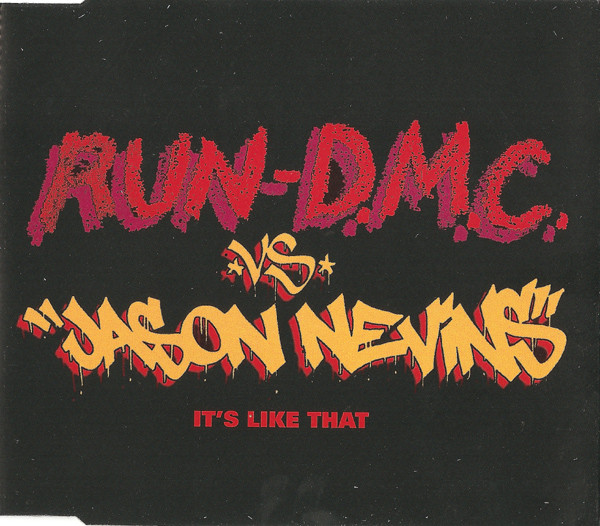
787. ‘It’s Like That’, by Run-D.M.C. vs Jason Nevins

Check this out… Just a couple of weeks after Norman Cook worked his magic on Cornershop’s ‘Brimful of Asha’, American house DJ Jason Nevins has his wicked way with a hip hop golden oldie…

It’s Like That, by Run-D.M.C. vs Jason Nevins (their 1st and only #1s)

6 weeks, from 15th March – 26th April 1998

I remember this being huge, an omnipresent hit that spring. And six weeks at number one is a very impressive run for the late-nineties (only one song will beat that total in 1998). But listening now, I’m a bit stumped trying to work out why it was quite so popular… It’s a bit repetitive, a sledgehammer beat that goes on, and on, with a less stardust sprinkled by Nevins compared to Fatboy Slim. Some of the transitions are predictable, and the original Run-D.M.C. vocals feel off in the mix.

Not that it’s bad, or that I don’t enjoy it on a certain level, or that it doesn’t unleash a heady wave of nostalgia listening to it again in 2024. I just mean that I can’t really locate the reason that it became the year’s 3rd best-selling single and – even more impressively – the only record to ever hold a Spice Girls’ song off number one in the UK (this was released in the same week as ‘Stop’, which it beat to the top by well over 100,000 copies).

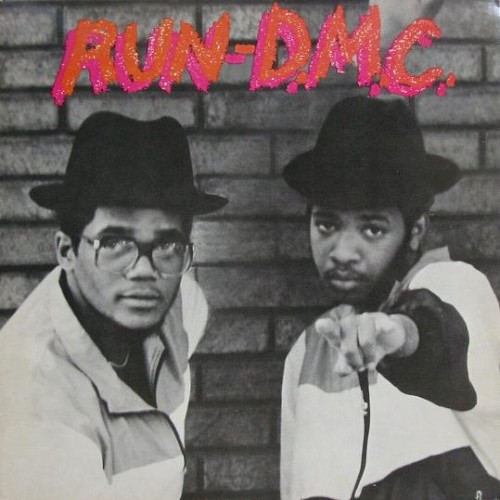
The original ‘It’s Like That’ had featured on Run-D.M.C.’s debut album in 1984, and was released as the LP’s first single. It’s a call-to-arms – a spikier, more cynical ‘What’s Going On’ for a new decade: Unemployment at record highs, People coming, People going, People born to die… Don’t ask me because I don’t know why, It’s like that, And that’s the way it is… What’s interesting about the original is that the 1998 hit is there, fully formed. If anything, the beat is even heavier. Nevins does little more than tart it up with a standard dance rhythm and some up-to-date flourishes (which admittedly is also what Norman Cook did on ‘Brimful…’, I just like that song better).

The one notable thing that Nevins does add is the sped-up Run DMC and Jam Master Jay! break, along with a bit off beatboxing. That’s the part I most remember, perhaps the hook that sold this as a hit. But in actual fact it last barely ten seconds, before that relentless beat comes slamming back in. (I always assumed that ‘Jam Master Jay’ was Jason Nevins, but he was actually the DJ in Run-D.M.C, who was sadly shot dead in 2002.)

Not surprisingly, this would be both Run-D.M.C.’s and Jason Nevin’s biggest ever hit. Nevins has only returned to the Top 10 one further time, although he’s gone on to work with stars like Nelly and Ariana Grande. For Run-D.M.C., this was their second Top 10, a decade on from ‘Walk This Way’ – in which they and Aerosmith fused rap with rock, much like Nevins was fusing rap and dance on this record.

Is it too early to call this the Age of the Remix? It is true that we’ve had two in quick succession, and that remixed hits will be more noticeable at the top of the charts as the century turns. I think it’s the fact that this is the first ‘versus’ record to make #1, as opposed to a plain old ‘featuring’ or an understated ‘&’. It feels so very turn of the twenty-first century (though a quick scan has shown me that there will actually only be a couple of other ‘someone versus someone else’ number ones between now and 2005.)

783. ‘Doctor Jones’, by Aqua

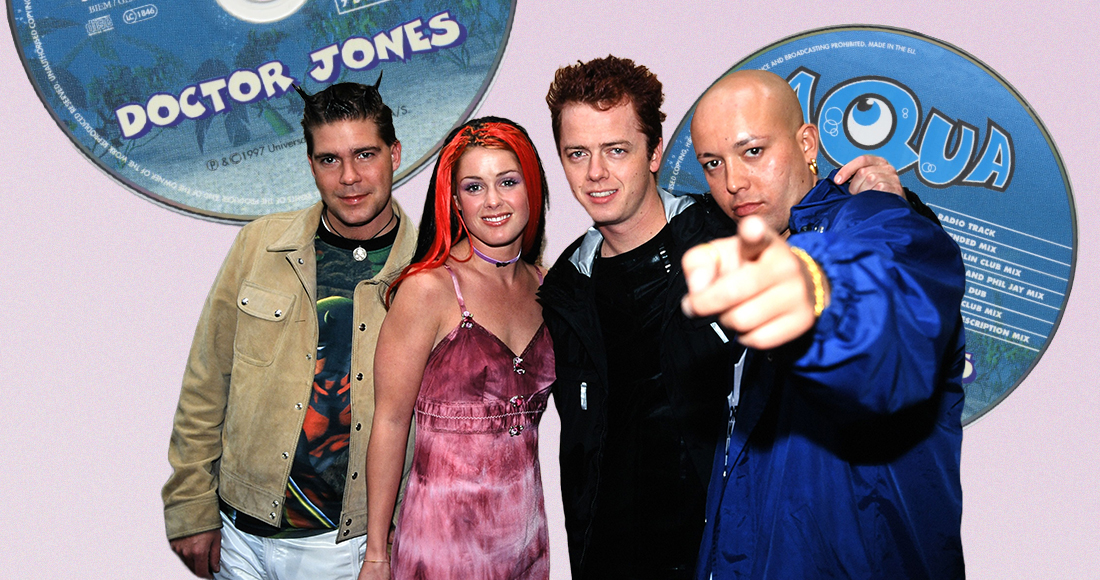
Aqua, looking for all the world like they’d be one-hit wonders, surprise us all by returning with not just a second hit, but a second number one.

Doctor Jones, by Aqua (their 2nd of three #1s)

2 weeks, from 1st – 15th February 1998

Perhaps the trick was that they stuck to a clear ‘if it ain’t broke’ formula. Female and male vocals, Eurodance production, about five different ultra-catchy hooks… The demand was obviously there post-‘Barbie Girl’. The tempo is increased from their earlier hit, giving this a proper Hi-NRG bounce to it. And like its predecessor, this single is also based around a pop culture icon.

The ‘Doctor Jones’ of the title is Indiana Jones, as made clear by the video in which Lene (formerly Barbie) and the other two members of Aqua plough through the jungle in search of René (formerly Ken). Doctor Jones, Doctor Jones wake up now… prattles the chorus, and he does wake up just in time to save his bandmates from being boiled alive. As with the ‘Barbie Girl’ video it’s good camp fun.

This whole endeavour, is of course, complete cheese, and if your tolerance for cheesy Eurotrash is low then this record certainly won’t be for you. I’m fairly immune to it, but the ayypee-aieeooaayyoo-ayypeeay-eh (I believe that is the official transliteration…) line in the chorus is annoying even to me. And sadly, René’s role is much less than it was in ‘Barbie Girl’, with his gravelly voice being used mainly to echo Lene’s lead.

It’s not as good as their biggest hit, or as memorable, but it does successfully manage the difficult balancing act of replicating what made the former such a big smash, recycling it cleverly, but without simply churning out ‘Barbie Girl Part II’. That’s quite a hard trick to pull off, especially when their first hit had had such massive success but had been filed away quite firmly in the ‘novelty’ drawer.

I’m starting to sound like quite the Aqua apologist. But it wasn’t just me, honest! 1998 was their year! Not only did they manage this second number one, they will soon manage a third. A third that will prove them capable of writing a proper pop song, and not just novelty dance numbers.

776. ‘Barbie Girl’, by Aqua

One of the reasons that ‘Spice Up Your Life’, the Spice Girls hot new single, didn’t stay at number one for very long is perhaps because Spice mania was cooling off. But another is that one of the year’s (nay, the decade’s) biggest hits was waiting in the wings…

Barbie Girl, by Aqua (their 1st of three #1s)

4 weeks, from 27th October – 23rd November 1997

Hiya Barbie… Hi Ken… Before we get to the song’s subject, and the lyrics, we should note that otherwise this is fairly standard, late-nineties Eurodance beat and production. Synth strings and an airy keyboard line (I think the technical term is ‘Balearic’). Fill it with generic lyrics about reaching for the sky and living it large, and you’d have a standard dance hit, on a par with Whigfield’s ‘Saturday Night’, say. But the melody and the production are not why this was such a big hit.

‘Barbie Girl’ was so huge because of its subject matter, and how it somehow manages to be utterly dumb and yet quite clever; an annoying novelty and yet a total earworm. Take two of the song’s biggest hooks: Come on Barbie, Let’s go party… Ah, ah, ah, yeah… and Life in plastic, It’s fantastic… The first is stupidly simple, and yet it’s been in your head for the best part of three decades. The second is actually quite brilliant. The whole song succeeds because it constantly straddles this line between greatness and nonsense.

You could make too much of the song’s social commentary. It’s got some fun lines, and some borderline innuendo; but it’s hardly a feminist manifesto. The song’s best section is the second verse, because the way the beat rests before swishing into it is great, and because it contains the most ‘challenging’ lyrics. I can act like a star, I can beg on my knees… Barbie chirrups, before Ken ignores her with a Come jump in, Bimbo friend, Let us do it again… (Personally, René Dif’s gravelly, sleazy ‘Ken’ is the reason this song works. I think if it were all on Lene Nystrøm’s high-pitched ‘Barbie’ it would really start to grate.)

I think this also might be an example of the ABBA-factor, which I’ve mentioned before with non-English speaking acts. Because English wasn’t Aqua’s first language, the lyrics are perhaps simpler than someone with a native-level ability would have come up with. But this also means that the lyrics stick very easily. Aqua were Danish, and this was the third single from their debut album. They had been around since 1989, though the closest they’d come to success was as Joyspeed, with this truly spectacular happy-hardcore version of ‘Itsy Bitsy Spider’.

Mattel, the creators of Barbie, were not amused by this global smash, claiming that it besmirched the doll’s image and turned her into a ‘sex object’. They embarked on a five-year lawsuit, while Aqua’s label filed a countersuit for defamation. Both were dismissed, the judge wrapping up with the brilliant line: “Both parties are advised to chill.” By 2009, Mattel’s stance had softened, and they were using the track in adverts. By 2023, they had licensed the song for use in the ‘Barbie’ movie, as well as a remake by Nicki Minaj and Ice Spice. In fact, watching the video to ‘Barbie Girl’ now, it’s interesting to see just how similar it is to the world created for the movie.

You’d have gotten very long odds on Aqua having any follow-up hits, as this has ‘one-hit wonder’ written all over it. Well, not only did they not disappear, they have two further number ones to come…

767. ‘You’re Not Alone’, by Olive

We’ve not been short of dance hits in recent months, although their frequency hasn’t been as rapid fire as it was back in the early-to-mid nineties. And the dance hits of 1996-97 have tended to be of the chunky, Big-Beat variety. But this next number one is very different from the likes of the Prodigy, and the Chemical Brothers

You’re Not Alone, by Olive (their 1st and only #1)

2 weeks, from 11th – 25th May 1997

It’s a step back towards a lighter, House sound, with a female singer leading the cavalry. But it’s also a step forward, because it’s taking those sounds and adding a few more modern touches. Personally, I often dread writing entries on dance chart-toppers – not because I inherently dislike dance music; more because it’s out of my comfort zone. I’ve just about got my head around big beat and trance, and now I’m being told that ‘You’re Not Alone’ is at turns breakbeat, ambient, and trip-hop.

Basically, I am trying to write and learn as I go. Apologies if any dance music experts stumble across this blog, and it causes them to snap their glo-sticks in anger. Anyway, ‘ambient’ I get – it’s a very atmospheric track: melancholy, haunting even. And trip-hop I get too, thanks to the drum beat. ‘Breakbeat’ I’m happy to go along with, because it sounds fun.

And I do like this record. My favourite part is the trippy keyboard riff, which sounds so much like a passage from a classical composition that I was convinced it must be. It takes great skill to write a chord sequence that sounds so timeless. I remember this record from the time, watching it on TOTP, thinking it sounded very grown-up, not quite getting it. I still don’t quite get it, thirty years on, because this isn’t really in my wheelhouse. But it’s well-made, and diverting enough, to make it a worthy chart-topper. One that enhances further the quality of 1997, so far.

What I will say is that, for all the atmospherics, the track does hold back a little. I’m waiting for the drop, for a full-on, banging, trance finish that never comes. It remains slinky and strange until the end. But, as I’ve just proven, I know nothing about dance music. If I had my way behind a set of decks everything would end up sounding like 2 Unlimited (and, let’s be honest, that would actually be amazing).

Olive were a London-based three piece, formed in 1994. ‘You’re Not Alone’ had been a minor hit the year before, and this chart-topping version was a remix (though you’d be hard-pressed to notice much difference between the two versions.) I believe the video below to be the one that made #1. It was their only Top 10 hit – the follow-up made #14 – and they split in 2003.

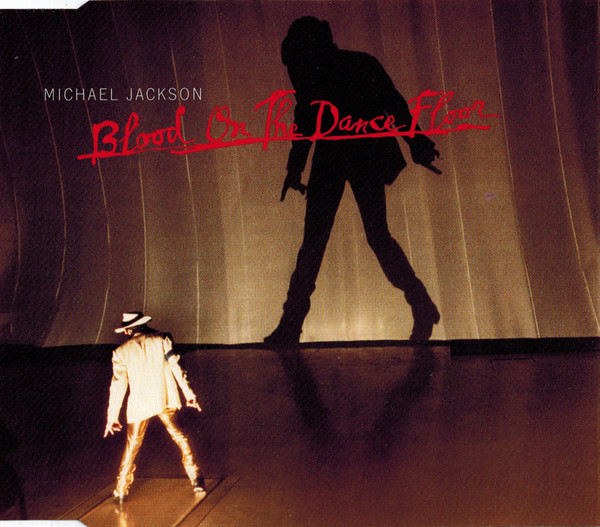
765. ‘Blood on the Dance Floor’, by Michael Jackson

And so Michael Jackson ends a twenty-year run of chart-toppers, with another of 1997’s curios…

Blood on the Dance Floor, by Michael Jackson (his 7th and final solo #1)

1 week, from 27th April – 4th May 1997

Throughout his career, it hasn’t been the MJ classics that have made #1. The Jacksons’ only made it there with ‘Show You the Way to Go’. Solo-wise, ‘One Day in Your Life’, ‘I Just Can’t Stop Loving You’, and ‘You Are Not Alone’ all made it, while ‘Bad’, ‘Beat It’, and ‘Smooth Criminal’ fell by the wayside. Only ‘Billie Jean’, and maybe ‘Black or White’, came close to popular ubiquity.

So what of his final #1? Well, at least it’s not a syrupy ballad, or one of his God-complex blockbusters. Actually, it’s much more reminiscent of his heyday. It isn’t up there quality-wise, but there are flashes. The bridge and chorus, the growl in his voice, and the dangerous woman in the lyrics, all feel very ‘Bad’-era. We can add Suzie (Suzie’s got your number, Suzie ain’t your friend…) to Billie Jean and Dirty Diana in Jackson’s list of ladies best avoided. Interestingly, some sources claimed that ‘Suzie’ was a metaphor for AIDS – giving a horrific double meaning to the line Look who took you under with seven inches in… – but Jackson denied it.

Elsewhere, the New Jack Swing production sounds quite dated, and away from the chorus he barely sings. The verses are a series of vocal tics strung together; sounding more like dolphins communicating, and just as indecipherable. When you learn that it was written originally back in 1991, during sessions for the ‘Dangerous’ album, the sound makes sense. The song was dusted off and tarted up ahead of Jackson’s remix album ‘HIStory in the Mix’.

In some ways, this is an underwhelming way for MJ to bow out. But then, several of his six other solo #1s have been underwhelming. And actually, compared to some of his nineties hits, this is a decent, if dated, dance tune with a fairly killer, funky beat. It was his 36th UK Top 10 hit, since his solo debut in 1972, and he still had a few more to come.

In fact, since his death he has featured on big hits with Akon, Justin Timberlake, and Drake, and so you wouldn’t count against him adding to his total in the years to come. Quite why records featuring Michael Jackson are still allowed to flourish while those featuring the man who preceded ‘Blood on the Dance Floor’ at number one – R. Kelly – have been buried in quicklime is a discussion for another day… Is it as simple as one having a court conviction? Or does musical snobbery come into play…? And I’ll end with an equally pressing question: am I the only person who just now realised that ‘dance floor’ is not one word…?

763. ‘Block Rockin’ Beats’, by The Chemical Brothers

Like their Big-Beat chums the Prodigy, the Chemical Brothers enjoyed two chart-toppers across 1996-97. When it came to the Prodigy’s ‘Breathe’, I wondered if it could be mentioned in the same breath as the pop culture moment that was ‘Firestarter’. I won’t be asking a similar question this time around…

Block Rockin’ Beats, by The Chemical Brothers (their 2nd and final #1)

1 week, from 30th March – 6th April 1997

For ‘Block Rockin’ Beats’ is not up to the standard of the wonderfully trippy ‘Setting Sun’. Not that it isn’t ear-catching, or that there’s nothing interesting in this melange of sounds. Or that underpinning the entire five minutes of noise there isn’t a pretty cool bassline. All this is true. But at times this song has the feel of a dance record from a decade before, when samples were thrown together with novelty, rather than musical, value in mind.

‘Block Rockin’ Beats’ contains what sounds like sirens, snatches of different hip-hop songs (including the constantly repeated Back with another one of those block rockin’ beats…!) and what I imagine is a donkey being assaulted with a red-hot poker. I’m not writing it off, because I do enjoy dance music when it’s this chaotic and aggressive, but it also feels like a Big Beat song written to order. ‘Setting Sun’ had the advantage of Noel Gallagher on vocals, and a thick dollop of inspiration from the Beatles, which this record lacks.

Looking further into the chart history of ‘Block Rockin’ Beats’, and other one-week #1s of the time, is interesting. It’s maybe time to introduce the term ‘non number one’. Not that I want to deny the Chemical Brothers their second chart-topper. They’ve added to the rich and interesting tapestry of 1997’s #1s, making it an enjoyable year so far. But after entering at the top, it dropped to #8 the following week, and ranked at #88 on the best-selling songs of the year list. Similarly, Blur’s ‘Beetlebum’ had fallen #1 to #7, while U2’s ‘Discotheque’ fell #1 to #6, both after just one-week stays on top.

I was asked recently by a commenter why this was, and I answered that it was to do with songs in the mid-late 1990s being promoted heavily, sometimes for weeks, before being released. So the majority of their sales were concentrated in the first week they were available. But it also ties into the fact that this period also saw some of the highest singles sales of all time. I don’t know if it was to do with disposable income, or the ubiquity of CD players, or even the quality of the music, but demand was there and record labels needed something to fill it. If anyone has noticed that it is taking us ages to get through entire years now (there will be as many #1s between January and May ’97 as there were in the entirety of 1992) then there’s your answer.

None of this is to say that the Chemical Brothers weren’t a genuinely popular act. They had no further #1s, but would go on scoring Top 20 hits for another decade after this. Including what is probably their signature song, ahead of either of their chart-toppers, 1999’s ‘Hey Boy Hey Girl’, which made #3.

760. ‘Discothèque’, by U2

We come to the last of five one-week number ones, the end of a run of interesting short-stays at the top of the charts. And is this the most interesting?

Discothèque, by U2 (their 3rd of seven #1s)

1 week, from 9th – 16th February 1997

U2 do dance. Or at least, U2 incorporate dance beats, loops and lots of effects into a rock song. Sadly, the title is misleading – there’s no disco to be found here. Bono doing his best Gloria Gaynor is sadly still a pipe-dream, though at various points he does attempt a falsetto to rival the Bee Gees.

No, the ‘dance’ element is firmly nineties-dance – house beats with a techno-ish edge. But underpinning it all is a pretty cool guitar riff, which is fed through different layers of feedback as the song winds on. It is at times crunchy, chiming and, in its best incarnation, gloriously scuzzy. It means that for all Bono’s theatrics, ‘Discothèque’ is actually the Edge’s show, especially when you see his handlebar moustache in the video…

But more on that in a sec. As soon as this single was played on the radio, rock snobs may well have clutched their pearls in horror at what U2 had become. Dance beats! In a rock song! And remixes… by DJs! Pass the smelling salts… But the Prodigy and the Chemical Brothers, even Babylon Zoo, have been pushing this sound for months already, to great success. If anything the critics could have accused U2 of bandwagon jumping. But who cares if it’s not that original – it’s a fun tune. A banger that is sadly forgotten among some of U2’s bigger, more po-faced, hits.

Plus, anyone complaining about this hadn’t been listening to U2 for the better part of a decade. Large swathes of ‘Achtung Baby’ and ‘Zooropa’ had incorporated non-rock influences. Their last #1, ‘The Fly’ was well over five years earlier, but you can hear the roots of ‘Discotheque’ in it, and for most of the 1990s they had been flirting with some avant-garde stuff. So, no, this cannot claim to be the quirkiest of our recent chart-toppers – that accolade remains with White Town. Finally, what confirms this as a good song is that the band look like they’re having great fun in the video, prancing around inside a disco ball, and dressing up as The Village People.

In my posts on U2’s previous number ones, ‘The Fly’ and ‘Desire’, I may have referred to them not being my favourite band, and Bono not being my favourite frontman. But actually, their first three chart-toppers are all very good, and very different. I might even name ‘Discothèque’ as my favourite of all their #1s, if I didn’t know one of the harder-rocking ones to come. It’s definitely better than their next chart-topper, which is U2 by numbers. In fact, this, and the ‘Pop’ album, were probably the last really experimental thing that the band did. For their next LP, in 2000, they went back to the stadium rock anthems that their fanbase loves, but that always leave me a little cold.

756. ‘Professional Widow (It’s Got to Be Big)’, by Tori Amos

1997, then. The late ’90s! And we get off to a banging start…

Professional Widow (It’s Got to Be Big), by Tori Amos (her 1st and only #1)

1 week, from 12th – 19th January 1997

‘Professional Widow’ was a track from singer-songwriter Tori Amos’s third studio album, ‘Boys for Pele’, which had made #2 exactly a year before this. It had been released as the album’s third single, making #20. It’s a woozy, rude, barroom stomper of a song, driven by a harpsichord, and Amos’s Kate Bush like vocals. It’s ear-catching, but it does nothing to prepare you for the remix that would eventually top the chart.

The word ‘remix’ doesn’t feel sufficient here. A remix is a song rearranged, extended, or stretched out over a new beat. This is a song completely reimagined, huge chunks chopped off it, with very little of the original remaining. One line is repeated over and over: Honey bring it close to my lips… while the other line – It’s gotta be big – must be somewhere in the original, even if I can’t quite hear it.

It’s amazing how Armand Van Helden, the DJ responsible, could hear the opening harpsichord riff and reimagine it as a modern disco bassline. Some remixes are fairly lazy, with few changes of any note; but not this. It almost samples the original, the riff and the two lines, and creates a completely different song. Van Helden is American, and the track is more house-influenced than our recent dance #1s, but there’s hints of the Prodigy and the Chemical Brothers in the big chunky beats, in the creepy background noises, and the sudden break halfway through.

The ‘Professional Widow’ of the title is apparently a snide reference to Courtney Love, something that Amos has neither confirmed nor outright denied. She had nothing to do with the remix – she was contractually obliged to approve them – but in interviews she has said she enjoys Van Helden’s version. It brought about the biggest hit of her long career, anyway – surpassing the #4 peak of the folksy ‘Cornflake Girl’ from 1994 – and is, to date, Amos’s last visit to the UK Top 10. Armand Van Helden was just getting started, and will go on to be one of the biggest dance producers of all time. He’ll be back at number one, fully credited, fairly soon.

We can’t finish without mentioning the misheard lyric – one of pop’s filthiest mondegreens – where It’s gotta be big becomes… Well, I won’t write it out. Safe to say, once you hear it you can’t unhear it. Misheard or not, it does fit in fairly well with the bawdy original.

You could say that this is a classic January #1 – a fairly random remix sneaking a week at the top in the post-Christmas lull. In fact, January 1997 is one of the best examples the phenomenon, with a run of fun and quirky one-weekers coming up that I’m looking forward to getting into.

751. ‘Breathe’, by The Prodigy

Post-recap, we delve into the next thirty. And it’s a very strong start to the next bunch: more headbanging nastiness from The Prodigy.

Breathe, by The Prodigy (their 2nd and final #1)

2 weeks, from 17th November – 1st December 1996

Is ‘Breathe’ better than ‘Firestarter’? Or is it just more of the same thing? Not that more of the same thing, when the thing in question is ‘Firestarter’, is a bad thing, but still… It’s definitely built around the same foundations: a Drum and Bass beat, a heavy riff, a distinctive sample (that sounds to me like someone throwing nunchuks around), and some pretty aggressive lyrics.

Come play my game… growls Keith Flint, like the villain in a particularly twisted fairy-tale. Inhale, Inhale, You’re the victim! responds rapper Maxim, who also gets the song’s best line: Psychosomatic! Addict! Insane! As with ‘Firestarter’, the lyrics are kept to a minimum, but it seems to be a panic attack set to some Big Beats. The video, featuring lots of creepy-crawlies, darkened rooms, and crazed gurning through holes in walls, certainly emphasises this.

I’d say that if it does pale in comparison with the Prodigy’s previous single, it’s because it lacks the shock factor. Would ‘Breathe’ have been the one that got the tabloids in a tizz, and be better remembered today, if it had come first? Or is it a shadow number-one, that wouldn’t have made it without the controversial predecessor? It’s certainly even heavier than ‘Firestarter’, and less commercial sounding, meaning that it really stands out as one of the angriest, most brutal chart-toppers the UK has ever had.

Again, the song was built around a couple of eclectic samples: a drum fill from Thin Lizzy, and ‘whiplash swords’ (AKA the nunchuks) from the Wu-Tang Clan. It was the 2nd single from the massive ‘Fat of the Land’ album, but it gets overshadowed by the songs released either side of it. Following this came the still-controversial ‘Smack My Bitch Up’, which some say glorified drug use and domestic violence.

But if ‘Breathe’ is overshadowed, then it’s to the song’s benefit. It remains fairly fresh, and still packs a big old punch through your headphones. And whether or not it is better or worse than ‘Firestarter’ is beside the point, really. I’m just glad the Prodigy have been around to add some nasty, punk energy to the top of the charts for 1996.

After this the band took a break for several years, before releasing their fourth album in 2004. They have been putting out new music fairly regularly ever since, though the only consistent member has been founder Keith Howlett, and they scored their most recent Top 10 hit in 2009. Keith Flint, who had struggled with depression and addiction over the years, was tragically found to have hanged himself in 2019.

747. ‘Setting Sun’, by The Chemical Brothers

There’s no doubt that ‘Firestarter’ was the big, banging dance-rock crossover hit of 1996; but that song’s infamy probably means that it has unfairly overshadowed the year’s other big, banging dance-rock crossover hit…

Setting Sun, by The Chemical Brothers (their 1st of two #1s)

1 week, from 6th – 13th October 1996

Because ‘Setting Sun’ hits even harder than ‘Firestarter’, and it hasn’t been tamed by years of ubiquity. I hadn’t heard it properly for ages, and was genuinely taken aback by how nasty it sounds. Take the relentlessly monotonous, boldly uncommercial, one-minute long intro for a start. These are big beats with a capital ‘B’.

The shrieking klaxons and the gut-dropping bass hold the track together, and are very nineties. But in the droning sitar, and the vocals played in reverse, there’s also more than a nod to the original tape-looping, Eastern-looking, psychedelic game-changer: the Beatles’ ‘Tomorrow Never Knows’. At one point lawyers looked like getting involved, before a musicologist was brought in to prove that the song was merely inspired by, and didn’t sample, The Beatles. The fact that it was used as a template for a dance track thirty years later surely just proves how incredibly ahead of its time ‘Tomorrow Never Knows’ was.

And what could be more Beatlesy, back in 1996, than to have Noel Gallagher on vocals? Uncredited, and filtered through layers of feedback, but still recognisable from the off, he even manages to rip-off his own lyrics from ‘Half the World Away’… You said your body was young but your mind was very old… And I have to say that this is probably the best #1 single that he features on, as much as I do enjoy many of Oasis’s chart-toppers.

Other brilliant moments include the intense break half-way through, which sounds like a helicopter landing on your head. (I was going to call it the ‘middle-eight’ but I don’t think traditional terms like that apply to boundary pushers like this.) And then there’s the completely unhinged outro, in which the song disintegrates before our ears. The video I’ve attached below is the radio edit, but it’s worth hearing the full five and a half minute version, to drag out the exquisite nastiness…

Another thing that’s interesting about this record is that, unlike The Prodigy when they unleashed ‘Firestarter’, The Chemical Brothers had only a couple of minor hits to their name before ‘Setting Sun’. According to most sources, airplay was limited too. So it seems to have been a genuine underground, word of mouth smash (with Noel G for added clout) that set the duo up to become one of the biggest dance acts of the late-90s and early-00s.

The Chemical Brothers (yet again, like the Walkers, the Righteouses and the Outheres, they are not actually brothers!) had met at the University of Manchester in 1989, and had bonded over their love of rave culture. There can be few chart-topping DJs with a degree in late-Medieval history, but the Chem’s Ed Simons is one. They have one further chart-topper to come, but it will have to go some to match the power of this.