865. ‘Breathless’, by The Corrs

Our next number one feels very much of its time – the Corrs were probably playing on at least one British radio station at any given moment between 1998 and 2000 – but also a bit of an outlier among the chart toppers we’ve been working our way slowly through.

Breathless, by The Corrs (their 1st and only #1)

1 week, from 9th – 16th July 2000

‘Breathless’ isn’t dance. It’s not hip-hop. It’s not bubblegum. Instead, we’ve got some good old-fashioned MOR pop-rock. With actual guitars! And it’s a welcome sound!

At the time, as an unsufferable teen, I thought this track was a bit naff. And yes, it has lots of unfashionable touches. There are some cheesy synth fills, revving guitars, and that naggingly catchy (but also pretty annoying) Go-ooh on! Go-ooh on! hook. But the driving riff, and the sheer breeziness of the song wins me over, belatedly. I’m just disappointed that I’d written it off for a quarter of a century!

The fact that I wrote it off, and didn’t pay much attention to it, is probably tied to the fact that, despite being chart-obsessed from the age of eleven, and despite owning every ‘Now That’s What I Call Music’ album between… I think… Now 35 and Now 44; by my mid-teens I’d lost interest. I went from taping the charts from the radio and writing them out in notebooks every week to not really knowing who was who in the Top 10. I knew the big songs, from the radio and from classmates, but couldn’t have told you who was #1 on any given week. This lasted until around late-2002, when my interest in the charts suddenly burst back into life, and has never left!

Anyway, back to the song at hand. It also has some vaguely Celtic touches, which every Irish act had to have at this time, but these are dialled well back from some of the Corrs’ earlier hits. What it reminds me of is Shania Twain’s huge ‘Come On Over’ album from around the same time (now she really should have had a couple of number ones out of that…) It’s no surprise then to learn that this was produced by ‘Mutt’ Lange, producer of, and husband to, Shania. And thanks, presumably to Lange, we are treated to a guitar solo! When was the last time we heard one of those?? (Oasis, a couple of months ago, but you get my point…)

The Corrs are a family group, consisting of siblings Andrea, Sharon, Caroline, and Jim. The three women are raven-haired Irish beauties, which meant the jokes in the playground at the time were mainly at Jim’s expense… ‘Breathless’ was the lead single from the follow-up to the hugely popular ‘Talk On Corners’ album, and so was always positioned to do well. I’m glad it did this well, though, as I’ve been able to rediscover a fine slice of power pop. It represents the pinnacle of the Corrs’ chart fortunes too, as they only managed one further Top 10 hit. They split in 2005, but reformed a decade later and remain a touring and recording concern.

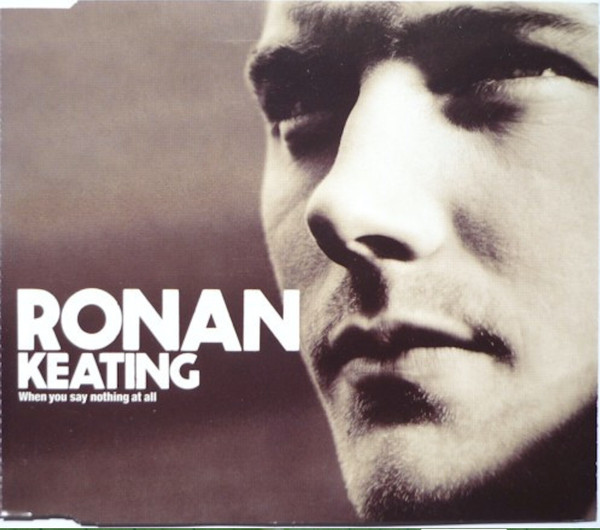
831. ‘When You Say Nothing at All’, by Ronan Keating

I did warn you… Just because Boyzone’s chart-topping days are over, we’re far from hearing the last of Groanin’ Ronan.

When You Say Nothing at All, by Ronan Keating (his 1st of three solo #1s)

2 weeks, from 1st – 15th August 1999

Barely three months on from ‘You Needed Me’, and before his band had even released their final single, Keating launched a solo career, with immediate success. Of course, he was helped in this by having his debut single included on the soundtrack to the year’s biggest romcom, ‘Notting Hill’, but still. I’ll admit, quietly and grudgingly, that I’ve always quite liked this…

It’s got a nice country lilt to it, and a decent chorus. Some of the production is very late-nineties bells and whistles, and it could have done without the overpowering backing singers. Plus the tin-whistle chorus is better not mentioned. Still, I’d tentatively state that this is better than at least four out of Boyzone’s six number ones.

The worst thing about it is… Yup, you guessed it. The singer. Ronan Keating is not a bad singer. He hits the right notes, he holds them, and you can make out what he’s saying (a quality my late gran held above all else). But his vocal affectations, his growls and lisps, his insistence on pronouncing his ‘ch’s and ‘sh’s like Sean Connery… He doesn’t speak like that. It’s put on when he sings. It’s annoying! And it was a huge risk for him to tempt every comedian in the land by releasing a record with the crucial line: You say it best, When you say nothing at all…

I’ve had various people commenting on Keating’s voice in previous posts. One has suggested that he might have had an alternate career as a grunge singer, which I can understand. Another has suggested that he is better on upbeat numbers, a theory that his performance on ‘When the Going Gets Tough’ doesn’t hold up but that we can put to the test again with his next chart-topper. Further thoughts on his vocal stylings are always welcome.

This was the fourth time in just over a decade that ‘When You Say Nothing At All’ had been a hit. Keith Whitley took it to the top of the Billboard Country Charts in 1988, while Alison Krauss & Union Station took it to the lower reaches of the Hot 100 in 1995. Both of those versions are a lot rawer, and less polished. Frances Black then took it to the Irish Top 10 in 1996, which is when Ronan first heard it. He upped the Irishness – perhaps inspired by B*Witched’s recent dedication to all things Celtic – and scored the biggest hit of all.

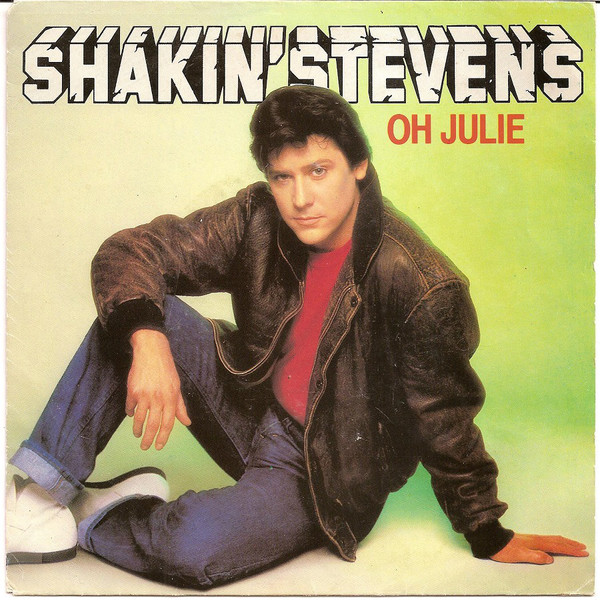
493. ‘Oh Julie’, by Shakin’ Stevens

Shaky’s back, the biggest selling British artist of the decade (!), with his third chart-topper in less than a year.

Oh Julie, by Shakin’ Stevens (his 3rd of four #1s)

1 week, 24th – 31st January 1982

While his first two #1s lent heavily (and happily) on the sounds of the 1950s, his third lends very heavily on the sounds of a German Bierfest. As, for better or for worse, there is a lot of accordion involved here. (Though according to folks who know better than me – i.e. Wikipedia – it is more Cajun than German. Just FYI)

It’s another short and sweet slice of retro rockabilly but, compared to ‘This Ole House’ and ‘Green Door’, Stevens has lost his edge. (Whatever ‘edge’ Shakin’ Stevens ever had – these things are all relative!) It’s very middle of the road, very schlager – which fits with the Bierfest vibe, I suppose – and just a little bit safe. He’s coasting here. Again, I’m not claiming that ‘Green Door’ was punk, or anything, but it was a fun moment of rock ‘n’ roll revival at the top of the charts. This isn’t.

‘Oh Julie’ improves after the midway point, when the guitars start to drown out the accordions and it starts to show the charms of his earlier hits. But it’s not quite enough. And again, Shaky gives it his all. He sells it like the seasoned pro he is. I’m getting Elvis, of course, and Orbison, but most of all Jerry Lee Lewis in this one. The way he oooohs, and then yelps the line honey don’t leave me alone… Pure Killer.

I had assumed that this must have been a cover of an oldie, as his first two #1s were, but no. It’s a Shaky original, and it is impressive how authentic this record sounds. I can’t hate it: it’s catchy, it’s well-performed, it’s thankfully short. But nor can I love it. And I feel this is another type of January hit… ‘The Land of Make Believe’ was a Christmas leftover that belatedly made the top; this is an early in the year release that, perhaps, sneaked a week at #1 without too much competition. Of course, stick a girl’s name in a song and you’ll always sell a few more copies – Julie joins Annie, Clair, Maggie May, Rosemary, Juliet, and quite a few others, in having a song written just for her.

I have no proof for these cynical theories, though. My apologies to Shaky if this turns out to have been his biggest-selling hit (apart from, you know, that other one). Either way, ‘Oh Julie’ was a hit across Europe. Stevens went on scoring Top 10 hits throughout the early to mid-eighties, but it’ll be a little while before he’s back with his final chart-topper. A song that British readers, at least, may have heard once or twice before…

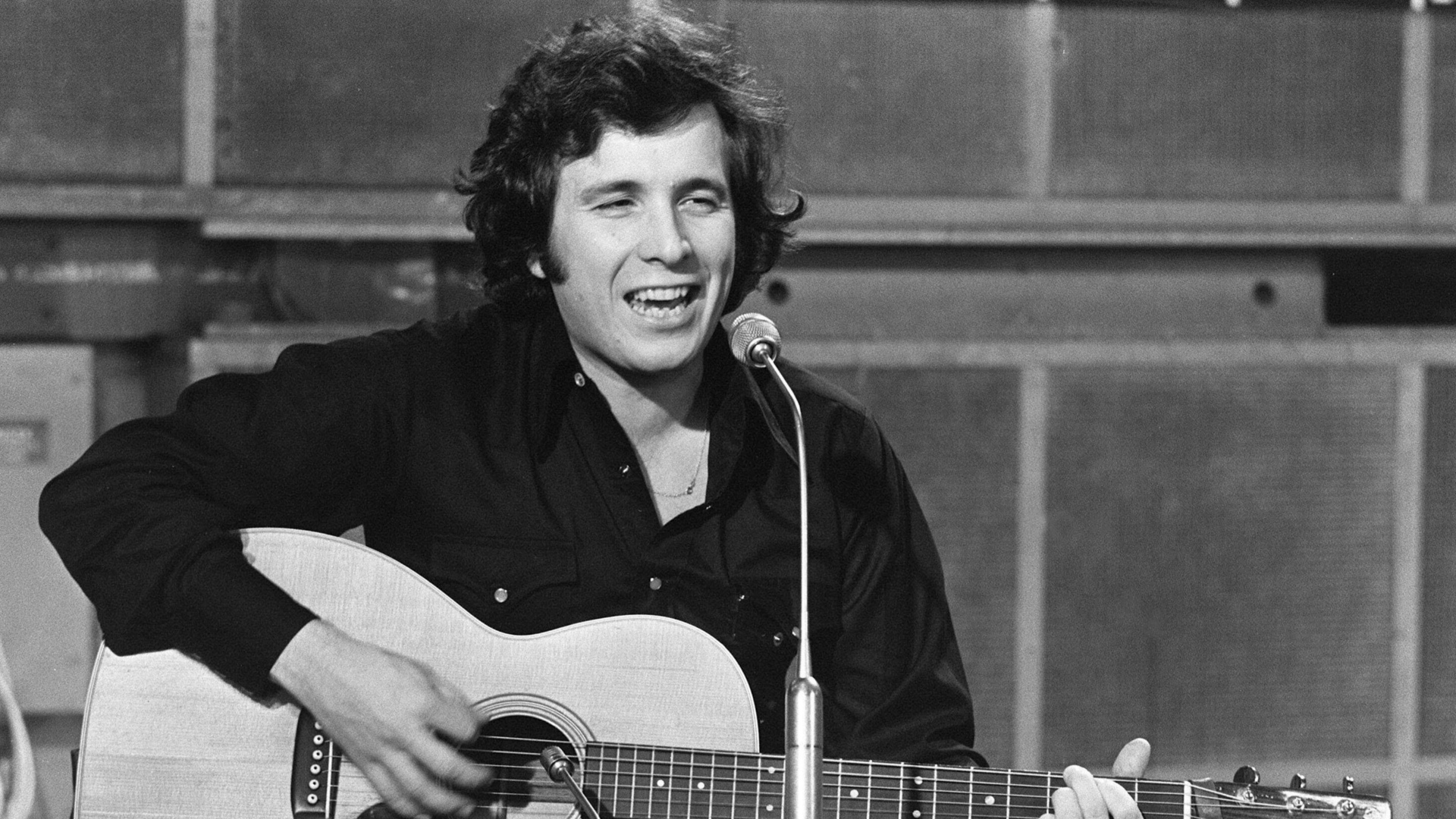
460. ‘Crying’, by Don McLean

Hot on the heels of ‘Suicide Is Painless’, we are crying, crying, crying… A depressing double-whammy at the top of the charts…

Crying, by Don McLean (his 2nd and final #1) 

3 weeks, 15th June – 6th July 1980

‘Crying’ was, of course, originally recorded by Roy Orbison. As I do every time I approach a cover of a famous hit, I try to blank out any knowledge of the original. Which is always hard, but especially so when said original was by The Big ‘O’. Don McLean takes what was already a ballad, and slows it down further. We are moving at treacle pace here.

I was alright, For a while, I could smile, For a while… It’s a classic Orbison theme: hiding your heartbreak behind your dark glasses. But when I saw you last night, You held my hand so tight… And it’s effective, as we’ve all been there – watching as a former crush moves on. And though you wished me well, You couldn’t tell, That I’d been crying… 

My biggest problem with this take – and let’s just have it out and admit that this isn’t a patch on the original – is that all the melodrama has been stripped out. Roy had a latin beat, strings and a marimba… You could samba as you cried. Don goes for a much more straight-forward, country version, and suddenly the lyrics sound trite and basic. The music plods as you wait for it to reach the climax.

Another sizeable problem is that for all Don McLean’s skills as a singer, he isn’t Roy Orbison. The climax here is the word ‘crying’ repeated over and over. Orbison rattles the roof with it, as he does on all his big heartbreak bangers: ‘Running Scared’, ‘It’s Over’ and the like. McLean can’t, and his voice ends up sounding reedy. That’s not to say he can’t put emotion into his songs. I find his previous #1, ‘Vincent’, heartfelt and heartbreakingly sad. Here, though, he over reaches, and his Cry-y-y-ying sounds… like Miss Piggy?

It’s still a pleasant melody, and I am enjoying it to some extent, but it’s a bit of a wet-blanket of a song. And yet another country chart-topper that I can’t quite get behind. At least, quickly scanning down my list, it looks like the last one for a while… This was also Don McLean’s last hit in the UK (he had barely charted since ‘Vincent’ either) until a re-release of ‘American Pie’ in the early ‘90s. He remains active, though, and released his 22nd studio album just last year.

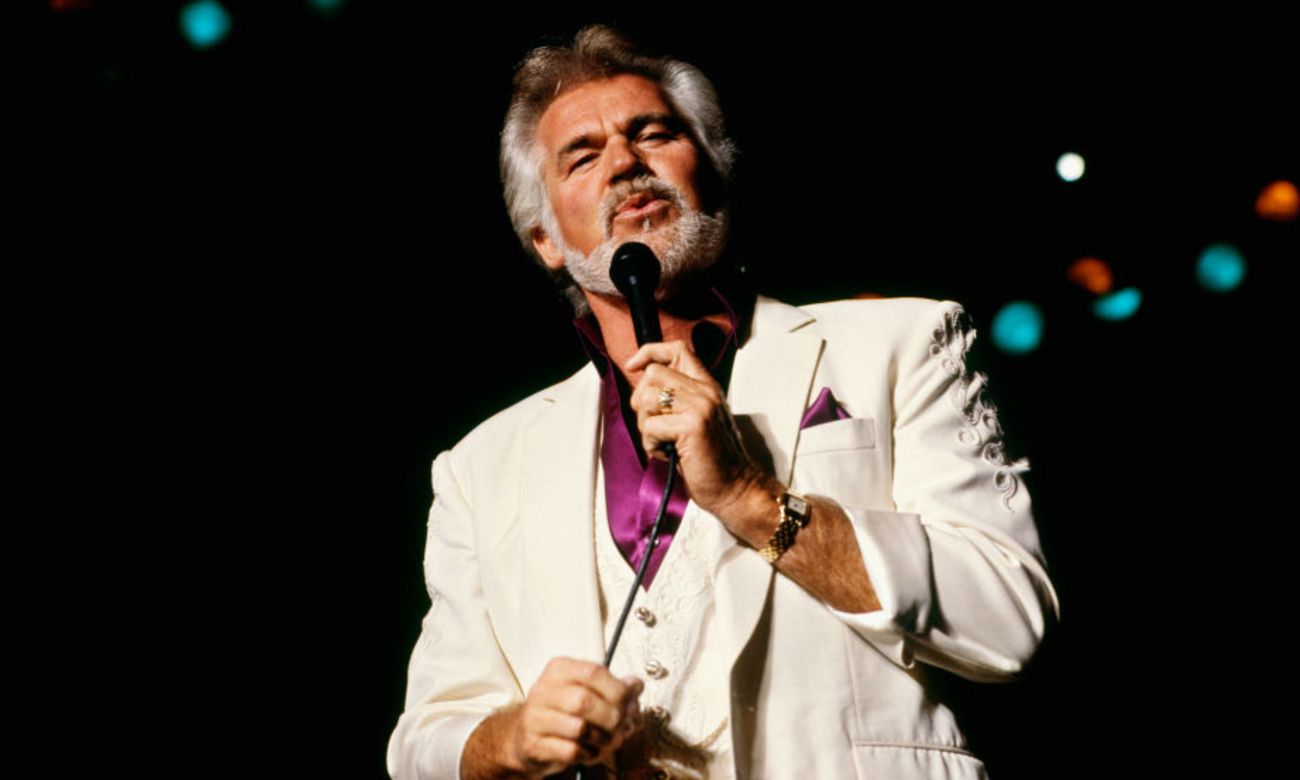
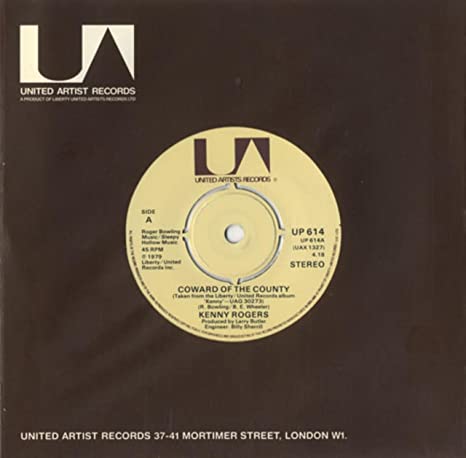
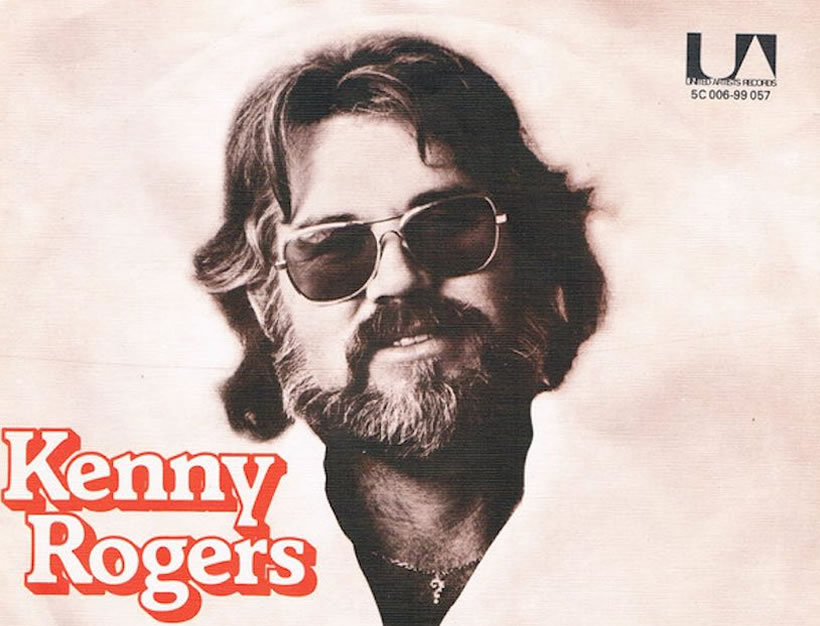
451. ‘Coward of the County’, by Kenny Rogers

Oh well. The brave new world of the eighties – the world of The Pretenders and The Specials – lasts for precisely two chart-toppers. Because, as they so often do, a Country and Western song has come along to remind us not to get too carried away…

Coward of the County, by Kenny Rogers (his 2nd of two #1s)

2 weeks, 10th – 24th February 1980

It’s another homespun tale, with the exact same jaunty, acoustic plod as Lucille, Kenny Rogers’ first #1 from three years earlier. It’s the tale of a – presumably – fictional nephew, the eponymous ‘Coward of the County’. His momma named him Tommy, The folks all called him yellow…

Why is he such a ‘coward’? Well, it’s all down to a promise to his dying father, who had made Tommy swear he’d always run from trouble, always turn the other cheek. I hope you’re old enough to understand, Son, you don’t have to fight to be a man… Which was all fine, until the day Gatlin boys came to have their way with his wife, Becky.

Yes, this is a #1 single that centres around a gang rape. In some ways this is one of the most shocking chart-toppers, ever. Except, the way Rogers delivers the line – and there was three of them… – is almost funny. Not intentionally, you’d hope, but still… Yep, she’s been raped. Key change!

Long story short: Tommy decides that there are limitations to his promise, goes to the local saloon, and beats the shit out of the Gatlin boys. Hurray! And as in ‘Lucille’ there’s a plot twist. Papa I sure hope you understand, Sometimes you gotta fight when you’re a man… There’s something noble about that, I guess… But there’s so much wrong with this song: the vigilantism, the voiceless Becky’s rape as a plot device, the idea that men must fight or they are sissies… All wrapped up in a jaunty little tune. I’m not against dealing with tough topics in pop singles – Rogers did it excellently in his breakthrough hit ‘Ruby, Don’t Take Your Love to Town’ – but it doesn’t work here.

I’m shocked by my reaction to this song, actually. I thought I liked it… But the more I listen, the more I’m put off. The obvious comparison is to Johnny Cash’s ‘Boy Named Sue’ – both country, both about absent fathers controlling their sons’ destinies – but Cash plays his hit for laughs. The idea of a father naming his son ‘Sue’ so that he’ll have to fight is genuinely funny, and plays with the masculine conventions of country music, whereas ‘Coward of the County’ is self-righteous and predictable.

Kenny Rogers may not be appearing on this blog again, but his hit-making career was far from over. He’d have one further Top 10 in the UK, the karaoke classic ‘Islands in the Stream’ alongside Dolly Parton. He died last year, aged eighty-one. Meanwhile, ‘Coward of the County’ was turned into a TV movie and was covered – and this is 100% true, just check out this link – by Alvin & The Chipmunks. There was also controversy when it turned out that the writer, Roger Bowling, may have named the song’s villains after the band The Gatlin Brothers, against whom he held a grudge… Actually, that’d make a really good storyline for a country song. Better than this one, anyway…

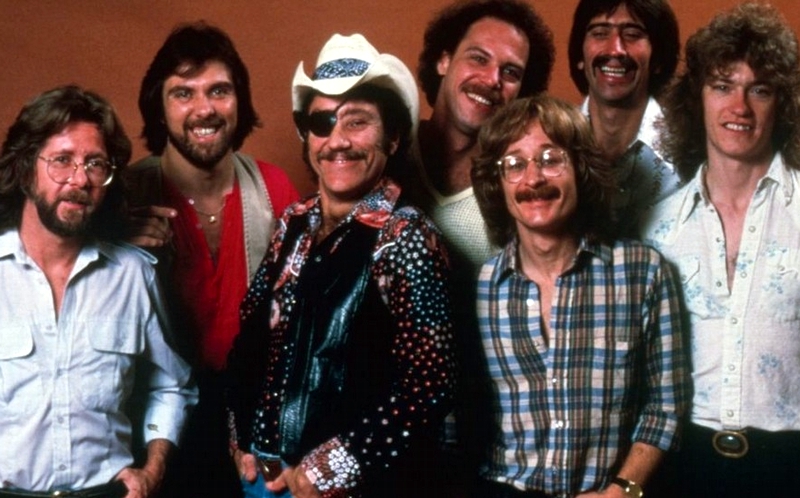
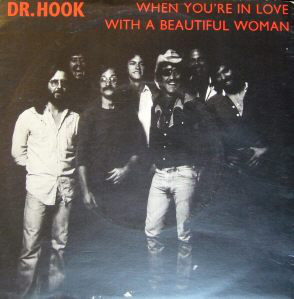
446. ‘When You’re In Love With a Beautiful Woman’, by Dr. Hook

The pre-penultimate #1 of the decade, then. And what’s this…? More country and western?

When You’re In Love With a Beautiful Woman, by Dr. Hook (their 1st and only #1)

3 weeks, from 11th November – 2nd December 1979

At least this isn’t the abrasive, twanging, Lord-have-mercy country style brought to us by Lena Martell. It’s a much softer, disco-edged kind of country. A sort of pop-Eagles. Completely against the grain of what’s topped the charts for much of 1979, but perfectly pleasant.

Let’s get one thing out of the way first: When you’re in love with a beautiful woman, It’s hard… (You know it gets so hard…) Well, quite. Stop sniggering at the back, there! Innuendo aside, it’s an interesting concept for a song, and very ‘country’ in the way a good thing – being in love with a beautiful woman – is gleaned for negatives.

You can’t trust your friends around her, you see. You watch her eyes. You wonder who that was hanging up when you answered the phone… Everybody wants her, Everybody loves her, Everybody wants to take your baby home… I like the backing vocalists – You better watch your friends, Watch your friends… – that feel as if they’re whispering devils on the singer’s shoulder.

Actually, though, if you stop and think about it, it’s a little bit sinister. Your lover’s unfaithful, your friends are backstabbers, the world is out to burst your loved-up bubble… Maybe it’s just an ego problem… sing Dr Hook. Sounds like it, yup. It’s a bit of a study in fragile masculinity, really. What’s the solution? Only go for ugly girls…? Be less of a suspicious twat…?

However, it’s easy to ignore the creepy undertones, and to get swept away by this light, fun, fairly inconsequential chart-topper. Dr Hook had been around since the start of the decade, popping up in the charts at regular intervals, before achieving their one and only chart-topper. The band name came from the fact that singer Ray Sawyer wore an eye-patch following a car crash. (Hook – Captain Hook – pirates – eye-patches… get it?)

This was almost their chart swan song – they would have a couple more Top 10s before splitting up in the mid-eighties. And this is almost our seventies swan song: just two more chart-toppers before the decade is out…!

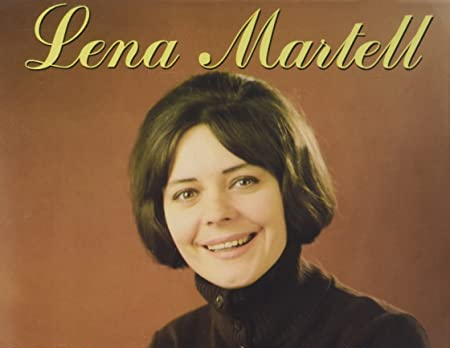
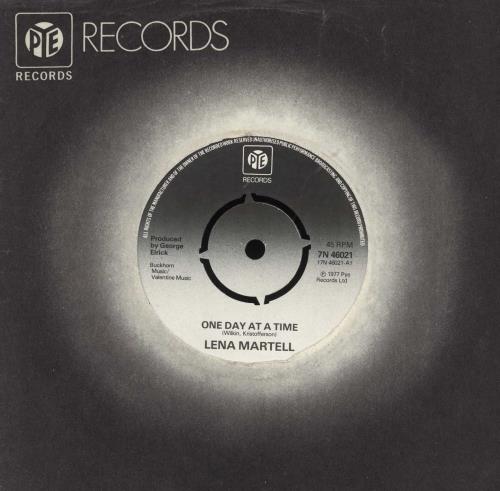
445. ‘One Day at a Time’, by Lena Martell

Oh, OK… Well, this is perfect. After all that blather in my last post about a new-wave, technicolour era, as we prepared to dive head first into the eighties… This comes along.

One Day at a Time, by Lena Martell (her 1st and only #1)

3 weeks, from 21st October – 11th November 1979

I had forgotten, you see, that the British nation has a weird obsession with country and western music. Had forgotten that in amongst the explosion of new sounds topping the charts during the last year or so, that actually the most consistent sound of the seventies has not been glam, or disco, punk or synth-pop… It’s been C & W. From the decade’s 2nd #1 ‘Wand’rin’ Star’, through Dawn, Tammy Wynette, J.J. Barrie (shudder) and Kenny Rogers… to this.

One day at a time, Sweet Jesus…! We’ve had sentimental country, country with lonesome men and stoic women, folks returnin’ from war, from jail… But until now, we had been spared this. Christian Country. Show me the stairway, I have to climb, Lord for my sake, Teach me to take, One day at a time… Lena is struggling in this modern world, so she looks above for guidance.

One thing I knew about Lena Martell is that she and I are compatriots. Yep, the steady stream of country hits in the UK was, for some reason, largely fuelled by us Scots. Something about their hard-drinkin’, rough-livin’ ways appeals to us… (no comment) Martell is the second Glaswegian to have a country #1, after Billy Connolly. And she does, to be fair to her, put on a good southern twang. But while Connolly’s ‘D.I.V.O.R.C.E.’ was a funny piss-take, ‘One Day at a Time’ is painfully earnest. Truth is, I am a sucker for this kind of country schmaltz. Musically, this is fine. If she were singing about her good for nuthin’, cheatin’ man, I’d be all in. Unfortunately, this record is lyrically rancid.

In the final verse, she goes full ‘Daily Mail’ comments-board. Oh Lord, she moans, what’s the world coming to? Well, Jesus you know, if you’re looking below, It’s worse now than then… Cheatin’ and stealin’, Violence and crime… I’m going to be careful here, as I don’t want to offend anyone’s beliefs… But I’m pretty sure even the good Lord above would have been offended by this crap.

‘One Day at a Time’ was originally released by a Marilyn Sellars in 1974, and has been recorded over 200 times… Mostly by country singers I’ve never heard of, though I see both Tennessee Ernie Ford and Brotherhood of Man have had a crack. Meanwhile, this disc gave Lena Martell her one and only chart hit. She did, though, have a long-running show on the BBC, sang with Frank Sinatra on her US tours, and was releasing country and religious albums well into the 2000s, until she retired following heart surgery.

Fair play to her, then, for having a career that many can only dream of. As for her chart-topping, one-hit-wonder moment in the sun, though… I think I can sum it up in two words: Sweet Jesus!

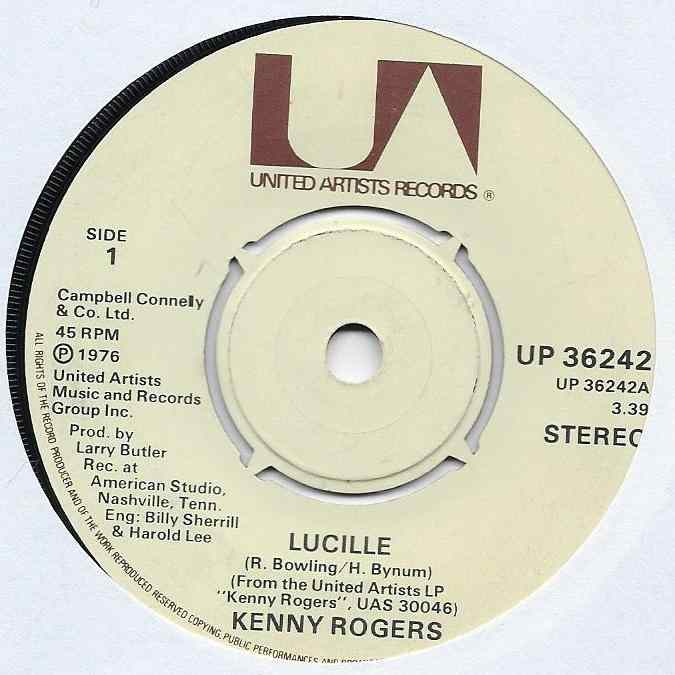
406. ‘Lucille’, by Kenny Rogers

So, while The Sex Pistols perhaps should have kicked Rod Stewart off the top, in the end he was replaced by another crazy-haired, middle-finger sticking punk rocker… Only kidding, he was replaced by Kenny Rogers.

Lucille, by Kenny Rogers (his 1st of two #1s)

1 week, from 12th – 19th June 1977

The two main sounds of the mid to early-late seventies, since glam died, have undeniably been disco and slushy soft-rock. But coming up behind, in the bronze medal position, surprisingly, is country and western. We’ve had Tammy Wynette, Billy Connolly as Tammy, J. J. Barrie, Pussycat… and now a proper legend of the genre.

Country music is often sad; and yet often ridiculous. It is a melodramatic genre. And the opening line of this record is up there with some of the very best. In a bar in Toledo, Across from the depot, On a bar stool she took off her ring… Talk about setting a scene! A tawdry tale is told, as the singer approaches this beautiful, sad woman.

She’s been living on dreams, she’s finally had enough, she needs more out of life… Kenny’s about to make his move, when in through the barroom doors strides Lucille’s ex. The big hands were calloused, He looked like a mountain, For a minute I thought I was dead… As silly as all this is, when Kenny Rogers is on form he tells a story like no other.

You picked a fine time to leave me, Lucille… The story spins on its head. Four hungry children and a crop in the fields… We assumed she was the victim, finally breaking away from hardship and abuse… But is she? Kenny takes her to a hotel, but when the time comes to do the deed, all he can hear is her estranged husband’s voice… This time your hurtin’ won’t heal…

What this song really needs is a third and final verse. Who’s really to blame? Who’s telling the truth? Does she go back to her family farm? Does Kenny get his leg over? We need closure! Instead we get the chorus and a slow, slow fade. He may have set an excellent scene; but Rogers needs practice in wrapping up a story. Thankfully, come his next #1 single – yes, he has more than one – he will have mastered the art of storytelling, and produced a classic.

If it weren’t for the pretty gritty subject matter, I’d describe this as a lullaby. The guitar sways and soothes, while the bass keeps time like a metronome. Many Kenny Rogers hits I can think of do this, hide a tough subject matter behind a soothing rhythm: ‘Ruby’, ‘The Gambler’, his aforementioned 2nd chart-topper… ‘Lucille’ was his first big smash since breaking with his band The First Edition, and it set him off on an extended run of hits.

I was going to ask why on earth this record made #1, for a near forty-year-old country singer. But perhaps we’re past that. ‘Lucille’ made #1 simply because country and western music was a very popular genre at the time. It’s not an ever-present, but this is far from the last time we’ll be hearing it…

395. ‘Mississippi’, by Pussycat

Following on from ‘Dancing Queen’ is a daunting task, but someone had to do it. In the autumn of 1976, that task fell to Pussycat, and their sole #1 record, ‘Mississippi’.

Mississippi, by Pussycat (their 1st and only #1)

4 weeks, from 10th October – 7th November 1976

It’s a gentle intro, a slice of soft country rock, that puts me in mind of the Eagles at their blandest, or Matthews Southern Comfort’s ‘Woodstock’ from earlier in the decade. In the past year or so, country and western has become something of an established presence at the top of the charts, from Tammy Wynette to J.J. Barrie to this…

But when the vocals come in, we move from country to schmaltzy. Well you can hear a country song from far, When someone plays a honky-tonk guitar… It’s a tribute to country music, an ode to the genre, and a love-letter to the USA’s most famous river. Mississippi, I remember you… Whenever I should go away, I’ll be longing for the day…

It’s the sort of song that you start to forget before it’s even finished. It’s very gentle, a pleasant enough stroll down the middle of the road, but it’s a bit dull. It makes you yearn for ABBA… But that’s not fair. We can’t go comparing songs to what went before! It is too long, though. I’ll state that with conviction. Times were four and a half minutes was record-breaking; now it seems to be the standard.

By the end, the band are bemoaning the fact that rock ‘n’ roll took over from C&W. The country song forever lost its soul, When the guitar player turned to rock and roll… Except, that’s patently not true. Rock ‘n’ roll was born from country (and jazz and the blues) – rock ‘n’ roll is country – plus here we are, with a country song at number one… So it can’t be that dead. We flutter to a finish, and I remain underwhelmed.

Pussycat were a Dutch band – which perhaps explains the schlager-heavy feel that this record has (they also, perhaps inevitably, recorded a version in German.) They were a seven piece, with what looks like three girls and four boys… (To be fair, they all have long hair and frills in the pictures I can find!) The best way I can describe them is like looking at a picture of ABBA after you’ve had a blow to the head. Still, they officially make 1976 the year of the mixed-gender pop group, after Brotherhood of Man and our aforementioned Swedes.

‘Mississippi’ was written by the band with the Bee Gees ‘Massachusetts’ in mind, and you can really hear the influence. Plus, it gives us our second #1 single named after a US State (and I’m happy to hear suggestions of others to come/that I’ve missed). They scored one more minor hit in the UK following this, but remained big in the Netherlands well into the ‘80s.

To finish, I think I have to crown ‘Pussycat’ as the worst band name to feature on this blog. It’s just… a ‘no’ from me. And Spotify seems to agree, as they have erroneously grouped this group’s back-catalogue with a trip-hop group of the same name, who’s last album was titled ‘Sexy Bondage Domination’…

390. ‘The Combine Harvester (Brand New Key)’, by The Wurzels

After wading through waist-deep treacle on J. J. Barrie’s ‘No Charge’, and barely making it through with our sanity intact, are we really ready for another novelty single to top the charts? Actually, yes. We are.

The Combine Harvester (Brand New Key), by The Wurzels (their 1st and only #1)

2 weeks, from 6th – 20th June 1976

This. This is how you do a novelty song. It is an absolute palate-cleanser after what went before. We’ve got banjos and country-bumpkin accents, a raucous music hall chorus and a relentless oompah beat. Ladies and Gentlemen: our first ever ‘Scrumpy & Western’ chart-topper!

I drove my tractor through your haystack last night, I threw me pitchfork at your dog to keep quiet… A rustic, pastoral picture is painted. The rolling hills and golden fields of Somerset hove into view. Meanwhile, a man is proposing marriage, but not for the most romantic of reasons. I’ve got twenty acres, And you’ve got forty-three… Now I’ve got a brand new combine harvester, And I’ll give you the key…

Personally, and I think I speak for a large part of the British population when I say this, I can’t hear the words ‘combine harvester’ without this playing in my head. As a song it might not be on heavy rotation these days, but its chorus lives on. And, in the finest music hall tradition, there’s a strong undercurrent of smut here… Aar, Yer a fine lookin’ woman, An I can’t wait to get me hands on yer land! (Fnarr, fnarr)

Actually, if you think that this is actually about a grain-harvesting device, then you’re more innocent than you look. The Wurzels, though, sell it with a nudge and a wink, and glug of your cider. ‘The Combine Harvester’ is everything ‘No Charge’ wasn’t (although I have to admit that I might not have been so kind on this record had J. J. Barrie not done his worst directly before).

There’s a bit of history behind this one. It’s a parody of a hit from 1971 – ‘Brand New Key’, by Melanie Safka, a US #1 no less – and had been a hit in Ireland for Irish comedian Brendan Grace (who would, twenty years later, steal the show in an episode of ‘Father Ted’ – he had his fun, and that’s all that mattered…) The Wurzels scrumpy-fied it and scored an unlikely smash hit.

In a bittersweet moment, this biggest of hits came shortly after The Wurzels (‘Wurzel’ means ‘yokel’ in the Somerset dialect) had lost their founder Adge Cutler in a car crash. They followed this up with the equally catchy/daft ‘I’m a Cider Drinker’, and have been around ever since. Most recently they’ve been releasing covers albums. If you’ve enjoyed this slice of silliness, and are wondering what a Wurzeled version of Oasis’s ‘Don’t Look Back in Anger’, the Kaiser Chief’s ‘Ruby’, or even Pulp’s ‘Common People’, might sound like, well you’re in luck…

Next up, a recap!

Catch up with all the #1s so far, with my playlist: