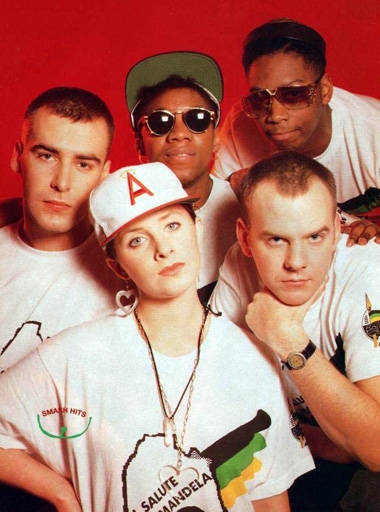
646. ‘World in Motion’, by ENGLANDneworder

Ah yes. It’s that time again in which I, a Scot, have to write about the English National Football Team, and attempt impartiality…
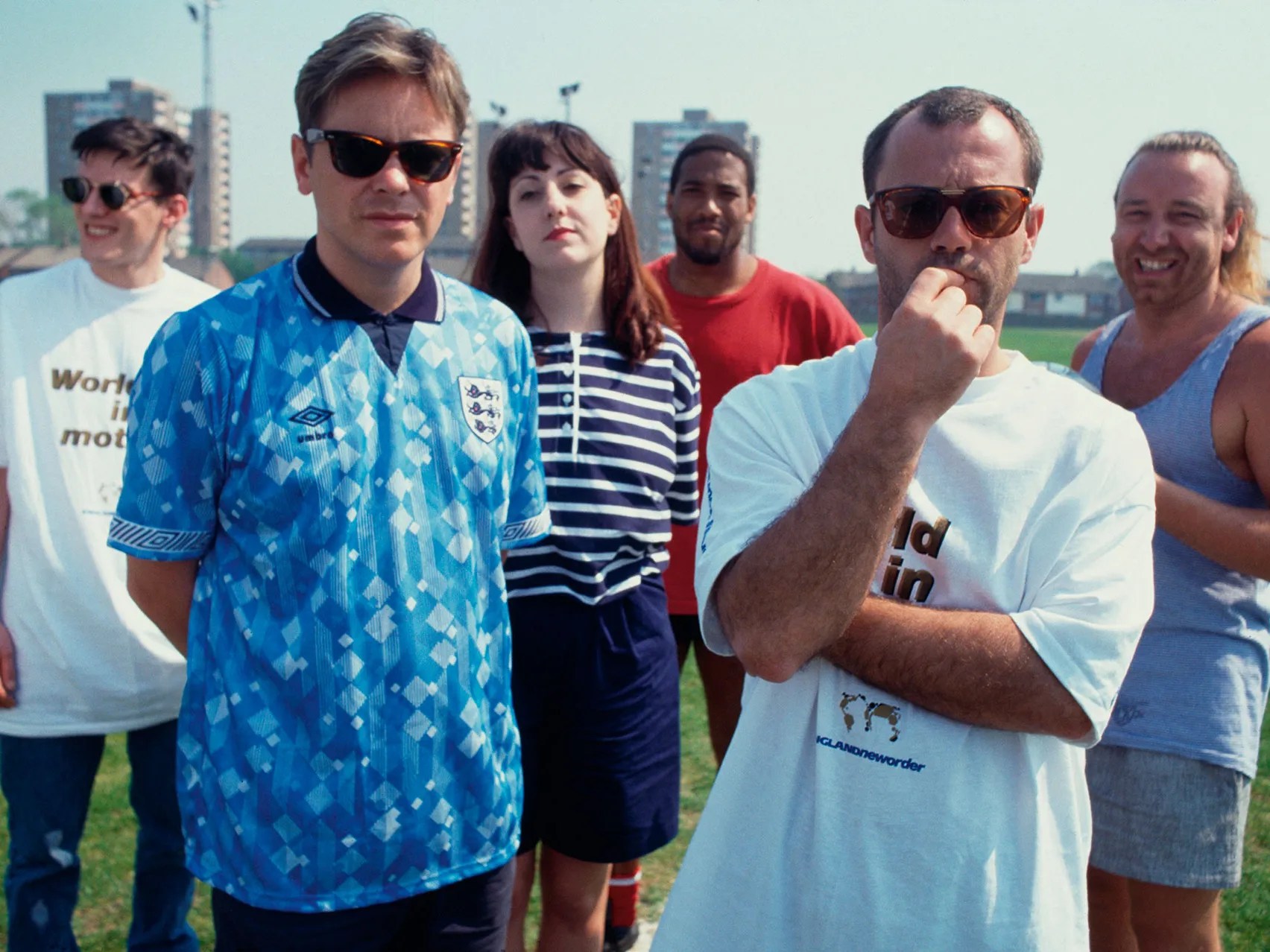
World in Motion, by ENGLANDneworder (New Order’s 1st and only #1)

2 weeks, from 3rd – 17th June 1990

OK, there’s only been one ‘England’ #1 before: the 1970 World Cup squad’s jaunty ‘Back Home’. (Scotland, meanwhile, have cracked the Top 10 several times – they just haven’t quite made it to the top. Which is quite fitting, really, given our footballing history…) But this record is a different beast to ‘Back Home’. This is no cheesy squad singalong, about trophies and triumph. This is actually quite cool.

It helps that New Order were a very good band, the band of ‘True Faith’ and ‘Blue Monday’, and of Joy Division before that, and that they created a credible piece of dance-pop. And it helps that they tried to write a song that could stand alone if separated from its footballing context: Express yourself, Create the space… Beat the man, Take him on… And of course the chorus: Love’s got the world in motion, And I know what we can do…

Sensibly, the actual players are limited to backing vocals. Until, of course, the rap. Liverpool winger John Barnes takes over for perhaps British hip-hop’s most iconic moment, written by comedian Keith Allen (who prances around in the video): Catch me if you can, Cos I’m the England man… Three lions on our chest, I know we can’t go wrong… And then boom! Suddenly, it’s a full on football song, with Eng-er-land chanting, and canned commentary from the 1966 final. But by that point, even Scots will have given in and started tapping their feet to the best, yes I’m committing right here and now, football single ever.

The back stories to this song are quite fun. New Order initially suggested a song called ‘E for England’, which was quickly rejected by the FA for its fairly blatant drug references. Star striker Gary Lineker didn’t want to feature as he was releasing his own World Cup single, the completely forgotten ‘If We Win It All’. Meanwhile, seventy-year-old Kenneth Wolstenholme re-recorded his ’66 commentary specially for the song (making him the oldest person so far to feature on a #1…?)

‘World in Motion’ came at an interesting time for football. The Hillsborough disaster had happened the year before, and the changes to stadiums and crowd management that would come out of that tragedy were about to be implemented. Meanwhile, at the World Cup in Italy, England put in their best performance since you-know-when and lost on penalties to West Germany in the semis: Gazza’s tears, Chris Waddle, Pavarotti and all that. (Scotland, naturally, went out in the group stages.) The video is charmingly low-budget, and the players a world away from the well-groomed, tattoo-ed, sculpted lads of today. It’s an interesting glimpse of a sport that I cannot quite remember, just two years before the Premier League/Champions League explosion.

But, that’s a story for a different blog. Musically, this was New Order’s only #1, though they scored eight Top 10s between 1983 and 2005 (including the best-selling 12” of all time). They were, still are, hugely influential and as fun as this record is, it’s somewhat bittersweet that it’s their biggest chart hit. And sadly, ‘World in Motion’ has since been relegated to the second division of football songs, behind a far more obnoxious, entitled, and frankly (without giving too much away) insufferable single from six years later…

645. ‘Killer’, by Adamski

The first word that comes to mind as this next number one begins is ‘lumbering’. Like Godzilla trampling Tokyo underfoot, the beat here is heavy, and relentless…

Killer, by Adamski (his 1st and only #1)

4 weeks, from 6th May – 3rd June 1990

It’s a fourth consecutive dance #1, and each one has done something slightly different within the genre’s confines. ‘Dub Be Good to Me’, ‘The Power’, ‘Vogue’, this. They’ve all had one thing in common, though: pretty low bpm. There have been moments, while listening to each one, in which I’ve wondered whether you could do much dancing to them. The early ‘90s was the height of rave culture in the UK, of people off their tits and mad for it in a field in Hampshire, but you wouldn’t necessarily know it by listening to the most popular dance tracks of the time.

While ‘Vogue’ well and truly warmed up after a slow start, I’m not sure if ‘Killer’ ever quite rises above its plodding beat, decorated with creepy synth effects that sound like aliens trying to broadcast to the mothership. There’s a moment in the middle where some choppy trickery with the vocals turns them into a sort of dance Morse Code, and this kicks things into life. There’s a more traditionally ‘dancey’ piano riff after that, and a moment where you think this might be turning into a banger. But it doesn’t quite manage it.

Solitary brother… I like this line… Is there still a part of you that wants to live…? Again, not your run-of-the-mill dance lyrics. And while we should applaud strangeness, and creativity, and so on; it doesn’t mean that I particularly enjoy this record. I’d file in under ‘interesting’, rather than ‘fun’.

The vocalist was an at the time unknown bloke called Seal. (So unknown that the Official Charts didn’t credit him on the single, which seems a bit harsh.) He’d been a funk and soul singer in Britain and the Far East, and was sleeping on a friend’s sofa when he met DJ and producer Adamski, handing him a demo tape. The rest is history, though nothing he did after his big breakthrough hit has the same oomph. He went back down the smooth soul route, and along the way recorded one of my least favourite songs of all time: ‘Kiss From a Rose’. (It just gives me goosebumps, and not the good kind…)

What’s ‘Killer’ about, though? The lyrics, written by Seal, are an exhortation to freedom and to transcending whatever holds you back, according to the man himself. That sounds more like M People than this weirdly ominous record, while Adamski meanwhile thinks it sounds like the soundtrack to a movie murder scene. It ends with a message: Racism in amongst future kids can only lead to no good… Which is worthy, but which means the record ends on a strangely sombre note.

Seal released his debut solo album later that year, and has gone on to sell twenty million records around the world, and to marry Heidi Klum. Adamski, meanwhile, scored a #7 with the follow-up, before fading from popular view. He still records though, and tours as a DJ.

Of the past four number ones – the spring of dance, I’ll call it – I’d have ‘Vogue’ as my favourite, closely followed by Beats International. But I’d have ‘Killer’ in third, ahead of Snap! It’s a very odd song, an uncomfortable, edgy record; but there’s greatness there, buried somewhere deep. Up next, an act that are undoubtedly dance music pioneers, the daddies of all this electronic business, and one of the most influential bands of the 1980s… With Peter Beardsley.

644. ‘Vogue’, by Madonna

What’re you looking at? snaps Madonna at the start of her seventh, and perhaps most iconic number one. You of course, Madge. You.

Vogue, by Madonna (her 7th of thirteen #1s)

4 weeks, from 8th April – 6th May 1990

At this point, Madonna was hitting at a rate of one #1 per year. 1989’s chart-topper, ‘Like a Prayer’, gave us Madonna the shocker, the church baiting provocateuse. 1990’s chart-topper was the other side of her coin: Madonna the trend-setter, the cultural chameleon (or bandwagon jumper, if you’re not a fan…) For she was off to the ballrooms of Harlem…

‘Vogueing’ as a dance movement had grown there during the 1980s, among black and Latino gay communities. The sudden, sharp movements were supposed to be an impersonation of Egyptian hieroglyphs, or of a star changing poses in a photoshoot for, yes, ‘Vogue’. Madonna had been introduced to it by her own dancers and choreographers. (*Insert complaints about Madonna milking the gay community for her own commercial advantage* Not that I’d at all agree: this was perhaps the start of ‘gay’ culture going mainstream, at the height of the AIDS epidemic, and Madge has always been open about her support of LGBTs.)

Like ‘The Power’, the record it replaced at the top, ‘Vogue’s slick house rhythm doesn’t sound instantly danceable. But it creeps up on you, until two minutes in you realise that you’re shimmying. The tinny drums that lead up to each verse and chorus are very Hi-NRG (dare we say, very SAW?) and the short sharp horn blasts keep you on your feet. By the time she yells the Get up on the dancefloor! line, you’re there. Meanwhile the lyrics are fairly generic dance: Let your body move to the music… You’re a superstar, That’s what you are… etc. etc.

Of course many people at the time, unfamiliar with gay ballroom culture, would have assumed that the title referred to the fashion magazine. Madonna nods to that too, in the spoken word section, as she lists various women with an attitude and fellas who were in the mood from Hollywood’s golden age, on the cover of a magazine. And, just in case this record wasn’t gay enough, it includes the line: They had style, They had grace, Rita Hayworth, Gave good face…

Unlike ‘Like a Prayer’, ‘Vogue’ isn’t from a classic album. It’s the final track, tacked on to ‘I’m Breathless’: the soundtrack to the prohibition-era movie ‘Dick Tracy’. The follow-up single was the ridiculous ‘Hanky Panky’ (nothing like a good spanky!) But ‘Vogue’ has long-outlasted both album and film, to rank alongside Madonna’s very best songs. Whereas I didn’t enjoy listening to ‘Like a Prayer’ as much as I thought I would; the past hour has brought me to realise just how good ‘Vogue’ really is.

Believe it or not, this is the last we’ll be hearing from Madonna for eight whole years. She only has two #1s in the 1990s (while she has as many in the ‘00s as she managed in the ‘80s). Not that she’s going anywhere: aside from those two #1s, the decade will bring her a staggering twenty-two Top 10 hits, including four #2s. And ‘Vogue’, a number one in thirty countries and to date her biggest-seller worldwide, kicked it all off.

643. ‘The Power’, by Snap!

The spring of 1990 truly was an age of interesting intros. Well, I don’t know if two songs quite make an ‘age’, but following on from Beats International’s famous rap, our next #1 kicks off with a burst of Russian LW radio. Something something transceptor technology…

The Power, by Snap! (their 1st of two #1s)

2 weeks, from 25th March – 8th April 1990

Then boom: a riff that sounds like an electric shock, and (another) dance diva with big lungs bellowing about having the power. So far so famous, a hook that pretty much everyone of a certain age knows. Unfortunately, the less-remembered remainder of the song struggles to match the energy of the title line.

It’s much lower-tempo than you’d think: I’d mis-remembered it as a madcap ride, akin to S-Express, but it’s nowhere near as fun. There’s a rapper – in fact this might be the most rap-heavy chart-topper so far, at the start of the decade in which hip-hop will finally go mainstream. Turbo B has a couple of good lines: Maniac, Brainiac, Winnin’ the game, I’m the lyrical Jessie James… and a real clunker: So peace, Stay off my back, Or I will attack, And you don’t want that… While Penny James, the female lead, has a voice that contrasts with him well.

Both the rap and the vocals were based on earlier songs, by a Chill Rob G and a Jocelyne Browne respectively, and for a while it seemed there might be lawsuits on the horizon when the producers tried to use the originals without permission. The record was quickly re-recorded by Turbo B and James, inadvertently setting up Snap! as an actual band with a hit making future rather than a one-hit wonder.

There’s another good moment, when the electric shock riff takes over and performs a bit of a solo; but for me, as a whole, this record struggles to build up a head of steam. I can’t imagine dancing to it, unlike recent dance bangers from Black Box and Beats International. Snap! (note the Wham!-like exclamation mark) were a German creation, and I get “Boney M for the ‘90s” vibes, what with their nationality, their take on Eurodance, and the questions over whose voices you’re actually hearing… (Though both Turbo B and Penny James were American.)

‘The Power’ was Snap!’s first release, and they would go on to have an impressive nine further Top 10 hits between 1990 and 1994. So popular were they that their fifth single was a medley of the previous four, which still made #10. And while this record may not reach the heights of ‘Ride on Time’, you could argue that it was just a warm-up for Snap!’s globe-humping second, and definitive, chart-topper: one of the biggest dance records of all time. Until then, then…

642. ‘Dub Be Good to Me’, by Beats International

Tank fly boss walk jam nitty-gritty, You’re listening to the boy from the big bad city, This is jam hot…

Dub Be Good to Me, by Beats International (their 1st and only #1)

4 weeks, from 25th February – 25th March 1990

I often find writing intros to be the hardest part of a new post. Not today: for who can argue with those opening lines? Jam hot, indeed. (Not that I have a clue what he’s on about, but hey ho…) Off we go, then, into a #1 single a little less intense than ‘Nothing Compares 2 U’, but perhaps every bit as iconic (that word again…)

If you listen carefully, both this record and Sinéad O’Connor’s predecessor follow a similar beat. It’s very nineties, as if both these records were setting the tempo for the decade to come. Other than that, though, they’re very different beasts. ‘Dub Be Good to Me’ takes us for a stroll through the backstreets of the big bad city. The laconic harmonica sounds like a train rumbling past, the horn towards the end sounds like a sad busker, the humming break in the middle sounds like the crazy guy you’d cross the road to avoid…

Meanwhile, you can just picture the singer walking along with a ghetto blaster, singing the title line: I don’t care about your other girls, Just be good to me… Like Soul II Soul and Black Box before it, this record is a more modern, stripped-back version of dance music, another step away from the sample-heavy culture of the 1980s. Just a beat, that harmonica, and a female diva giving it large (Lindy Layton, who in some places gets a ‘featuring’ credit on the record).

Not that ‘Dub Be Good to Me’ doesn’t contain a sample, or two. Actually, it’s pretty much all samples. The lyrics and melody come from The SOS Band’s 1983 song ‘Just Be Good to Me’. The bassline is the Clash’s ‘Guns of Brixton’, the harmonica is from Ennio Morricone’s theme for ‘Once Upon a Time in the West’, and the catchy intro rap is called ‘Jam Hot’, and is by Johnny Dynell. I know that for some sampling is a sin, that music should always be original. But it takes a special ear to hear music from acts as disparate as The Clash, Morricone, and a little-known rapper, and spot a number one hit lurking among the noise. And, unlike some recent dance hits, all the samples seem to have been cleared and consensual, with no subsequent legal battles for Beats International.

For the record, I have no problem with sampling. The more imaginative, the better. Sometimes you’re maybe left with a hot mess. But this record is a masterclass in sampling various pieces into a very smooth, very cool piece of music. Beats International were the brainchild of Norman Cook, whom we last met playing bass for The Housemartins. To say that Beats International were a musical departure for him is something of understatement, but I’d also say that there’s a cheeky, indie ethos to both acts. Beats International are described on Wiki as a ‘loose confederation’ of DJs, rappers and musicians, as well as a graffiti artist who would paint as the band played on stage.

They weren’t around for long, as after two albums they disbanded (they did get one Billy Bragg sampling follow-up Top 10 in the wake of their biggest hit). Cook moved quickly on to form another band, ‘Freak Power, before going it alone as Fatboy Slim. We’ll meet him again before the decade is out. Back in 1990, though, we’re left with a cool and funky glimpse of things to come. And it’s jam hot…

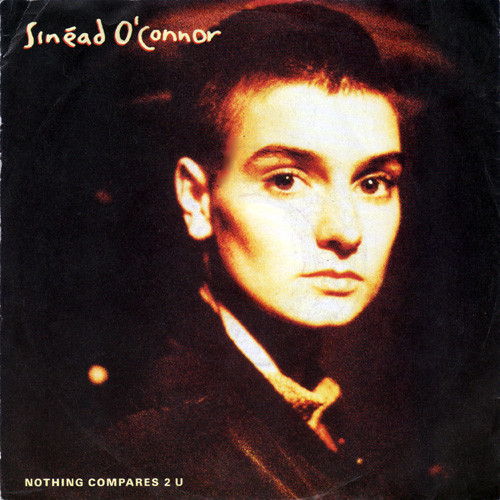
641. ‘Nothing Compares 2 U’, by Sinéad O’Connor

Just four weeks, and three number one singles, into the new decade and the 1990s have their first iconic moment…

Nothing Compares 2 U, by Sinéad O’Connor (her 1st and only #1)

4 weeks, from 28th January – 25th February 1990

First things first, I hate overuse of the word ‘iconic’. Yass! Slay! Dresses are ‘iconic’, memes are ‘iconic’, everything’s bloody ‘iconic’. But I think the term is valid here. From the sustained opening note, to the Orwellian opening line: It’s been seven hours and fifteen days… the song grabs you, makes you sit up and listen.

And that is pretty much all down to Sinead O’Connor’s vocal performance. She hits every note perfectly – the soft ones, the angry ones, the ones you don’t expect. Some favourite lines: I went to the doctor, And guess what he told me, Guess what he told me… or All the flowers that you planted mama… Or the way Nothing can take away these blues… hits a really bluesy note at the end. To tell the truth, without O’Connor’s heroics, with a different, less committed singer, this could be a flat, maybe even dull song. The synths are slow, the beat is steady, with a trip-hop edge that will become ubiquitous as this decade goes on.

The most famous of her vocal tricks has to be the key-change in the title line: No-Thing compares, To you… It’s the one hook that ultimately sells the entire song. But we can’t pretend that this song did well on vocals alone. There’s the famous video, another iconic aspect of this whole business (I promise that’s the last time I’ll use that word), in which O’Connor remains in close-up, her face strikingly cat-like, head shaved, a tear rolling down either cheek. (The tears were unplanned, and brought on by the ‘mama’ line, her mum having died in a car crash several years earlier.)

‘Nothing Compares 2 U’ was famously written by Prince, though his version was never released. O’Connor’s version was also famously disliked by its author, perhaps because it outperformed pretty much every song he ever released. It was #1 in thirteen countries, and Top 10 in countless others, overshadowing everything that she has done since. I’d never heard the Prince original, which was finally released in 2018, and it’s nowhere near as good – cluttered with fiddly guitar and a wild sax solo, completely missing the sparse beauty of this definitive version.

Is it surprising that this song did so well? I say that because it is unremittingly miserable: the singer counts down the hours since her break-up, listing all the things that won’t help her get over her loss, all the flowers that have wilted since. And yet, I asked a silly question, really. All the best ballads aren’t about love; they’re about lost love: ‘Without You’, ‘The Winner Takes It All’… Misery hits home. It’s the hopeful, positive ones that often lack an edge: ‘Nothing’s Gonna Change My Love for You’, or ‘Hello’, to name but two.

Sinead O’Connor wasn’t a complete unknown when this, the second single from her second album came out; but none of her earlier, or her subsequent releases, made the Top 10. Her career in the US ended abruptly when she ripped up a picture of the pope on ‘Saturday Night Live’ as a protest against child abuse in the Catholic church, and she has courted controversy in statements about her sexuality, her religion, and her views on Irish politics. She is an eccentric, a contrarian, one who is hard to define. Except everyone can agree that her biggest hit kickstarted the 1990s, and remains one of the decade’s most iconic (sorry) songs.

640. ‘Tears on My Pillow’, by Kylie Minogue

Kylie does Grease!

Tears on My Pillow, by Kylie Minogue (her 4th of seven #1s)

1 week, from 21st – 28th January 1990

Well, no. Kylie’s never done ‘Grease’ – though she’d have made a good Sandy – and ‘Tears on My Pillow’ only ever features in the background of the original movie. But this record certainly has that feel about it…

It’s the final UK #1 to be produced by Stock Aitken and Waterman… pause for a moment to cheer/sigh (delete as appropriate)… though you wouldn’t particularly know it. It’s a shame that they don’t bow out with a Hi-NRG banger, but the chart Gods can be cruel. Like Jason Donovan’s stab at the sixties on ‘Sealed With a Kiss’, this is nothing more than karaoke. At least the trio bow out with a big hit for their chief muse, the lovely Ms Minogue. And in the big ‘Jason Vs Kylie Retro Covers Contest’ there can be only one winner: this one, because it’s Kylie.

There has been a bit of a retro wave sweeping the charts over the final year of the ‘80s. There was Jive Bunny, of course, but also those sixties covers from Jason, and Marc Almond with Gene Pitney. ‘Tears on My Pillow’ had originally been a 1958 hit for Little Anthony & The Imperials – one which failed to chart in the UK but had made #4 in the US. (There has of course been a completely unrelated ‘Tears on My Pillow’ at #1 in the UK, for Johnny Nash in 1975. Off the top of my head, I think this is the second time two different songs with the same name have made #1, after ‘The Power of Love’…)

This was from the soundtrack to Kylie’s big-screen debut ‘The Delinquents’, a Romeo and Juliet-ish tale of teenage love in ‘50s Australia. Apparently the movie isn’t great, but it continues a trend of forgettable films accompanied by number one singles (‘Nothing’s Gonna Stop Us Now’, ‘When the Going Gets Tough’…) And it scored Kylie her fourth chart-topper in just under two years. Amazingly, this will be her sole nineties #1. A decade of fading chart fortunes, duets with Nick Cave, and a stab at something more alternative will keep her busy until a spectacular comeback in the early ‘00s. Still, she sneaks in, and in due course will join a select band of artists with #1s in three different decades.

If it feels like I’ve been padding this post out, blethering on about everything but the actual, largely forgettable, music then you’d be right. Let me pad it out a little more before finishing, then. Though I don’t remember this particular record, Kylie (and Jason) are pop ground zero for my generation: the first singers we remember from TV, from the playground, the first CDs we bought (more on that later…) The music may not have always been great, but this is nostalgic stuff for us older millennials. This rundown is suddenly getting quite real!

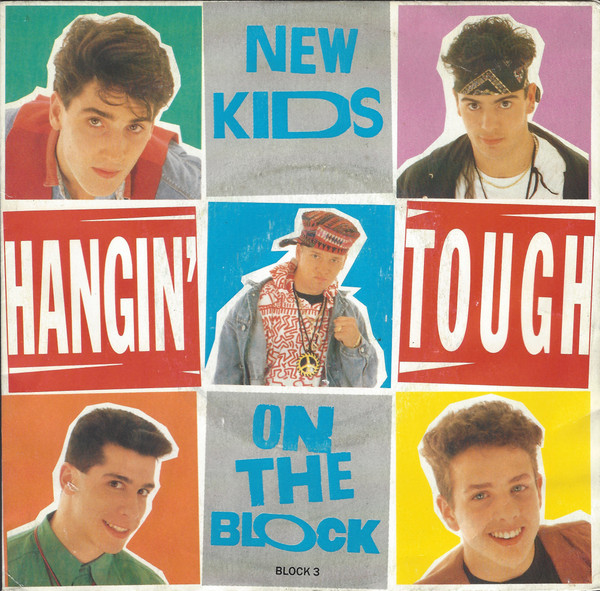
639. ‘Hangin’ Tough’, by New Kids on the Block

Here we go then. The nineteen nineties. The fifth decade of the UK singles chart. The decade I did half my growing up in. Almost four years old at the start, almost fourteen by the end. I’ll try to keep the personal reminiscences – interesting for nobody but myself – to a minimum as we go. But there’s no escaping the fact that some of  these are the first #1s that I can remember in ‘real time’.

Hangin’ Tough, by New Kids on the Block (their 2nd and final #1)

2 weeks, from 7th – 21st January 1990

Not that three-year-old me, brain filled with Thomas the Tank Engine and dinosaurs, had much interest in 1990’s first number one. NKOTB were back, just a month after ‘The Right Stuff’ had vacated top-spot, to bless the decade with its first of many, many boy-band chart-toppers.

First things first, a question. Did ‘Hangin’ Tough’ ever actually sound tough? I suppose it might have to twelve-year-olds, who were the only audience that mattered. But at a remove of thirty-odd years, the bass chords, the whistles and the oh-oh-ohing all sound incredibly lame. Hangin’ tough… the boys chant, very slowly (this song needs a shot or two of caffeine) Are you tough enough!? they demand, before ending the chorus on a very unconvincing We’re rough!

At my high school these dweebs would have been laughed all the way behind the bike sheds, before having their lunch money nicked. And I think the Kids knew it, because the vocals – especially the oh-oh-ohs – feel half-arsed compared to ‘The Right Stuff’. Elsewhere, the chords in the chorus remind me of ‘I Love Rock ‘n’ Roll’, and it’s never a good idea to rip-off a classic song to make a bang-average one like this. A remixed version of the record, the one that presumably got airplay at the time, beefs things up a bit; but not enough.

In fact, the rockier mix takes away one of the few really interesting things about this song. In the album version, a good minute or so is given over to a fiddly, noodly synth-organ solo. I’m not claiming it’s very good, just that few teen-pop songs are allowed moments of such self-indulgence. (The rockier mix switches the organs for a pretty forgettable guitar solo.) By the end though, the Kids are beat-boxing and freestyling, and the song really loses its way. You know it ain’t over till the fat lady sings… one of them announces, and you wish she’d started singing earlier.

The one thing to be thankful for is that, once again, it’s not a syrupy ballad. NKOTB had plenty of them among their ten British Top 10 hits, but none of them troubled the top. The band split in the mid-nineties, with Jordan Knight and Joey McIntyre attempting solo careers. They reformed in 2008, then teamed up for a tour and an album with Backstreet Boys (NKOTBSB anyone?)

Whatever their merits (or lack thereof), New Kids on the Block hit two chart milestones with ‘Hangin’ Tough’. They joined Al Martino, Michael Holliday, Edison Lighthouse and The Pretenders in scoring the first #1 of a new decade (a big deal for chart geeks like me!) The second was less illustrious: in the record’s first week on top of the charts, it posted the lowest sales ever for a number one single…