284. ‘All Kinds of Everything’, by Dana

We are only four #1 singles into the 1970s, and we already have a contender for the worst chart-topper of the decade. Prepare yourselves…

dana

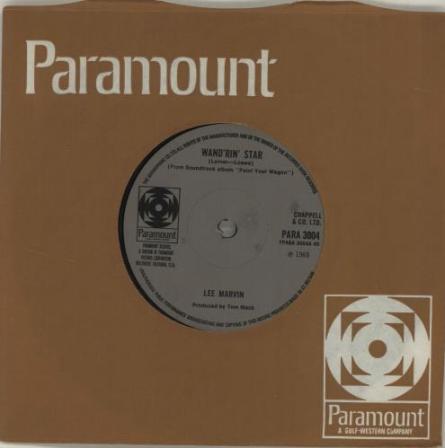
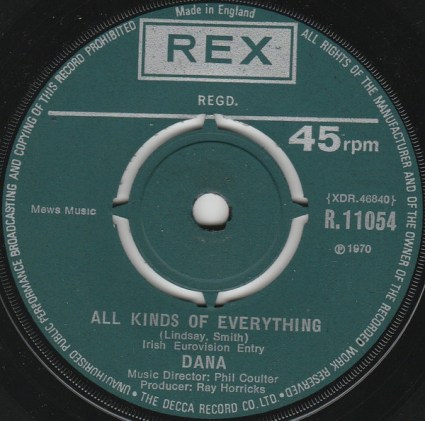
All Kinds of Everything, by Dana (her 1st and only #1)

2 weeks, from 12th – 26th April 1970

The intro comes in like the theme-tune to an educational show, aimed at nursery school kids. You brace for something bad, but nothing can quite prepare you for just how bad it’s going to be. Snowdrops and daffodils, Butterflies and bees, Sailboats and fishermen, Things of the sea… The entire song is a list. A list of the things that remind the singer of her special someone. Seagulls, And aeroplanes, Things of the sky… (Seagulls? Who sees a seagull and thinks of their beloved? Maybe he saved her from one that was trying to steal her chips?) All kinds of everything, Remind me of you…

Literally everything reminds her of him. Insects, the wind, wishing wells, morning dew, neon lights, postcards, grey skies or blue… Everything. It just doesn’t work. These are lyrics that could have been written by a ten-year-old (though, actually, I teach ten-year-olds, and it’s insulting of me to think they couldn’t write something better than this.) The only way this song works is if the singer is a wide-eyed child, no older than thirteen.

And, to be fair, Dana does have a very innocent, childlike voice. She sells the drivel that she’s singing, in her lilting Irish accent, and sounds like she believes in it… (*Edit* She was eighteen when ‘All Kinds of Everything’ was released. Far too old.) Things take a slightly creepy turn when she starts to sing of dances, romances, things of the night… And you think, be careful Dana, I know what happens to young Irish girls that find themselves ‘in trouble’. I’ve seen ‘Philomena’…
R-1706278-1477809062-9075.jpeg

This was a hit thanks to the Eurovision Song Contest – an evening famous for terrible music. But not this type of terrible. Eurovision is over the top, camp, cheesy glitz. We’ve had one winner hit #1 so far – Sandie Shaw’s ‘Puppet on a String’ – as well as Cliff’s ‘Congratulations’, which took the runners-up position. Neither of those records were very credible, but they were fun. This, though, isn’t interesting terrible or fun terrible… It’s just terrible terrible. And yet… it won. The rest of Europe heard ‘All Kinds of Everything’ and thought, yeah, go on then.

‘All Kinds of Everything’ was Dana’s first big hit, though she had been releasing music since 1967, and it gave Ireland their first Eurovision win. She would have hits in Ireland, and in Europe, throughout the seventies, but her star slowly waned. By the eighties she had turned to more traditional, Christian music before she was elected as a member of the European Parliament for Connacht-Ulster in 1999. She still records music (in 2007 she released an album called ‘Good Morning Jesus!’, no less.)

Well then. It’s been a scattergun start to the seventies. Like I said, we’re only on the 4th number one and we’ve already had some catchy, no-nonsense pop, a grizzled actor and a genuine classic at the top. And now this… The charts come and go in peaks and troughs. We’re definitely hitting a bit of a trough through the tail-end of ‘69 and into the seventies. But then, the golden days of the swinging sixties couldn’t last forever, could they? We will wait with bated breath for the 1970s to spring fully into life…
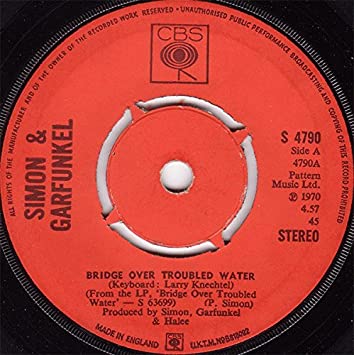
283. ‘Bridge Over Troubled Water’, by Simon & Garfunkel

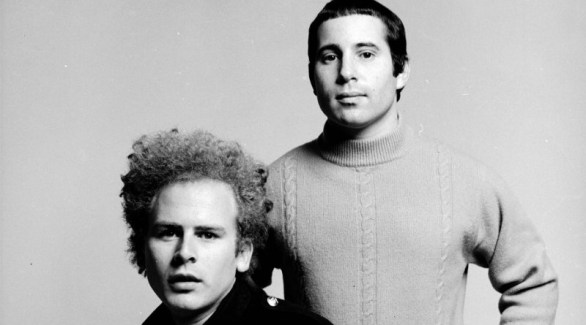
A couple of times already, I’ve written about pop music as hymn. ‘Hey Jude’ was one. Here’s another. The one, and only, British chart-topping single for America’s foremost pop duo. (Sorry Don and Phil, Hall and Oates…)

mainSIMGARF-800x445

Bridge Over Troubled Water, by Simon & Garfunkel (their 1st and only #1)

3 weeks, from 22nd March – 12th April 1970

I’m only going to write good things about ‘Bridge Over Troubled Water’, but I have to get off my chest first and foremost that I didn’t always like this song. It was a big presence in my childhood – my parents are big fans – but for a long time I thought it was a bit proper, a bit overwrought, a bit… too much like a hymn! Art Garfunkel certainly does enunciate his lines properly (the cut-glass ‘t’ in when tears are in your eyes…) and, if you were being cruel, he does sound a little like a choir-boy.

But you’re allowed to make dubious musical choices when you’re young (*cough* Kid Rock *cough*). I have since come to see the error of my ways. This is an undeniable classic, from the understated confidence of the opening piano, to the giant crescendo of an ending.

And, fittingly for a song that sounds angelic, the lyrics are apparently sung by an angel. Someone looking out for you, someone who’s on your side. Like a bridge over troubled water, I will lay me down… They will follow you even at your lowest ebb, down and out on the streets, as darkness comes. Theories abound that the voice singing is that of heroin, the drug, and that the listener is an addict, which would be a spectacular twist in such a Christian sounding song. Simon and Garfunkel have always denied it.

After two verses of just voice and piano, in come the drums, like gunshots in the distance. And we start to build… I think the moment that this goes from being a great song and becomes one of the greatest is when Art’s voice dips: Oh, If you need a friend… Then the chorus comes in, and what was a simple ballad has grown into something massive without you even really noticing. Suddenly it’s ending with strings, and cymbals, and what sounds like fireworks. Suddenly it’s midnight on New Year’s Eve.

61BAj+jfwTL._SY355_

It’s superb. It’s timeless. It’s a classic. To think I used to prefer ‘Cecilia’. Seriously, though, I think ‘Bridge Over Troubled Water’ does sometimes lose something in its ubiquity. Twice in the past few years – decades after it originally hit #1 – the song has reached the top of the UK charts in the form of well-intentioned but fairly dreadful charity singles. It’s kind of easy to lump this record in with other easy-listening, uplifting MOR hits, but that would be a mistake.

And, like many of the best pop songs, there’s a friction working under the surface of ‘Bridge Over Troubled Water’. Simon and Garfunkel weren’t the best of friends by this point, and would split up later in the year. Simon apparently resents the fact that he wrote their biggest hit but Garfunkel gets remembered for singing it. When he performed it on his farewell tour, in fact, he introduced the song by saying “I’m going to reclaim my lost child.”

Actually, I have to confess that I’ve been slow to realise the merits of not just this song, but of Paul Simon and Art Garfunkel’s entire back-catalogue. I was force-fed them on childhood car journeys and, while I’ve come to recognise that ‘The Sound of Silence’, ‘Mrs. Robinson’ and ‘Homeward Bound’ are great, and ‘The Boxer’ a work of art, I still find the likes of ‘I Am a Rock’, ‘America’ and ‘Wednesday Morning, 3 A.M.’ a bit twee. I can’t stand their version of ‘El Condor Pasa’. And part of me is still seven-years-old, and still loves the outright catchiness of ‘At the Zoo’ and ‘Cecilia’. In fact, there probably is no other act about which I am so undecided. I genuinely have no idea whether or not I like Simon and Garfunkel! I do definitely like ‘Bridge Over Troubled Water’, though, and definitely think you should press play below and enjoy it one more time…

282. ‘Wand’rin’ Star’, by Lee Marvin

The seventies’ second number one… is not what I was expecting. Not by a long stretch.

5b18b0aba7b32184792db93d93f58a7a

Wand’rin’ Star, by Lee Marvin (his 1st and only #1)

3 weeks, from 1st – 22nd March 1970

For a start, it’s got one of the longest intros to a number one single, surely, ever. A gentle, countryish rhythm, some horse hooves clip-clopping, and lots of humming. For a full minute and fifteen seconds. They hum through an entire chorus and verse! Apparently the radio-edit was shorter, but it seems that the single version was the full four and a half minutes, with the added humming. I can’t find a shorter version anywhere.

Finally the vocals come in. And my, what a voice. Chiselled straight from granite, like a statue come to life. A series of deep vibrations, rather than actual words. I… Was born… Under a wand’rin’… Star… The singer is a traveller, one born to roam. Wheels are made for rollin’, Mules are made to pack, I’ve never seen a sight that didn’t look better lookin’ back… Harmonicas trill in the background, while the slight rhythm carries, and on. The wagon keeps headin’ west…

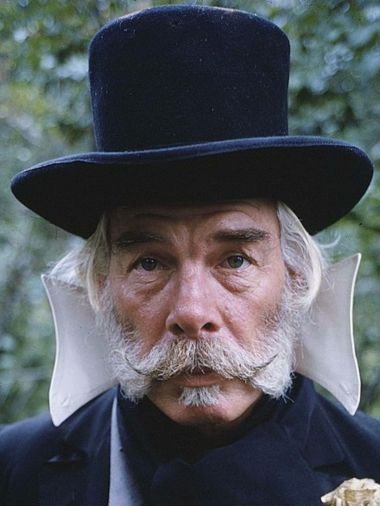
‘Wand’rin’ Star’ is a showtune, that much is clear from the first listen (it’s the backing singers that give it away) and Lee Marvin an Oscar-winning actor. He sung (whispered, grunted, grumbled… I can think of so many better verbs for his performance than plain old ‘sung’) this in the character of Ben Rumson, a gold prospector, in the movie version of ‘Paint Your Wagon’.

To be fair to Marvin, he perks up a little in the verses. I especially like the third, in which he appeals to anti-social people everywhere: Do I know where hell is? Hell is in ‘Hello’… Heaven is ‘Goodbye’ forever, It’s time for me to go… He’s happiest alone, heading somewhere new. Home is a place best dreamt of. There’s something quite romantic in the song’s cynicism.

In the following chorus, he lets the final ‘star’ flop out of his mouth, as if he’d like to go back to sleep, and you presume that’s that. But no, the song keeps plodding along, Marvin keeps chewing his tabaccy. It’s almost a lullaby – parents of the time could have used this record, and Marvin’s spectacularly sonorous voice, to get their babies to sleep.

Lee+Marvin+Wandrin+Star+-+Solid-585856

‘Wand’rin’ Star’ could have been a hit in the early-fifties, for someone like Frankie Laine. That’s the kind of territory we’ve temporarily slipped back into. The musical version of ‘Paint Your Wagon’ did debut in 1951, in fact, though the movie version had been released just the year before this single hit #1. It is apparently a ‘not very good film’, though one I’ve never seen, which didn’t make a lot of money. The soundtrack, though, made up for it. If you’ve ever wondered what Clint Eastwood would sound like singing a song called ‘I Talk to the Trees’ then check it out (he’s got a surprisingly light voice!)

Lee Marvin stuck to the acting after this, never releasing another single. Which means we’ve had two one-hit wonders in a row! He passed away in 1987, with full military honours thanks to his service in WWII. To be fair: an Oscar, a #1 single, several military medals… a life well-lived. ‘Wand’rin’ Star’ has an equally interesting postscript, including a cover version by Julian Clary (if you don’t know who he is then please, please follow this link) and being played at Joe Strummer’s funeral.

281. ‘Love Grows (Where My Rosemary Goes)’, by Edison Lighthouse

The first #1 of a new decade, and it’s a good ‘un. I love the simple, growling riff that starts us off, that grows and grows, has some horns added to it, and then…

p036gpsd

Love Grows (Where My Rosemary Goes), by Edison Lighthouse (their 1st and only #1)

5 weeks, from 25th January – 1st March 1970

She ain’t got no money, Her clothes look kinda funny, Her hair is kinda wild and free… Rosemary is a bit of a manic pixie dream girl – or a bit of a hippy, as they might have said at the time – who turns guys’ worlds upside down. Oh but love grows, Where my Rosemary goes, And nobody knows like me…

It’s a soaring pop song, one that seem to be constantly heading upwards, one that pushes all the right pleasure receptors in your brain and makes you smile. I might even go as far as to describe it as euphoric. Rosemary talks funny, and nobody knows where she came from, but she casts a spell. I imagine a girl in a floaty dress, with flowers in her hair, turning the world from black and white into technicolour as she skips past…

It’s a cheesy song, but one that stays on the right side of cheesy. Any song that includes a line like I’m a lucky feller and I just gotta tell her… is flying close to the wind, but ‘Love Grows…’ gets away with it. By the time we get to the end, which sounds a bit like a refrain of the main melody with extra strings and horns, I’m ready to say it. It’s pop perfection.

I’m not sure if this is simply because I know it’s the first number one of the 1970s, but something about this disc sounds new. Yes it sounds like some of the late-sixties bubblegum records – ‘Dizzy’, ‘Sugar Sugar’ – and the like, but it also sounds like the next step. A glossier, poppier take on sixties rock. But that might only be because I’m expecting it to be the next step… Either way, it’s a great start to the decade.

edison-lighthouse-love-grows-(where-my-rosemary-goes)

Edison Lighthouse were a London-based band – mildly surprising, because they sound very American to my ears – and ‘Love Grows…’ was their biggest hit by far. Their second highest charting single, ‘It’s Up to You, Petula’ made #49, which means they are officially one-hit wonders. Their lead singer, Tony Burrows, had a long career beyond the band, recording with Brotherhood of Man, who we’ll meet before long, and singing backing vocals for Elton John and Cliff Richard among others. Also, Edison Lighthouse are probably the only chart-topping act to be named after an actual lighthouse (Eddystone Lighthouse, in Devon.)

Records like this are, at the end of the day, what the pop charts are for. It’s interesting when strange hits make it to the top, ones that push boundaries – for better or worse – but there will always be a place for well-made, catchy pop. Plus, we can now add ‘Rosemary’ to our growing list of girls names which have made #1, alongside *deep breath* Rose Marie, Josephine, Diana, Mary, Cathy, Laura, Diane, Juliet, Michelle, Eleanor Rigby, Bonnie, Lady Madonna, Jude (though that could be a boy), Lily and Yoko!

https://www.youtube.com/watch?v=f-BxnmW9Kh0

Listen back to every number one from the sixties (and the fifties) here: