55. ‘The Garden of Eden’, by Frankie Vaughan

Before I begin my next post in this countdown, I would just like to address something. The elephant in the room, if you will. As I mentioned back when writing about Guy Mitchell’s ‘Singing the Blues’, one of its weeks in the top spot was shared with the record that’s up next: Frankie Vaughan’s ‘The Garden of Eden’. It’s the second time we’ve encountered this situation, and it won’t be the last. Which begs the question… How did records end up sharing the top spot with such regularity in the 1950s? Well, the answer’s pretty simple. But it kind of whips the rug away from under this whole countdown. You see, the charts back in the early days of their existence simply weren’t very accurate.

Way back in my intro I mentioned that the concept of a ‘singles chart’ was introduced in November 1952 by the NME. And the UK Singles Charts company has since incorporated this chart into the ‘official’ chart – even though such a thing didn’t exist at the time. There were various other charts published every week in the 1950s: the Melody Maker chart, the Record Mirror chart, the Record Retailer chart… and the NME chart, which is recognised as the most comprehensive. But not completely comprehensive. There are still many bones of contention. Which I won’t go into here – they can be easily searched for online.

The number of record stores surveyed by the NME for their chart was surprisingly low and the methods very old fashioned compared to the instant downloading and streaming databases used in 2018 – they basically called up a bunch of record stores and asked them to keep a record of what they were selling. The first chart – topped by the record we met in my earliest post, Al Martino’s ‘Here in My Heart’ – was compiled using data from only 20 (twenty!) major record stores. And thus, every so often, because they were working from such a small sample, there were ties. David Whitfield and Frankie Laine in 1953, Guy Mitchell and Frankie Vaughan in 1957… In 1960, the Record Retailer Chart became the UK Chart Company’s chart of choice and there were no further ‘joint’ number ones (though there were still several contested number ones). Then in 1969 the British Market Research Bureau took over chart-compiling duties and steadied the boat further, while in 1982 chart compilation went digital. Since then, it’s been on the straight and narrow. 100% reliable.

So, while it may be distressing to some to discover the records that you have read about during this countdown may not actually have been the best selling records in a particular week, I thought it was only correct that I address the issue. And with that, today’s sermon is brought to a close. On with the next (presumed?) Number One Single!

s-l300

The Garden of Eden, by Frankie Vaughan (his 1st of two #1s)

4 weeks, from 25th January – 22nd February 1957 (including 1 week joint with Guy Mitchell from 1st – 8th February 1957)

So I press play on this record, ‘The Garden of Eden’ by Frankie Vaughan, and pretty soon I get to thinking that, from ‘Just Walkin’ in the Rain’ to this, I don’t think we’ve encountered such a run of similar-sounding songs. Here we have yet another male singer, with yet another performance involving guitar and vocals and not much else. I’m gearing up for another recap, so I don’t want to get too introspective right now, but it seems like we are settling into a groove which – glancing ahead at what’s to come – might last for a while yet.

I am not left thinking this for too long, however. This record is slightly deceiving. It does start off with a simple guitar strum, and with understated backing singers, but halfway through someone flicks a switch. We get trumpets, and a cymbal clash. Things escalate pretty quickly. The drums go up several notches, and suddenly the vocals are accompanied by a full-on big-band swing section. It’s a never ending crescendo, a key-change drawn out for two and a half minutes, and I like it! You can imagine this being performed on TV, the curtain opening to show Frankie Vaughan alone on stage. Then, as the song progresses, the lights draw further and further back to reveal, by the end, the full-blown orchestra that are bringing us to climax. It’s not rock ‘n’ roll, in terms of the sound, but it is in terms of the frenzied tempo.

Lyrically we are in somewhat stranger territory too. Recent number ones have been lovelorn, and wry. This is… well to tell the truth I’m not entirely sure what this is: When you walk in the garden, The garden of Eden, With a beautiful woman, And you know how you care… And a voice in the garden, The garden of Eden, Tells you she is forbidden, Can you leave her there?

It goes on… When you’re yearning for loving, And she touches your hand, Can you leave her to heaven, And obey the command, Can you walk from the garden, Does your heart understand?

It’s a parable, maybe. Resist temptation? Don’t resist temptation? I don’t really know what it’s about even after several listens. My best bet is that this is Vaughan explaining his behaviour to St. Peter at the Pearly Gates. “Yes, m’lord, I should have resisted the advances of that beautiful woman but, to be honest, she was far too hot…”

hqdefault

Without knowing any of this track’s backstory, I imagine it must have been pretty risqué to have had this many religious references in a pop song back in early 1957. Remember how, back in 1953, Frankie Laine and David Mitchell had remove the ‘My Lord’ from the title of their versions of ‘Answer Me’? But I can’t find mention of any controversy online. So that’s that.

Also of note is the fact that, once again, it’s a British artist doing the rockin’ and a rollin’. Vaughan was a Liverpudlian for whom this appearance at the top of the UK charts was the culmination of a few years of growing success – he was voted ‘Showbusiness Personality of the Year’ in 1956, and was one of the biggest stars of the late fifties. Pictures show him in dickie-bows and top-hats, so we know what kind of territory we’re in. And we will meet Mr. Vaughan again, in a few years, though I feel he has been somewhat forgotten over time, considering how famous he once was.
54. ‘Singing the Blues’, by Tommy Steele and The Steelmen

Tommy+Steele+Singing+The+Blues-553316

Singing the Blues, by Tommy Steele & The Steelmen (their 1st and only #1)

1 week, from 11th – 18th January 1957

If there’s one thing I’ve learned from doing this countdown, from listening to all these number ones of old, it’s that the ‘pre-rock’ era is a very hard thing to pin down. What was it? What did it sound like? Who were its biggest stars? And… when did it end?

Did it end in November 1955, when ‘Rock Around the Clock’ brought a teenaged frenzy to the top spot? Not really – that was a bit of a false dawn. Did it end in April ’56, when ‘Rock n Roll Waltz’ reached #1? Not really – the only thing rock ‘n’ roll about that song was the title. Was it when The Teenagers claimed a chart topper last summer? Not really – they may have been kids, but they were doo-woppin’ rather than rockin’.

So, I’m about to stick my neck out and make a bold claim. Are you ready? The 11th January 1957 marks the end of the ‘pre-rock’ era and the beginning of the ‘rock n roll’ era. In the UK at least. I can’t speak for anywhere else.

Why the 11th January 1957? Well, it’s when one Tommy Steele and his band The Steelmen (see what he did there?) hit the top spot with their version of ‘Singing the Blues’. Steele was the UK’s first rock ‘n’ roller, the pre-Cliff Richard if you will, and he grabbed this song away from Guy Mitchell’s nice-enough-but-somewhat-bland version, gave it a good shake and a slap, and ushered in a new era.

Not that you’d notice straight away. The song starts with the same plinky-plonky guitar and the same twee ba bum bum bums from the backing singers. And the trumpets and hand claps added to this version give it a slightly camp, Butlins-esque air. No, the one thing that makes this record rock is Steele himself: We-hell.. a-never felt…m’re like singin’ the blues… cos I never thought Ivrlose… yr love… dear

I’m not having a fit as I type – that’s really how he sings: like the last old man crawling out the pub. He’s slurring. He goes quiet, then loud, then quick, then slow. He sounds snotty, and bratty. When he delivers the lines The moon and stars no longer shine… The dream is gone I thought was mine… There’s nothin’ left for me t’ do, than cry-y-y OVER YEEW he starts off sounding quite posh and proper but ends the lines dripping in insincerity. He sounds like he’s taking the piss. You can picture him sneering and gyrating. It’s a world away from previous British male chart-toppers like David Whitfield, even Dickie Valentine. I don’t think it’s too much of a leap to say he sounds like a cross between David Bowie and Johnny Rotten. Seriously.

tommy_1

And had I been a fifteen-year-old girl – Susan, let’s call me – sitting in the gloom and cold of January 1957, my heart would have gone a-flutter when this record dropped onto the turntable. Steele sounds like a bad boy; the sort that flicks ink-blots at the teacher and smokes behind the gym. He sounds much younger than Guy Mitchell while singing the same lyrics (Steele was twenty, Mitchell was thirty when they had their turns at #1) Susan’s mum would definitely have preferred Mitchell’s version. Her dad would probably have grumbled something about Steele needing a good stint in the army.

And so that’s it. In the two minutes twenty seconds it takes Tommy Steele to rattle through his version of ‘Singing the Blues’, we cross the Rubicon. There’s no going back from here. Steele’s star shone brightly and briefly – we won’t be hearing from him again beyond this solitary week at the top – but he did what he had to do, and changed the face of British popular music forever.

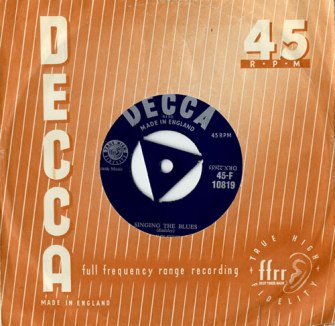
53. ‘Singing the Blues’, by Guy Mitchell

10-78Rpm-Guy-Mitchell-Singing-The

Singing the Blues, by Guy Mitchell (his 3rd of four #1s)

1 week, from 4th – 11th January / 1 week from 18th – 25th January / 1 week joint with Frankie Vaughan, from 1st – 8th February 1957 (3 weeks total)

I feel I should post a warning ahead of this next chart-topper because, for the second song in a row: CONTAINS WHISTLING.

Well I never felt more like singin’ the blues, ‘Cause I never thought that I’d ever lose, Your love dear… Why d’you do me this way?

It’s another long gap between #1s for one of the biggest pre-rock stars – longer than the wait endured by Frankie Laine and Johnnie Ray before him – it’s been almost three and a half years since Mitchell’s second chart-topper ‘Look at That Girl’. It’s quite nice too, in a way, that the three biggest male singers of the early to mid 1950s have lined up for one last hurrah before the new guard swoop in. And it’s understandable that artists like Guy Mitchell and Johnnie Ray experienced – I don’t know if you could call it a ‘resurgence’, as they had remained popular – success at the dawn of rock ‘n’ roll. I commented on Mitchell’s rock ‘n’ roll edge way back in September 1953, and his voice is just as suited to this rockabilly number.

Like ‘Just Walkin’ in the Rain’, this is another simple little record: guitar, backing singers, Guy Mitchell, and some whistling. Whether or not the whistling is Mitchell’s is unconfirmed. A piano pitches in towards the end to give us the big finish.

Lyrically too, this song is very similar to the one it replaced at the top. He’s feeling lonesome thanks to a lost love. And, instead of taking matters into his own hands, or looking for divine inspiration, as earlier chart-topping stars might have done, he’s just going to have a good old wallow in his misery. He’s resigned to his fate. He’ll cry and cry…

The moon and stars no longer shine, The dream is gone I thought was mine, There’s nothing left for me to do, But cr-y-y-y over you…

3dfa9028eb05e4f4072a50a1d556666a--american-artists-classic-rock

I knew this song, vaguely, as a sort of ‘Heartbeat’ compilation album standard, without ever having really listened to it. It’s a nice tune – much jauntier than its subject matter would suggest – and it’s easing us into what looks like a big ol’ run of rock ‘n’ roll hits. In the ‘Guy Mitchell #1s Chart’ I’d put it in second place, behind ‘Look at That Girl’ but well ahead of the reprehensible ‘She Wears Red Feathers’. #2 out of his #1s, if that makes any sense at all.

However, perhaps the most interesting thing about this record is its bizarre chart run. I mean, just look at that title up there… 1 week on, 1 week off, 1 week one, 1 week off, 1 week joint, divorced, beheaded, survived…. It is, I believe, one of only five records in UK chart history to return to #1 more than once. Let me help you to make head and/or tail of this…

Are you sitting comfortably? Guy Mitchell’s ‘Singing the Blues’ spent four weeks on the chart before climbing to the top for a week. It was then replaced by Tommy Steele with – wait for it – a different version of ‘Singing the Blues’. Mitchell then deposed Tommy Steele after just a week and returned to the top. A week after that he was knocked off for a second time by Frankie Vaughan (thankfully not with another version of ‘Singing the Blues’). A week later it returned to the top for a final week, but had to share pole position with Vaughan, who then claimed the #1 position back for himself a week later and Mitchell’s time at the top finally ended. Phew… It’s possibly the messiest five weeks in UK Charts history. And, frankly, getting replaced at the top by a different version of the same song before returning to number one but having to share the top spot is soooo 1950s! It’s all happened before, of course – David Whitfield and Frankie Laine’s versions of ‘Answer Me’ shared #1 in 1953 while two versions of ‘Cherry Pink and Apple Blossom White’, by Perez Prado and Eddie Calvert, hit the top in 1955 – but never in such a short space of time. It’s peak 1950s! It’s 1950s AF!