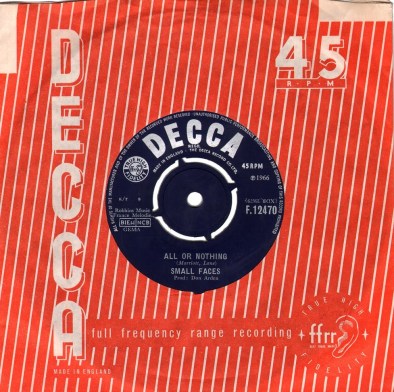
223. ‘All or Nothing’, by The Small Faces

1966 has been a pretty cool year in terms of its chart-toppers. Nancy’s boots, The Walker Brothers, the cynical Stones and Dusty finally making it… Plus a lot of soul: The Spencer Davis Group, Georgie Fame and, most enjoyably of all, Chris Farlowe. To that list you can now add The Small Faces.
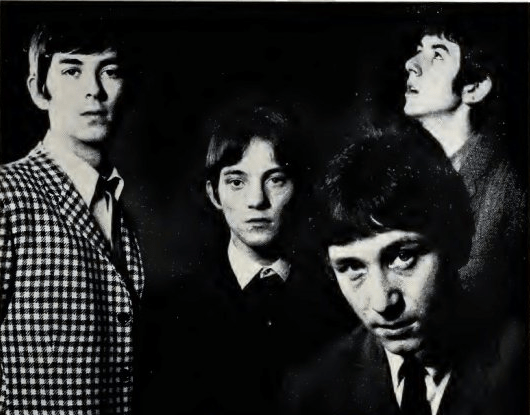
SmallFaces1966

All or Nothing, by The Small Faces (their 1st and only #1)

1 week, from 15th – 22nd September 1966

This is another cool record, and it’s cool from the very start – from the fade-in drum roll. We’ve not had one of those before at the top of the charts. Then a trippy riff, and a wistful voice: I thought you’d listen, To my reasoning, But now I see, You don’t hear a thing… Intelligent lyrics, and I do love the bravado required to rhyme ‘reasoning’ with ‘hear a thing’. The singer is trying to make his lover see that he doesn’t share. Things could work out, Just like I want them to, If I could have, The other half of you… And then an ultimatum: All or nothing, For me…

The guitars in the chorus are thick and chunky. Very forward-thinking. Very power-pop. It’s The Undertones come a decade early. I’d rank it along with ‘You Really Got Me’ and ‘Get Off Of My Cloud’ as one of the heaviest #1 singles so far. Although ‘All or Nothing’s heaviness is more subtle, not as in your face.

And it doesn’t last the whole song through. There’s a mellow ba-ba-ba-baba refrain mid-way through, and then a funky breakdown towards the end. And lots of great soul shout-outs from the lead-singer Steve Marriott. It’s amazing to think that he was just nineteen when this was recorded. Aw Yeahs, and Hear my children sing!, and Gotta keep on tryin’! And when he belts out the crucial I ain’t tellin you no lie, So don’t just sit there and cry! line, it’s a real finger-kiss moment. It’s a record that packs a lot in to its three minutes. Funky, heavy, soulful… A song I knew vaguely; but hadn’t realised just how forward facing it sounded. If you were a pop-loving kid in 1966, this is what your cool older brother would have been listening to.
7503405132_3ee2877a47_b.jpg

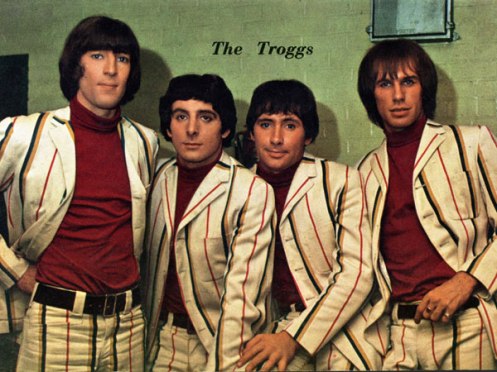
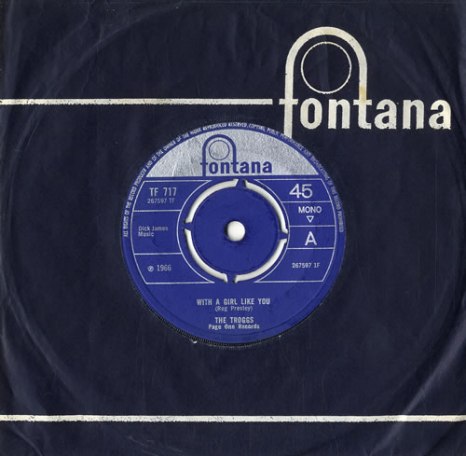
That’s the best word for this record. Cool. No point searching for a better one. Another cool chart-topper for the year. In pictures from the time, The Small Faces look the part too. Mods, with long hair and sharp suit jackets. And they crammed a lot into their four years together. (It is amazing, isn’t it, how many of these mid-sixties groups fell apart after just a few years – with a couple of obvious exceptions…) Like The Troggs from two posts back, certain other of their hits far outshine their one and only chart-topper. ‘Itchycoo Park’ made #3 the following year, and ‘Lazy Sunday’ – for many a year the only Small Faces song I knew – made the runners-up position in 1968. Neither of those songs sound anything like the heavy, soulful R&B on ‘All or Nothing’, which speaks to the band’s quality and creativity.

I have to admit that I thought I had imagined some link between The Small Faces and The Faces – assuming that it was just a coincidence in naming. But no, I was right: Marriot left, the remaining Faces dropped the ‘Small’ and recruited Rod Stewart. Rod the Mod, as he was back then. The rest is history. Marriot died tragically young, in a house-fire aged just forty-four. He’s kind of forgotten today, in the pantheon of sixties stars, which is a shame, as his legacy helped shape both punk and Britpop. The Jam and Blur certainly owe him a debt, anyway.

The Small Faces, then, with their one and only week atop the British Singles chart. Sit back, and Hear the children sing!

Keep up with this Spotify playlist:

222. ‘Eleanor Rigby’ / ‘Yellow Submarine’, by The Beatles

In my intro to The Beatles’ last #1 – ‘Paperback Writer’ – I said that it was a definitive split away from ‘The Fab Four’. This latest chart-topper from the group, then, is an even greater stride away from the mop-top days.

PtsjOFH

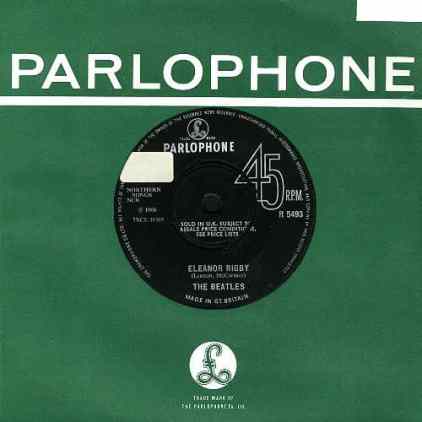
Eleanor Rigby / Yellow Submarine, by The Beatles (their 11th of seventeen #1s)

4 weeks, from 18th August – 15th September 1966

The first side of this double-‘A’ disc contains a song that features no guitars, no drums, no nothing apart from strings. It’s a story about two people: Eleanor Rigby, who lives in a dream and wears a face kept in a jar by the door, and Father McKenzie, who writes sermons that nobody will hear and who spends his nights darning socks… We are a million miles away from ‘I Want to Hold Your Hand’, and that was barely two and a half years ago!

It’s a horribly sad song. Just start with the main refrain: Ah, look at all the lonely people! Then delve into the details. The images. Eleanor sweeping confetti from the floor of a church, after a joyful wedding party has been and gone. The priest and his socks. Eleanor’s funeral, at the end of which Father McKenzie wipes the dirt from his hands and walks back to church alone. No-one was saved…

The characters are fictional, although Paul McCartney has at times been ambiguous when asked about them. The grave of an Eleanor Rigby exists in Liverpool, very near to where Paul and John first met as teenagers. She died in 1939, aged just forty-four, and it does seem slightly too much of a coincidence. But then again, if you were going to invent a fictional old woman’s name, Eleanor Rigby wouldn’t be a bad shout.

Real or invented, Eleanor’s song races along on tight, menacing violins – the story told in barely two minutes. It’s a vignette, a moment in time. You can imagine Paul McCartney viewing the churchyard from the window of a double-decker bus, Eleanor sweeping the church steps, Father McKenzie waiting for the congregation that will never come, and then going home to write the song. Just what is it about? A study in loneliness? The decline of Christianity? A comment on the misery of post-war Britain? The more you listen to it, the more important ‘Eleanor Rigby’ sounds. And the less like a chart-topping record. Only The Beatles could have taken this song to chart success. Largely because only The Beatles were capable of writing pop songs like this.

uk_eleanor-rigby

They were also the only band capable of writing songs like the one on the other side of this disc. We flip the record, and move from the sublime into the ridiculous. As if they thought that ‘Eleanor Rigby’ might be too much of a departure, too avant-garde, and so wanted something childishly reassuring to go along with it. But, in its own way, ‘Yellow Submarine’ is every bit as arresting…

Let me state right here right now – it is impossible to truly hate ‘Yellow Submarine’. It might be irritating, cheesy and pointless… but there’s a loveable nugget buried in there. Perhaps it’s because ‘Yellow Submarine’ is often the first Beatles song people ever hear as toddlers. I think also, for me, it’s the fact that Ringo sings it. There’s something wonderfully soothing about Ringo’s voice. It’s got a melancholy tremble that contrasts nicely with the song’s stupidly optimistic lyrics. Plus, his voice always reminds me of ‘Thomas the Tank Engine’, which was my favourite TV show as a sprog.

In the town, Where I was born, Lived a man, Who sailed to sea… Ringo and chums sail out to find the land of submarines. They live a life of ease, beneath the waves… The end. It’s a complete novelty. The silliest, most childlike chart-topper since ‘(How Much Is) That Doggie in the Window’ from way back when. To pair this with ‘Eleanor Rigby’ reminds me of when Elvis paired ‘Can’t Help Falling in Love’ with ‘Rock-a-Hula Baby’, times ten.

But hey. I like the bit where the band begins to play, and the use of goofy sound effects as the sub gets its journey underway, and the final verse, with the shouted, distorted backing vocals. The band must have enjoyed recording it, as they went and endorsed a whole movie based on the song. The cartoon ‘Yellow Submarine’ is probably one of the iconic Beatles images, along with Sgt Peppers and the EMI stairwell pictures.

Of course, this being The Beatles, the lyrics to ‘Yellow Submarine’ have undergone intense scrutiny. Just what is it about, man? Is it an anti-war statement (Yellow Nuclear Submarine?) Is it an ode to a hippy commune? The band themselves, as they usually did, stated that it was just a children’s song about a big, yellow submarine. Nothing more, nothing less.

So, there you have it. Two completely bizarre songs from the biggest band in history, at the height of their powers. There’s an arrogance to them releasing this disc – in them saying to their adoring public: ‘Here, get your pretty little heads around this!’ And it marks the start of a mini-hiatus from the top of the charts for The Beatles. Their next release, another very famous double-‘A’ side, will (gasp!) not make #1, and we won’t hear from them until almost a whole year has passed. By which time they will have taken another supersonic leap forward…

Follow along here:

Remembering Kay Starr

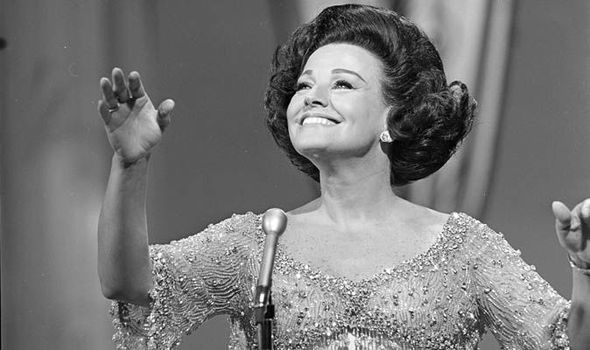
On this day three years ago, one of our earliest chart-toppers passed away: Kay Starr, smoky voiced pre-rock chanteuse.

kay-starr-cropped

Born in 1922, on a Native-American Reservation, Katherine Laverne Starks parents were a sprinkler fitter and a chicken raiser, and she was singing with bands in Texas from the age of ten, to earn a few extra dollars for her family. (Sounds like the sort of story you might invent, were you challenged to invent a story from Depression-era America…) She sang with big bands through the thirties and forties, before going solo and recording two of my favourite pre-rock n roll #1 singles.

Back when I was working my way through the first fifty or so UK chart-toppers, before Elvis, Buddy, Jerry Lee et al came along, I did find it a bit of a slog at times. Painfully earnest crooners (Eddie Fisher, David Whitfield), irritating novelties (‘That Doggie in the Window’, ‘I See the Moon’) and staid instrumentals (Eddie Calvert, Mantovani) plodded by, one after the other. It was the hidden gems, such as Kay Starr, that made the journey more bearable.

She popped up as early as chart-topper number three, in January 1953, with the sprightly, sassy ‘Comes A-Long A-Love’ – a record that was a whole lot of fun, and one that proved a lot of my preconceptions about the pre-rock era wrong.

And then we had to wait a while for her second, and final, #1. A record that Starr was, apparently not too keen on, but that gave her a hugely unexpected hit: ‘Rock and Roll Waltz’. The story of a teenager (though Starr was thirty-two when she recorded it) who comes home to find her parents trying to waltz to one of those new-fangled rock ‘n’ roll discs. It hit the top in the spring of 1956, just before Elvis went stratospheric with ‘Heartbreak Hotel’, and can perhaps be counted as one of the first rock ‘n’ roll chart-toppers, even if it is poking slight fun at the genre…

(I’ve linked to an 1980s TV performance, as it’s a lot of fun and shows Ms Starr still swinging in her sixties. Follow the link above to hear the original.)

And that was that for Kay Starr on the UK charts. She only ever charted five singles here, though she would have presumably had more had the charts begun before November 1952. In the US she was much more prolific, with fifteen Top 10 hits between 1949 and 1957. ‘Wheel of Fortune’ was the biggest, but she also had big duets with fellow UK chart-topper Tennessee Ernie Ford. In later years she toured with Pat Boone, and Tony Bennett.

I think the reason that Kay Starr stood out amongst the other pre-rock stars is that there is such a sparkle in her voice – it flirts, flitters and then suddenly goes all husky-sexy. Billie Holiday apparently claimed that Starr was the only ‘white woman who could sing the blues’. It’s a great voice, but not ‘proper’ like her cut-glass contemporaries. She could have succeeded as a rock ‘n’ roll singer like Connie Francis or Brenda Lee, had she been born a decade later.

Kay-starr-729243

Kay Starr, July 21st 1922 – November 3rd 2016

220. ‘Out of Time’, by Chris Farlowe

Amidst all the great pop being produced in the mid-sixties, two acts inevitably stand out above the rest. The Beatles and The Stones. Lennon & and McCartney, Jagger & Richards. Trading blows at the top of the charts. But John and Paul could always boast one original claim: that, on top of the ten #1 singles they have appeared on, they had written three more for other artists. ‘Bad to Me’, ‘A World Without Love’, and ‘Michelle’… Until now.

p01bqs74

Out of Time, by Chris Farlowe (his 1st and only #1)

1 week, from 28th July – 4th August 1966

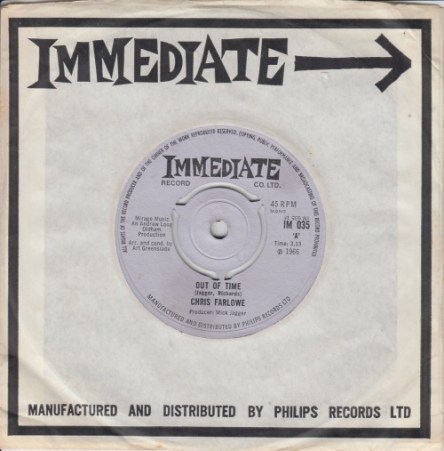
For it is with much fanfare that we announce Mick and Keef as official ‘Chart-Topping Songwriters For Other Artists’, as Chris Farlowe takes ‘Out of Time’, from The Stones’ ‘Aftermath’ album, to the very summit of the hit parade! For a long time, I must admit, I did not know this was a Stones original. Which is strange, as the lyrics are straight from page one of the Rolling Stones’ songbook.

You don’t know what’s going’ on, You’ve been away for far too long, You can’t come back, Think you are still mine… A patronising, slightly threatening approach to women? Ladies and Gentlemen – The Rolling Stones! (See also ‘Under My Thumb’, ‘Heart of Stone’, ‘Stupid Girl’.) You’re out of touch my baby, My poor, old-fashioned baby… Baby, baby, baby, You’re out of time… It’s a song about a miscommunication: the girl was under the impression her BF would wait for her while she was away; BF was under no such illusion. And yes, he’s a dick, no disputing, but calling somebody ‘obsolete’ while you dump them is pretty bad-ass.

Chris Farlowe has one hell of a voice. It’s soulful and husky. He sounds like he smoked at least twenty a day. Maybe the reason that I went for so long without realising that ‘Out of Time’ wasn’t his song is down to the fact that he completely owns this record. He sounds like he’s having a ball. He sings it with a cocky confidence, a knowledge that there will be twenty more girls where this last one came from… I love the drawn-out sneer in the ‘tiiiiiimeee’, the ‘Ha!’ and the ‘Yeah!’ before the final chorus, and the way they call ‘Is everybody ready?’ before launching into an encore. (Some sources suggest that that is Mick and Keith themselves on the backing vocals…)

CHRIS_FARLOWE_OUT+OF+TIME+-+1ST+-+3PR-77306

Compared to The Stones’ version (which you can listen to here), and even though Mick Jagger produced this cover, Farlowe’s is a very different beast. Soaring strings, crashing Wall of Sound drums, and swooping, doo-wop backing singers accompany him. The original is much more stripped back: all organs and finger clicks. It’s also much harsher: switch ‘old-fashioned’ for ‘discarded’, and add a verse about how the girl has ‘had her day.’ Farlowe’s version is more likeable, way more over the top, making it easier not to notice how unpleasant the song is. The Rolling Stones leave you in no doubt…

Chris Farlowe featured on the first sixties compilation I ever heard, as young boy, on a cassette in my parents’ car. It was his version of ‘Handbags and Gladrags’, which came before Rod Stewart, and then The Stereophonics, did it to death. And I remember thinking distinctly, even as an eight year old, that he had a voice and a half. Why he wasn’t bigger than he was is a strange one. He had had one, minor hit before this, and his biggest hit after ‘Out of Time’ was ‘Handbags…’ which only made #33. And I have to admit, while listening to him sing in the car as a kid, and for years afterwards, I imagined him to be black. Racial profiling by voice? Maybe. As you can see from the picture up there, he is most definitely white.

His sound is – I’m starting to notice – very 1966, coming hot on the heels of The Spencer Davis Group’s couple of #1s, and Georgie Fame. All white boys doing soul. And that, like most hot sounds of the sixties, didn’t last long. Flower power is coming. Maybe Farlowe just couldn’t adjust. He still tours, with jazz bands and Van Morrison, and was included in the 50th Anniversary celebrations of England’s Football World Cup win (‘Out of Time’ was at #1 the week of the final against West Germany.)

Follow along with this handy playlist:

219. ‘Getaway’, by Georgie Fame & The Blue Flames

Following on from The Kink’s ‘Sunny Afternoon’, and we are keeping up with the summery theme. For what could be more summery than a little getaway…?

georgie-fame-and-the-blue-flames-1965-resize-1-1280x620

Getaway, by Georgie Fame (his 2nd of three #1s) & The Blue Flames (their 2nd and final #1)

1 week, from 21st – 28th July 1966

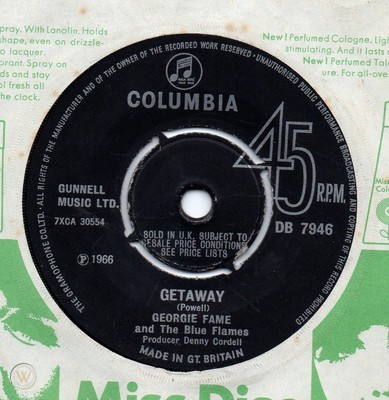
Gotta go, I hope you’re ready cos, Take a look outside… Georgie sings… We’ll leave the city folk, They’ll have to stay… he persuades… Don’t have to pack a thing, Just get away… It’s not as soulful, or as funky, as his previous number one, ‘Yeh Yeh’. It’s a simple enough acoustic riff, with a brass section for back-up. It’s cute. It’s catchy enough. It makes sense when you discover that it was written, initially, as an advertising jingle for a brand of petrol.

A lot of the song, around thirty percent I’d guess, is Fame chanting gotta go over the jaunty rhythm. Dig a little deeper into the remaining lyrics, though, and it turns out that his ‘getaway’ isn’t going to be a particularly luxurious one. I know a little place… A kind of pretty place… But it sounds charming: sun, sea and a bit of peace and quiet. I suppose it speaks to a time when young people didn’t have as much freedom, and perhaps could only truly ‘getaway’ once they were married…

georgie-fame-blue-flames-getaway-1966_360_a14c4c905930e91eb7f8b67044e08e6d

Musically, there are two things of note. There’s an organ solo, which places this song firmly in the mid-sixties. And every few lines a horn gives out a low parp, the sort of sound that usually follows a clown’s pratfall, which lends an (unintentionally?) comic air to the record. Apart from that, there doesn’t seem to be that much to it. It’s a nice enough diversion. Both of Georgie and The Blue Flames’ #1s have been a little off the beaten path compared to the dominant sound of the time. I like that – he was doing his thing and, clearly, people were digging it.

Another point to note – this hit is referred to as both ‘Getaway’ and ‘Get Away’, with different vinyl pressings having one title or the other. The Official Charts list it as one word so that’s what I’m going with… And I’m struggling to write much more about this chart-topper, to be honest. It’s nice. The end.

Plus, Georgie Fame will be making one more appearance at the top of the charts in a year or so, minus his Blue Flames (it is a really cool name for a backing band, isn’t it: The Blue Flames), so we can skip the bio bit. Anyway, I know that I’m publishing this in late October, but close your eyes and imagine that it’s high-summer, as it was when this disc hit the top of the charts. Close your eyes and, for two minutes thirty-one seconds, getaway.

218. ‘Sunny Afternoon’, by The Kinks

It’s high summer. The sun bakes in the sky, heat haze rises from the tarmac, a willow droops lazily by the river. ‘Sunny Afternoon’ is a record that has always, ever since I first heard it as a kid, conjured up an image in my mind. An image of a man, on the lawn of his country house, in a deckchair, with a tall, icy drink in hand.

kinksweb

Sunny Afternoon, by The Kinks (their 3rd and final #1)

2 weeks, from 7th – 21st July 1966

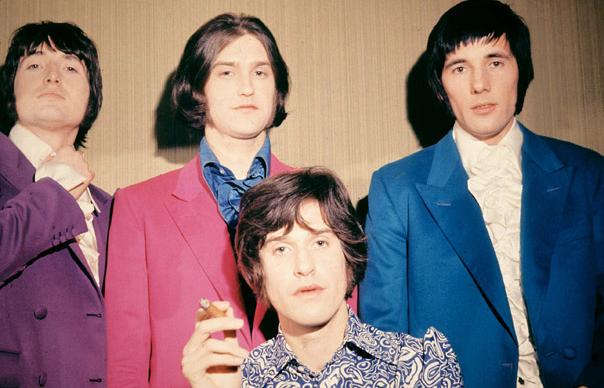
The intro descends, like the weeping willow, into a tale of upper-class woe. I mentioned that the previous #1, ‘Paperback Writer’, had a satirical edge to it, and The Kinks take it up a notch here. The taxman’s taken all my dough, And left me in my stately home, Lazin’ on a sunny afternoon… A rich man has been fleeced, by the government and then by his girlfriend, and has been left with nothing. It’s standard rock star stuff: I’m famous, successful and now I’m being taxed through the nose. They’ve taken my yacht, oh woe is me…. (Another obvious Beatles comparison would be to ‘Taxman’)

Except, The Kinks were cleverer than that. Perhaps aware that people might not be too sympathetic to rich musicians moaning about tax rates, they invented a character to take us through the song. A not terribly nice character: My girlfriend’s run off with my car, And gone back to her ma and pa, Telling tales of drunkenness and cruelty… You don’t feel sorry that he’s been left with nothing but his ice cold beer… They’re complaining, sure (the progressive tax rate at the time was 83%!), but in a very palatable way.

I love this song. It’s a ‘never-skip’ whenever it pops up in a playlist. And I especially love the bridge, with its music-hall piano. Aw, Save me, Save me, Save me from this squeeze…and then a line I loved shouting out as a child… I got a big fat mama, Tryin’ to break me… Those two lines are one of the most brilliant pop moments of the decade. And the song as a whole is near-perfect: it works both as pure summery pop, and as knowing satire. And then there’s the jingly-jangly fade-out, which is very borrowed-from-The Beatles.

The-Kinks-Sunny-Afternoon-1966-on

I also love this version of The Kinks, the one that had moved past the R&B, garage rock of ‘You Really Got Me’, into the uber-British phase of their career – the years of ‘Dedicated Follower of Fashion’, and ‘Autumn Almanac’. I’m going to go a little link-crazy here as, tragically, this is their final UK #1 single. And yes, that does mean ‘Waterloo Sunset’ in 1967, and ‘Lola’ in 1970, two of their best-known and best-loved hits, only reached #2…

It feels as if The Kinks occupy a strange place in pop music history. They were successful, and popular, and very, very good. But they seem to be permanently in the shadow of The Beatles and The Stones, and other stone-cold sixties legends. Elvis, Cliff, Dylan and The Who…  Perhaps they were too British, too playful in the way they leapt between genres, and wrote songs about once-rich aristocrats, London dandies, and drag-queens. They’re big, and very well-respected; but it feels as if they should be bigger, and even better-respected. Take a moment, then, I urge you, to listen to The Kinks today. Starting with this, their final #1 single – as clever as it is catchy. The perfect kind of pop.

Catch up on the previous 217 #1s with this playlist:

217. ‘Paperback Writer’, by The Beatles

If you can draw a line in the sand, between early-era Beatles #1s and late-era Beatles #1s – if you really want to locate the moment when they stopped being ‘The Fab Four’ – then I’d say this is it.

BEATLES PICTURED IN PHOTO RELEASED BY CAPITOL RECORDS

Paperback Writer, by The Beatles (their 10th of seventeen #1s)

2 weeks, from 23rd June – 7th July 1966

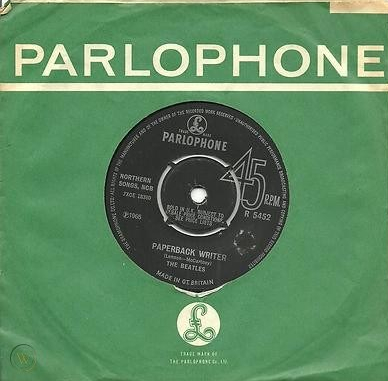
There’s the echoey, layered intro – Paperback writer, writer, writer… A simple, harder than anything that’s gone before, riff. A filthy bassline. It’s not a clean line in the sand – it’s not as if The Beatles hadn’t been getting progressively heavier, cooler, druggier with every chart-topper since ‘I Feel Fine’ – but this does feel like a significant step away from their earlier days. 1966 would be the year of ‘Revolver’ and their last ever stadium concerts.

The biggest difference though, for me, comes in the lyrics. All their previous #1s have been boy-meets-girl, girl treats boy well or badly, pop songs (with the exception of ‘Help!’) ‘Paperback Writer’, however, is a song about a, well, a paperback writer, written by Paul McCartney after he was challenged to write a song about anything but ‘love’.

Dear sir or madam, Will you read my book, It took me years to write, Will you take a look…? It’s a song in the form of a letter – our very first epistolary chart topper? – from a wannabe pulp-fiction writer, presumably living in a cramped attic, to some unnamed publishers. It doesn’t, to be honest, sound like a very appealing read: a dirty story of a dirty man (whose) clinging wife doesn’t understand… And the unnamed writer doesn’t sound like much of an artiste: I need a job and so I wanna be a paperback writer…

360_214e15f9f8f054990022bb0ace81d936

It’s actually quite a funny record, satirical even. The hero of this trashy story also wants to be a paperback writer, while the book is already a thousand pages long, with more to come in a week… In the background, the other members of the band harmonise, in falsettos, over the French nursery rhyme ‘Frere Jacques’.

It’s also a short record, just over two minutes long, which sounds loveably rough and ready, as if it were knocked out in one take over a single afternoon. And that’s not a bad thing. It’s probably The Beatles’ heaviest chart-topper, and a song that’s always felt like a bit of an anomaly in their discography. Although, if you think the lyrics to ‘Paperback Writer’ are a big change of pace, their next #1 will be about an old woman who cleans churches…

Before we finish, let’s just pause to notice that the past three chart-toppers have gone The Rolling StonesFrank Sinatra – The Beatles… has there ever been a more illustrious run of #1s?

216. ‘Strangers in the Night’, by Frank Sinatra

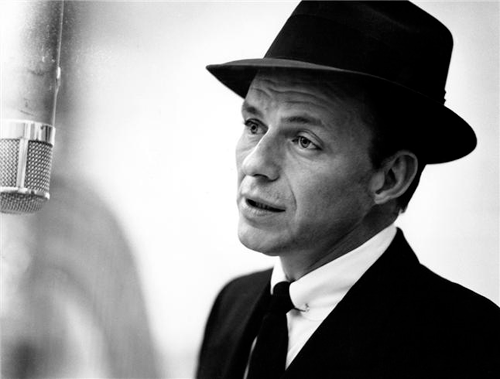
After the all-out nihilism of ‘Paint It, Black’, it’s time for a slight change of pace. A fifty year old crooner – a legend, even by this point in his career – with a song about the joys of a chance meeting.

frank-sinatra1

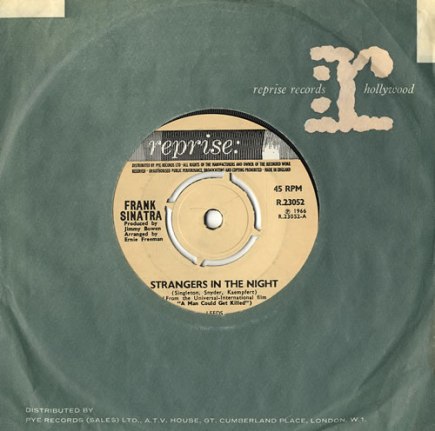
Strangers in the Night, by Frank Sinatra (his 2nd of three #1s)

3 weeks, from 2nd – 23rd June 1966

Soaring strings, a gentle sway, and Ol’ Blue Eyes… Strangers in the night, Exchanging glances, Wond’ring in the night, What were the chances… It’s timeless, traditional pop. A similar, if much classier, version of Ken Dodd’s mega-hit ‘Tears’ from the previous year. A record that might have been #1 in 1946, 56, 66, 76… you get the drift. By this point in his career, a good twenty years since he graduated from teen-idol status, Sinatra was not about to reinvent himself as a folk singer.

Strangers in the night, Two lonely people, We were strangers in the night… And, yes, there’s something in the sweep of the violins and the softness of the horns, that conjures up an image of two people, in New York, entering a darkened bar for last orders… By the end of the song, they’ve been together for years. Things turned out alright, you see, for strangers in the night.

Frank Sinatra is a weird proposition for me. He’s old, too old even for my parents to have listened to him. He released his first single in 1939, and he would be a hundred and four were he still around today. And yet, the songs are there. They reach you anyway, regardless of whether you grew up hearing him. ‘Fly Me to The Moon’, ‘New York, New York’, ‘My Way’… He’s also a weird proposition for me as I’m not convinced that he was all that great a singer. I mean, he obviously was – the way he holds the yooouuuuu before the chorus here is good – but at the same time he talks his way through certain lines. The Ever since that night… line, for example.

FRANK_SINATRA_STRANGERS+IN+THE+NIGHT+-+4PR-555761

We have heard from Frank before in this countdown – going on twelve years ago, when he took ‘Three Coins in the Fountain’ to the top. Now, twelve years between #1 hits is a long time in any era of the charts; but this gap, straddling rock ‘n’ roll and the beat revolution, is particularly impressive. And this is the Sinatra that everybody knows, the Sinatra that wannabes cover on talent shows… the vast majority of his best known hits come from the sixties. Try naming one of his bobby-soxer hits from the early forties…

I love the pause, before we sweep into the final verse of ‘Strangers in the Night’. It’s cinematic, cocky Sinatra. And then perhaps the most famous bit of this song: do bee do bee dooo, da-da-da-da, yayayaya… So famous that it apparently inspired ‘Scooby Do.’ He sounds like your uncle, drunk at a wedding, forgetting the words… And then it hits you. That’s why Sinatra was, and still is, so popular. Because drunk uncles at weddings can just about pull off an impression!

Sinatra, though, hated this song. He couldn’t stand the record that returned him to the top of the charts after a decade. And he wasn’t ever subtle about it, either. It was ‘a piece of shit’ and ‘the worst fucking song (he’d) ever heard.’ You wonder, then, if the do-bee-do skat is simply him giving up. (Which makes the whole song even more glorious, if you ask me…)

Whatever the reason – the quality of the song, the iconic doo-be-doos, Sinatra’s vehement hatred of it – ‘Strangers in the Night’ became one of his biggest hits, one of his signatures, a song that he would have to bite the bullet on and perform every night for the rest of his life. I’d also suggest that his daughter hitting the tops of charts around the world just a few months earlier wasn’t bad publicity, either. Not that it matters. An artist of Sinatra’s stature needs to feature in this countdown. And I’m glad that he does.

Catch up here:

215. ‘Paint It, Black’, by The Rolling Stones

Picture a mid-summer’s evening: a soft, dusty light, some people gathered around an ancient stone circle, having a sing-song. Long hair and baggy clothes. Pagans? Hippies? Look a little closer, though. They look familiar… Why, it’s The Rolling Stones! Conducting a full-blown Satanic ritual!

mainSTONESBLC2

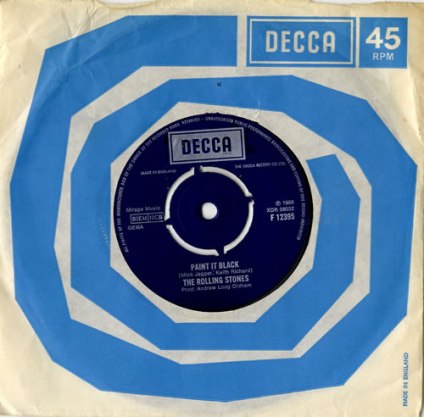
Paint It, Black, by The Rolling Stones (their 6th of eight #1s)

1 week, from 26th May – 2nd June 1966

I’ve used many words to describe the chart-toppers we’ve covered so far. Catchy, dull, quirky, God-awful… ‘Paint It, Black’, though, is the first I’ve had to consider calling ‘evil’… It’s a hulking, threatening, malignant brute of a #1 single. From the opening riff, it’s as if an evil spirit is taking up residence in your ears. Brain Jones is playing a sitar, and sitars, to me, usually sound blissed-out, and spiritual – the background soundtrack to massages and yoga sessions. Not when The Stones get their hands on one…

Then there’s the lyrics. I see a red door, And I want it painted black, No colours any more, I want them to turn black… Jagger’s voice melts into the insistent, pounding rhythm – sometimes soft and coaxing, sometimes aggressive and half-crazed. What is it about? Depression? Drug-induced psychosis? A funeral (as the line about a line of black cars suggests)? Whatever it is, it’s a bleak, bleak record. I see people turn their heads and quickly look away… or I look inside myself and see my heart is black… And then there’s the serial killer line: I see the girls walk by dressed in their summer clothes, I have to turn my head until my darkness goes…

It’s an amazing song. A song I respect a lot. I love that it was a #1 hit. But I can’t bring myself to love it. It’s not a song to put on in the background. It’s a song that you have to be in the right mood to deal with. In many ways it’s a weird song – not helped by the fact that, for years, I thought one of its lines went: No more will my green seagull turn a deeper blue… (It is, of course, ‘my green sea go’. Which makes even less sense…)

ROLLING_STONES_PAINT+IT,+BLACK+-+BOXED-88953

By the end, our hilltop ceremony is reaching its climax. The bass grinds, the sitar dances, the band are humming with intent, and Jagger is crowing: I wanna see it painted, Painted black, Black as night, Black as coal…! He wants to see the sun blotted out… He wants to end it all… The record slowly fades to a frenzied close. This was only top of the charts for a week. That’s probably all the country could deal with from such a relentlessly nasty disc.

Back when I first got into The Stones, with their Greatest Hits etc, ‘Paint It, Black’ (apparently the comma was just a record-company typo, though it does lend a nicely pretentious air) blended in amongst the hits. Its edge was dulled. Not here, though, doing this countdown in real-time. It really makes you stop and think… This was a best-selling single. It’s a superb piece of music; but only one act could have pulled it off and still kept it commercially viable.

I’ll say it again… The Stones’ hits might never quite have matched the Beatles in ‘musical’ terms. But they were pushing the boundaries of what could be considered ‘pop music’. The Fab Four used sitars, yes, to write cute acoustic numbers like ‘Norwegian Wood’; while Jagger, Richards and Jones were using one to summon the Devil.

This is something of an end of an era moment for the Stones, too. They’ve crammed four number one hits into just over a year – all of them towering slices of swagger, anger and petulance. But we won’t hear from them now for over two years. By which point they will have tried their hand at flower-power, gone hard on the drugs, driven Brian Jones out of the band… This is a moment. And not just for The Stones. For the singles charts. For British music. For popular music as a whole. Go on… Paint it,… Black!

Catch up with all the #1s so far – including five other Stones’ hits: