
Cover Versions of #1s – The Fratellis and Weezer

Day Two of ‘cover versions’ week, and I’m being a bit self-indulgent. I’m including this pair not because I think they are amazing covers, but because they are by two of my favourite bands. Bands that will come nowhere near to featuring on my regular countdown, so here’s their moment…

The Fratellis – ‘Yes Sir, I Can Boogie’ (originally a #1 in 1977, for Baccara)

Like Miley Cyrus yesterday, this is another cover done for radio. Although a desire to cover ‘Yes Sir, I Can Boogie’ would be completely understandable by anyone, at any time, there is a little bit of context here. The Fratellis are Glaswegian, big football fans, and the Scottish national team had just qualified for the European Championships – their first tournament appearance in twenty-three years. ‘Yes Sir…’ was adopted as the team’s unofficial anthem, after a video of the players dancing to the song went viral. In the run-up to the tournament T-shirts were printed with the lyrics, the song title became a hashtag, and Baccara themselves put their full support behind the campaign. Scotland, as tradition demands, went out at the group stage… Away from this cover, The Fratellis are a band well worth discovering. Their biggest hit in the UK was glam-rock anthem ‘Chelsea Dagger’ – a #5 from 2006 that you all know, even if you don’t realise it.

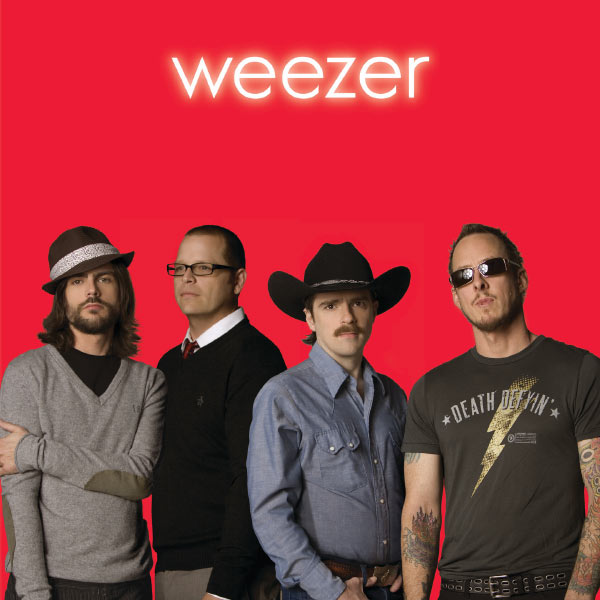
Weezer – ‘Are Friends Electric’ (originally a #1 in 1979, for Tubeway Army)

I love Weezer. I love the Weezer that everybody loves (The Blue Album), and I love the Weezer that many people hate (everything they’ve released since The Blue Album). I even love ‘Raditude’. And I admired Gary Numan’s futuristic electro-chart topper, but I can’t help enjoying it a little bit more with Weezer’s trademark crunchy guitars. Crunchy Weezer guitars make everything better. This was released as the ‘B’-side to 2008 single ‘Pork and Beans’ (one of the band’s classics). Like The Fratellis, Weezer will never trouble the #1 slot – their biggest hit in the UK was 2005’s ‘Beverly Hills’, which made #9. They’re a bit better known than The Fratellis, but still worth discovering in more depth. Even ‘Raditude’.

Two more tomorrow…

Cover Versions of #1s – The Dee Gees & Miley Cyrus

As a celebration for reaching 500 (!!) #1s, I’m going to spend the rest of the week treating you to some cover versions of #1s. First up, some 2020s takes on a couple of disco classics…

The Dee Gees – ‘Tragedy’ (originally a #1 in 1979 for The Bee Gees)

There are some people for whom Steps did the definitive cover of ‘Tragedy’. (They do exist…) Luckily for them, that version will feature at #1 in its own right. So, stepping up to the plate with their own cover… The Dee Gees. Ok, ok… Foo Fighters! For their most recent album, the band devoted half of the run-time to covers of late-seventies Bee Gees hits. ‘Night Fever’, ‘You Should Be Dancing’… But I’ve gone for this one. It’s a pretty faithful cover – I do wish they’d gone a little more ‘rawk’ – though Dave Grohl’s falsetto is a majestic thing to behold. There was a time when rock bands wouldn’t have touched disco with the end of a smashed-up guitar. Those days are gone, hurrah! And isn’t ‘Hail Satin’ just the perfect album name for a hard rock band’s disco covers?

Miley Cyrus – ‘Heart of Glass’ (originally a #1 in 1979 for Blondie)

In the past twenty years, it’s become the thing for current chart acts to do live sets for radio stations and streaming services. Radio 1 kicked it off, in the UK at least, with their ‘Live Lounge’ series. Here then, is Miley Cyrus belting her way through ‘Heart of Glass, from the iHeartRadio Music Festival in Las Vegas in 2020. It’s not the subtlest take on the song, and it’s a pretty faithful cover like The Dee Gees, but there’s something compelling in the way she just goes for it. Folks agreed, because this made #38 in the UK charts (quite unusual for a live cover version).

Two more tomorrow…
Advertisements

500 Number Ones Down…

The last chart-topping record I featured was as average as you can get: ‘A Little Peace’. A nice acoustic pop song with nice sentiments sung by a nice girl… Except, it was actually quite a notable chart milestone – the UK’s 500th number one single.

Which means, in just over four earth years we have covered almost thirty chart years! From Al Martino belting out the very first chart-topper, ‘Here in My Heart’ in 1952, past the pre-rock years, rock ‘n’ roll, Elvis, Merseybeat, four lads from Liverpool, the Summer of Love, the come-down, glam, disco, post-punk and new wave… To the spring of 1982.

Which means, at the current pace, we’ll hit the 1990s early next year, and we’ll meet the 1000th UK number one (although, actually, that’s a song which has already featured in the first 500… don’t ask…) sometime in early 2026! But, really, it’s dangerous to look that far ahead in life. I’m in no rush.

The pleasure here is to be had from the slow stroll: the discovery of lost gems, the re-discovery of all-time classics, a shrug of the shoulders at the boring ones, and a crack of the knuckles before I dive in studs-up on an absolute shocker of a song. And, of course, the fact that I’ve picked up so many dedicated followers, readers and commenters, without whom this pursuit would be pointless…

To celebrate this minor achievement, I had a look at my stats, and can now reveal the most viewed posts from each decade I’ve covered. I may have my favourites, but these are apparently the #1s that the good followers of WordPress (and beyond) want to know about…

The 1950s:

‘She Wears Red Feathers’, by Guy Mitchell

The most viewed post from the decade of Elvis, Buddy and the Killer is a song from the days when barely anyone had heard the phrase rock ‘n roll. It was just the 6th song I covered, so I guess it has had a bit of a head start. Read my original post here. (I wasn’t kind…)

The 1960s:

‘House of the Rising Sun’, by The Animals

Probably not the first song you’d guess for the sixties, but an undeniable classic nonetheless. The longest, and possibly the most risqué, song to have topped the charts at that point. Read my original post here.

The 1970s:

‘Rivers of Babylon’ / ‘Brown Girl in the Ring’, by Boney M

Despite coming towards the end of the decade, this one gets all the hits. It’s actually my most viewed post… ever. It’s also one of the best-selling singles of all time. Underestimate Boney M at your peril would be the lesson! Read my original post here.

The 1980s (so far):

‘Green Door’, by Shakin’ Stevens

Despite publishing it barely a month ago, ‘Green Door’ is already my most viewed post from the 1980s. Interestingly, of the four songs, only ‘House of the Rising Sun’ is one that you could find much critical acclaim for. Guy Mitchell, Boney M and Shaky all had something much more elusive (and lucrative)… popular appeal. And apparently still do!

And finally, before I go, a bonus. My least viewed post and, by these metrics, the least popular of the first 500 #1s…

‘Dance On!’, by The Shadows

Yes, this one-week number one from early 1963 has had barely any views. That could be comment on the state of popular music in the months just before the Beatles went supersonic. Or a comment on my writing. But I quite like the tune. Give it some love here.

Thanks everyone for reading and commenting over the past four years. For the rest of the week, I’ll be posting some cover versions of classic #1s. Here’s to the next 500!

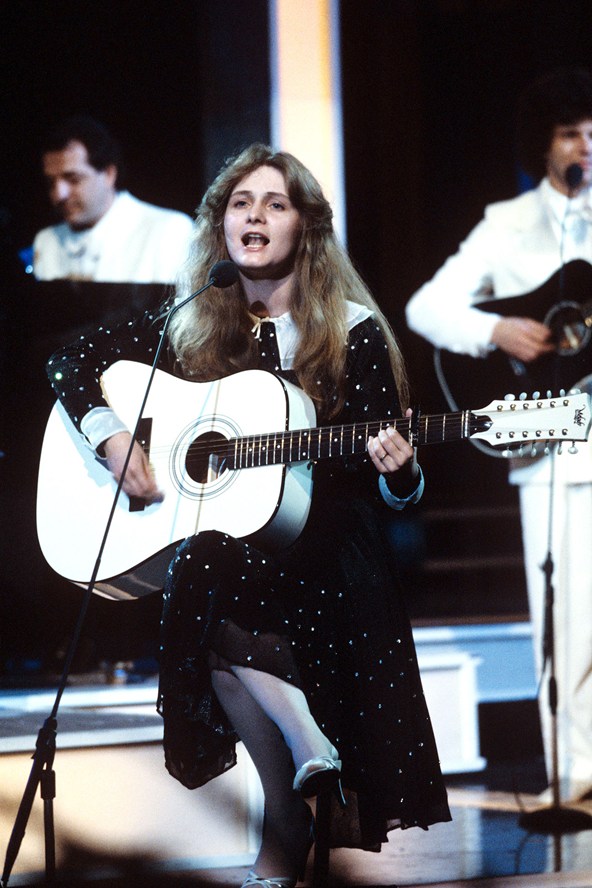
500. ‘A Little Peace’, by Nicole

For the third year in row, the song that won the Eurovision Song Contest also tops the UK singles chart. Unlike Bucks Fizz in 1981, though, the winner is not British. Nor Irish, as Johnny Logan was in 1980. Enter Nicole Hohloch, a seventeen-year-old German.

A Little Peace, by Nicole (her 1st and only #1)

2 weeks, 9th – 23rd May 1982

Just like a flower when winter begins… It’s jaunty, it’s cute, it’s pure Eurovision… Just like a candle blown out in the wind… And, oh no, I’m getting flashbacks… Just like a bird that can no longer fly… Dana flashbacks! Twelve years ago, another teenager won with a similarly saccharine slice of Eurocheese. ‘A Little Peace’ isn’t that bad – very few records are – but it still sticks in your throat.

The world is hard but, deep in her young heart, Nicole has a dream. A little loving, A little giving… For our tomorrow, A little peace… Straight on from ‘Ebony and Ivory’, it’s more happy-clappy ‘peace’ nonsense at the top of the charts. (Though I can tolerate this crap from naive schoolgirls far more than I could from Misters McCartney and Wonder, who should have known better…)

The nicest thing about this record is its gentle country lilt. It’s been a good while since we had a #1 that we could class as ‘country’. And I’d also like to mention Nicole’s excellent English. You’d think she was singing in her native tongue. (There is also a German version.) But, overall, this is a pretty forgettable record. And forgotten it pretty much has been – it’s nowhere to be seen on Spotify, for example.

At the time, though, this was huge. A first ever German Eurovision winner (perhaps the definitive sign that Europe had forgiven them for you-know-what?) and the biggest winning margin until 1997. Nicole continues to record and perform, she’s still only fifty-seven, though chart success outside of Germany has been limited. Plus, Nicole is already the 3rd German act to top the charts in 1982, after Kraftwerk and The Goombay Dance Band, and it’s only May!

Most significantly for us, ‘A Little Peace’ marks the 500th number one. Hurray! We are actually well over two-thirds of the way through our never-ending countdown! If only it were a slightly more auspicious song to mark the occasion. I’ll do a special post to celebrate this milestone in a couple of days, alongside some cover-versions of past chart-toppers, then it will be back to normal service. Thankfully, after two #1s and five weeks of preaching, the next number one is about, oh yes, randy schoolboys buying condoms…

499. ‘Ebony and Ivory’, by Paul McCartney with Stevie Wonder

We’re almost at the five-hundredth number one single. Thirty years since the very first chart, twenty years since Stevie Wonder released his first singles, well over ten years since The Beatles disbanded… It’s amazing that we had to wait this long to meet a solo McCartney, or any kind of Wonder, chart-topper.

Ebony and Ivory, by Paul McCartney (his 1st of three solo #1s) with Stevie Wonder (his 1st of two #1s)

3 weeks, 18th April – 9th May 1982

I’d have happily waited a bit longer, to be honest. The best you can say about this anthem of love and acceptance is that it’s well-intentioned. Ebony and ivory, Live together in perfect harmony, Side by side on my piano keyboard… If piano keys, inanimate slices of elephant tusk and timber, can sit happily together then Oh Lord, why don’t we…? (To be fair, the metaphor of ebony and ivory as black and white people wasn’t invented by McCartney and Wonder. It had been around since the 1840s.)

Did this song sound clumsy at the time? It’s not as if the early ‘80s were a racial utopia; but given the events of the past few years this definitely sounds clumsy. Yet you can’t judge the past by the standards of today. You also shouldn’t judge a song by the artists involved but, come on, how can you listen to this and not compare it to what you know both McCartney and Stevie Wonder were actually capable of?

Away from the lyrics, the music does little to save this record: soft-rock guitars, horns, and a cheesy-sounding sitar mean that the song coasts along fairly forgettably. And yet, beating at the heart of this record is a good pop song. No way were two of the century’s best songwriters going to get together and write something completely irredeemable. It’s not awful – though I can see why it would be tempting to kick this record more than it deserves – and of course it was a ginormous hit around the globe. (Apart from South Africa, where it was banned after Wonder dedicated it to Nelson Mandela.)

It’s tempting to imagine what John Lennon would have had to say, had he been alive. Is it a coincidence that McCartney started churning out crap like this not long after his one-time partner died? Probably. But compare Lennon’s great protest songs – ‘Working Class Hero’, ‘Give Peace a Chance’, ‘Imagine’ and ‘Happy Xmas’ – to this. Even at his most idealistic (and I gave ‘Imagine’ some stick when it topped the charts) he was hectoring us, berating us, making us confront uneasy truths, rather than simply singing about how nice it would be if we were all chums. Lennon often sang those songs like he knew he’d be disappointed: listen to his sneering It’s easy… on ‘All You Need Is Love’. McCartney sings this like he believes every word.

Anyway. ‘Ebony and Ivory’ has nothing to do with John Lennon. It’s hard on Macca that his late bandmate gets brought up. Hard, but inevitable. The saddest thing here is that this is probably neither McCartney nor Stevie Wonder’s worst musical crime of the decade. There is more to come from both of them as we forage towards the heart of the 1980s. Up next, we hit 500! *Applause* With another song about peace and love! *Groans*

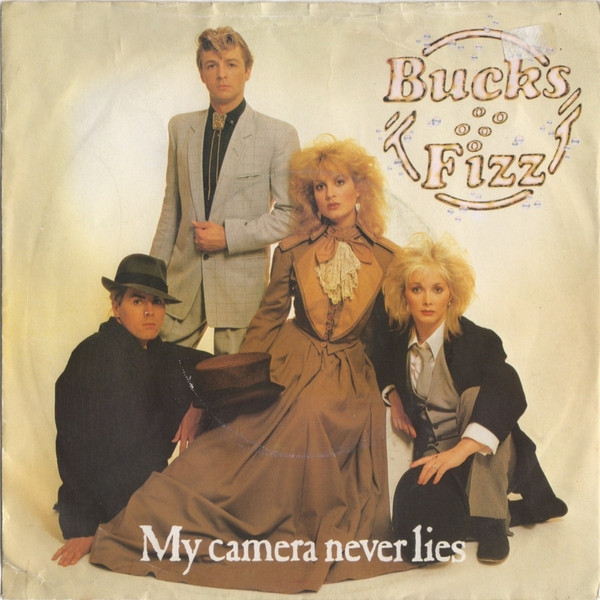
498. ‘My Camera Never Lies’, by Bucks Fizz

Precisely a year on from scoring their first number one single, Bucks Fizz score their last. And what they lacked in longevity, they more than made up for in variety.

My Camera Never Lies, by Bucks Fizz (their 3rd and final #1)

1 week, 11th – 18th April 1982

Their chart-toppers have grown less cheesy as we’ve gone on: Euro-camp on ‘Making Your Mind Up’, pure-pop on ‘The Land of Make Believe’. This one is actually quite modern, very early-eighties, power pop. Very, dare I say it… cool? Seriously, this sounds a bit like something Cheap Trick, or The Cars, would have been putting out at the same time.

My camera never lies anymore, Cos there’s nothing worth lying for… The subject matter isn’t your usual pop group fodder, either. The singer has been following his significant other around, taking snaps of her infidelities. He’s both a sympathetic sap; and a total creep. Meanwhile there are angular guitars, power chords, zippy direction changes, and a catchy gimmick in the click click ahhhhs.

I like the lines where the girls have their say in return: It doesn’t matter anymore to you, Cos everything you tell me is boring… It reminds me of ‘Don’t You Want Me’. Mixed-sex bands don’t do that often enough – have a conversation, or a battle, through the lyrics. While the harmonies in the My camera-ra-ra sections are both stupidly catchy, and very complex. I’m starting to think that this is the Fizz’s best #1, though I have the same problem here that I had with ‘…Make Believe’: the drums are too much (on the album version we end with a full-on drum solo).

The band members have gone on record saying that this is their best song, but that it came too early in their career and has been forgotten among their poppier moments. In fact, it’s a shame that Bucks Fizz’s other (better) hits are completely overshadowed by ‘Making Your Mind Up’, and that skirt-whipping move. And it is definitely a shame that you won’t be hearing ‘My Camera Never Lies’ on the radio anytime soon.

Most of Bucks Fizz’s singles were written by Andy Hill, who has written big hits for many big acts, some of which are still to come on this countdown. I’d like to draw a more modern comparison here, with Girls Aloud: another willing pop group with a dedicated song-writing team, who churned out peerless pop in the mid-‘00s. In fact, sticking with this theme, I’d say Bucks Fizz are the very first act on this countdown that feel ‘modern’ to me.

I mean that in the sense that I was born at the tail end of their heyday, while their members were still featuring on kids’ TV into the late-eighties and early-nineties… (‘Eggs ‘n’ Baker’ anyone?) They are the very first, of many, acts I’ll write about here, that were directly part of my childhood, rather than being a famous band my parents listened to, or an act I discovered in my teens or later. Anyway, I’m off now to find a clip of Cheryl Baker walking down Baker Street, singing ‘Baker Street’, on ‘Going Live’ circa 1992, to convince myself that six-year-old me didn’t dream it…

497. ‘Seven Tears’, by The Goombay Dance Band

Like Marcel Proust biting into his madeleine, the intro of this next #1 brings the memories flooding back. Hints of Boney M, wafts of ABBA at their cheesiest, ‘Mull of Kintyre’, even a base note of ‘Auld Lang Syne’…

Seven Tears, by The Goombay Dance Band (their 1st and only #1)

3 weeks, 21st March – 11th April 1982

I have never heard ‘Seven Tears’ before, I am pretty much positive of that. But it sounds so familiar, so damn sentimental, that it comes through like a folk standard. Seven tears have run into the river, Seven tears have run into the sea… The singer stands at home, pining and crying for his love, his tears mingling with the river, then the sea… (To me, it sounds like a bit of a subtle dig: just the seven tears…?)

It’s a nice enough tune, I’ll admit. There’s something relaxing in its calypso-plod. Yes there are myriad key changes, and a spoken-word section, but somehow ‘Seven Tears’ stays just the right side of annoying, unlike Tight Fit before them. Cheesy, yes. Cloying, yep. Complete and utter Eurotrash. But something about it appeals to me.

I was convinced that this, like ‘The Lion Sleeps Tonight’, must have been an old song, remixed and repackaged for the early-eighties. But nope. It was written by two Germans, in 1981. In fact, the similarities between The Goombay Dance Band and Boney M are pretty blatant: they were created in 1979 by Oliver Bendt – who takes lead vocals on this record – a German who had lived in St. Lucia in the Caribbean. ‘Goombay’ is a beach on the island.

They weren’t as successful as Boney M, though. This was their only sizeable hit in the UK (though their breakthrough, ‘Sun of Jamaica’ topped the German charts for nine weeks). And for a few weeks in the spring of 1982, it seems the UK charts were looking farther afield. Not just to Germany (though this does make them already the second German chart-toppers of the year) but to the jungles of Africa, and then to the beaches of the Caribbean.

The charts were also, you have to admit, sounding a lot tackier than even just a year earlier. I don’t want to sound like a guitar-snob, because I’m really not – and there have been some very high-quality electronic #1s recently – but it is much easier to use computers to make music. I’d wouldn’t bet against ‘Seven Tears’ having been thrown together in an afternoon… I’d also bet that it’s been completely forgotten by the general public (I meant it when I said I’d never ever heard it before). Today, though it’s back, at least for the time it takes you to read this post. A toast, please, for The Goombays, and their ‘Seven Tears’… May we not leave it another forty years before listening to this again. Thirty-nine will be plenty.

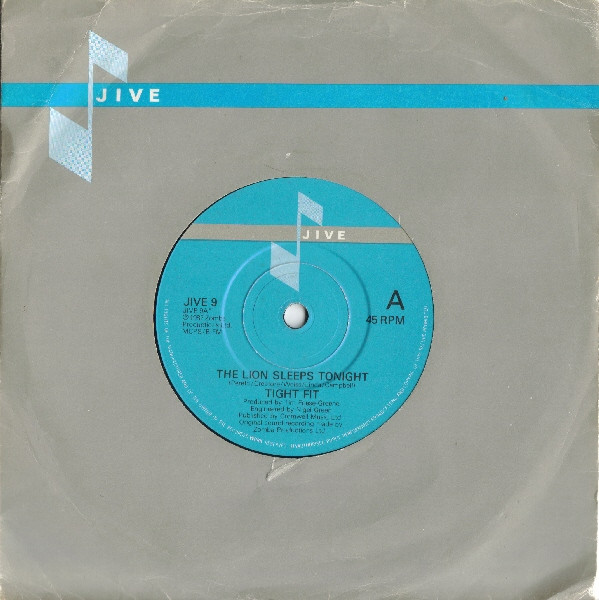
496. ‘The Lion Sleeps Tonight’, by Tight Fit

Another, yes another, well-trodden intro awaits us here. Note that I say ‘well-trodden’, rather than ‘memorable’, or ‘iconic’… or even ‘enjoyable’.

The Lion Sleeps Tonight, by Tight Fit (their 1st and only #1)

3 weeks, 28th February – 21st March 1982

I have several pre-conceptions about this song: that it is an old folk tune, that this is far from its first visit to the pop charts, that the band singing it – Tight Fit – were Australian (for surely only an Australian could come up with a song this aggressively annoying…) I’ll hold off for a moment on finding out if any of these pre-conceptions are true.

For first we have to listen to the thing. And at a very basic level, this is a catchy melody. Good for kids parties and animated movies, that sort of thing. It could have been a fairly decent pop song. Unfortunately, however, pretty much every artistic decision taken here has gone wrong. The lead singer’s voice is, at best, an acquired taste. The faux-tribal drums are jarring. The solo is horrible. The animal noise effects are cheap and nasty. The video is… well, see for yourself at the foot of the post.

It’s a novelty – the video makes that very clear – and I refuse to get too serious about #1s that were never actually meant to be taken seriously. But that doesn’t mean I’m going to come anywhere close to enjoying this irritating little record (even if I can’t help joining in on the wimowehs…) The fine head of steam that 1982 had worked up in its first four chart-toppers is dashed before March.

So what of my pre-conceptions? Well, yes this is an old, folk tune. Originally recorded in 1939 as ‘Mbube’ (Zulu for ‘lion’) it was a big hit in South Africa in 1939. (Since it was written by Africans, who must know much more about these things than me, I won’t point out that lions live in the savannah, not the jungle.) And yes, it had charted several times before, mostly in 1961, when Karl Denver took his version ‘Wimoweh’ to #4, and The Tokens made #11 (while topping the charts in the US).

And what of Tight Fit being Australian…? So. I apologise profusely to the good people of Oz, as they are from London. They were around for not much more than a year, but scored three Top 10s in that time, including this million-selling (!) hit. They reformed in 2008, and continue to play ‘eighties nights’ at clubs around the country. And I don’t know… In one sense it’s good that a song with such a long and varied history as ‘The Lion Sleeps Tonight’ topped the charts eventually; it’s just a shame that it had to do so in such a tacky version…

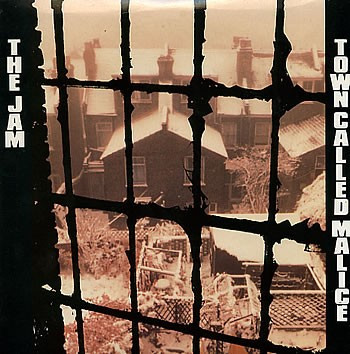
495. ‘Town Called Malice’ / ‘Precious’, by The Jam

Straight in at number one with the lead-single from their final album… The Jam do Motown.

Town Called Malice / Precious, by The Jam (their 3rd of four #1s)

3 weeks, 7th – 28th February 1982

We’ve been treated to some iconic intros in recent weeks: ‘Under Pressure’, ‘Don’t You Want Me’, ‘The Model’… ‘Town Called Malice’ is right up there too. It’s not really a riff, more an explosion of exuberance, a technicoloured smile with a jaunty bassline and a cheesy organ. I know it’s The Jam, because it’s a well-played classic, but it sounds a world away from their earlier #1s.

This being Paul Weller and The Jam, however, things aren’t as rosy as they sound. The title perhaps gives it away, and a quick google of the lyrics (sorry Paul, but they are quite hard to make out) reveals a deeply downtrodden song. Malice is a town where people dream of rosy days and the quiet life, where decisions have to be made: buy beer or clothes for the kids. Some of it is darn near poetic: Rows and rows of disused milk floats stand dying in the dairy yard, And a hundred lonely housewives clutch empty milk bottles to their hearts…

When he starts to sing about Sunday’s roast beef, I get a huge sense that this is an early-eighties take on Ray Davies’ suburban odes from a generation earlier. Weller wrote it based on his childhood in Woking, a commuter town outside London. Funnily enough, this middle-eight is the most modern-sounding bit of the song, as we go from The Supremes to The Specials’ ska tones. And at its core – which wasn’t always the case with The Kinks – I think ‘Town Called Malice’ is optimistic. It’s up to us to change, A town called Malice… Life may be shit, but you still have to live it as best you can.

Despite being as biting as ever, The Jam do sound happier than they did in 1980. Success puts distance between you and any hardships you’ve endured, and maybe that left them feeling free to experiment with different sounds. It’s certainly a sneak-preview of the soulful sounds that Weller would push to the forefront with The Style Council. And in my mind this song will forever be associated with the scene in ‘Billy Elliot’, where he dances across the rooftops of County Durham (though, much like the contrast between ‘Malice’s melody and lyrics, Billy was dancing in frustration, rather than joy…)

For the second post in a row, we have a double-‘A’ to write about. I’m not sure how much airplay ‘Precious’ got, but the history books have it at #1 and so we must give it a spin. If ‘Town Called Malice’ was a departure for The Jam, then ‘Precious’ is a giant leap. I’d describe it as ‘disco-funk’. There are chucka-chucka guitars, there are horns… I’m half-waiting for Weller to shout ‘Shaft!’ It’s another moment where you can see that The Jam were nearing the end of their shelf-life.

Not that it’s bad. Or that bands shouldn’t try new things. But when you’ve gone from punk to funk in barely five years, it’s clear that the confines of a three-piece, guitar, bass ‘n’ drums band are not enough to satisfy the members’ creativity. Like ‘Malice’, the lyrics are very hard to make out, but unlike ‘Malice’, I feel no compulsion to look them up. This record is a groove, a mood. There’s a short single edit and a longer album version, towards the end of which things go very acid, with a free-styling saxophone.

It all adds to the fact that this has been a brilliantly eclectic start to 1982, with all four number ones (six songs, if you count the two double-‘A’s) bringing something very different to the top of the charts. And for all this talk of the end nearing for The Jam, they have one more #1 to come: their very last release. They’ll be going out on top, then, one of the decade’s most distinct and successful bands. Until then…

494. ‘The Model’ / ‘Computer Love’, by Kraftwerk

Atmospheric, electronic, and über-cool… Ja. Kraftwerk ist da!

The Model / Computer Love, by Kraftwerk (their 1st and only #1)

1 week, 31st January – 7th February 1982

She’s a model, And she’s looking good… It has to be said, German-accented English is the perfect voice in which to deliver an electro-pop hit like this. She plays hard to get, She smiles from time to time… While this model sounds a bit high-maintenance: all champagne, nightclubs and envious glances…

A drum-machine keeps steady, deliberate time, while two or three different synths play variations of the main, instantly memorable, riff. There are not many fancy flourishes, no tricks or gimmicks, which can’t be said of some recent electronic #1s (‘It’s My Party’ springs to mind…)

There’s a minimalism to it, a precision. (It’s hard to avoid certain national stereotypes, but I’ll try…!) There’s nothing here that doesn’t need to be. It’s repetitive, certainly; but not boring. It’s a song that seduces you, just like the model in the lyrics. It’s almost lo-fi, which could have something to do with the fact that ‘The Model’ was nearly five years old when it topped the charts.

It was originally supposed to be the ‘B’-side, an older hit included to beef up the appeal of the new single, but radios started to play it and it became a double-‘A’. And it’s the perfect hit for a winter’s week: both in its frosty sound, and in how it sits alongside some very random early-year chartmates in Bucks Fizz and Shakin’ Stevens.

What of that new single, then? ‘Computer Love’ kicks off with another catchy riff – one catchy enough for Coldplay to borrow decades later – but as the record finds its groove you can feel a slightly lighter touch than the heavy, deliberate ‘Model’. There’s almost something disco in the staccato drums, and feathery high notes. It sounds more modern, more ‘eighties’ really, than song on the flip-side. (Though it had only made #36 before being twinned with ‘The Model’.)

It’s another twisted love story, but this time a computer is the object of the singer’s affections: another lonely night, another lonely night… He stares at the screen and longs for a data date. I wonder if the band had any idea, in 1981, of how prescient those lyrics would become in the twenty-first century…? Aren’t we all just staring at our screens, these days, needing a rendezvous?

I’m not enjoying this as much as ‘The Model’, though. It’s too light, too ephemeral. There’s not as much to get your teeth into here. But as a chart-topping, double-‘A’ side single, both tracks work very well. And I say that without being the biggest fan of electronic music. It feels like a moment at the top of the charts. True, it’s far from the first electronic #1, but Kraftwerk had been there from the very beginnings of the genre: forming in 1969, scoring their first hit in 1974. In many ways, they’ve been a part of all the synth-based number ones so far, from ‘I Feel Love’, to the Buggles, to ‘Don’t You Want Me’.

Kraftwerk were/are basically two men – Ralf Hütter and Florian Schneider (who passed away in 2020) – and a revolving cast of supporting musicians. They are notoriously reclusive, and have released one album in the past thirty-five years. They don’t have many hits to their name in the UK, this one being the only time they ever breached the Top 10. But their legacy cannot be understated. Considering how prevalent electronic music is now – how few acts don’t incorporate at least a smattering of non-analogue sounds – they have to be seen as legends. The NME has argued that while ‘The Beatles and Kraftwerk’ doesn’t have the same ring as ‘The Beatles and The Stones’, it is probably more accurate in reflecting who pop music’s two most influential bands are.